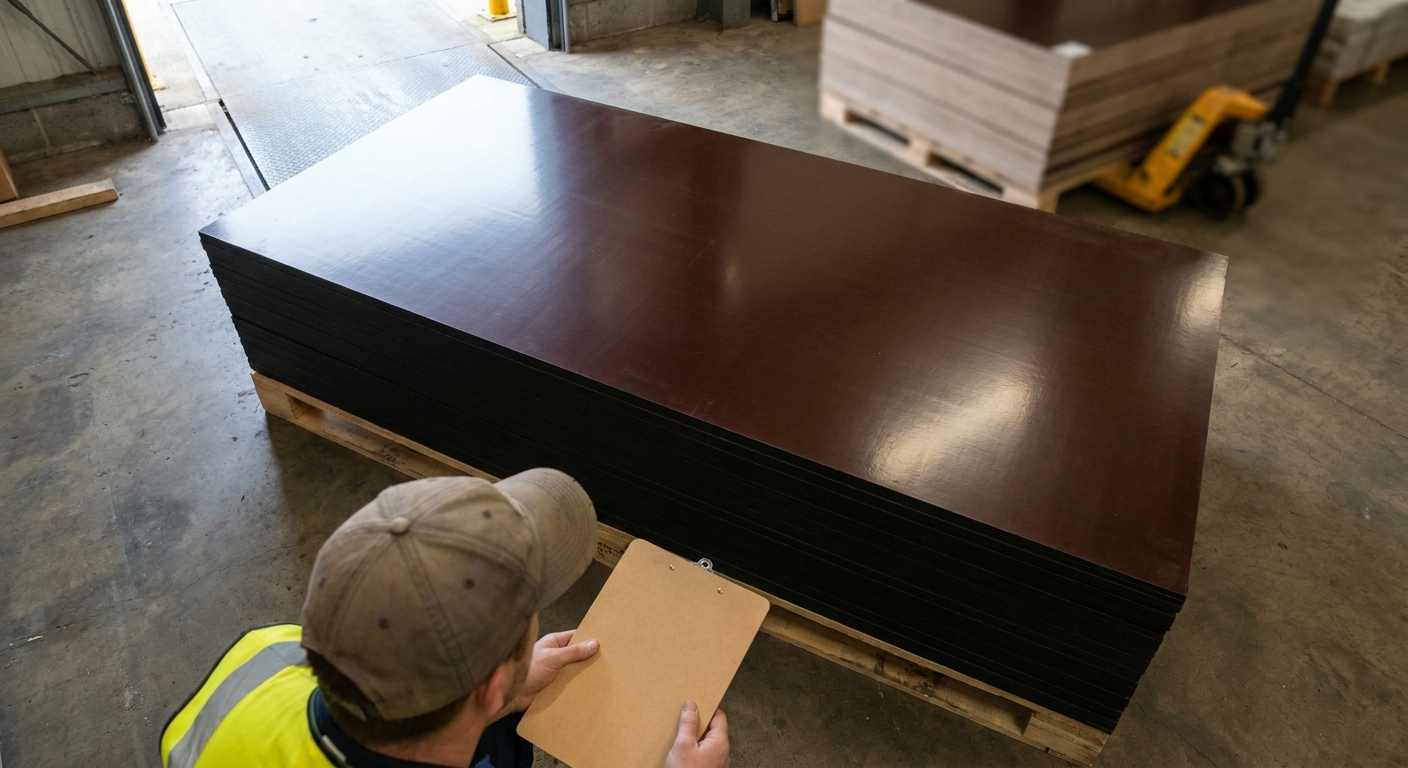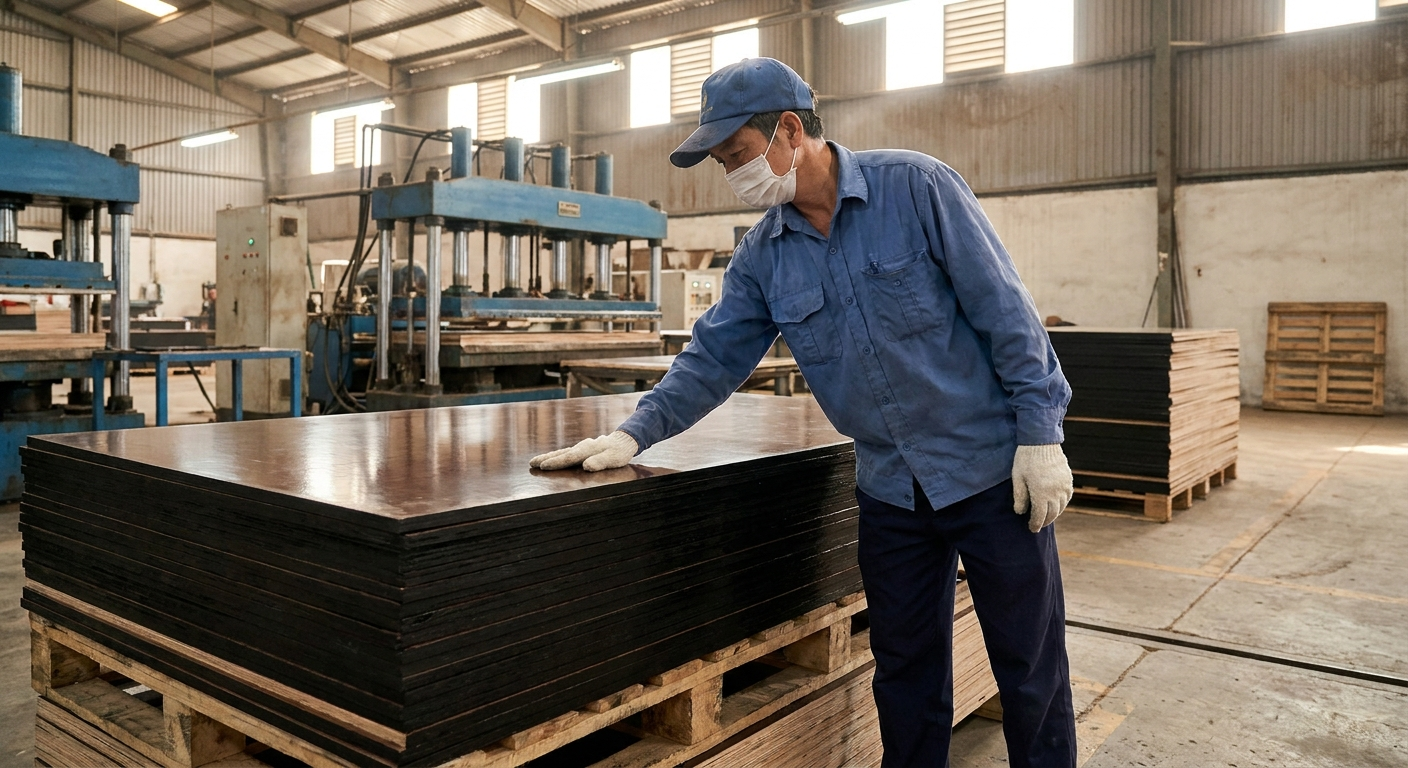
Film Faced Plywood Buying Guide: Thickness, Reuse Cycles, and Pricing
How buyers spec film faced formwork plywood: thickness, EN 636 bond class, film gsm, and reuse up to N. Vinawood ladder from Eco Form Plus to Pro Form and HDO — no invented sheet prices.
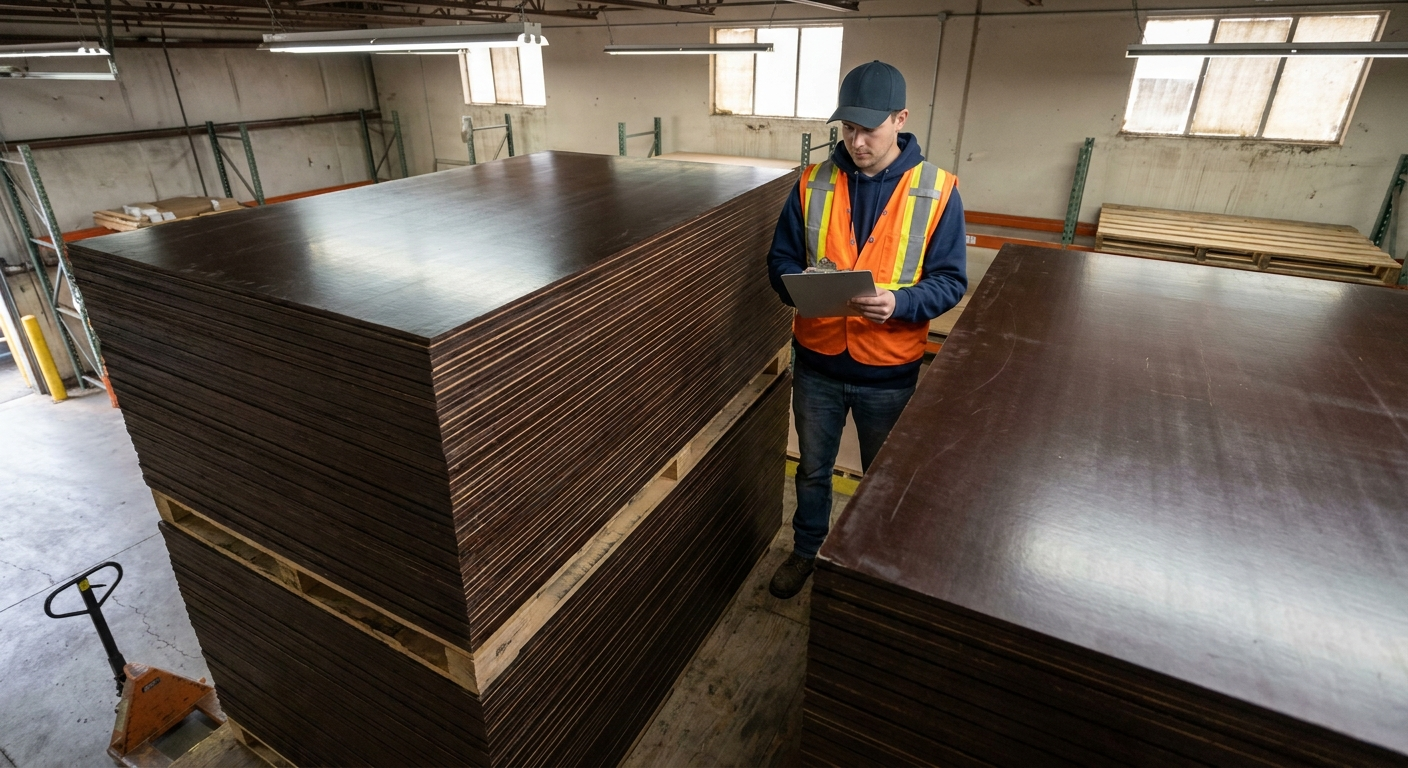
Buying film faced plywood for formwork starts with four fields on the RFQ: thickness, bond class, film weight, and reuse. Colour swatches do not close a pour programme. The sheet is the temporary mould face crews pour against, so overlay, core glue, and size decide both the finish the architect will see and how many pours the panel still earns before it leaves the gang.
Vinawood has manufactured plywood in Vietnam since 1992. About 5,000 containers a year leave for 55+ countries on plantation-grown hardwood cores. This page maps those four RFQ fields to a commercial ladder, then points you at mill or warehouse stock without inventing sheet prices. Soft SoT forming types across film-faced, HDO, and MatteFace live on concrete forming plywood. Cite it. Do not re-body it here.
What buyers actually choose on a film-faced RFQ
Thickness sets stiffness under pour pressure. Bond class splits the market: EN 636-2 with MUF core glue for humid service, versus EN 636-3 / Class 3 with phenolic PF glue for exterior wet cycles. Film weight in grams per square metre (gsm) sets abrasion life and release. Reuse is written as up to N under careful handling. Never as a guaranteed cycle count, and never as N+ marketing copy.
Film colour is a mill marking habit. Brown, black, green. It is not a performance class. A dark face does not prove Class 3 glue. Put class and film gsm on the same RFQ line as thickness and sheet size. Many US, Canadian, and UK gangs run 1220×2440 mm. EU and Middle East equipment often wants 1250×2500 mm. Mix those footprints on one wall and you get a lip in the concrete.
WBP means weather-and-boil-proof bond class. Water-resistant. Not a sealed hull. Fresh concrete stays alkaline and wet for hours. Cut edges drink water the moment you trim a panel. Edge seal and release agent habits spend the reuse life as much as the grade on the invoice.
Thickness for walls, slabs, and columns
Most commercial formwork programmes sit between 12 mm and 21 mm. Twelve millimetres covers light column boxes and secondary returns when stud spacing is tight and pour height is modest. Fifteen millimetres is a common mid step for walls and slabs on smaller commercial jobs.
Eighteen millimetres is the workhorse. Ordinary stud spacing. Ordinary wall pours. The balance of strength, weight, and handling that most gangs recognise. Twenty-one millimetres shows up on heavier decks, bridge work, and tall walls where deflection under pour pressure would telegraph into the face. Thickness alone does not upgrade a Class 2 panel into Class 3. Spec thickness for the pour pressure case, then pick bond class for the outdoor and reuse envelope.
Detailed weight and CBM tables live in the specifications library. The CBM calculator turns piece count into volume for the ocean booking. I still see RFQs that only write "18 mm film faced, best price." Those land as guesses. Name thickness, format, EN 636 class, PF versus MUF core glue, and film gsm before anyone chases a landed number.
Film weight, glue, and the three meanings of melamine
Face film weight is usually quoted per face. Lighter films cover short commercial cycles. Mid-band films around 120 to 165 g/m² handle most wall and slab programmes. Heavier films around 220 g/m² sit on high-rotation and fair-face work when abrasion life matters. Film gsm is not the same thing as core glue. A phenolic face can sit over an MUF core. That is phenolic-faced, not phenolic-bonded Class 3.
Melamine means three different things in this trade. First, MUF resin in the core — the EN 636-2 band. Second, a lighter face film on some light-duty panels. Third, decorative laminate on kitchen carcasses. The third meaning drives the myth that melamine is interior only. An MUF-bonded forming panel is weatherable at EN 636-2. When a datasheet says melamine, ask which of the three.
Two lookalikes stay off a Class 3 formwork list. P-Form is polypropylene-faced, not Pro Form. Consply is commercial Bintangor, not film-faced formwork. Mixing those names on a packing list puts the wrong panel on the truck. Overlay chemistry for phenolic faces sits on phenolic plywood.
Vinawood reuse ladder — up to N only
When a buyer asks for film-faced formwork from the film-faced collection, we map the reuse target to this ladder. Every figure is a maximum under good site practice. Crowbar stripping, standing water on the stack, or skipped release agent cut those figures roughly in half.
| Grade | Core glue | Bond class | Reuse (maximum) | Best fit |
|---|---|---|---|---|
| Eco Form Plus | MUF (WBP) | EN 636-2. Not Class 3. | up to 8 | Entry film-faced, short covered cycles |
| Form Basic | MUF (WBP) | EN 636-2. Not Class 3. | up to 10 | Short pour series, residential basements |
| Form Extra | Superior Glue MUF | EN 636-2. Not Class 3. | up to 15 | Mid-range housing; longer life from glue chemistry, not a heavier film |
| Pro Form Lite | PF (phenolic) | EN 636-3 / Class 3 | up to 15 | Class 3 writing without Pro Form's full ceiling |
| Pro Form | PF (phenolic) | EN 636-3 / Class 3 | up to 20 | Commercial walls, longer outdoor exposure |
| HDO Basic / Premium | PF (phenolic) on Premium | Basic: EN 636-2 / Class 2; Premium: EN 636-3 / Class 3 | Basic up to 10; Premium ≤20 | North American fair-face overlay programmes |
Only Pro Form, Pro Form Lite, HDO Standard and HDO Premium are Class 3; HDO Basic is Class 2. Form Extra is Superior Glue MUF at EN 636-2. Not Class 3. Extra reuse comes from core glue chemistry, not a heavier face film.
For North American overlays, add MatteFace Plywood (MTF) as a soft bridge. Buyers often search it as MDO formwork plywood. Benefit and cost-per-pour framing sits on advantages of film faced plywood.
How to judge quality without a catalogue price table
Vinawood does not publish list prices. Sheet retail ranges change with freight, duty, and yard mark-up, so inventing a dollar-per-CBM table here would mislead the RFQ. Judge the buy on cost per pour: landed panel cost divided by the pour count you actually expect. A cheaper MUF panel and a Class 3 phenolic panel can land the same cost per pour when the lighter sheet only lasts a handful of cycles.
On samples and production lots, check film adhesion at corners. Look for core gaps in the cross-section. Check edge straightness and seal. Confirm moisture in the export window. Ask for bond reports against EN 314 or the method your tender names. Thickness tolerance on calibrated panels sits around half a millimetre either way for common 18 mm stock. Confirm the tolerance line on the mill certificate. Ask for the mill legal name on the test report, not only a trader letterhead.
Container loading for planning (not pricing) is a thickness and packing question. Eighteen millimetre packs typically fill a 40HC near the volume ceiling before weight becomes the constraint. Use the loading calculator for exact piece counts on your size and thickness. Landed-cost math belongs on your quote, your freight, and your broker. Not on invented midpoints.
Mill container, warehouse stock, and the RFQ checklist
Three lanes serve different jobs. Mill container gives the highest spec control and mill documents with the lot. Trader fills help when you need mixed thicknesses on one vessel. Local distributor stock covers break-pack and rush sheets. Vinawood keeps distribution warehouses in Toronto, Vancouver, Calgary, Montreal, Miami, Houston, and Baltimore to supply ready stock to local distributors. That is stocking for lead time. It is not an exclusive stockist claim and not a shop-here CTA.
Lane choice detail sits on where to buy film faced plywood. Mill identity and press ownership sit on film faced plywood manufacturer. System formwork partners such as Doka, Peri, and Alsina specify their own panel envelopes. Match those envelopes on the RFQ rather than swapping class by film colour.
Write these fields before price: grade (Eco Form Plus through Form Basic, Form Extra, Pro Form Lite, and Pro Form, or HDO and MatteFace for North America); core glue (MUF vs PF) and bond class (EN 636-2 vs EN 636-3); thickness and sheet size; film gsm and one-side versus two-side; reuse target as up to N; emission docs (CARB Phase 2 / EPA TSCA Title VI, FSC-COC, EN 13986 DoP when required); destination port or yard. Send the pack through /rfq or /contact?type=quotation. Founded 1992. About 5,000 containers a year. Fifty-five-plus export countries. Plantation-grown. Water-resistant WBP glue line — never sold as waterproof.
Category
how-to
▶Sources & References (3)
- EN 636 Plywood — Specifications — CEN (2015)
- EN 314-2 Plywood — Bonding quality — CEN (1993)
- Vinawood film-faced formwork collection — Vinawood