How much weight can plywood hold? Plywood load capacity chart
Wondering how much weight plywood can hold? The load capacity of plywood depends on its thickness, grade, and support structure. Whether you're using it for flooring, shelving, or structural applications, understanding its strength is crucial. Check out our plywood load capacity chart to see how…
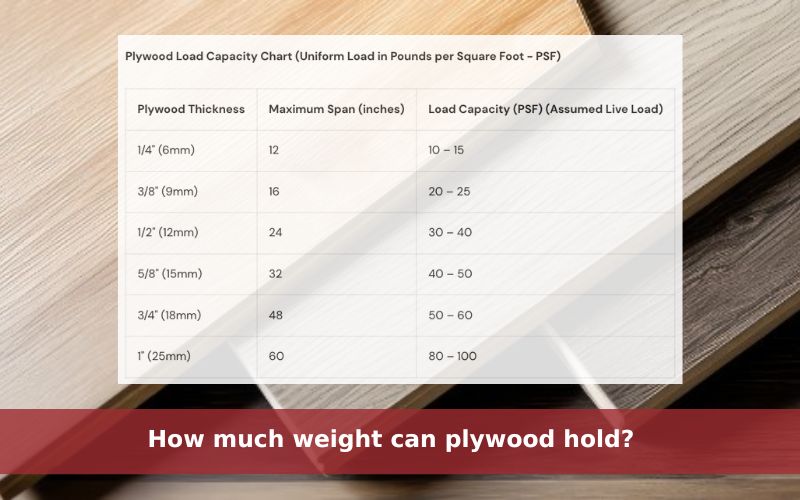
An 18 mm (3/4 inch) sheet on joists 400 mm (16 inches) apart holds about 50 to 60 pounds per square foot in a floor, call it 2.4 to 2.9 kN/m². Go to 12 mm (1/2 inch) on that same spacing and you are closer to 30 psf. Most people came here for that one number and can stop reading. If you are sizing something you actually plan to stand on, keep going, because three things move that number around and one wrong guess wrecks it.
Thickness is the obvious one. Span between supports is the second. The third catches people out: which way the face grain runs. A sheet is two to three times stiffer when the grain crosses the supports instead of running along them. Lay it the wrong way and half the rated load is gone before the first load goes on.
One thing to settle first, because it sends people to the wrong page. This is about how much weight plywood holds — its load capacity. If you came for how much a sheet weighs to lift or freight, that is a different number, and the weight references linked near the end have it.
Plywood load capacity chart
Two things can go wrong. Breakage is the dramatic one, face peeling or the core letting go, and it is rarer than people expect. What actually gets you on a floor is deflection. The panel never snaps. It just sags a hair, and that hair cracks the grout line or leaves the floor feeling springy underfoot. Flat matters as much as intact. A shop bench can bow a little and who cares. Numbers below assume the weight is spread evenly on standard joist spacing.
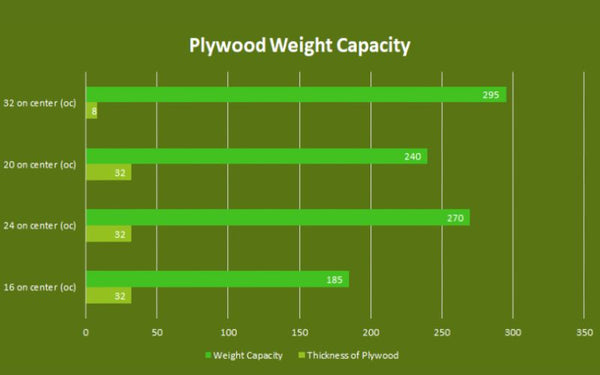
Plywood Load Capacity Chart (Uniform Load in Pounds per Square Foot - PSF)
| Plywood Thickness | Maximum Span (inches) | Load Capacity (PSF) (Assumed Live Load) |
|---|---|---|
| 1/4" (6mm) | 12 | 10 – 15 |
| 3/8" (9mm) | 16 | 20 – 25 |
| 1/2" (12mm) | 24 | 30 – 40 |
| 5/8" (15mm) | 32 | 40 – 50 |
| 3/4" (18mm) | 48 | 50 – 60 |
| 1" (25mm) | 60 | 80 – 100 |
How do you calculate the load capacity of plywood?
The field version is one multiplication. Panel area times the max pressure rating for that thickness:
Load Capacity (lbs) = Width (ft) × Length (ft) × Max Pressure (psf)
Say you have a 1.2 m × 0.6 m (4 ft × 2 ft) offcut, 6 mm (0.250 inch) thick. The table below puts max pressure for 6 mm at 16 psf. Run 4 × 2 × 16 and you get 128 lbs, roughly 58 kg, spread flat across the sheet. Note that last part. Evenly. Pile the same weight in one corner and the sum means nothing, which is exactly what the point-load bit further down gets into.
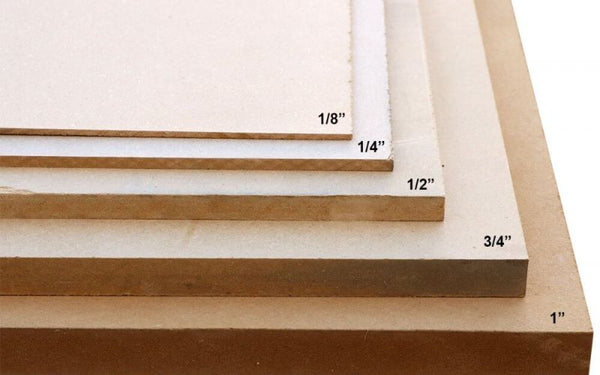
Estimated Maximum Pressure for Plywood (PSF) - For Rough Estimates Only
| Thickness (inches) | Max Pressure (PSF) |
| 0.125" (1/8") | 8 |
| 0.250" (1/4") | 16 |
| 0.375" (3/8") | 22 |
| 0.500" (1/2") | 35 |
| 0.750" (3/4") | 79 |
| 1.000" (1") | 106 |
Load capacity by thickness
Capacity climbs with thickness, with panel grade, and with how close together the framing runs underneath. On standard joist spacing, fastened properly, here is roughly where each thickness sits:
- 6 mm (1/4"): 5 to 15 psf if it is backed well, not much on its own.
- 9 mm (3/8"): 20 to 25 psf. Light duty.
- 12 mm (1/2"): 25 to 40 psf, which is why it ends up in most floors and sheathing jobs.
- 15 mm (5/8"): 40 to 50 psf, now you are into structural work.
- 18 mm (3/4"): 50 to 60 psf. The subfloor and heavy-shelving default.
- 25 mm (1"): 80 to 100 psf when the job is genuinely heavy.
How much weight can plywood hold vertically?
Stand a panel up and the loading changes. Walls, partitions, the back of a shelf unit. Now it comes down to thickness, the species, and whether the sheet is pinned hard to framing or left to fend for itself:
- 6 mm (1/4"): 10 to 15 psf with support every 400 mm (16 inches).
- 12 mm (1/2"): 30 to 40 psf if the studs are spaced right.
- 18 mm (3/4"): 50 to 60 psf and up, depending on grade, species, and support spacing.
To get the most out of a vertical panel: screw it hard to the framing rather than nailing, and keep concentrated loads off the open face so nothing crushes the veneer or splits the core.

Point load versus uniform load
Everything above is a uniform load. Weight spread flat across the sheet. A point load is a different animal. Set one table leg, a jack stand, or the corner of a loaded pallet on a panel and nearly all of it lands on a few square inches of face veneer instead of the whole area. The sheet gives out far below its uniform rating. That 18 mm panel happy at 50 psf spread out can crack under a fraction of that when the weight sits in one spot between joists.
The fix is not a thicker sheet, usually. It is support. If the real load is a point (a machine foot, a gun safe, a wheel), put blocking straight under it or spread it with a bearing plate, and forget the PSF table for that spot. The chart is for evenly distributed weight, full stop.
How much weight can 3/4 plywood hold?
An 18 mm (3/4 inch) sheet takes 50 to 60 psf evenly loaded on standard joist spacing. Bring the joists closer or double up the framing and it goes higher. On structural-grade or marine-grade 18 mm, a concentrated point load can push past 100 lbs (about 45 kg), but only with the span and the support under the load point both working in your favour.
How much weight can a plywood floor hold?
A plywood floor is only as good as what sits under it. Residential floors usually run 40 to 60 psf. Commercial, 100 psf and beyond. Industrial floors carry 250 psf and more once they are reinforced. Every lever that raises the number is about support: joists closer together (400 mm / 16 inch on-centre is the residential norm), thicker panels, a second layer of subfloor. Machinery room or heavy storage? That is structural-grade plywood over added beams, sized by an engineer, not read off a chart. For the panel itself, grade and thickness get sized to the floor's real load, not read off a table.
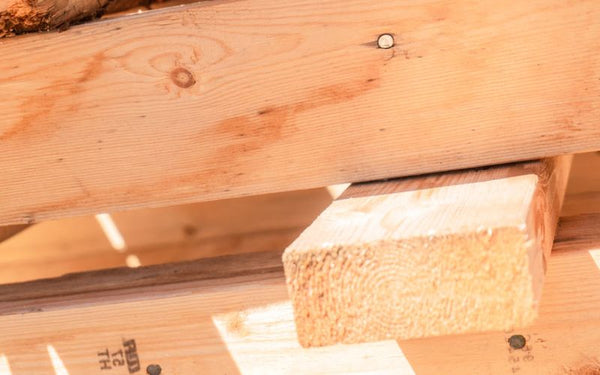
Load capacity, weight, and span rating are not the same thing
Three questions get muddled together on this topic, and each lives on its own page. This one is load capacity, how much a panel holds before it sags or fails. Call it strength. How heavy the sheet itself is is a separate thing that matters for lifting and freight, not for what it carries; the numbers for that sit in our plywood weight reference by thickness and species, and for a single sheet or a full 4×8 bundle, the 18 mm sheet-weight spec. Span rating is the last one, the APA stamp with the 32/16 and 48/24 figures that fixes the maximum support spacing for roof and floor sheathing. Staring at a panel stamp trying to make sense of it? The plywood span rating guide takes it apart. A heavy sheet is not a strong sheet by default, and neither figure tells you the stamped span.
About Vinawood
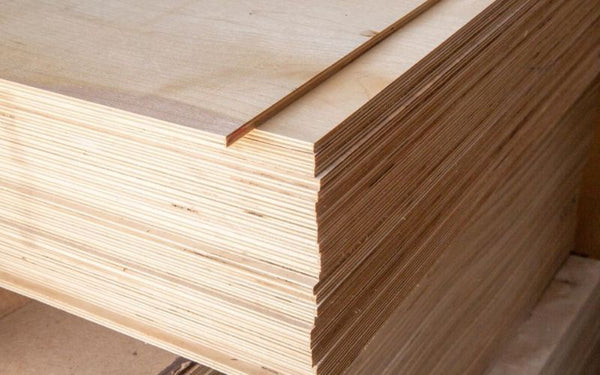
Vinawood has been making plywood in Vietnam since 1992, shipping more than 5,000 containers a year to over 55 countries. One thing worth saying plainly here: our lane is concrete formwork and film-faced panels certified to EN 636 and EN 314, not APA-span-rated structural floor sheathing. The load figures on this page are general-plywood design references, the kind you use to size shelving, a subfloor, a bench top. Where reuse and a clean concrete face matter more than joist-span capacity, the HDO plywood range is what we would point you at. Take any structural number here as a starting point, then check it against local building code and the panel maker's spec sheet before it carries anything real.
VINAWOOD – Vietnam Plywood Supplier & Manufacturer
Category
guides