Birch Plywood Thickness: Standard Sizes, Actual Dimensions & Tolerances
Birch plywood thickness chart with nominal vs actual dimensions, ply counts, and EN 315 tolerances — plus where Baltic and Vietnamese birch part ways at the spec sheet.
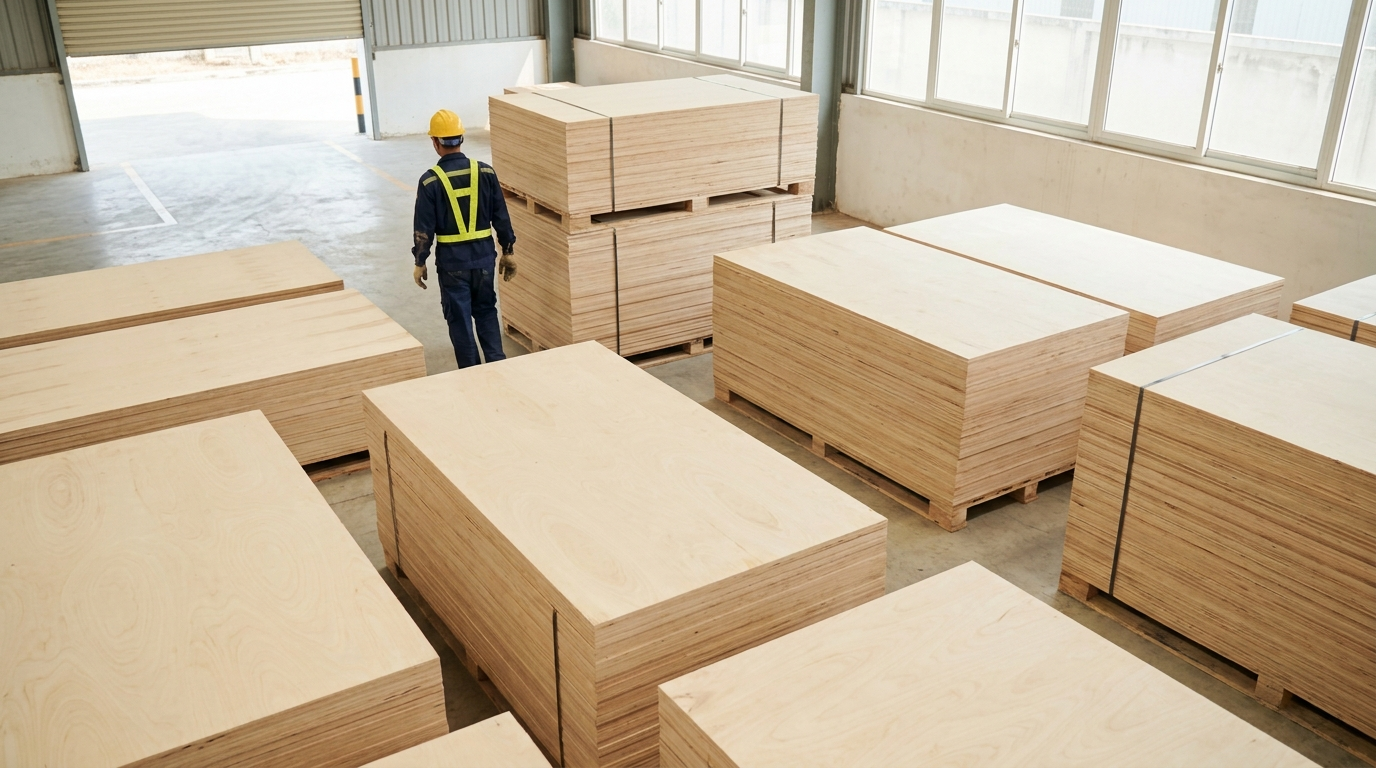
Most birch plywood searches end at the same question: what does this panel actually measure when it lands on my bench? The marketing label says one thing, the calipers say another, and the dado you cut last week is now too loose. The chart below is what searchers came for. Everything after it explains why the numbers move and how to plan for it.
Quick Reference: Nominal vs Actual Birch Plywood Thickness
| Nominal | Actual (typical) | System | Ply count (Baltic) | Common use |
|---|---|---|---|---|
| 3 mm | 2.7–3.0 mm (~0.118″) | Metric | 3-ply | Laser cutting, model parts |
| 1/8″ (3.18 mm) | 3.05–3.18 mm | Imperial | 3-ply | Bending forms, scroll work |
| 4 mm | 3.7–4.0 mm | Metric | 3-ply | Drawer bottoms, back panels |
| 6 mm | 5.5–6.0 mm | Metric | 5-ply | Cabinet backs, jig bases |
| 1/4″ (6.35 mm) | 6.0–6.35 mm | Imperial | 5-ply | Templates, drawer bottoms |
| 9 mm | 8.7–9.0 mm | Metric | 7-ply | Light shelving, drawer sides |
| 3/8″ (9.53 mm) | 9.0–9.53 mm | Imperial | 7-ply | Drawer boxes, paneling |
| 12 mm | 11.5–12.0 mm | Metric | 9-ply | Drawer sides, small carcasses |
| 1/2″ (12.7 mm) | 12.3–12.7 mm | Imperial | 9-ply | Drawer boxes, small panels |
| 15 mm | 14.5–15.0 mm | Metric | 11-ply | Cabinet sides, shelves |
| 5/8″ (15.88 mm) | 15.5–15.88 mm | Imperial | 11-ply | Subfloor, cabinet sides |
| 18 mm | 17.5–18.0 mm (~0.689–0.709″) | Metric | 13-ply | Cabinet carcasses, tabletops |
| 3/4″ (19.05 mm) | 18.5–19.05 mm | Imperial | 13-ply | Cabinet carcasses, work surfaces |
| 21 mm | 20.5–21.0 mm | Metric | 15-ply | Heavy shelving, jig plates |
| 24 mm | 23.5–24.0 mm | Metric | 17-ply | Workbench tops, structural |
| 1″ (25.4 mm) | 24.5–25.4 mm | Imperial | 17-ply | Workbench tops, fixtures |
| 30 mm | 29.5–30.0 mm | Metric | 21-ply | CNC bed sacrificials, heavy fixtures |
Two things stand out. Metric panels almost always finish under nominal. Imperial panels almost always finish at or near nominal. Both behaviours are normal, and both are written into the spec.
Why Nominal and Actual Don't Match
Three production steps move the number on the label away from the number on the calipers.
Calibration sanding is the big one. After hot-pressing, every birch panel runs through a wide-belt sander to true the faces. That step removes 0.2–0.5 mm per side. A 12 mm panel that came out of the press at 12.4 mm leaves the line at about 11.6 mm. Mills tune the press thicker than the target on purpose, so calibration brings the panel down into spec.
Metric-to-imperial conversion is the second. A nominal 18 mm panel converts to 0.709″, not 0.750″. Buyers who treat 18 mm as a swap for 3/4″ lose 0.041″ of width — about 1 mm — and that gap is exactly what kills a snug dado.
Tolerance bands are the third. EN 315 allows ±0.4 mm on panels up to 12 mm and ±0.5 mm on thicker panels at the time of manufacture. ANSI/HPVA HP-1 sets the imperial bands a touch tighter for hardwood plywood (typically ±1/64″, or 0.4 mm). The mill is in spec across that whole range, so your bundle of "12 mm" sheets may measure anywhere from 11.6 to 12.4 mm and still be a compliant order.
Standard Baltic Birch Thicknesses
Baltic mills (Russia, Belarus, Latvia, Finland) work in metric. The standard range runs 3, 4, 6, 9, 12, 15, 18, 21, 24, and 30 mm. Some mills also produce 8 mm and 25 mm for industrial customers. Ply count climbs with thickness on a fixed cadence: each interior ply is roughly 1.5 mm of veneer, so a 12 mm panel ends up at 9-ply, 18 mm at 13-ply, and 30 mm at 21-ply.
Sanctions on Russian and Belarusian birch shifted Baltic supply hard after 2022. What still arrives in North America under "Baltic birch" labels is increasingly Latvian, Finnish, or Ukrainian — and a growing share of the visual look-alike comes out of Vietnamese birch plywood grades, which run on the same calibrated-sand workflow but with plantation-grown faces.
Standard Imperial Birch Thicknesses
North American mills produce birch plywood at 1/8″, 1/4″, 3/8″, 1/2″, 5/8″, 3/4″, and 1″. Ply count typically runs 3, 5, 7, 9, 11, 13, and 17 respectively, though imperial veneer thickness varies more between mills than Baltic does. A 3/4″ panel from a US mill might be 13-ply with 1.5 mm veneers or 11-ply with thicker face plies, depending on whether the panel is built for cabinetry or for utility.
The imperial side runs closer to nominal because mills calibrate to a fractional target. A 3/4″ panel out of a US line is built to land between 0.730″ and 0.750″. Baltic 18 mm, by contrast, lives in a 17.5–18.0 mm window. The cabinetmaker who orders 3/4″ gets a panel within 0.020″ of the label. The cabinetmaker who orders 18 mm gets a panel within 0.020″ of the label too, but the label says something different.
Tolerance Bands and What They Mean for CNC, Laser, and Dado Work
For most cabinet work, ±0.4 mm doesn't matter. Drawer slides accommodate it. European hinge cup depth accommodates it. Edge banding hides it.
For tight-tolerance work it does matter. CNC pocket depths set in the controller assume nominal — feed in 12 mm and the cutter plunges 12 mm regardless of what the panel actually measures. The ±0.4 mm error stacks across multi-pass operations. Laser cutters that compensate in software for kerf and focus need the actual panel thickness measured at multiple points across each sheet, not assumed from the label. Dado joints designed for nominal 3/4″ open up loose when the panel arrives at 0.730″.
The fix is upstream of the cut. Caliper a representative sheet from each bundle before programming the cut list. From a Vietnamese mill perspective, we send pre-shipment thickness reports on every container — three readings per panel, sampled across the bundle — precisely because the calibration window matters more to OEM cabinet buyers than the rated maximum.
Ply Count by Thickness
Ply count is a stiffness signal, not just a cosmetic one. More plies in the same thickness means thinner individual veneers and more glue lines, which translates to a stiffer panel with less seasonal movement. It also means more visible edge layers if you leave the edge exposed.
| Thickness | Plies | Approx. veneer thickness |
|---|---|---|
| 3 mm / 1/8″ | 3 | 1.0 mm |
| 6 mm / 1/4″ | 5 | 1.2 mm |
| 9 mm / 3/8″ | 7 | 1.3 mm |
| 12 mm / 1/2″ | 9 | 1.4 mm |
| 15 mm / 5/8″ | 11 | 1.4 mm |
| 18 mm / 3/4″ | 13 | 1.4 mm |
| 21 mm | 15 | 1.4 mm |
| 24 mm / 1″ | 17 | 1.4 mm |
| 30 mm | 21 | 1.4 mm |
The 11-ply 18 mm format that some buyers prefer for furniture trades stiffness for a slightly cleaner edge. Both spec patterns are legitimate — confirm which one the mill is shipping before you commit to a job that depends on either look.
Vietnamese Birch vs Baltic Birch — Thickness Conventions
Vietnamese mills produce both metric (Baltic-equivalent) and imperial (US-equivalent) birch panels, often on adjacent press lines. Baltic mills produce metric only — when a US distributor sells "Baltic 1/2 inch," the panel inside the bundle is 12 mm relabeled. The 0.7 mm difference is invisible to most furniture work and disqualifying for some CNC and joinery work.
For comparison shoppers, the deeper read is in Baltic birch vs Vietnamese plantation hardwood plywood — face species, glue line, and certification differ across the two supply lanes even when the thickness chart looks identical.
Choosing Thickness by Application
A short selection guide that tracks how cabinetmakers and shops actually order:
- Laser cutting and small parts: 1/8″ or 3 mm. Three plies keep kerf clean. Watch for 0.1–0.2 mm thickness variation across the sheet.
- Templates and routing jigs: 1/4″ or 6 mm. Stiff enough to register a follower bearing, light enough to handle.
- Drawer bottoms: 1/4″, 6 mm, or 1/2″. Match the groove on the drawer side.
- Drawer boxes: 1/2″ or 12 mm. Light enough to slide cleanly, stiff enough to hold a dovetail or finger joint.
- Cabinet sides and shelves: 3/4″ or 18 mm. The default for kitchen cabinetry across both metric and imperial systems.
- Worktops, jig plates, fixtures: 1″, 24 mm, or 30 mm. 21-ply Baltic is a workshop standard for CNC sacrificial beds.
Sheet weight scales linearly with thickness. For weight per sheet across the full thickness range, see the companion birch plywood density and weight per sheet reference.
Common Spec Mistakes
The errors that show up on rework lists at our customer-service desk come from a small set of substitutions:
Treating 18 mm as 3/4″. They are not the same. 18 mm is 0.709″. 3/4″ is 0.750″. The 1 mm gap is exactly what loosens a dado, a finger joint, or a drawer slide pocket. If the project drawing calls for one, order that one — don't translate.
Treating 12 mm as 1/2″. Same problem, smaller. 12 mm is 0.472″. 1/2″ is 0.500″. Most furniture work absorbs the 0.7 mm. Some CNC pocket work doesn't. For the closest comparison between adjacent imperial sizes, see 5/8″ vs 3/4″ plywood actual thickness.
Assuming all "Baltic birch" is metric. Some North American distributors carry imperial-thickness Baltic-grade panels — full 1/2″, full 3/4″ — sourced from mills that produce both systems. Confirm the dimension system on the invoice before cutting.
Ignoring within-bundle variation. Calibration sanding is a tolerance, not a guarantee. Sheet-to-sheet variation of 0.2–0.3 mm within the same bundle is in spec under EN 315. Plan the cut list around the measured average, not the printed nominal.
At-a-Glance Reference Card
| If the spec calls for… | Order… | Plies | Watch for |
|---|---|---|---|
| 1/8″ (laser, models) | 3 mm or 1/8″ birch | 3 | Sheet-to-sheet 0.1–0.2 mm variation |
| 1/4″ (templates, jig bases) | 6 mm or 1/4″ birch | 5 | Metric runs ~0.4 mm under |
| 3/8″ (drawer boxes) | 9 mm or 3/8″ | 7 | Specify metric or imperial up front |
| 1/2″ (drawer boxes, small panels) | 1/2″ for joinery; 12 mm if drawing is metric | 9 | 0.7 mm gap if you swap the two |
| 5/8″ (subfloor, cabinet sides) | 5/8″ or 15 mm | 11 | Metric runs 0.5 mm under nominal |
| 3/4″ (cabinet carcass) | 3/4″ for joinery; 18 mm only if drawing is metric | 13 | 1 mm gap if you swap the two |
| 1″ (workbench, fixtures) | 1″ or 24 mm | 17 | Heavy — get help moving full sheets |
Category
guides
Related Markets
Related Countries
Related Products
▶Sources & References (4)
- EN 315: Plywood — Tolerances on dimensions — European Committee for Standardization (CEN) (2000)
- ANSI/HPVA HP-1 Hardwood and Decorative Plywood — Hardwood Plywood & Veneer Association (2020)
- APA Engineered Wood Construction Guide — Panel Thickness — APA — The Engineered Wood Association (2024)
- BS 6566: UK Specification for Plywood — British Standards Institution (1985 (current))