Importing Vietnam Plywood to India and the Middle East
Practical guidance for buyers in India and the Middle East importing plywood from Vietnam — covering BIS requirements, import duties, construction demand, and shipping logistics.
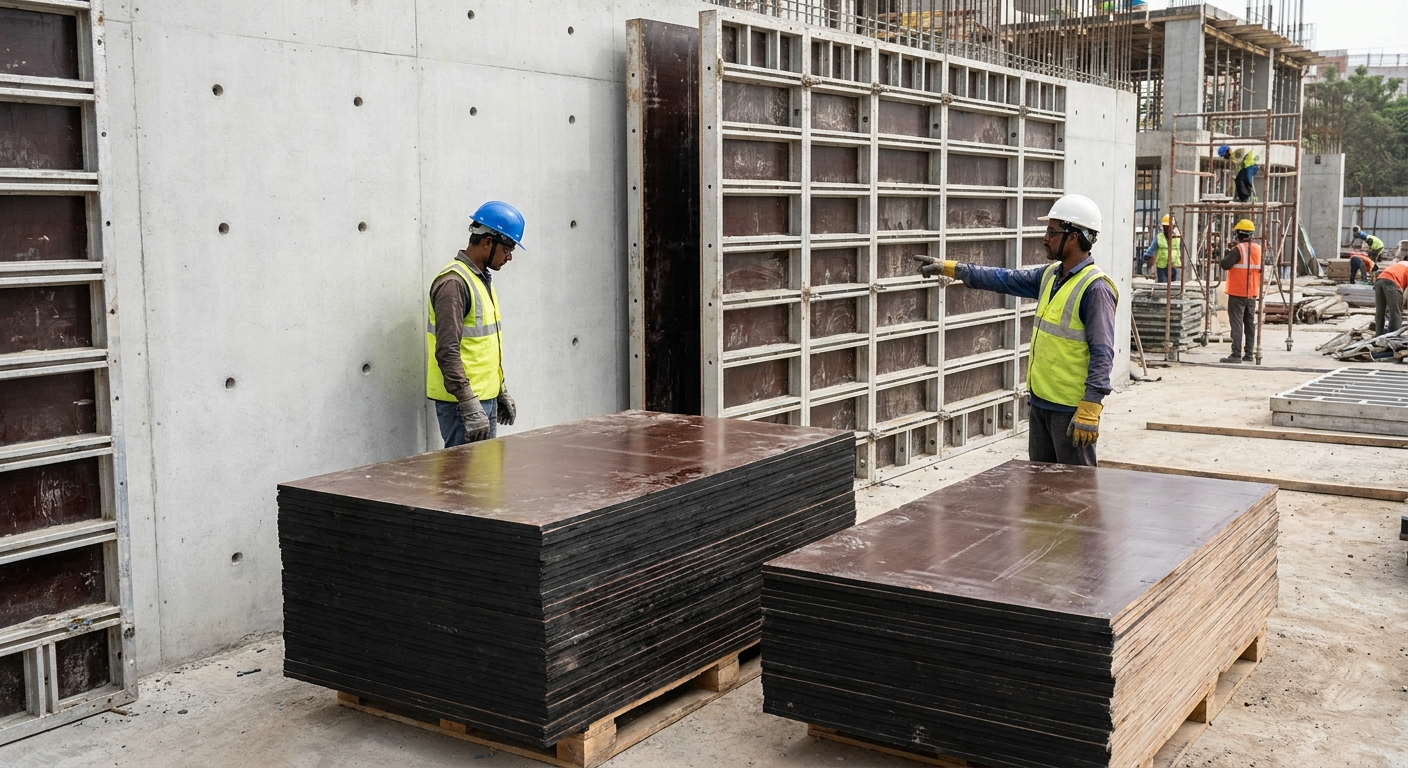
Ask an importer in Mumbai or Dubai what happens to the Vietnamese plywood they bring in, and you'll mostly hear one word: concrete. A cabinet maker might take a pallet now and then. The rest gets nailed to formwork and poured against until it's worn out, which changes what an import decision is really about. Does the glue hold up in the heat? Will the papers get the box through the port without a hold? And will a sheet last enough pours to earn back what you paid for it?
We've been making construction plywood in Vietnam since 1992 (roughly 5,000 containers a year now, going to 55+ countries), and India and the Gulf are two lanes where we keep seeing the same avoidable problems. Quick caveat before going on. Duty and certification rules move around, occasionally in the middle of a year, so a licensed broker in your own country should sign off on the details for any real shipment.
Why India and the Gulf buy from Vietnam at all
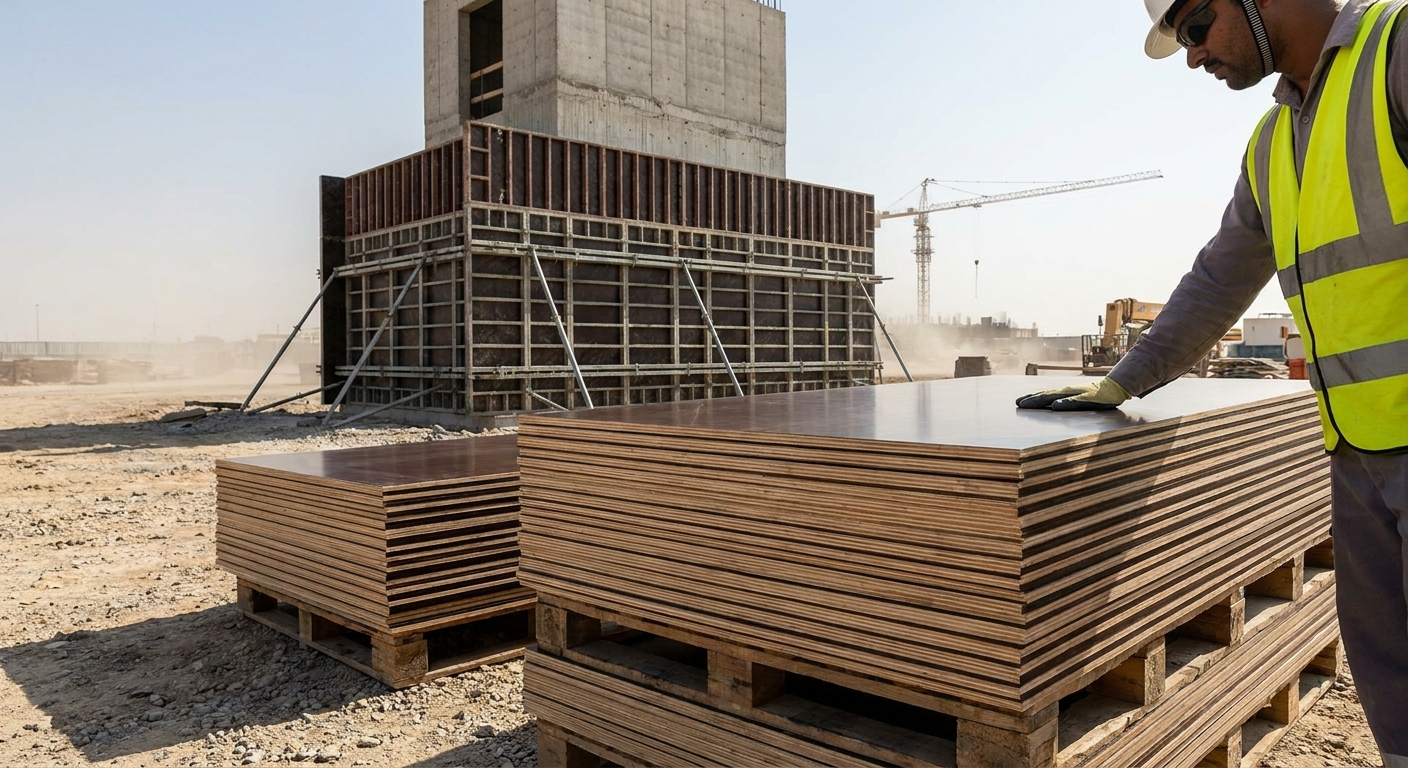
Formwork is the short answer. That's the temporary mould wet concrete sits in until it can stand up by itself, and both regions go through a lot of it. On Indian housing and metro jobs the cycles are tight and the quantity surveyor counts every rupee per use. Out in the Gulf, high-rise frames get poured right through July and August, and glue lines that look fine in a cool warehouse start to show their age fast.
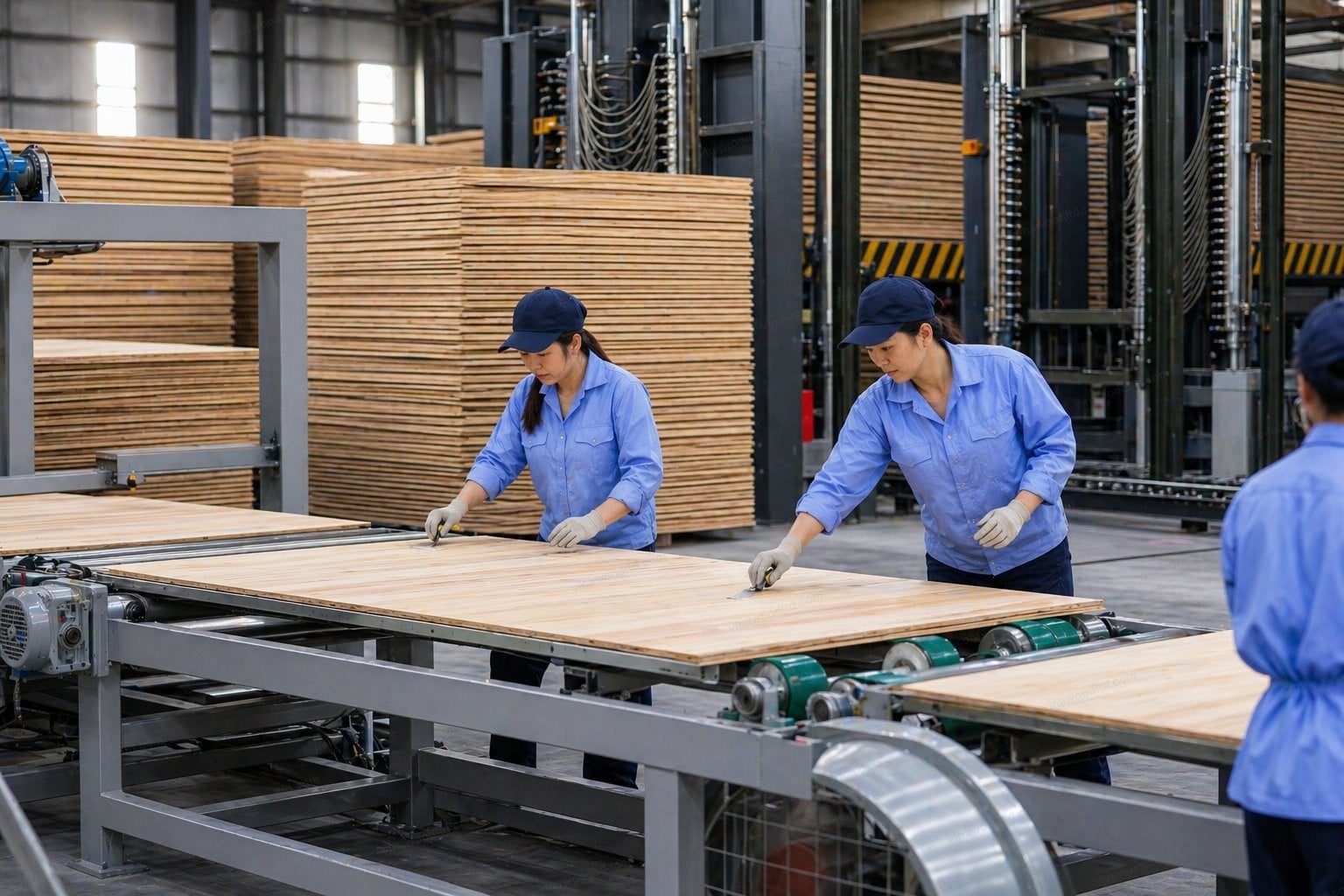
Vietnam suits all of that because our timber is plantation-grown. Mostly it's Acacia and Eucalyptus, with some Hevea (rubberwood) in certain cores, and since those plantations get replanted and cut again on short cycles, core quality doesn't swing much between orders. Distance is the catch. A box from Hai Phong is at sea for weeks and goes through customs twice, and once it's on site you can't swap a wrong grade by Monday. So spend the time on the spec before the deposit goes out. You'll save more there than by squeezing the sheet price.
The paperwork that has to travel with the goods
Plywood goes under HS heading 4412 in both regions. HS stands for Harmonized System, which is just the shared numbering customs uses to say what's in the box. Everyone agrees on the first six digits; India and the GCC then tack on their own, and it's those extra digits that decide the duty. Get your broker to confirm the full code before we print the commercial invoice (fixing it afterwards is a pain). The rest of the usual set is a packing list showing sheets and cubic metres per bundle, plus the bill of lading and a certificate of origin. Need heat-treated pallets for your port? Say so on the order and they'll come stamped with the ISPM 15 mark.
India adds one document that deserves real care. Vietnam and India are both inside the ASEAN-India Free Trade Area, and any preferential duty under it is claimed with a certificate called Form AI. Get the HS line or origin wording wrong on that form and the shipment is simply assessed at the normal rate, or held at Nhava Sheva while someone sorts it out. Rates themselves move with the Union Budget. Price your landed cost off the current schedule, through your broker, before you commit volume.
Over in the Gulf there's a common GCC customs tariff, though every member state still layers its own import procedure on top. Saudi Arabia is the one to watch. Depending on the product and the port, it may add conformity checks or want documents attested, so get the importer of record to confirm those steps before we start production. If an attestation shows up after the vessel has sailed, you'll likely be paying the terminal to store the container while you wait.
BIS, explained without the jargon
BIS is the Bureau of Indian Standards, the national standards body, and it files plywood by end use under IS numbers. For formwork the number to know is IS 4990, the standard for plywood used in concrete shuttering. You'll see IS 303 for general-purpose board too, and IS 710 for marine.
Is a BIS licence compulsory for your order? It depends on the category the goods are declared under and on whichever government orders are in force when the container lands, and those have changed more than once in recent years. We'd treat BIS as part of choosing a supplier rather than something to tick off at the port. Vinawood holds BIS among its certifications, and the BIS certification page sets out the scope. Before we book an Indian order, our team checks which product and which standard the licence actually covers, because a certificate that doesn't match the container is worse than none. Still deciding on grade? Our guide to shuttering plywood in India digs into how contractors there write their specs.
Picking a panel: glue first, then film
A formwork sheet gets talked about as one product, but you're really buying two separate things glued together. On the outside there's the face film, a thin skin of phenolic resin pressed onto the veneer, and that skin is what the concrete sees. It sets how smooth the wall comes out and how easily the panel lets go when you strip. Inside, the glue line between plies is doing a different job entirely: keeping the sheet in one piece after weeks of curing water and sun.
Europe's EN 636 standard is the easiest way to describe that glue. EN 636-2 covers humid conditions. EN 636-3, which most of the trade calls Class 3, covers exterior exposure, and in our range it always means a phenolic glue line. You'll also hear WBP, short for "weather and boil proof", an older trade name for the same kind of exterior bond. The name oversells it a little. It's a water-resistant bond, and if you leave a cut edge unsealed the core will still soak up water.
In our range, Class 3 means Pro Form and Pro Form Lite on the film-faced side, along with HDO Standard and HDO Premium (overlay panels that mostly go to North America). Form Basic and Form Extra use an MUF core adhesive, melamine-urea-formaldehyde, rated EN 636-2. Form Extra lasts longer than Form Basic because its core glue is stronger, a formula we call Superior Glue. It isn't a thicker face, as the two share the same phenolic film. Reuse figures are ceilings under good site practice: up to 8 pours for Eco Form Plus, up to 10 for Form Basic, up to 15 for Form Extra or Pro Form Lite, and up to 20 for Pro Form.
For the Gulf we nearly always steer people toward the phenolic grades. Heat goes looking for the weakest glue line on the job, and Gulf panels spend a lot of time lying in full sun between pours. Indian programmes are often shorter and more price-driven, and there an MUF grade can be the sensible buy, provided somebody keeps the stack dry and reseals edges after cutting. If I had to pick, I'd take fewer sheets of the right glue class over a full container of the wrong one every time. All the grades sit side by side on our film-faced plywood page if you want to compare.
What to write on the RFQ
Start with size. In both markets 1220 × 2440 mm is the everyday sheet, though we make 1250 × 2500 mm as well for systems built on metric modules. We press film-faced thicknesses from 12 up to 21 mm. Walls and slab decks mostly get 18 mm, column boxes and similar light work often get by on 12 or 15, and 21 mm turns up when spans are long or the pour rate is aggressive. Your formwork designer sets that from joist spacing and pour rate. A sales sheet shouldn't.
A request for quotation (RFQ) that gets a quick, useful reply also names glue class and film colour, the reuse you're hoping for and the quantity. Add the destination port and the Incoterm too. An Incoterm is the trade rule for where our cost and risk end and yours start. On FOB Hai Phong you book the freight; on CFR or CIF to Jebel Ali or Nhava Sheva, we do. If you'll need Form AI or a BIS reference on arrival, put that on the RFQ and we'll have it ready with the goods rather than chasing it later. Not sure how many sheets fit? Try the container loading calculator for a 20 ft or 40 ft box.
Samples and payment on a first order
With a letter of credit (LC), your bank promises to pay us as soon as the shipping documents line up with the agreed terms. LC at sight is the usual way first orders run from Vietnam into either region, mainly because it protects both sides while you're still getting to know each other. Repeat buyers often move to a deposit with the balance paid against copy documents. Whatever's agreed goes onto the proforma invoice.
Samples come before money, always. Send a courier set to site and let the crew look at the face and pour a test panel; after that, one trial container shows you how the grade behaves over a full run. Each Vinawood bundle also has its own QR code, linked to the production record. On export work that's more useful than it sounds, because if a site reports a problem months later we can trace the bundle back to its batch instead of arguing about it.
Getting it from Hai Phong to your port
Most of our India and Middle East cargo goes out through Hai Phong. Typical discharge ports are Jebel Ali for the UAE, Jeddah or Dammam for Saudi Arabia and Hamad for Qatar, with Nhava Sheva, Mundra and Chennai on the Indian side. Transit time depends on the carrier's service and on whether the box is transhipped on the way, so we quote the schedule per sailing rather than promising a fixed number of days.
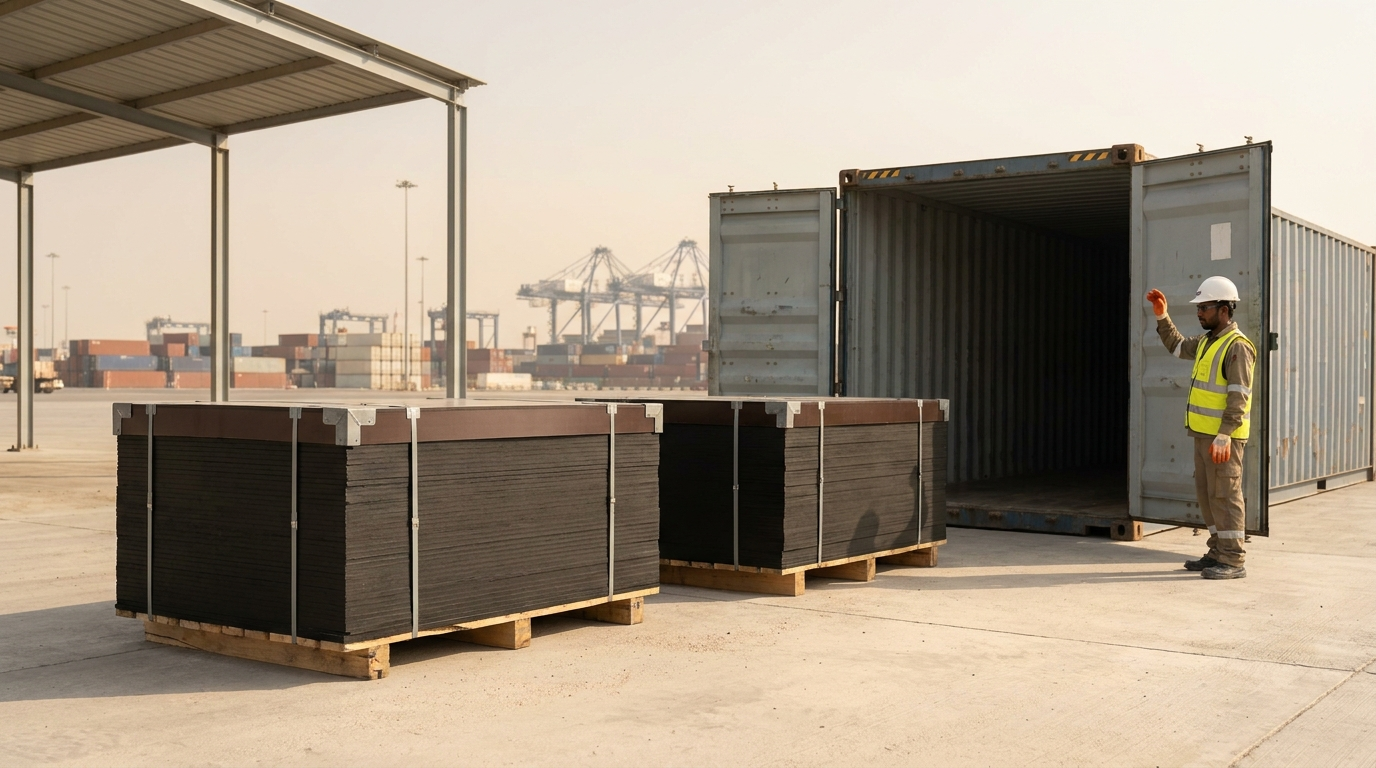
Heat is what buyers underestimate. A steel box sitting on a Gulf terminal in July gets hot inside, hot enough to dry out an exposed edge. That's why our bundles leave the mill edge-sealed and wrapped, held with steel banding over corner protectors. Unload them soon after arrival and store them flat, off the ground and out of the sun. Once your broker has confirmed the tariff line, the landed cost calculator will give you a working figure for freight and duty.
Planning the next container
Buying for Gulf sites? Our guide to formwork plywood for GCC construction covers film choice for heat and high-rise cycles in more depth, and the piece on formwork plywood supply in the Middle East looks at how sourcing works across the region. If you're lining up documents for more than one market, the round-up of certifications for Vietnam plywood exports puts BIS next to the European and forestry schemes.
When your spec is ready, send it through the request for quotation form with the port and the documents you'll need. Would you rather talk the grade through first? Contact our sales team and we'll match glue class and thickness to your pour programme before we put a price on it.
Category
market-insights
▶Sources & References (5)
- Bureau of Indian Standards — Bureau of Indian Standards
- Customs Tariff of India — Central Board of Indirect Taxes and Customs
- ASEAN-India Trade in Goods Agreement — ASEAN Secretariat
- GCC Common Customs Law — Gulf Cooperation Council Secretariat
- EN 636 - Plywood specifications — CEN