Plywood Buyers Secure December Space Ahead of Winter Schedules
Carriers are trimming winter schedules, and the space left goes to cargo already booked. Why December is the time to load Q1 formwork, plus freight, Gulf routing and currencies.

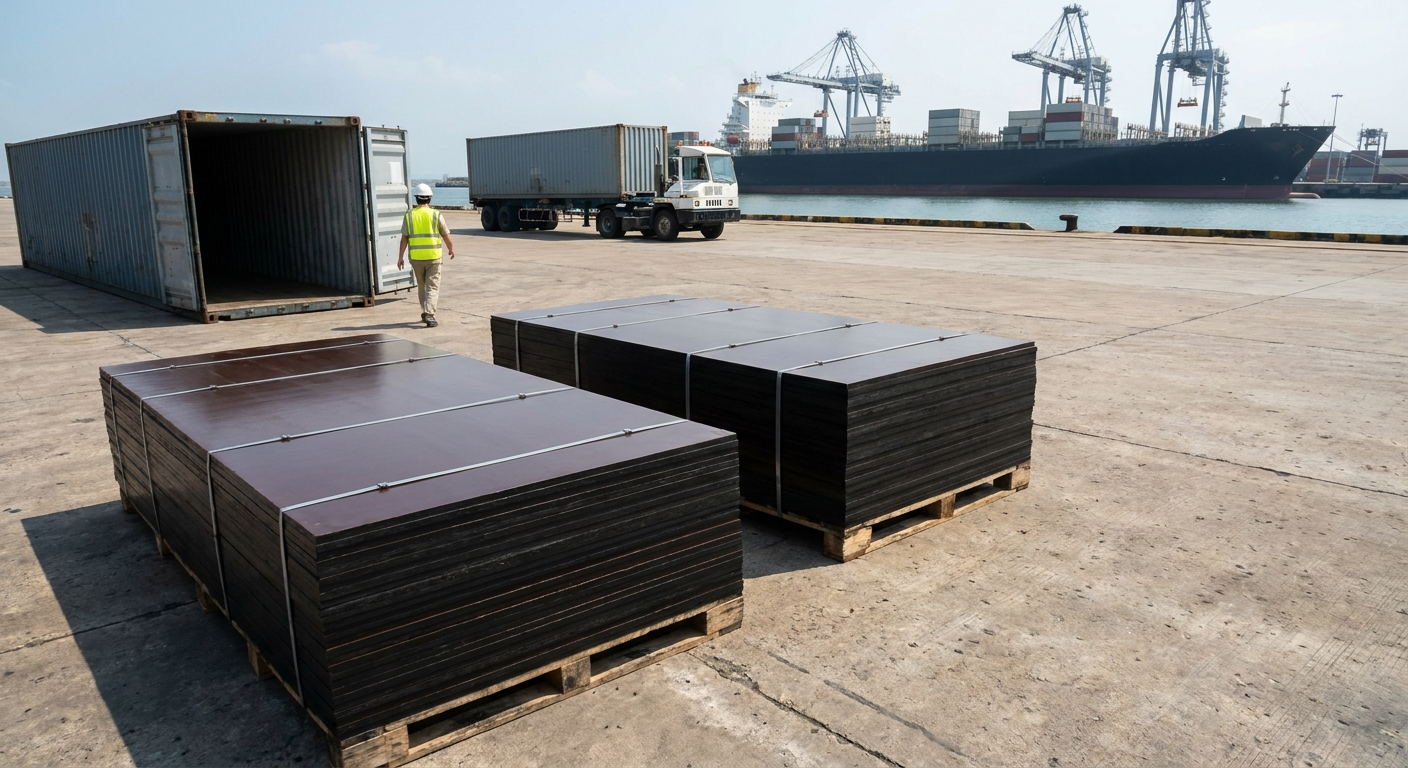
December is when formwork buyers in Europe and North America start lining up loads for the new year, and carriers are planning their winter schedules at the same moment. Drewry expects 56 sailings on the main east-west routes to be cancelled between early November and the first week of December. A cancelled sailing, often called a blank sailing, is a voyage the carrier takes off its schedule to match capacity to slower winter demand. Most ships still run, but the space that remains goes to cargo that is already booked. For a plywood importer, that makes this a good month to put January and February arrivals on paper.
Winter schedules from Asia
Drewry's tracker shows that 92% of planned voyages in that five-week window are expected to sail. Asia to North Europe and the Med accounts for almost half of the cancellations, and the transpacific route to the US for about a third. Carriers have also announced higher November rates to Europe, although Drewry is unsure they will stick while demand is soft.
What we see at the loading port each winter is that the cargo booked last is the cargo that rolls to the next ship. A container that rolls once can lose a week, and before Tet a week matters. Our 26 October brief set out the holiday calendar: the shutdown begins about five days before Tet on 6 February 2027, and the supply chain needs 30 to 40 days after that to reach full speed again. Panels booked onto December and early January sailings stay clear of that gap.
Arrival dates need room
Ships are still not arriving when the schedule says. Sea-Intelligence found that only about half of vessels worldwide arrived on time in September, and late ships came in close to a week behind. Reliability on the routes from Asia to both US coasts slipped during the month as well.
For a contractor with a pour date, the fix is simple and cheap. Plan the site date with a week or two of slack after the scheduled arrival, and confirm the booking as soon as the order is signed. Distributors restocking yards for spring can do the same by placing two smaller loads a few weeks apart instead of one large order late in January.
Freight rates
Rates eased a little last week. Drewry's World Container Index, a composite of eight routes priced from Shanghai, fell 3% to $4,429 per 40ft container on 29 October, mostly because of softer transpacific prices, while rates to Europe were firm. Carriers are cancelling sailings precisely to stop that slide, so a quiet week is a chance to book rather than a sign that freight will keep getting cheaper.
For a 40ft from Hai Phong, we're planning on about $7,500 to the US West Coast, $9,630 to the US East Coast, $3,690 to North Europe and $4,150 to the Med. Booking the container together with the confirmed order is the most reliable way to hold a rate close to those figures.
Gulf deliveries
Buyers in the Gulf face a different problem. With the Strait of Hormuz still disrupted, mainline ships aren't calling directly at Jebel Ali or Dammam. Containers for the UAE now land mostly at Khor Fakkan or Fujairah and travel on by truck, and Saudi cargo is coming in through Jeddah and King Abdullah Port on the Red Sea, according to Expeditors and Hapag-Lloyd updates. The ports are working, but the extra leg adds time. We agree the routing with Gulf customers at the quote stage so that the delivered date reflects it.
Currencies and panel prices
Our quotes are in US dollars, so the buyer's own currency sets the landed cost. The ECB had the euro at about $1.12 on 30 October, almost unchanged from a week earlier, and the Bank of Canada had the US dollar at about C$1.40, with the Canadian dollar a touch firmer. A forward contract taken out alongside a Q1 order fixes the rate for the payment date, which protects euro buyers after the autumn dip and holds the recent gain for Canadian importers.
Panel prices are firm. British Columbia's weekly price report showed Canadian softwood plywood unchanged through late October. With panel prices stable, a delivered cost fixed now is easier to pass on in spring quotes.
December loads
We think December is the cleanest month of the winter to ship formwork. Space is there for cargo that books early, and the month sits far enough ahead of Tet to leave room for one missed sailing. European buyers can compare grades in our film-faced plywood range, and North American buyers can start with HDO plywood for concrete forming.
About Vinawood
Vinawood is a Vietnamese plywood manufacturer established in 1992. We ship about 5,000 containers a year to 55+ export countries, and every formwork and film-faced panel goes through a 12-step production process and 100% individual sheet inspection. Certifications include ISO 9001, FSC-COC, PEFC, EN 13986 CE marking and UKCA, the wood is plantation-grown, and an EUDR evidence pack is available on request for European orders. For December and January loads, request a quote.
Category
market-insights
Related Markets
Related Countries
Related Products



▶Sources & References (8)
- World Container Index – 29 Oct — Drewry (2026-10)
- Cancelled Sailings Tracker – 30 Oct — Drewry (2026-10)
- Global schedule reliability records a marginal gain in September — Sea-Intelligence (2026-10)
- Middle East operational update: Saudi Arabia transportation disruptions — Expeditors (2026-10)
- Operational update Middle East, week 44 — Hapag-Lloyd (2026-10)
- Euro foreign exchange reference rates — European Central Bank (2026-10)
- Daily exchange rates — Bank of Canada (2026-10)
- Forest product prices, week of 30 October 2026 — Government of British Columbia (2026-10)