
Plywood Price: How Export Buyers Read FOB, Sheet, and Container Quotes
How to read a plywood quotation from Vietnam: what FOB Hai Phong, CIF and DDP include, which glue, film and container details move the number, and how to request a factory-direct Vinawood quote.
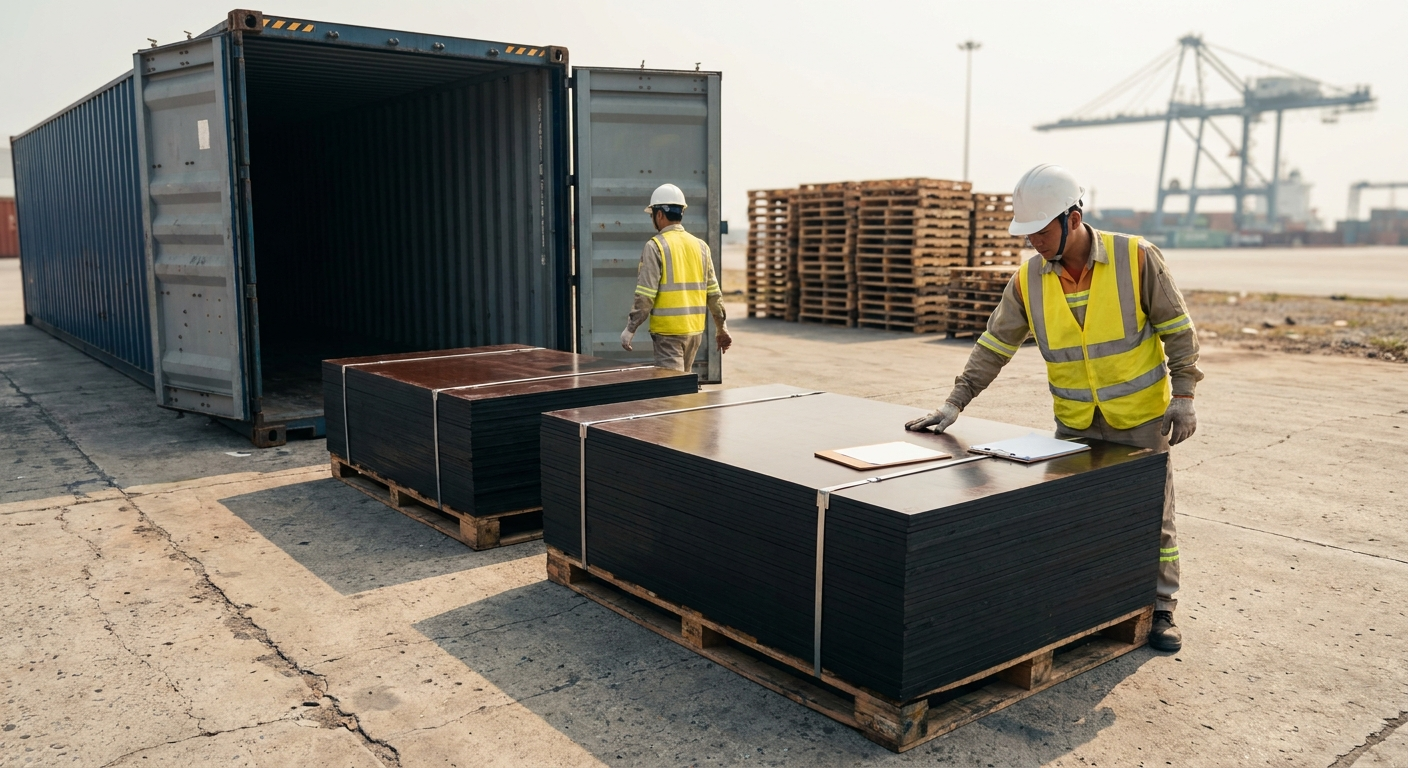
Short answer: a plywood price from Vietnam only means something once the grade, the sheet size, the Incoterm and the named port are all pinned down. Leave one of them open and two perfectly honest mills will send you numbers you can't line up, because one of them priced a different glue, or a thinner film, or delivery to a different place. So the fastest way to a usable figure is to send a spec, not to ask for a price list. Below we go through how an export quote is put together, how to read one line by line, and what actually moves the number.
What "plywood price" means once you're buying by the container
A lumberyard prices a 4×8 sheet you can pick up on Friday. A mill is quoting panels you won't see for weeks. Between the press and your yard there's loading, insurance, customs classification, clearance. The number gets written per sheet or per square metre, now and then per cubic metre (traders like it), per 40-foot high-cube, or landed at your door. One cargo. Four figures that don't look related.
Most bad comparisons start right there, with a cheap sheet that packs badly being mistaken for a cheap programme, when the dearer sheet that loads tight wins on the box. Before ranking anyone, we'd put the same few questions to every supplier: which unit, which Incoterm at which port, the exact size and thickness, and the packing plan.
Reading a plywood quotation from Vietnam, line by line
We read a factory quote as three blocks. First comes the panel. The middle one describes the container, and the bottom one sets the commercial terms. If a block is missing, the price sitting above it is unfinished, however good it looks. In our experience, when two 18 mm offers look miles apart, it's nearly always a different film weight or glue class rather than one mill being cheaper.
Here's what each field is telling you:
| Field on the quote | What it tells you |
|---|---|
| Product and grade name | Panel family, and which grade inside it |
| Core glue and bond class | MUF or phenolic (PF) core; EN 314-2 Class 2 or Class 3 |
| Face film | Phenolic film weight in g/m², colour, one face or two |
| Thickness, size, tolerance | The sheet you can actually claim against |
| Sheets per pack, packs per container | How a sheet price turns into a container price |
| Net and gross weight, CBM | Whether weight or volume caps the load |
| Incoterm and named place | e.g. FOB Hai Phong, or CIF at your port |
| Validity, production window | How long the number holds, when goods are ready |
| Payment terms, inspection | What's agreed on the proforma, who checks the goods |
Start with the panel lines. A grade name on its own won't protect you, because the core glue and face film account for most of the gap between two "18 mm film-faced" offers. If the glue class and film weight are written down, you can hold the mill to them when the container lands; if the quote just says "film-faced plywood", there's nothing to claim against when the first pours go wrong.
Then look at the container lines, which is where a sheet price turns into real money. Sheets per pack and packs per container, plus the weights and CBM, tell you how many panels you're paying freight on. Same sheet price, more sheets in the box? That's the cheaper offer.
The last block looks dull, so people skim it. Don't. Validity is how long the number holds, and the production window is when the cargo can actually load. Payment terms are settled on the proforma invoice. Get them written there rather than leaving them in an email from three weeks back. Sending an inspector before loading? Say so early, because the visit has to fit the schedule.
FOB, CIF and DDP: the same mill, three different numbers
Pressing a panel costs what it costs, whatever term is on the quote. The Incoterm just shifts lines in or out of the figure and settles who eats the loss if a vessel slips or a box arrives dented. FOB (Free On Board) stops at the ship: packed panels, loaded on your vessel at the named port, and after that the freight bill is yours. With CIF (Cost, Insurance and Freight) the seller pays the sea leg and a basic cover to your port, yet unloading, clearance and trucking normally still land on you. DDP (Delivered Duty Paid) runs to your door, duty included, and because it leaves the seller carrying the classification risk, a careful mill holds off on DDP until it understands the destination well.
There are no prices in this table, on purpose. Freight and duty change by route and by week, and duty hangs on classification as well, so treat it as a who-pays map.
| Cost line | FOB named load port | CIF named destination port | DDP named place |
|---|---|---|---|
| Panels, export packing, origin documents | In the quote | In the quote | In the quote |
| Loading on board at origin | In the quote | In the quote | In the quote |
| Ocean freight | Buyer | In the quote | In the quote |
| Marine insurance | Buyer | In the quote (often minimum cover) | In the quote |
| Destination terminal charges | Buyer | Buyer | In the quote |
| Customs clearance and duty | Buyer | Buyer | In the quote |
| Inland delivery | Buyer | Buyer | In the quote |
A row the quote doesn't mention is a cost you still carry. Watch the dates too. Freight swings with the season, and two CIF quotes taken a month apart end up partly measuring the freight market.
What "FOB Hai Phong" covers
A quote written FOB Hai Phong covers the agreed panels, packed and cleared for export, and loaded onto the vessel you nominate at that port. Once the cargo is on board, the booking, the insurance and every destination charge belong to you. That's what makes FOB the fairest way to compare two Vietnam mills with each other. It's a poor way to compare a mill against a local distributor's delivered price, unless you add the rest of the chain yourself (the landed cost calculator does that part).
Why the container, not the sheet, sets the real price
Export orders get planned by the full container, and the minimum is confirmed on the quotation, so pricing quickly turns into container arithmetic. The box has fixed inside dimensions and a weight ceiling. Sheet count then depends on thickness and size, on the core species, and on the room pallets and banding take up. Thick hardwood is the classic case: you reach the weight ceiling while there's still air above the top pack. Mixed thicknesses waste space nearly every time.
So the packing list matters as much as the price. Divide the container price by the real sheet count, not one you assumed. The loading calculator gives a first estimate for your sizes, and the mill's proforma should confirm it. A supplier who won't show how the box is packed is leaving you to guess at landed cost.
What moves the price once the Incoterm is fixed
With the delivery point locked, nearly all of the gap that's left comes from the panel. The core glue decides how long the bond lasts through repeated wetting. The face film decides the concrete finish and how cleanly a sheet strips. You can't see either in a product photo, and you'll see both after a few pours.
Glue is the clearest example of this. An MUF core (melamine-urea-formaldehyde resin) is tested to EN 314-2 Class 2, and it's a real formwork bond, made for wet concrete and open sites. A phenolic (PF) core is tested to Class 3, which is the level EN 636-3 exterior panels need, and it keeps going longer once a face is scratched or a cut edge has taken on water. The dark brown phenolic film on the face is a separate thing from either core glue, which is how two sheets that look identical can sit in different bond classes and different price brackets.
Our own film-faced range shows how that plays out on reuse:
- Form Basic: MUF core, 165 g/m² phenolic film, Class 2, up to 10 reuses.
- Form Extra: a stronger MUF glue under the same phenolic face film as Form Basic, still Class 2, up to 15 reuses.
- Pro Form Lite: phenolic core, Class 3, up to 15 reuses; it sits between Form Extra and Pro Form.
- Pro Form: phenolic core with a 125 g/m² top-grade phenolic film, Class 3, up to 20 reuses.
Look at Form Extra for a second: its extra pours come from glue chemistry, not from a heavier film, which is exactly why film weight alone can't rank two panels. Over in HDO, the Basic grade is Class 2 and the Standard and Premium grades are Class 3. All of these cores are plantation-grown Acacia, Eucalyptus or Hevea, and if a bid document wants to know how the WBP panels behave around water, write water-resistant.
Thickness and format are the levers everyone notices. North American forming runs mostly on 18 mm; you'll see more 15 and 21 mm in other markets. The US works in 1220 × 2440 mm, while plenty of European jobs want 1250 × 2500 mm. Thicker costs more per sheet, obviously. Per millimetre it usually costs a bit less, because pressing and inspection are spread across more wood.
Destination changes the shortlist as well. Buyers in Europe and the UK mostly work from the film-faced grades above, whereas forming contractors in the US and Canada more often ask for HDO or MatteFace Plywood (MTF). Our distribution warehouses in Toronto, Vancouver, Calgary, Montreal, Miami, Houston and Baltimore hold ready stock for local distributors there.
How to compare two plywood quotes fairly
Run these six checks before you rank anything:
- Same product family. Film-faced, MatteFace, HDO, marine, MPP and packing grade are different products, and a marine offer isn't a formwork discount.
- Same construction: species or mix, core glue and bond class, film weight, one or two faces, edge seal, and any logo film.
- Same size and tolerance, including the thickness tolerance the mill really runs.
- Same terms on the paper: Incoterm and port, how long the price is valid, when it ships, how it's paid, who inspects.
- Same documents, meaning origin proof and whatever CE, formaldehyde or chain-of-custody papers the job asks for.
- Rebuilt to landed cost at one point, with freight, insurance, destination charges, duty and inland added.
A quote that names no glue or film, or a container price with no packing list, is a number that's going to move. The offer you want is the one whose landed cost still holds on the third container, on a spec your site still accepts.
Some product decisions need their own read. For forming panels, start with concrete form plywood price. HDO is a heavier overlay family with its own maths, so use HDO plywood cost rather than bolting a guess onto a film-faced figure. Buyers weighing matte forming faces will find more in MDO plywood price, and marine panels, which are mostly a voids-and-glue question, are covered in marine plywood price.
Duty and origin checks for US and EU buyers
In the United States, origin is the first filter. Anti-dumping and countervailing duty orders on Chinese hardwood plywood pushed a lot of US importers toward other origins, Vietnam among them. Concrete-forming panels and structural panels made to PS 1 or PS 2 are excluded from the scope of the US hardwood plywood countervailing duty case on Vietnam. That exclusion follows the product and how it's described, though; it doesn't mean everything from Vietnam goes in duty-free. Before your landed model treats duty as settled, get your customs broker to confirm the HTS line and scope SKU by SKU. Expect the mill to prove, on paper, that the veneer and the processing are Vietnamese.
Europe works differently. Under the EU-Vietnam Free Trade Agreement (EVFTA), in force since August 2020, plywood under HS 4412 that qualifies as Vietnam-origin pays a preferential rate. You don't get it automatically, though. The goods have to meet the agreement's rules of origin (real processing in Vietnam, not transshipment) and travel with a EUR.1 movement certificate or a valid origin declaration. Miss the paperwork and the cargo can be charged the standard rate even though the mill is in Vietnam. Our advice is simple: ask for the origin papers on the same RFQ as the price, along with CE and EN 13986 declarations where the end use needs them and the EUDR due-diligence file.
How to request a factory-direct quote from Vinawood
We've made plywood in Vietnam since 1992, and these days about 5,000 containers a year leave for buyers in 55+ countries. After that many quotes, one pattern is hard to miss: the ones that hold are the ones that started from a full spec. What we make runs from film-faced formwork, MatteFace Plywood (MTF) and HDO through MPP, phenolic and PP panels to marine, commercial and packing grades. The mill holds ISO 9001, FSC-COC, PEFC, CE (EN 13986) and EPA TSCA Title VI. If your request covers the points below, the quote that comes back can be compared line for line:
- Product family and grade, or the construction you want matched
- Thickness, length × width, one face or two
- Core species or mix, and a density target if you have one
- Core glue and bond class, film weight, edge seal
- Certificates and marks the bid or the border will ask for
- Quantity in containers, single SKU or mixed
- Destination country, Incoterm and named place
- Application: wall forms, slabs, architectural finish, packing or marine work
- Any logo film or private-label packing
- Ship window, and whether an inspector will attend
Torn between two overlay families? Ask for both. Seeing the two constructions priced side by side settles most arguments quickly. Send the spec through our RFQ form and we'll quote factory-direct against it. If you only have a general question for now, the contact page reaches the same sales team.
Category
guides
▶Sources & References (2)
- Incoterms 2020 — International Chamber of Commerce (2020)
- EU-Vietnam trade agreement — European Commission, DG Trade (2020)


![Marine Plywood Price Guide [2026]: What Buyers Actually Pay](https://kvwcunpmdrfnpzuibkdq.supabase.co/storage/v1/object/public/site-public/media/blog/e153cbc9-720d-45ca-a23e-d39aeb3ca9e9/marine-plywood-price-featured.png)