Actual Size of 4X8 plywood and Price Overview
Plywood is not just a simple construction material, it is an essential component for various projects. There are numerous plywood products available in different grades, plywood sizes, and variations to ensure the best choice for each project. Choosing the wrong plywood can be costly and…
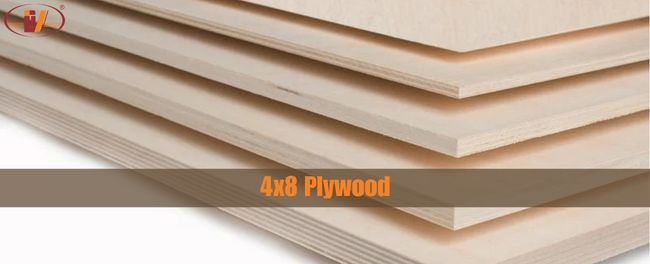
A standard 4×8 plywood sheet is 4 feet by 8 feet — 1220×2440 mm in metric — and covers 32 square feet. That footprint is the unit most yards, container plans, and cut lists still start from. Thickness is a separate choice: the same length and width show up from about 1/8 inch through 3/4 inch and beyond.
Pick the sheet size first when you are counting panels on a truck or stuffing a container. Pick thickness second, once the span, finish, or form pressure is clear. Getting those two out of order is how programmes end up with the right area and the wrong stiffness.
Actual size of 4×8 plywood
Length and width on a 4×8 panel are usually the true dimensions. Thickness is the field that drifts: North American stock sells under nominal fractions while the caliper reads thinner. Larger sheets (4×10, 4×12) exist for long runs, but 4×8 remains the default because it fits standard frames, lifts, and storage racks.
Related thickness guides on this site: 1/2 plywood, 5/8 plywood, 1/4 plywood.
How much does a 4×8 sheet weigh?
Weight tracks thickness and species more than the 4×8 outline itself. A 3/4-inch softwood sheet often lands near 60–70 lb. Hardwood cores push heavier. Thin interior panels can sit well under that band.
A rough check uses area × thickness × density. With 32 sq ft, 0.75 in thickness, and about 35 lb per cubic foot as a mid softwood figure, you get a planning weight in the same 60–70 lb neighbourhood after unit conversion. Treat that as a lift estimate, not a certificate. Coatings, moisture, and core mix all move the scale.
For forming or exterior programmes, also see MDO plywood and HDO plywood when the face system matters as much as the sheet size.
8×4 plywood in metric
Buyers who write 8×4 usually mean the same rectangle rotated: 2440×1220 mm. Container and mill paperwork in Vietnam almost always list millimeters. If your PO mixes feet and mm without a clear target, the packing list will invent one for you.
What does a 4×8 sheet cost?
Retail softwood panels can sit in a broad everyday band (often cited around $20–$60 per sheet depending on grade and market). Marine and furniture hardwood lots climb higher, sometimes past $100. Import film-faced and specialty overlays price on thickness, glue class, face grade, and freight week — not on the 4×8 label alone.
Ask the mill or yard for a dated quote on the exact grade. Region, certification pack, and ocean rates change faster than a static blog number can track.
Thickness options on 4×8 / 8×4 sheets
Export hardwood programmes commonly run 9 mm, 12 mm, and 18 mm on the 1220×2440 footprint. Those metric gauges map to the US thickness conversation without forcing a fraction on the RFQ. Face grade and glue class still decide whether the sheet belongs indoors, on a wall, or against wet concrete.
4×8 plywood in the Vinawood catalogue
Vinawood ships forming and construction panels on the 4×8 / 1220×2440 format across film-faced and overlay lines. Examples include MDO ECO 1SF Panel with backer, KS Concrete Panel Standard, KS Concrete Panel Eco, KS Tego Premium Film Faced Plywood, KS Tego Standard Film Faced Plywood, and Top Form Plus. Related 4×8 forming SKUs include P-Form 2S Formply, MDO 1SF Panel with Film backer (high density), and HDO Standard HD 1SF Formply.
When you RFQ, list length × width × thickness in millimeters, face type (film, MDO, HDO), glue class, and destination certs. That package is clearer than “one 4×8” with no other fields.
About Vinawood
Vinawood is a Vietnamese plywood manufacturer established in 1992. The mill ships more than 5,000 containers a year to 55+ export countries, with film-faced and formwork panels built on a documented process and sheet inspection. Core certifications include ISO 9001, FSC-COC, PEFC, EN 13986 CE marking, and EPA TSCA Title VI for US-bound orders. Wood is plantation-grown. For sheet-size and thickness programmes, request a quote.
Category
guides