Concrete Efflorescence: What the White Residue Means and How to Handle It
Efflorescence is the white residue that soluble salts leave on concrete when moisture carries them to the surface and evaporates. It is a moisture, mix and curing question, not a plywood defect. Here is what it means, whether it signals a real problem, how to remove it, and how to prevent it.
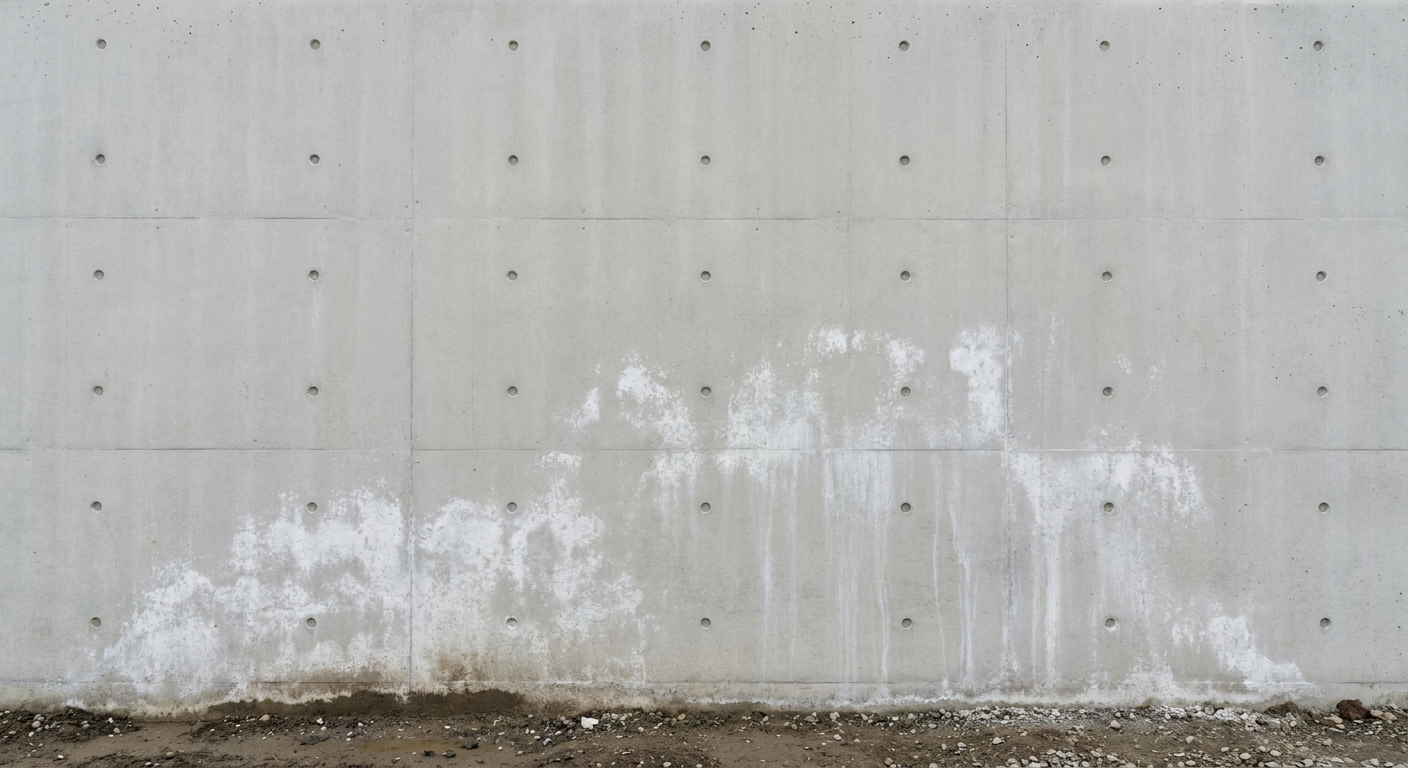
The white bloom on fresh concrete looks like damage. It is closer to the opposite. That chalky film is salt leaving the concrete, carried to the surface by evaporating water and left behind as a deposit once the water is gone. On most new pours it is a sign the slab is drying the way it should, not a sign it is failing. Efflorescence is one of the most common things to show up on cement-based surfaces, and one of the most misread.
From a panel manufacturer's seat, the honest version matters here. Efflorescence is a moisture-and-salt story tied to the concrete mix, the curing conditions, and what the surface is exposed to. It is not a property of the form face that shaped the pour. The form face governs surface texture and imprint. It does not govern the salt chemistry inside the concrete. Below is what efflorescence actually is, whether it signals a real problem, how to remove it, and how to keep it from coming back.
What efflorescence is
Efflorescence is a fine white or off-white powdery deposit, sometimes crystalline, that forms on the surface of concrete, brick, mortar, and other cement-based materials. The mechanism is straightforward. Cement hydration and the original mix water leave soluble salts inside the hardened concrete, mainly calcium hydroxide. When water moves through the concrete, it dissolves those salts and carries them toward the surface. At the surface the water evaporates and the salts are left behind. The calcium hydroxide then reacts with carbon dioxide in the air to form calcium carbonate, an insoluble white crust that no longer washes off as easily as it arrived.
Three things have to be present for it to happen: soluble salts in the material, water to dissolve and move them, and a path to a surface where the water can evaporate. Remove any one of the three and efflorescence stops. That is the whole picture, and it is why the fix is always about controlling moisture and salts rather than changing the panel that formed the concrete.
Primary and secondary efflorescence
| Type | When it appears | Where the salts and water come from | Treatment approach |
|---|---|---|---|
| Primary efflorescence | Early, often within the first days of cure | Salts and mix water already inside the fresh concrete, brought out as it dries | Usually self-limiting; let it run its course, then clean. Do not seal until it stops. |
| Secondary efflorescence | Later, weeks to years after cure | External moisture entering the hardened concrete, then evaporating at the face | Find and stop the moisture source first, then clean. May recur if the source remains. |
Primary efflorescence is the one most people see on new concrete. It tends to taper off on its own once the initial mix water has worked its way out. Secondary efflorescence is the one worth paying attention to, because it means water is still getting into the concrete from somewhere and bringing salts with it each time. The deposit is the symptom. The moisture path is the thing to chase.
It is worth separating efflorescence from concrete dusting, which people sometimes lump together because both are pale and powdery. Dusting is a loose, free-lime powder that comes off a weak or poorly finished slab surface when you rub it. Efflorescence is a crystalline salt deposit left by evaporating water. Different cause, different fix.
Usually cosmetic, not structural
On most slabs and walls, efflorescence is a surface deposit and nothing more. It sits within normal expectations for cement-based materials and does not mean the concrete is weak, under-strength, or failing. A driveway, a retaining wall, or a basement slab can show a white bloom in its first season and be entirely sound underneath. The deposit is salts that came out of solution, not concrete that came apart.
The point where it is worth a closer look is when efflorescence is persistent or recurring on a wall or a below-grade surface. There it may indicate ongoing moisture intrusion that is worth checking on its own terms, not because the white residue is dangerous, but because the water moving through the concrete is the thing that keeps feeding it. Recurrence is a moisture signal. A one-off bloom on new concrete usually is not.
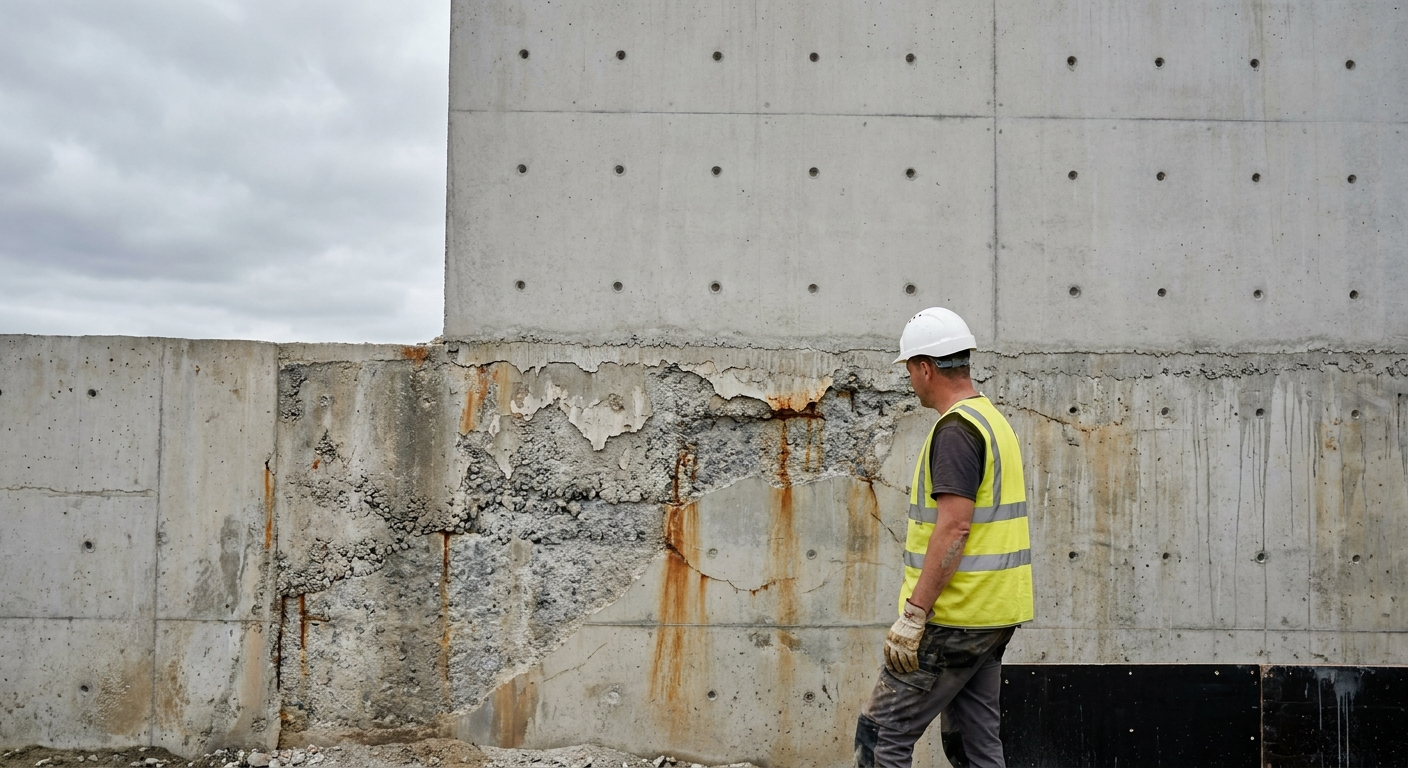
This is the same honest line we draw on other as-cast and post-cure surface questions. Concrete spalling, for example, is a genuine durability mechanism driven by corrosion and freeze-thaw, while bug holes are surface air voids from the pour. Efflorescence belongs to the cosmetic end of that family far more often than the structural end.
The real drivers, in order
If you want to know why a particular surface is blooming, the causes line up by how much they contribute, and every one of them sits with the concrete and the site rather than the form panel.
- Water-cement ratio and bleed water. A wet mix with a high water-cement ratio carries more dissolved salt to the surface and gives bleed water more to move. Excess water is the single biggest lever.
- Subgrade and ground moisture. A slab cast on damp ground with no vapor barrier, or a poor one, draws moisture up from below for months. That rising water is a continuous salt delivery system.
- De-icing salts and groundwater. Chlorides from road salt, or salts carried in groundwater against a foundation wall, add to the soluble load already in the concrete and feed secondary efflorescence.
- Salts in the aggregate or mix water. If the sand, aggregate, or mixing water carried soluble salts to begin with, the concrete starts life with more to give up.
- Curing conditions. Cool, humid, slow-drying conditions let water linger and migrate, which tends to bring more salt to the face than a warm, even cure would.
Read that list and the pattern is plain. Efflorescence is decided by the mix, the ground, the exposure, and the cure. None of those is the plywood that shaped the pour.
Where the form face does and does not matter
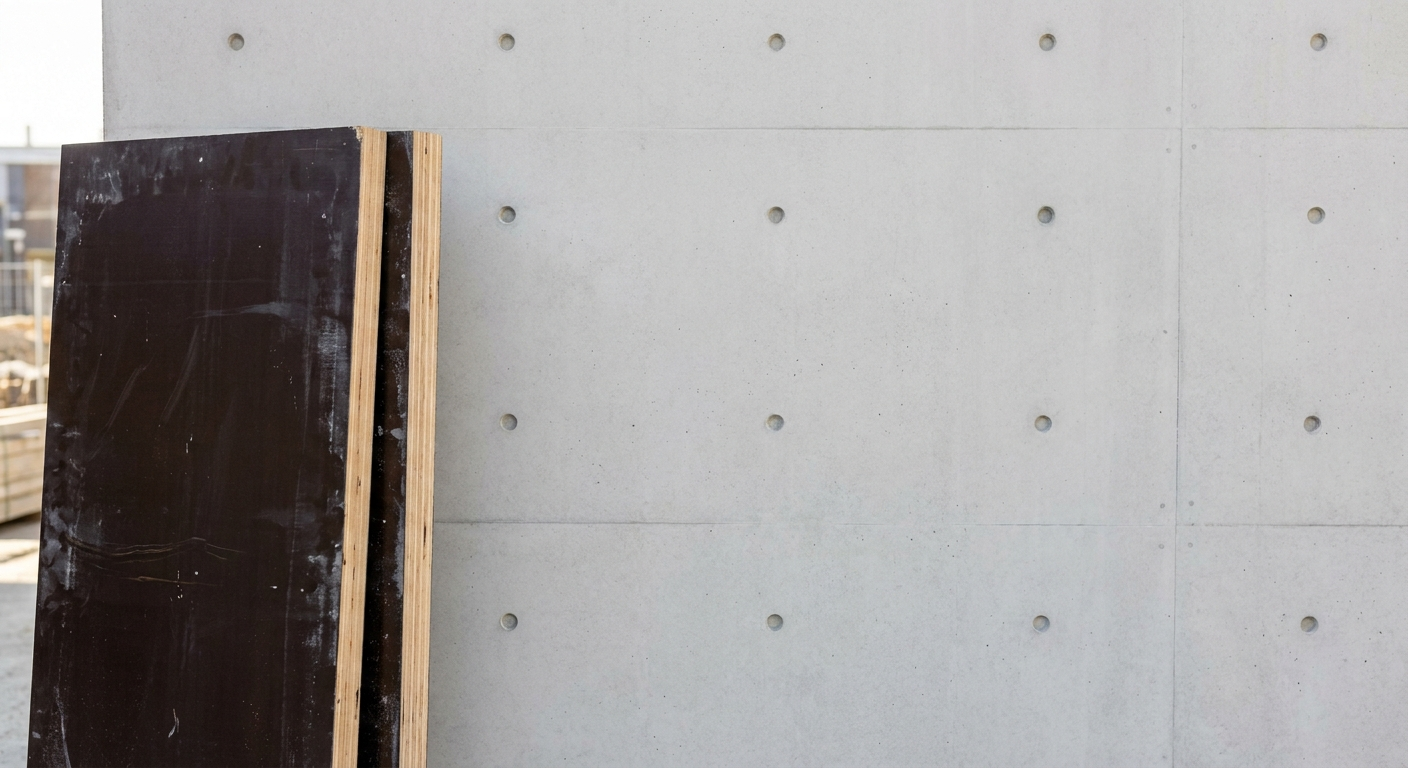
This is where a plywood maker should be precise rather than promotional. The form face controls the texture and imprint of the concrete surface. It decides whether the finish is smooth and closed or open and absorbent. It does not control the salt chemistry inside the concrete, and it cannot stop water that is migrating through the slab from below or from the side.
There is a narrow, honest connection. A non-absorbent phenolic film face gives a denser, more uniform, less absorbent concrete surface than a raw or absorbent form would. A tighter surface holds less free water at the face and can influence how early efflorescence shows and how evenly it sits. That is a texture-and-uniformity effect, not a chemistry one. We are clear about the limit: a good form face can present a better surface to start with, but efflorescence is governed by the moisture and the salts in the concrete, and no panel prevents it on its own. Anyone told that the right plywood stops efflorescence has been sold a story the material cannot back up.
When to investigate further
Most efflorescence needs cleaning, not investigation. The cases that deserve a second look share a pattern: the bloom keeps coming back after you clean it, or it shows up on a wall or a below-grade surface that is in contact with ground moisture. Recurring efflorescence on a basement wall or a retaining wall may indicate that water is still entering the concrete and evaporating at the face, which points at drainage, a missing or failed vapor barrier, or an unsealed surface rather than at the concrete itself.
Before assuming the worst, check the simple things first. How was the slab stored and exposed before and after the pour? Is there standing water or poor drainage feeding the wall? Is there a vapor barrier under the slab? The moisture conditions usually explain the deposit, and fixing the water fixes the white.
How to remove it
Removing efflorescence is usually simple, and the guiding rule is to use as little water as possible, because water is what brought the salts out in the first place. Adding more can pull a fresh round to the surface.
- Dry brushing. For light, recent deposits, a stiff dry brush or broom often takes most of it off. This is the first thing to try and frequently the only thing needed.
- Light water rinse or low-pressure wash. Where brushing is not enough, a light rinse followed by drying can lift more. Keep the water to a minimum and let the surface dry fully afterward.
- Proprietary efflorescence removers. Heavier or older calcium-carbonate crusts that have set can be dissolved with a mild-acid efflorescence cleaner made for the job. Follow the product directions, test a small area first, and neutralize and rinse as instructed.
- Let primary efflorescence run its course. On new concrete, do not chase every early bloom or rush to seal. Let the primary phase finish, clean once it has stopped, and only then consider a sealer.
We have seen in our own customers' field reports that the surfaces giving the most trouble are almost always the ones with an active moisture source feeding them. Clean the deposit, but find the water, or you will be cleaning it again.
How to prevent it
Prevention is moisture and mix control, set before and during the pour rather than at the form face.
- Control the water-cement ratio. A lower, well-managed water content puts less dissolved salt in motion and reduces bleed. This is the front-line defence.
- Cure properly. A controlled, even cure limits the slow migration that carries salts to the surface.
- Install a vapor barrier under slabs. A sound vapor barrier on prepared subgrade stops ground moisture from rising through the slab and feeding secondary efflorescence for years.
- Seal once the concrete is dry. A penetrating sealer applied after the surface has dried and any primary efflorescence has finished slows water entry and helps keep salts from reaching the face. Sealing too early traps moisture and can make matters worse.
- Use quality formwork that limits grout loss. Tight, well-jointed forms with a sound face reduce grout loss and surface moisture variation, which gives a more uniform surface to start from.
About Vinawood
Vinawood is a Vietnamese plywood manufacturer established in 1992, with more than 30 years of continuous production and exports to 55+ countries at over 5,000 containers a year. Every panel passes 100% individual sheet inspection across a 12-step manufacturing process, and the formwork range carries CE marking to EN 13986 for Europe and EPA TSCA Title VI / CARB P2 compliance for the United States. A sound form face does not control the salt chemistry that produces efflorescence, but it gives a pour a dense, uniform surface to start from. For finish-critical, repeat-use forming, Pro Form is a WBP phenolic panel to EN 636-3 rated up to 20 reuse cycles, and the wider film-faced plywood range covers lighter-duty work. Request a quote with your panel sizes, finish requirements, and project volume.
Category
guides
Related Markets
Related Countries
Related Products
▶Sources & References (2)
- Efflorescence: Causes and Control — Portland Cement Association (2018)
- Removing Stains and Cleaning Concrete Surfaces (IS214) — Portland Cement Association (2006)