Concrete Spalling: What Causes It, How to Repair It, and How to Prevent It
Concrete spalling is surface concrete flaking or breaking away, exposing aggregate or rebar. It is a post-cure durability mechanism driven by rebar corrosion, freeze-thaw, fire and low cover. Here are the real causes, how to repair it, how to prevent it, and the narrow role forming honestly plays.
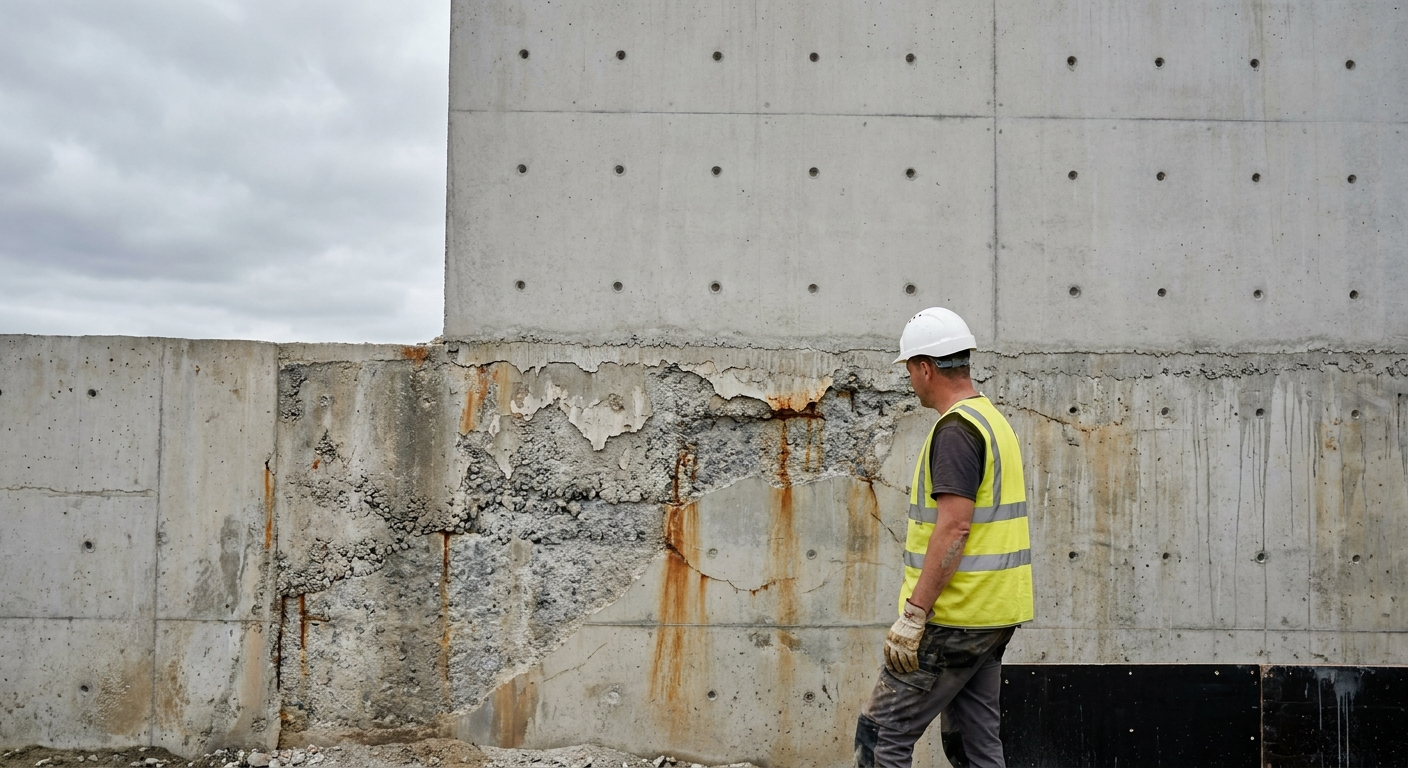
The flake of concrete lying on the ground is the last thing to happen, not the first. By the time a piece of a parking-deck soffit or a balcony edge lets go, the real event, corrosion of the steel a couple of centimetres inside, has been running for years. That is the part people get backwards about spalling. The surface coming apart is the symptom. The cause is out of sight, and it is almost always older than the damage you can see.
From a formwork panel maker's seat, the honest version is short: spalling is a post-cure durability problem, not a forming one. It shows up months or years after the pour, driven by what soaks into the concrete and what the steel inside it does over time. The form face has a narrow, front-end role, and we get to it. But anyone told that the right plywood prevents spalling has been sold a story. Here is what actually causes it, how serious it is, how to repair it, and how to keep it from happening.
What concrete spalling is
Spalling is a loss of surface concrete: pieces break off, leaving a rough, irregular depression with aggregate showing and sometimes rust-stained steel visible at the bottom. It is a fracture and detachment process. Something inside the concrete expands or the bond near the surface fails, and the cover concrete pops off. The give-away features are exposed aggregate, a stepped or conchoidal break edge, and in reinforced members a band of damage that follows the line of the rebar below.
Spalling vs scaling vs other surface conditions
Spalling gets confused with scaling constantly, and the two call for different fixes. Name what you are actually looking at before you decide anything.
| Surface condition | What it looks like | Typical depth | Root cause |
|---|---|---|---|
| Spalling | Concrete flakes or breaks away in fragments, exposing aggregate or rebar | Deep — into the cover, sometimes to the steel | Rebar corrosion, freeze-thaw, fire, low cover, ASR, impact |
| Scaling | Shallow loss of the surface mortar, leaving a pitted, peeling top layer | Shallow — surface mortar only, usually 3 mm (1/8 in) or less to start | Freeze-thaw on a weak or over-finished surface, de-icing salts |
| Honeycomb | Rough, stony patches with exposed coarse aggregate and open gaps | Present from the start, at strip | Poor compaction, segregation, grout loss at form joints |
| Bug holes | Small rounded surface craters, usually under 15 mm (5/8 in) | Surface only | Entrapped air and bleed water against the form face |
| Cracking | Linear splits, hairline to structural | Varies | Shrinkage, loading, settlement, the early stage of corrosion damage |
The line that matters most: spalling and scaling both involve surface loss, but scaling is shallow mortar loss while spalling goes deeper into the cover and is often driven by something underneath pushing out. Honeycomb and bug holes, by contrast, are as-cast conditions that are already there when the form comes off. Our guides to honeycomb in concrete and bug holes in concrete cover those two in full. Spalling is the one that develops later.
The main causes
Spalling has a short list of well-understood causes, and they sit with exposure, design, and the environment far more than with construction practice. None of them is the form panel.
- Rebar corrosion. The most common cause in reinforced concrete. As steel corrodes it expands to several times its original volume, and that expansion pushes the cover concrete off from the inside. Corrosion is triggered when the protective alkalinity around the steel breaks down, usually through carbonation (atmospheric CO2 reacting into the concrete over years) or chloride ingress from de-icing salts or marine exposure.
- Freeze-thaw cycling. Water held in the pore structure expands about 9% when it freezes. Repeated freeze-thaw cycles fatigue the surface and break it apart, especially where the concrete was not air-entrained or where it stays saturated.
- De-icing salts. Chlorides drive both freeze-thaw scaling and rebar corrosion. Parking decks, bridge decks and salted driveways take the worst of it.
- Insufficient concrete cover. When the cover over the reinforcement is too thin, carbonation and chlorides reach the steel sooner and corrosion starts earlier. Cover is the clock on durability.
- Fire and heat. High temperature turns pore water to vapour faster than it can escape, and the internal pressure blows pieces off the surface. Explosive spalling in a fire is a distinct, rapid mechanism, separate from the slow corrosion story.
- Alkali-silica reaction (ASR). Reactive aggregate reacts with the pore solution to form an expansive gel that cracks and disrupts the concrete from within over years.
- Impact and mechanical damage. A hard knock to an edge or corner simply breaks concrete off. This one is mechanical, not chemical.
Look at that list and the pattern is clear. Spalling is an exposure-and-time problem: what gets into the concrete, what the steel does, and how cold, wet, or salty the environment is. Construction sets the stage through cover and mix quality, but the spall itself shows up long after the forms are gone.
Why it matters: cosmetic vs structural
Not all spalling carries the same weight. A flaking patch on a residential driveway is mostly a cosmetic and trip-hazard issue. Spalling on a parking deck, a balcony soffit, a bridge, or a building facade is a different conversation, because it usually signals active rebar corrosion that reduces the steel section and the load path, and because falling fragments are a safety hazard to people below.
The sensible response is to assess depth, location and cause before acting. Surface spalling on a non-structural slab is a repair. Spalling that exposes corroding rebar on a suspended deck, a balcony, or a column is an engineering question, and it should go to a qualified structural engineer rather than be judged from the ground. Balconies and parking structures in particular have a poor failure history, so err toward getting them assessed.
Signs and early warning
Spalling rarely arrives without notice. The early signals, in rough order of escalation:
- Rust staining bleeding through the surface, a sign the steel below has started to corrode.
- Fine cracks running in straight lines that follow the rebar layout beneath, where expanding corrosion product is splitting the cover.
- Hollow or drummy sounds when the surface is tapped, indicating the cover has debonded but not yet fallen.
- Delamination, where a layer of cover is detached over an area and ready to spall.
Catching it at the rust-stain or drummy-sound stage is far cheaper than waiting for the cover to fall. A drummy parking-deck soffit is a referral, not a wait-and-see.
Where forming practice fits
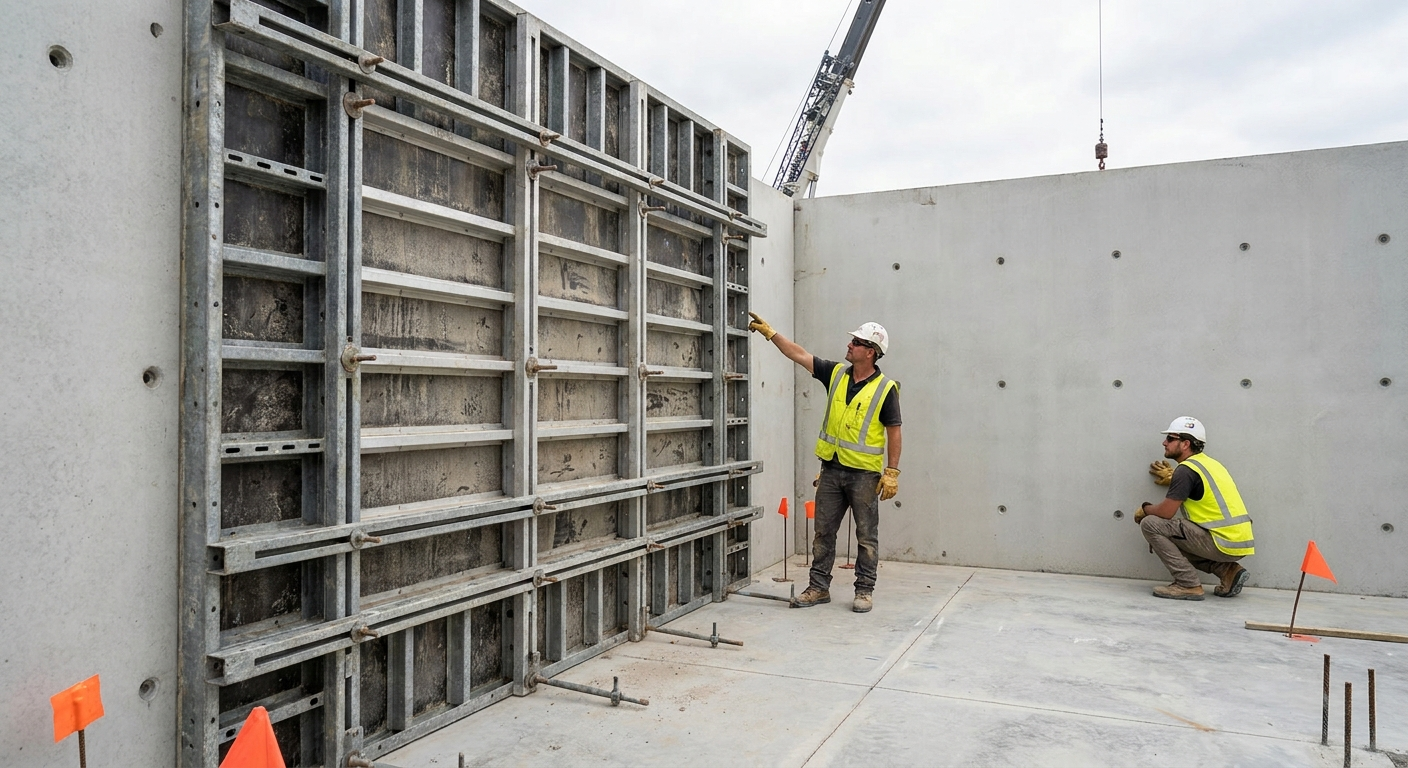
Formwork's connection to spalling is real but narrow, and it is entirely at the front end. Two things the forming stage controls have a genuine, if limited, influence on later durability.
The first is concrete cover. The geometry of the formwork and the placement of the reinforcement together set how much cover sits over the steel. Adequate, consistent cover is the single biggest design defence against corrosion-driven spalling, because it lengthens the time before carbonation and chlorides reach the steel. Forming and rebar fixing are where that cover is established or lost.
The second is early-age edge and corner protection. Striking forms too early or carelessly can chip green concrete at arrises and edges, and a damaged edge is a weak point that weather and salt exploit later. Clean, on-time striking with wedges rather than bars protects those edges. Our guide to formwork removal time covers when and how to strike without damaging the concrete.
From a Vietnamese mill's seat, this is where we have to be careful not to overclaim. A form panel can present a sound, dense surface and help the crew place and strike cleanly, but it does not control the mix, the cover depth, the air entrainment, or the exposure the structure will face for decades. We have seen this in our own customers' field reports: where spalling shows up, the trail leads to cover, salt, freeze-thaw or age, not to the sheet that shaped the pour. The panel relates to surface quality and clean striking. It does not prevent spalling, and no honest manufacturer should say it does.
How to repair spalling
Surface spalling repair follows a established sequence, and the steel is the part that decides whether a patch will last.
- Assess and mark the extent. Sound the area to find all the delaminated concrete, not just the visible spall, and mark the full repair zone.
- Break back to sound concrete. Remove the loose and weak material down to a solid substrate, and cut behind the rebar where steel is corroding so the new material can fully encase it.
- Treat the reinforcement. Clean the exposed steel back to bright metal, remove the corrosion product, and apply a corrosion-inhibiting or protective coating where specified. Skipping this step is why so many cosmetic patches fail within a couple of years: the corrosion underneath keeps going.
- Apply a bonding agent to the prepared substrate so the repair material grips.
- Place a repair mortar or micro-concrete, matched to the depth and the exposure, and consolidate it into the cavity and around the steel.
- Cure the repair properly so it gains strength and does not shrink away from the parent concrete.
For deep, extensive, or structural spalling, the repair moves beyond a patch into engineered concrete repair, possibly with supplementary reinforcement, cathodic protection, or a structural assessment of the member. The line between a cosmetic patch and a structural repair is exactly where a structural engineer should be brought in. Do not skim a thin mortar over spalling that exposes corroding steel and call it solved.
How to prevent it
Prevention is mostly a design-and-durability problem, decided before and during the pour rather than at the form face.
- Adequate cover. Specify and achieve the right cover for the exposure class. This is the primary defence against corrosion-driven spalling.
- Low water-cement ratio and good consolidation. A dense, low-permeability concrete resists the ingress of water, CO2 and chlorides that start the trouble.
- Air entrainment in any concrete exposed to freeze-thaw. The entrained air gives freezing water somewhere to expand, which is the proven defence against freeze-thaw scaling and spalling.
- Sealers and coatings on exposed flatwork and decks to slow water and chloride penetration, reapplied on a maintenance schedule.
- Drainage detailing so water is not held against the concrete. Standing water on a deck or a poorly drained balcony is a spalling factory.
- Clean, on-time striking to protect green edges and corners, per the forming role above.
Most of that list belongs to the concrete supplier, the designer, and the maintenance regime. The forming contractor owns the cover geometry and the clean strike.
Spalling in specific settings
Where spalling shows up tells you which cause to suspect first. On driveways and flatwork, the usual drivers are freeze-thaw and de-icing salt on a surface that may have been over-finished or under-air-entrained; this overlaps heavily with scaling. On parking structures and balconies, chloride-driven rebar corrosion in suspended slabs is the headline risk, and these are the cases most likely to be structural and safety-critical, so they belong with an engineer. On fire-exposed concrete, the spalling is the explosive, vapour-pressure kind, and the post-fire question is how deep the heat damage and strength loss went, which is an assessment job rather than a simple patch.
Spalling vs bug holes vs honeycomb
It is worth being explicit about the family these conditions belong to, because the fixes diverge. Spalling is a durability mechanism: the concrete was sound at strip and came apart later under corrosion, frost, fire or reaction. Bug holes are surface air voids trapped against the form face at the time of the pour. Honeycomb is a placement and segregation condition where the mortar never filled around the aggregate. Two of those three are visible the moment the form comes off; spalling is the one that develops over the service life. Reading the timeline alone tells you a lot: if the surface was clean at strip and degraded years later, you are looking at a durability problem, and the answer is exposure, cover and maintenance, not a different panel.
Sound forming for durable concrete
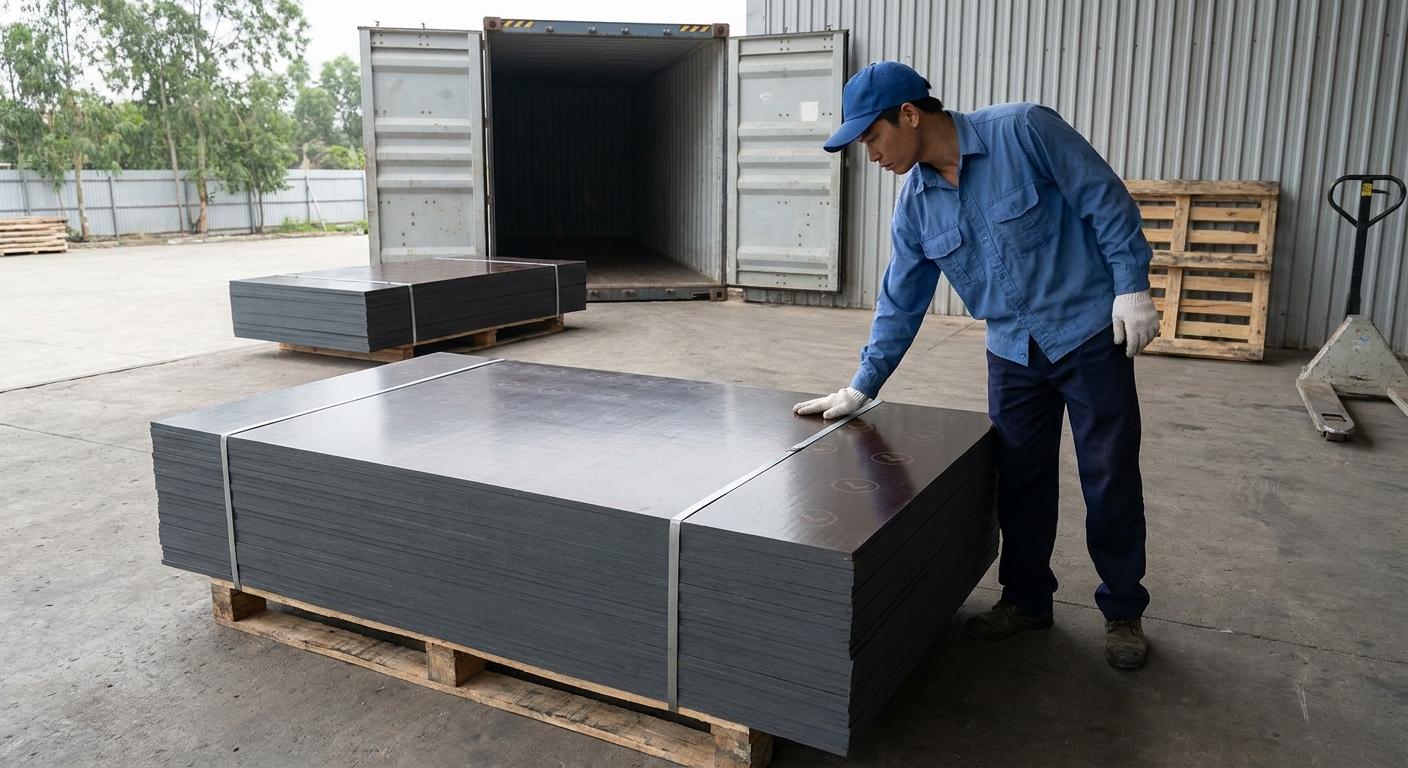
A durable concrete surface is mostly earned through mix design, cover, and exposure management over the structure's life, with the forming stage contributing a sound as-cast surface and clean, on-time striking that protects green edges. Film-faced plywood with an intact face presents a dense, closed casting surface and strips cleanly when struck on time; sealed edges and tight joints keep the as-cast surface sound. Vinawood manufactures film-faced and phenolic formwork plywood in Vietnam, with factory edge-sealing and 100% individual sheet inspection across the range. For finish-critical, repeat-use forming, Pro Form is a WBP phenolic panel to EN 636-3 rated up to 20 reuse cycles; the broader concrete form plywood guide covers how the grades compare. North American contractors working to imperial sizes can look at the HDO plywood range, where the high-density overlay holds a clean face across high-rotation pours. None of these prevents spalling, which is a durability outcome decided by cover, exposure and time. What good forming does is give the structure a sound, well-shaped surface to start its service life with. Request a quote with your panel sizes and project volume.
Category
guides
Related Markets
Related Countries
Related Products
▶Sources & References (2)
- Concrete Slab Surface Defects: Causes, Prevention, Repair (IS177) — Portland Cement Association (2001)
- Guide to Durable Concrete (ACI 201.2R) — American Concrete Institute (2016)