EUDR Compliance Guide for Plywood Importers (2026)
An importer's guide to the EU Deforestation Regulation in 2026: what due diligence requires, the 30 December 2026 and 30 June 2027 deadlines, Vietnam's low-risk benchmarking, and what a Vietnamese mill supplies for a due-diligence statement.
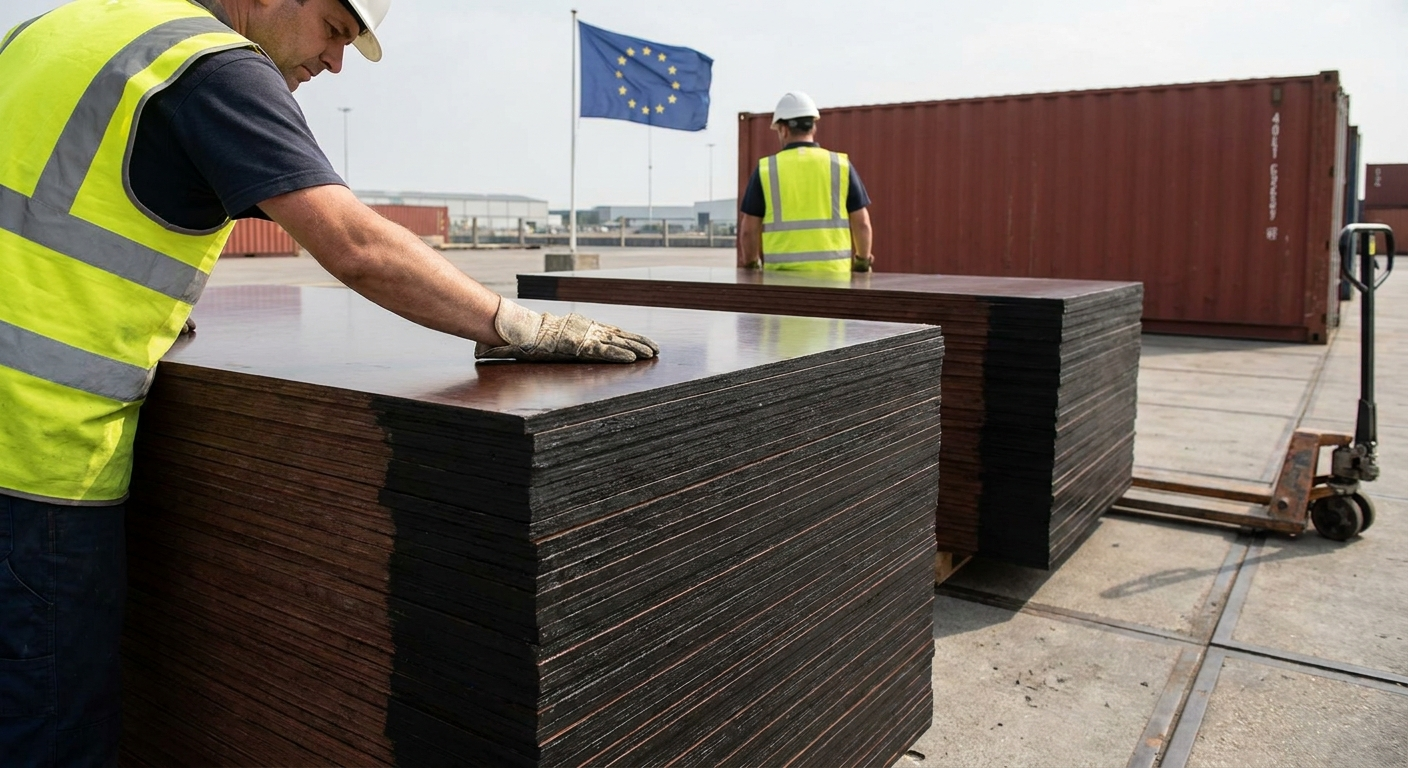
Most EU plywood buyers who call us about EUDR want the short version first. Deforestation-free wood. Legal harvest. A due-diligence statement on every consignment. Geolocation of the plots. That is the job under Regulation (EU) 2023/1115. The older Timber Regulation is gone. Application dates now sit in late 2026 and mid 2027 after postponement and a simplification package.
This is the importer-facing map. Not legal advice. The EU operator files. Counsel confirms your role.
The three-part diligence system
Collect the defined information. Judge deforestation risk against the 31 December 2020 cutoff. Mitigate anything that is not already negligible before the product hits the market.
- Product, quantity, species, country/region, and plot geolocation
- Risk view: conversion from natural forest after the cutoff?
- Mitigation until residual risk is negligible
Geolocation is the new hard field. Polygon for plots of 4 ha or more. Point for smaller ones. Cutoff does not move when timelines slip. Plantation that existed before 31 December 2020 can be harvested and replanted and stay in scope.
When it bites
Large and medium operators: 30 December 2026. Micro and small: 30 June 2027 with a lighter one-off declaration.
The May 2026 simplification package cut paperwork — Brussels floated roughly 75% annual compliance-cost relief for in-scope firms — and locked who files: only the business first placing product on the EU market. Downstream traders can reference an existing DDS number. That 75% is paperwork. It is not permission to skip geolocation or a documented risk view.
Vietnam's low-risk band
Implementing Regulation (EU) 2025/1093 (22 May 2025) put Vietnam in the lowest risk band. High risk: Belarus, Myanmar, North Korea, Russia.
Article 13 simplified route: collect information, file the DDS, skip full risk assessment and mitigation. Authorities sample fewer low-risk operators (1% vs 3% standard vs 9% high).
| Risk band | Due diligence | Min checks / year |
|---|---|---|
| Low | Simplified — collect and file | 1% |
| Standard | Full | 3% |
| High | Full + enhanced scrutiny | 9% |
I still say this on every first call: low-risk is a country badge, not a container blessing. Vietnam processes imported raw material too. Trace your wood to legal plots.
Operator files; mill supplies
EU operator → TRACES statement and legal liability. Vietnamese mill → evidence pack only. Origin dossiers, land docs, commercial trail, coordinates, cert claims.
Pack ≠ DDS. Clean pack speeds filing. Map: plantation evidence pack. Our transfer path: how Vinawood prepares EUDR evidence.
Mill data points
| Field | Mill supplies |
|---|---|
| Geolocation | Polygon or point per harvest plot |
| Species | Acacia mangium, Eucalyptus urophylla, Hevea brasiliensis, etc. |
| Quantity | Volume/mass + HS |
| Origin | Vietnam, province |
| Legality | Harvest/transport, land-use rights, VNTLAS |
Four rows are routine. Smallholder geolocation is the bottleneck. Legal depth: supplier evidence guide.
Head start — and the real bottleneck
Plantation acacia, eucalyptus, hevea, styrax on short rotations, on land planted before 2020. FSC/PEFC CoC does most of the traceability homework.
One container can pool veneer from dozens of family plots. That mapping bill did not shrink with the December 2025 postponement — it moved into 2027. Provincial plantation datasets targeted for end-2026 are what make aggregation boring again.
Ask for this at quotation
- Plot coordinates tied to the consignment
- Land-use rights or commune attestation
- VNTLAS harvest and transport records
- FSC/PEFC CoC for certified volume
- Species + province per batch
- Commercial trail at each custody hop
Then: map supply chains now, register in TRACES, keep records five years. Certifications context: Vietnam certifications guide, certifications page.
Frequently Asked Questions
When does EUDR apply?
30 December 2026 for large/medium; 30 June 2027 for micro/small. Cutoff fixed at 31 December 2020.
Is Vietnam low-risk?
Yes. Simplified diligence still needs information collection and a filed statement.
Who files?
EU operator in TRACES. Mill supplies the dataset. No geolocation, no EU sale support from that mill.
Can the cutoff move?
No.
Is FSC enough alone?
No. Helpful trail, still missing EUDR-specific plot geolocation and risk view.
Category
how-to
▶Sources & References (5)
- Regulation (EU) 2023/1115 (EUDR) — full text — EUR-Lex (European Union) (2023-06-09)
- Country benchmarking — Implementing Regulation (EU) 2025/1093 — European Commission (2025-05-22)
- Deforestation law: Parliament adopts changes to postpone and simplify measures — European Parliament (2025-12-11)
- Circular 26/2022/TT-BNNPTNT — management and traceability of forest products — LuatVietnam (2022)
- Vietnam issues Decree 102/2020/ND-CP regulating the Timber Legality Assurance System (VNTLAS) — USDA FAS (2020)