PPWR 2026 for EU Plywood Importers: What It Means for Inbound Shipments
From 12 August 2026, EU plywood importers must verify shipment-packaging conformity and DoC/TD under PPWR Article 18. Product panels stay outside packaging rules.

EU plywood buyers already spend real time on timber due diligence. From 12 August 2026, another file sits next to that work: packaging conformity under the Packaging and Packaging Waste Regulation (PPWR), Regulation (EU) 2025/40. The rule entered into force on 11 February 2025. The date that matters for most operator duties is the August 2026 application date.
PPWR is not a second name for the EU Deforestation Regulation (EUDR). EUDR asks whether the wood is deforestation-free and legally produced. PPWR asks whether the shipment packaging that wraps and unitises those panels meets sustainability and labelling rules, and whether the importer has checked the manufacturer's conformity path before placing that packaging on the EU market.
This article is a practical readout for EU importers of construction and formwork plywood. It is not legal advice. Member State enforcement practice and later Commission implementing acts can still refine details. Read the Regulation text and Commission guidance before you build a filing playbook. For a longer educational explainer on definitions and operator roles (no mill product pages), see the Vietnam Plywood atlas guide EU PPWR packaging compliance for Vietnam plywood and EU importers.
Key dates you should pin on the wall
Three dates show up in almost every PPWR conversation with EU plywood buyers. Pin them. Only one is the operational hook for this article.
| Milestone | Date | Why it matters for importers |
|---|---|---|
| Entry into force | 11 February 2025 | Regulation (EU) 2025/40 is live in the Official Journal path. |
| General application | 12 August 2026 | Importer duties on packaging placed on the market, including conformity checks and DoC/TD pathways, apply. |
| Later waves (context) | From 2030 onward | Recyclability grades, recycled-content targets and empty-space rules phase in later. Do not bury the August 2026 hook under those waves. |
Harmonised labelling details can still move with implementing acts. Confirm labelling timelines against the Official Journal text and Commission notices before you print new artwork. The August 2026 application date is the one to plan procurement and RFQ questions around now.
Plywood panels are products. PPWR hits the packaging around them
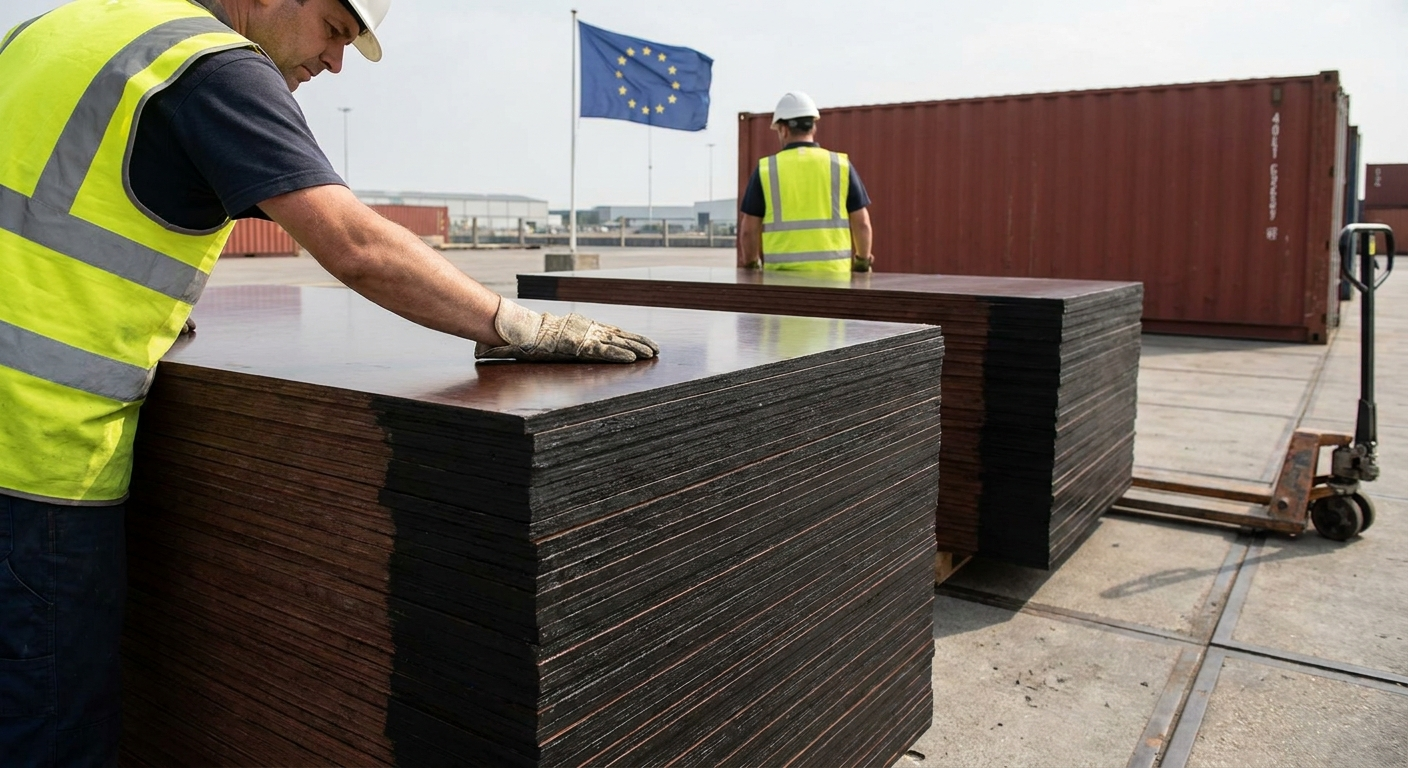
Formwork and construction plywood sheets are products. They do not need a PPWR Declaration of Conformity (DoC) as packaging. That distinction trips people up, so say it plainly once.
PPWR covers packaging and packaging waste. Under Article 3, packaging is an item meant for containment, protection, handling, delivery or presentation of products. Transport packaging helps move sales units or groupings and prevent damage. Road, rail, ship and air freight containers themselves sit outside that definition.
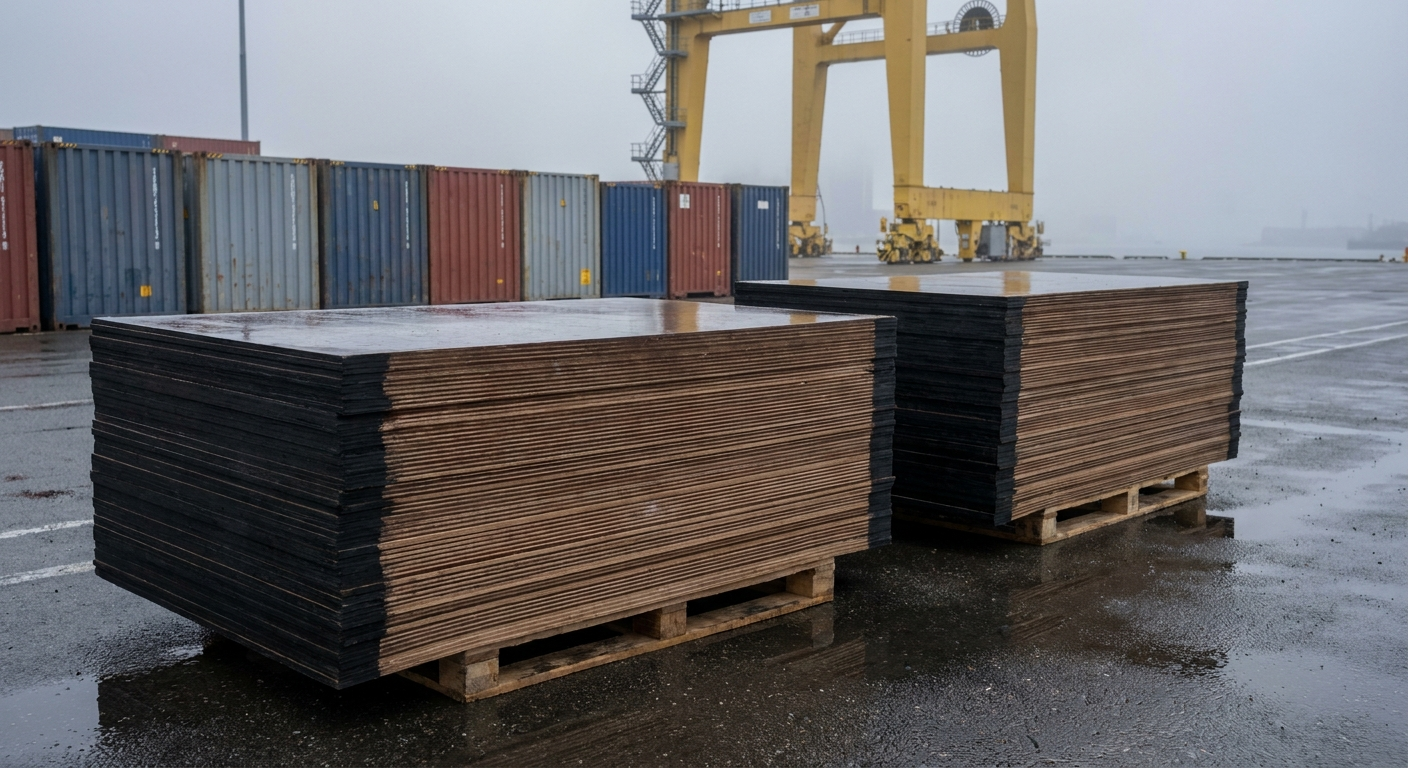
For a typical inbound plywood unit, the items that often meet the packaging definition include wrapping films, strapping or banding, edge protectors, and pallets or crates where they function as packaging. An item that is an integral part of the product, needed for its whole life, and meant to be used or disposed of with the product, is generally not packaging. Assess each format against Article 3 and Commission guidance. An Annex I listing alone is not enough.
CE marking on a construction panel, or any product DoC you already keep for EN 13986, does not prove PPWR packaging conformity. Separate evidence lanes. Same container. Different questions.
Who does what on a Vietnam-to-EU plywood shipment
Several parties can touch packaging on the way to an EU dock. Roles matter. The Regulation assigns different duties.
The manufacturer of packaging (Article 15) runs the conformity assessment for that packaging, draws up technical documentation, and issues the EU DoC. A packaging materials supplier can sit under Article 16. The importer (Article 18) is the EU business that places packaging on the market. That is usually where inbound plywood importers land for the wraps and unitising materials that arrive with the panels.
Authorised representatives and distributors have their own chapters. Fulfilment service providers appear in the operator map too. For most plywood RFQs, the practical question is still: who manufactured each packaging format on this unit, and who is the EU importer placing that packaging on the market?
Article 21 is the own-brand trap. If an importer places packaging under its own name or trademark, or modifies packaging in a way that could affect compliance, the Regulation treats that importer as a manufacturer. Then Article 15 duties apply. Do not assume the overseas mill is always the packaging manufacturer for every wrap or pallet on the unit. Who manufactured each packaging format is a fact-specific call.
DoC, Annex VII technical documentation, and Module A in plain language
Conformity assessment for packaging under PPWR uses Module A — internal production control (Article 38). The manufacturer prepares technical documentation (TD) against the applicable sustainability requirements in Articles 5–12. That TD follows the structure in Annex VII.
The manufacturer then draws up a written EU Declaration of Conformity to the model in Annex VIII (Article 39). Keep both the TD and the DoC available for the retention clock: 5 years for single-use packaging and 10 years for reusable packaging, counted from the date the packaging is placed on the market.
Market surveillance can ask for the papers. In the pathways set out for manufacturers, importers and authorised representatives, the relevant documents are typically expected within about 10 days of a reasoned request. Build your response ownership before that email lands.
What goes into the TD is evidence that the packaging meets the applicable Articles 5–12 requirements for that format. Exact evidence depends on the packaging type and which requirements apply. Do not invent recycled-content percentages or reuse rates to fill a template. Collect what the packaging manufacturer can actually support.
Industry toolkits such as the EUROPEN PPWR Conformity Assessment Toolkit can help structure a DoC and TD file. They are navigation aids. They are not legally binding. Final interpretation sits with the Court of Justice and national enforcement, with Commission guidance and FAQs alongside.
What Article 18 expects from the importer
Before placing packaging on the market, Article 18 requires the importer to ensure, among other points, that:
- the manufacturer has carried out the Article 38 conformity assessment and drawn up the Annex VII technical documentation required under Articles 5–11;
- the packaging is labelled in line with Article 12;
- the packaging is accompanied by the required documents;
- the manufacturer has met Article 15(5) and (6) on identification and contact-type markings.
Importers should only place conforming packaging. Non-conforming packaging stays off the market until it is brought into conformity. The importer's name, trade name or trademark and postal address (plus electronic means where available) must appear on the packaging, or via a digital data carrier or accompanying document when marking on the packaging is not possible.
Keep a copy of the EU DoC available to market surveillance. Make sure the Annex VII TD can be produced on request, on the same 5-year / 10-year clocks. Act fast if you believe packaging is non-conforming. Bring it into conformity, withdraw it, or recall it. Cooperate with authorities on reasoned requests.
None of this replaces product-side files you already keep for construction plywood. It adds a packaging-side file. Buyers who treat PPWR as "already covered by CE" will miss the importer checks Article 18 actually lists.
A practical importer checklist for plywood inbound units
Use this as an operating list, not a counsel memo.
- Map packaging types on the unit. List the formats that travel with the plywood: wraps, straps, edge protectors, pallets or crates. Keep the categories general until you verify composition data with the actual supplier of each format.
- Confirm a DoC exists per packaging type or format, with a clear manufacturer identity on each declaration.
- Confirm the TD pathway. Who holds the Annex VII file? How fast can they produce it if an authority asks within roughly ten days?
- Check labelling and accompanying documents against Article 12 expectations, and manufacturer contact markings under Article 15(5) and (6).
- Assign retention and recall ownership. Name who keeps copies for 5 or 10 years, and who runs withdraw/recall if something fails.
- Flag own-brand or modified packaging. Private-label wraps or post-arrival changes that could affect compliance push you toward Article 21 manufacturer duties.
We would rather see a buyer open that list at RFQ stage than discover a missing DoC after the container clears customs. Packaging questions belong next to species, HS code and EUDR evidence on the same enquiry form.
If your warehouse re-wraps units after arrival, or applies your own brand marks to the packaging, revisit Article 21 before you treat the overseas DoC as enough. Modification that could affect compliance changes the role map.
How this sits beside EUDR (and REACH)
Timber due diligence and packaging conformity are parallel dossiers for the same shipment. Do not merge them into one checklist and hope.
For the wood-side regime, use the existing guides: the EUDR compliance guide for plywood importers (2026) and how Vinawood prepares EUDR evidence. Those pages cover DDS filing, plot geolocation and mill-side evidence packs. They do not answer PPWR packaging questions, and this page does not rewrite them.
Chemical restrictions on panels are another lane again. Film-faced formaldehyde rules under REACH Annex XVII sit in the REACH plywood film-faced EU compliance companion. Keep PPWR, EUDR and REACH as separate evidence folders even when one booking carries all three.
What Vinawood can support on packaging documentation
Vinawood is a Vietnam plywood manufacturer established in 1992. We ship roughly 5,000 containers a year to 40+ countries, including EU buyers of plantation-grown formwork and construction panels. Water-resistant / WBP glue systems are part of that catalogue language. Call panels water-resistant when that is what the glue class supports. Do not call them waterproof.
On PPWR, our commercial stance is simple. We are willing to align shipment-packaging documentation requests with what EU importers need under Article 18. That means identifying packaging formats on the unit, routing DoC/TD questions to the right packaging manufacturer or supplier in the chain, and keeping the conversation tied to a named shipment.
We do not invent film gauges, recycled-content percentages, pallet certificates, "PPWR-certified" badges, PFAS test claims, or signed DoC statements we have not verified. Who is the manufacturer of each packaging component can change by packing method and supplier. Ask early. We will answer with what we can document, not with marketing labels.
Prepare your August 2026 packaging file now
If you import Vinawood plywood into the EU and need to line up packaging DoC and Annex VII pathways before 12 August 2026, send the usual RFQ detail (destination, volume, named importer, and the packaging formats you expect on the unit) through the quotation form or contact.
Disclaimer: This article is informational only and is not legal advice. PPWR obligations depend on the Regulation text, Commission guidance and FAQs, your role in the supply chain, and national market surveillance practice. Implementing and delegated acts may still refine recyclability criteria, labelling pictograms and related methods. Verify against Regulation (EU) 2025/40 and current Commission materials before you rely on any checklist.
Category
how-to
▶Sources & References (6)
- Regulation (EU) 2025/40 — Packaging and Packaging Waste Regulation — EUR-Lex (2025-01-22)
- Packaging and packaging waste from 2026 (LEGISSUM) — EUR-Lex (2025)
- Commission Notice — Guidance document for Regulation (EU) 2025/40 — European Commission (2026)
- EUROPEN PPWR Conformity Assessment Toolkit (non-binding) — EUROPEN (2026)
- EUROPEN — Key obligations and features (Art. 15–21) — EUROPEN (2026)
- EU PPWR packaging compliance for Vietnam plywood and EU importers — Vietnam Plywood (atlas) (2026-09-02)