Why Certification Systems Are Your Competitive Infrastructure, Not Compliance Theater
Sustainability certifications (FSC COC, EUTR, EUDR, EPD) aren't paperwork. They're competitive infrastructure. Formwork companies entering regulated markets need suppliers with documentation systems built over decades, not certificates purchased last quarter. VINAWOOD's 30-year certification…
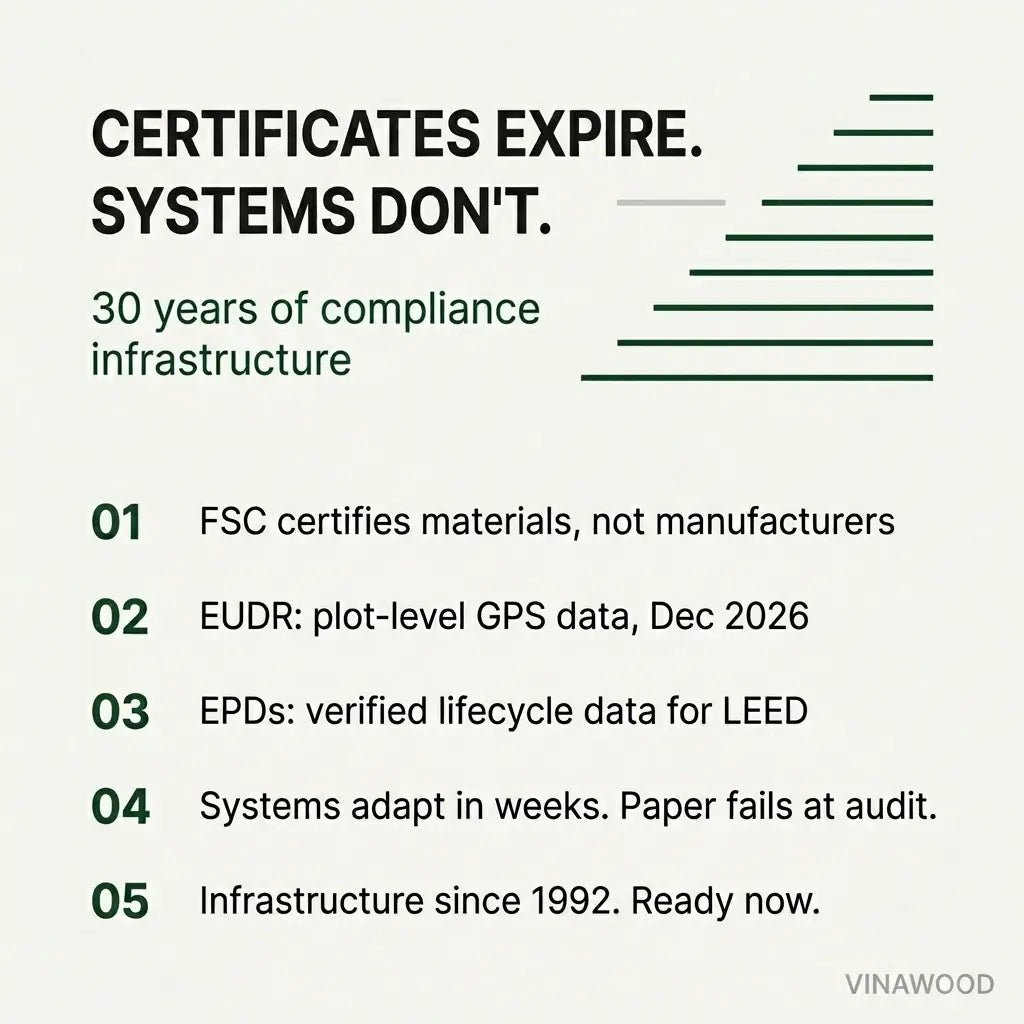
TL;DR: Sustainability certifications (FSC COC, EUTR, EUDR, EPD) aren't paperwork. They're competitive infrastructure. Formwork companies entering regulated markets need suppliers with documentation systems built over decades, not certificates purchased last quarter. VINAWOOD's 30-year certification infrastructure eliminates supply chain risk for LEED projects, European market entry, and deforestation compliance. With EUDR enforcement 9 months away for large operators, suppliers without systems are out of time.
Core Answer:
- FSC COC certification doesn't mean all products are FSC certified. The certification follows materials, not the manufacturer. Buyers who miss this risk LEED project failures.
- EUDR requires plot-level geolocation data for every timber shipment by December 2026. Suppliers without tracking systems have less than a year left.
- EPD certification provides verified lifecycle data needed for LEED credits and carbon accountability. Building this infrastructure takes years.
- Documentation systems beat certificates. Systems adapt to new regulations in weeks. Certificates without systems leave you starting from zero when enforcement begins.
- VINAWOOD operates from 30 years of certification infrastructure. When European market entry or LEED compliance is needed in 9 months, the systems are already running.
At VINAWOOD, we've spent three decades building certification infrastructure as competitive architecture.
When regulations tighten, when audits arrive, when you need proof your supply chain won't collapse under scrutiny, the difference between having certificates and having systems becomes clear.
Formwork companies calling us today aren't asking about plywood specifications.
They're asking how to enter European markets without risking LEED certifications. How to prove deforestation-free sourcing when EUDR enforcement begins. How to move fast in regulated markets without constant fear their supplier's documentation will fail when it matters.
If you're starting now, you're already late.
What's the Difference Between a Certified Company and Certified Products?
A supplier possessing FSC Chain of Custody certification doesn't mean every product they sell is FSC certified.
This is the most expensive misunderstanding in sustainable procurement.
A company holding FSC COC certification has the right to produce and sell FSC certified products.
But as the Forest Stewardship Council states, "this does not mean that all the products they sell are FSC certified. Most certified companies sell both certified products and non-certified products."
The certification follows the materials, not the manufacturer.
For a final product to carry FSC certification, every raw material input must come from FSC COC or FSC Forest Management certified sources. There must be an unbroken chain of certified organizations covering every change in legal ownership from the certified forest through to final delivery.
We see this confusion constantly:
- A formwork company selects a supplier because they see the FSC certificate on the website
- They assume they're covered
- They spec the material into a LEED project
- Months into construction, during documentation review, they discover the specific products they purchased weren't certified
- Only the company that sold them was certified
At this point, there's no going back.
They risk their LEED certification. They risk government regulatory compliance.
For projects where FSC-certified wood must constitute at least 25% by cost of total permanently installed building products, a documentation failure discovered during audit means losing points the project was designed around.
We built our systems to eliminate this risk entirely.
When we advise a customer on whether they need certified products for a specific project, we're matching certification level to actual market requirements.
Some projects demand full certification. Others operate in markets where competitive pricing matters more than premium credentials. We know the difference because we've navigated both scenarios across dozens of regions for three decades.
Bottom line: Our expertise creates transparency you trust. You're not guessing. You're not hoping your supplier read the regulations correctly. You know.
How Is EUDR Separating Serious Suppliers From Everyone Else?
The European Union Deforestation Regulation isn't coming. It's here.
Large and medium operators must comply by December 30, 2026. Small and micro operators have until June 30, 2027.
Large operators have 9 months to finalize documentation systems most suppliers don't understand yet.
EUDR requires companies to prove products are deforestation-free through plot-level geolocation data.
This means providing exact geographic location coordinates for each product shipment, traced back to specific real estate plots of land, with contact information from every organization in the supply chain associated with each shipment.
The regulation comes at a moment when deforestation pressure is intensifying.
In 2024, a record 6.7 million hectares of primary tropical forests were lost. Nearly double the 2023 rate. Equivalent to losing 18 soccer fields of forest every minute.
EUDR enforcement reflects this urgency.
We've gone through extensive due diligence processes for EUDR compliance.
Extensive means:
- Documentation covering every step of the production process from raw materials to final delivery
- Specific documentation required for every batch of products
- Systems to aggregate information, trace it backward through the supply chain, and produce it on demand during audits
Most suppliers underestimate what "well documented" means in practice.
It's not having files. It's having software infrastructure tracking every batch of production from raw materials to final products, adaptable to new regulations as they emerge.
We built our system over years. It can't be replicated quickly.
When a new regulation drops, we modify and adapt in weeks what would take a competitor months or years to build from scratch.
With a system in place, iteration is fast. Without one, you're starting from zero under deadline pressure.
Vietnam has positioned itself strategically here.
As the World Resources Institute notes, countries like Indonesia and Vietnam have been designing national measures to align with EUDR requirements, putting suppliers in these regions ahead of competitors still figuring out what compliance means.
Key insight: EUDR compliance requires documentation systems, not just paperwork. Systems take years to build and weeks to adapt. Paperwork takes months to produce and fails at the first audit.
Why Are Documentation Systems Worth More Than Certificates?
Penalties for non-compliance aren't abstract.
Under EUTR:
- Fines must be "effective, proportionate and dissuasive"
- Highest penalties reported: €80,000
- One case: €20,000 per cubic meter
- First UK business fined: £5,000
- Each EU member state determines penalty ranges starting from €50 with no upper limit
- Enforcement includes administrative fines, seizures, criminal fines, imprisonment, suspension of trade
But the real cost isn't the fine.
It's the project delay. The lost contract. The reputational damage when your supply chain fails audit and your customer realizes they can't trust your documentation.
Companies with digital infrastructure already in place aren't just compliant. They're gaining competitive separation.
As industry experts confirm, EUDR compliance is achievable with the right systems. Companies completing digitization by December 2026 gain:
- Cleaner, audit-ready records that simplify future EU inspections
- Greater internal visibility into fiber flows and risk
We've embedded this infrastructure into every aspect of our operation.
It's not something we talk about in marketing. It's how we function.
When a formwork company needs to enter a European market in 9 months, we tell them: come to us. We have everything you need. One stop.
Core advantage: Three decades building systems competitors are only now realizing they need.
What Are Environmental Product Declarations and Why Do They Matter?
Beyond proving where timber comes from, you need to demonstrate what your material choices mean for project-level environmental performance.
Environmental Product Declarations become procurement insurance.
An EPD provides verified, transparent information about a product's environmental impact across its entire lifecycle:
- Raw material extraction
- Manufacturing
- Transport
- Use
- End-of-life
It's third-party verified according to international standards like ISO 14025 and EN 15804. The data isn't marketing. It's auditable.
For formwork companies working on LEED projects, EPDs aren't optional extras.
They're how you earn credits under Building Product Disclosure and Optimization.
For companies operating in markets where carbon accountability is moving from voluntary to mandatory, EPDs prove your material choices align with emissions targets.
VINAWOOD maintains EPD certification because we recognized years ago that transparency would become competitive infrastructure.
When a customer needs lifecycle data for a green building certification, we don't scramble to generate estimates. We provide verified documentation that satisfies auditors and protects you from reputational risk.
Most suppliers avoid EPDs because the verification process is extensive and expensive.
It requires:
- Measuring environmental impacts across every production stage
- Submitting data for third-party review
- Updating declarations as processes change
For manufacturers without established environmental management systems, it's overwhelming.
For us, it's an extension of infrastructure we've already built.
Our internal tracking systems, our documentation discipline, our quality control processes all feed into EPD verification. We're not creating data structures from scratch when an auditor asks questions. We're pulling from systems running for decades.
Why this matters: When regulations shift from requiring proof of legal sourcing to requiring proof of environmental performance, EPDs position us ahead of the curve. They position you ahead of competitors still buying from suppliers who treat environmental data as someone else's problem.
What's Coming Next in Timber Transparency Requirements?
The regulatory environment isn't stabilizing. It's accelerating.
Beyond EUDR, the next shift is visible: we will have to be much more transparent about timber origins than we are today.
GPS-level traceability is becoming baseline.
Blockchain tracking, plot-specific harvest documentation, real-time supply chain visibility aren't future possibilities. They're requirements being written into regulations right now.
The barrier for suppliers who haven't been documenting at this level: cost and overhead.
More companies will require certifications. If you don't have budget allocated and systems built, catching up becomes prohibitively expensive.
You're not just paying for certification. You're paying for:
- Infrastructure to maintain it
- Software to track it
- Personnel to manage it
- Time you don't have because your competitors started years ago
VINAWOOD operates from a 30-year foundation.
We've been refining these systems since 1992, adapting to regulatory changes as they emerge, investing in infrastructure others avoid because the ROI isn't immediate.
This patience creates an advantage competitors can't buy their way into.
We're not chasing volume. We're not cutting corners to win price wars.
We're building the definitive bridge between Vietnam manufacturing excellence and global market compliance. Doing it in a way that protects you from supply chain disruptions catching everyone else by surprise.
Strategic reality: Future timber regulations will require GPS-level traceability, blockchain tracking, and real-time supply chain visibility. Building this infrastructure takes decades, not quarters.
How Does Certification Infrastructure Create Long-Term Partnerships?
When formwork companies work with us, they're not buying plywood.
They're gaining access to compliance infrastructure removing friction from regulated market entry.
We understand certifications deeply. We know when you need them and when you don't.
We advise customers honestly about certification requirements because we'd rather build long-term trust than maximize short-term sales.
Matching certification level to actual project needs rather than overselling premium options creates relationships lasting decades.
Our reputation as a long-standing manufacturer makes your compliance journey easier.
We've navigated the regulatory complexity. We've built the documentation systems. We've invested in the technology infrastructure making adaptation fast when new requirements emerge.
The formwork industry is moving toward a reality where supply chain transparency isn't optional.
Companies treating certifications as paperwork will find themselves locked out of markets. Companies with built systems will find themselves with structural advantages competitors can't replicate.
We've been preparing for this future for 30 years.
The question for formwork companies entering regulated markets isn't whether they need compliant suppliers. It's whether they're working with suppliers who were ready before the deadline arrived.
If you're asking us today about European market entry, LEED documentation, or EUDR compliance, you're asking the right questions.
If you're asking them 9 months before you need answers, you're running out of time.
But the window is closing.
Regulations are tightening. Enforcement is intensifying. Suppliers who built infrastructure are separating from those who thought they had time.
We built ours decades ago. It's ready now.
When the next regulatory shift arrives, the one most suppliers aren't preparing for yet, we'll be ready for this too.
Frequently Asked Questions About Timber Certification and Compliance
Does FSC COC certification guarantee all products from a supplier are FSC certified?
No. FSC COC certification means a company has the right to produce and sell FSC certified products, not that all products are certified. The certification follows the materials, not the manufacturer. Every raw material input must come from FSC COC or FSC Forest Management certified sources for the final product to be FSC certified.
What happens if I use non-certified products in a LEED project requiring FSC materials?
You risk losing LEED certification and regulatory compliance. Projects requiring FSC-certified wood to constitute at least 25% by cost of permanently installed building products will lose points during audit if documentation fails. At this point, there's no going back.
How long does it take to build EUDR-compliant documentation systems?
Years, not months. EUDR requires plot-level geolocation data, batch-specific documentation, and software infrastructure tracking every production step from raw materials to final delivery. Suppliers without existing systems have 9 months until December 2026 enforcement for large operators, 15 months until June 2027 for small operators.
Why do suppliers need Environmental Product Declarations for LEED projects?
EPDs provide verified lifecycle data needed to earn credits under Building Product Disclosure and Optimization in LEED v4. As carbon accountability moves from voluntary to mandatory, EPDs prove material choices align with emissions targets. The data is third-party verified according to ISO 14025 and EN 15804 standards, making it auditable, not marketing.
What are the penalties for EUTR and EUDR non-compliance?
Under EUTR, fines range from €50 with no upper limit. Highest penalties reported reach €80,000, with one case at €20,000 per cubic meter. Enforcement includes administrative fines, seizures, criminal fines, imprisonment, and suspension of trade. The real cost is project delay, lost contracts, and reputational damage when supply chain documentation fails audit.
How quickly do suppliers adapt documentation systems to new regulations?
Suppliers with existing systems adapt in weeks. Suppliers without systems start from zero and need months or years. When VINAWOOD's internal tracking software faces new regulations, we modify existing infrastructure rather than building from scratch. Iteration is fast with a system in place.
What timber transparency requirements are coming after EUDR?
GPS-level traceability is becoming baseline. Blockchain tracking, plot-specific harvest documentation, and real-time supply chain visibility are being written into regulations now. Suppliers without documentation infrastructure face prohibitive costs: certification fees plus infrastructure, software, personnel, and time competitors spent building over decades.
Why does VINAWOOD advise customers when they don't need certified products?
Because matching certification level to actual market requirements builds long-term trust over maximizing short-term sales. Some projects demand full certification. Others operate in markets where competitive pricing matters more than premium credentials. We know the difference from navigating both scenarios across dozens of regions for 30 years.
Key Takeaways: Certification Infrastructure as Competitive Advantage
- Certification follows materials, not manufacturers. FSC COC certification doesn't mean all products are FSC certified. Buyers who miss this distinction risk LEED project failures discovered during audit when it's too late to fix.
- EUDR compliance requires systems, not paperwork. Large operators have 9 months until December 2026 enforcement. Small operators have 15 months until June 2027. Plot-level geolocation data, batch-specific documentation, and supply chain tracking software take years to build, weeks to adapt with infrastructure in place.
- EPDs are procurement insurance for carbon accountability. As regulations shift from legal sourcing proof to environmental performance proof, EPD certification positions you ahead of competitors buying from suppliers treating environmental data as someone else's problem.
- Documentation system penalties exceed fine amounts. EUTR fines reach €80,000, but real costs are project delays, lost contracts, and reputational damage when supply chain documentation fails audit and customers lose trust.
- Future regulations require GPS-level traceability now. Blockchain tracking, plot-specific harvest documentation, and real-time supply chain visibility aren't future possibilities. They're requirements being written into regulations today. Building this infrastructure takes decades.
- 30-year certification infrastructure can't be replicated quickly. VINAWOOD's systems have been refining since 1992. When new regulations drop, we adapt in weeks what competitors need months or years to build from scratch. This patience creates advantages competitors can't buy their way into.
- Honest certification advice builds decade-long relationships. Matching certification level to actual project needs rather than overselling premium options creates transparency customers trust. You're not guessing or hoping your supplier read regulations correctly. You know.