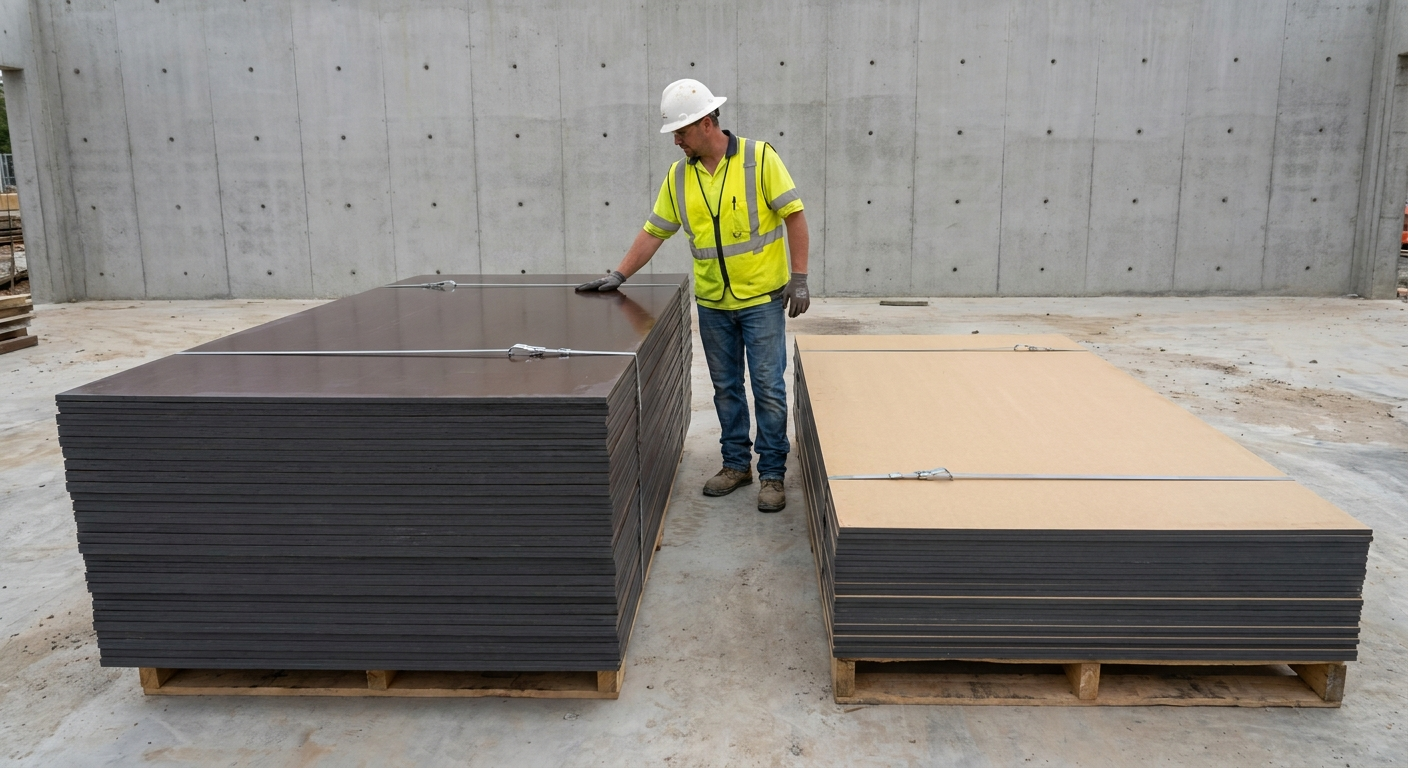
Maximizing Efficiency and Durability with Vinawood's MDO Plywood and Film Faced Plywood in Concrete Forming
MatteFace (searched as MDO formwork plywood) vs glossy film-faced grades for concrete forming: how finish, glue class and reuse target decide the panel, and how to write the RFQ.
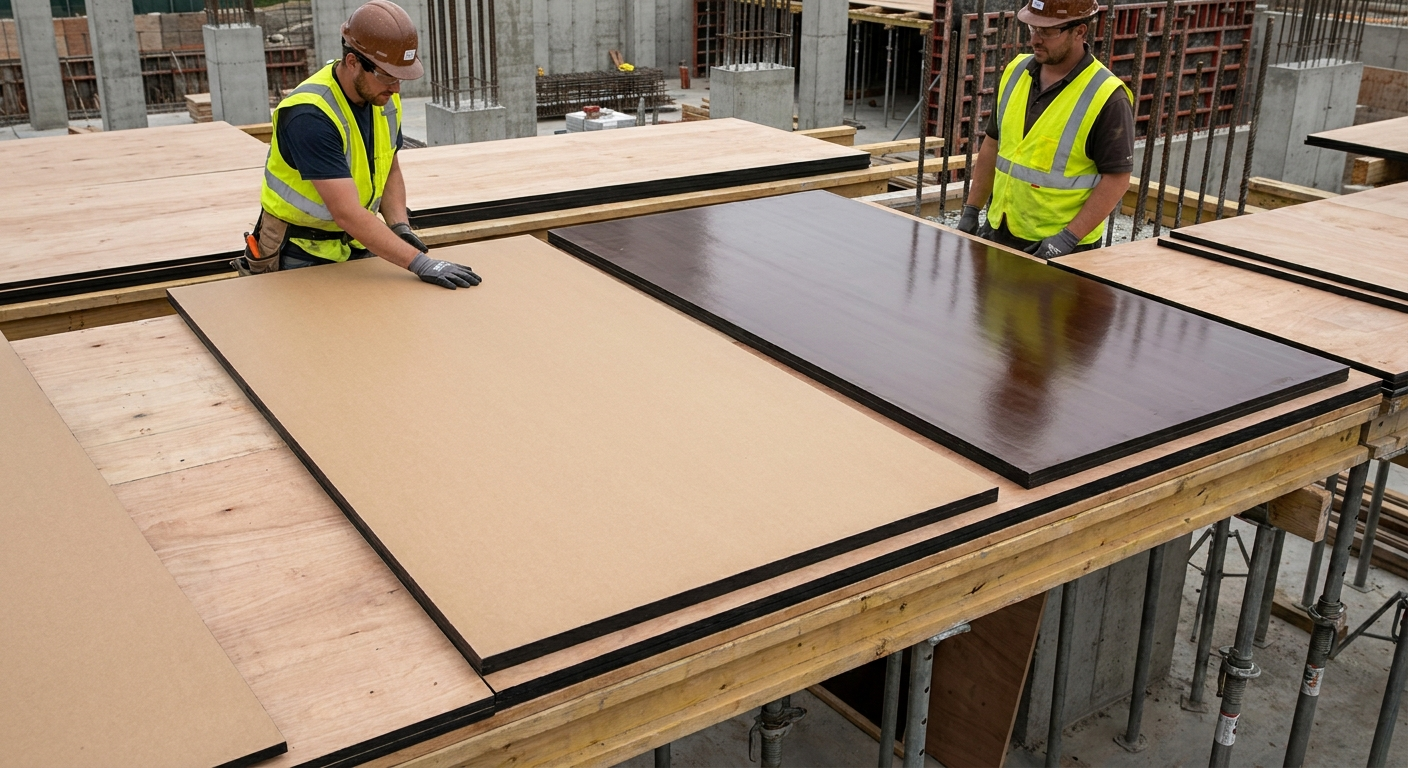
If you're hunting for the best film faced plywood for concrete formwork, the question you're stuck on is usually a simple one. Matte cast face, or glossy? Formwork plywood is the temporary mould a crew pours against. It soaks up the push of wet concrete and holds whatever face the architect drew, then it has to strip clean enough to go back up for the next pour. Pick the wrong finish, glue class or reuse target and the site pays for it later, in grinding hours or in panels that get scrapped early.
We've made formwork plywood in Vietnam since 1992 and ship roughly 5,000 containers a year to 55+ countries. This page stays on that matte-versus-glossy call. For the wider US forming map, keep the concrete forming plywood hub handy. When you need the full three-way panel walkthrough, use the film-faced vs MDO vs HDO comparison and the HDO vs MDO guide after you've picked a finish here.
MatteFace Plywood for a matte cast
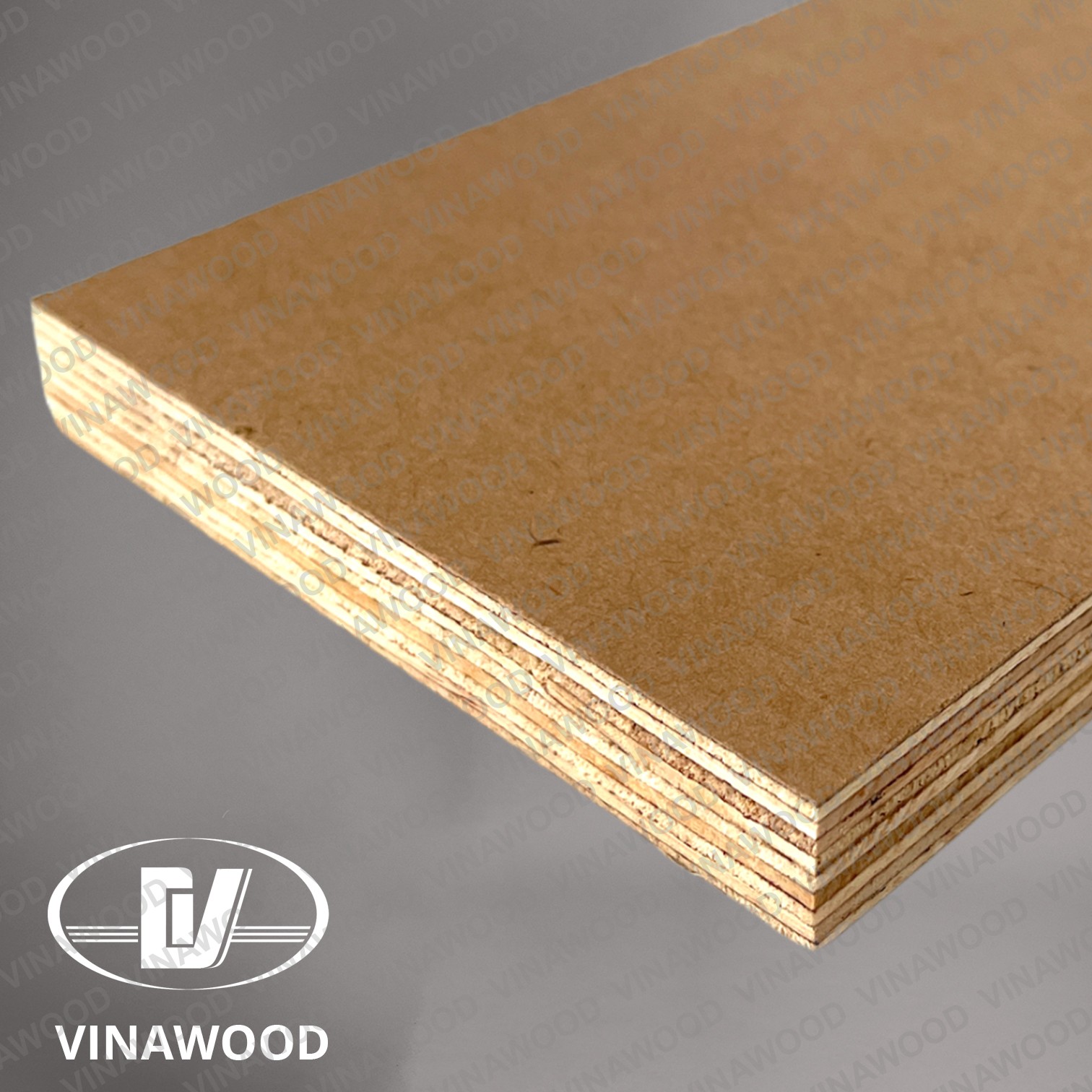
Buyers often search for MatteFace as MDO formwork plywood. That's fine as a search habit. On our line card the product name is MatteFace Plywood (MTF). Think of it as a formwork panel with a matte phenolic surface film on the face, plantation-grown acacia, eucalyptus and hevea inside, and WBP phenolic glue holding the plies together. It isn't kraft paper for signs. Nor is it a paintable sheet, or decorative laminate dressed up as formwork.
The face label to write on your RFQ for MatteFace 1SF (MTF3000) is MatteFace Surface 325 gsm. Strip it after the pour and the wall or soffit has a low sheen, nothing like a mirror, which is mostly why architects ask for it on exposed concrete. Release agent still goes on evenly. And the cut edges still get sealed, because end grain drinks rain far faster than a face film can cover for. You'll also find MatteFace Panel 1S (MTF1000), MatteFace Panel 2S (MTF2000) and the MatteFace HD 1SF Panel (MTF3HDP) in the range. We quote 1SF reuse as up to 15, on the understanding that the gang looks after the sheets like tools instead of treating them as disposable skins.
We say this on sales calls more often than we'd like, because getting it wrong costs real money. MatteFace is something you choose for forming, and MDO is just the phrase people happen to type into Google. If you see "Kraft" on a colourway, read it as a colour and nothing else. So when the drawing asks for a non-gloss face and your reuse budget sits somewhere in the middle, go with MatteFace instead of casting a glossy wall and trying to dull it afterwards. Once thickness and face/back are settled, the MatteFace collection is where to start.
Glossy film-faced grades when the cast should shine
Glossy film-faced plywood is the other road. Here a phenolic surface film is what touches the concrete, the paste releases clean and the cast looks even across the wall. People are often surprised how thin that film is (thinner than a fingernail). Pour count has much more to do with the glue in the core under it, and whether someone sealed the edges, and how the stacks were treated between cycles. Most buyers who type "formwork plywood Vietnam" or "phenolic film faced plywood" are looking for this glossy ladder, not MatteFace.
Every reuse figure below is an "up to" number. Bad habits on site can cut it in half without warning.
| Grade | Core glue | Face | Reuse (up to) | Notes |
|---|---|---|---|---|
| Eco Form / Eco Form Plus | MUF (core) | Phenolic film | 6 / 8 | Entry glossy film-faced |
| Form Basic | MUF (core) | Phenolic film | 10 | EN 636-2 panel class |
| Form Extra | Superior Glue MUF | Same phenolic film as Form Basic | 15 | Not Class 3; longer life comes from glue chemistry |
| Pro Form Lite | WBP phenolic (Class 3) | Phenolic film | 15 | Between Form Extra and Pro Form |
| Pro Form | WBP phenolic (Class 3) | Phenolic film | 20 | High-cycle glossy formwork |
| HDO Basic | Class 2 | HDO overlay | 10 | Not Class 3 |
| HDO Standard / HDO Premium | Class 3 | HDO overlay | Premium up to 20 | See HDO collection |
Two names land on the wrong truck every month. P-Form, for one, has a polypropylene face, and apart from the spelling it shares nothing with Pro Form. Consply is commercial Bintangor with no film, fine for packing work, not for pouring concrete against. Bare "melamine" on an RFQ is another trap, because that word can mean core MUF glue, a phenolic face film, or a decorative laminate. Ask which one before anyone books the container.
Class 3 phenolic glue on Pro Form, Pro Form Lite, HDO Standard and HDO Premium copes better with wet storage and boil-cycle stress than Class 2 MUF lines. Form Extra can still reach up to 15 reuses because Superior Glue MUF is built for that duty, but Form Extra isn't Class 3 and we don't sell it as one. Current cards live on the film-faced plywood collection and the HDO collection.
What the face and glue actually see on site
Think about what the face goes through. Pressure and vibration while the concrete goes in, then hours under curing paste. Glossy phenolic film lets go of that paste if the release went on evenly, and MatteFace does too, minus the shine. But no face film turns plywood into a sealed panel. We call it water-resistant, and we only say that when WBP or a properly specified MUF core glue is paired with sealed edges.
Most early failures start at the cut edge. End grain soaks first. Oil- or epoxy-based edge seal slows the soak. Rain on open bundles, wet sheets stacked face-to-face, and panels dragged across aggregate erase reuse faster than film wear ever does. We've seen gangs lose a week of pours that way. Soft backing under vibration can bruise a face so badly the clean fix is a new sheet.
Crowbars peel film. Keep them off the face. When the gang goes up by crane with the plywood sitting flat on its metal frame, the panel survives and so does the fair-face wall. I'd go further: flat, dry stacks off bare ground between cycles often buy you more pours than paying for a better grade would. ACI 347 is what site engineers look at for pressure, bracing and stripping times. Product durability and bond fall under EN 636 and EN 314-2, while EN 13986 is the CE construction-product route for European files that need one.
Spec fields that belong on the RFQ before price
We'd rather ask a dull question twice than press the wrong panel. So before the landed-cost argument starts, get finish, thickness, glue class, face/back, reuse target, panel size and certifications onto the RFQ. Finish means matte, which is MatteFace, or glossy, which is phenolic film-faced or HDO. Most forming jobs land on 12, 15, 18 or 21 mm. Glue is Class 2 MUF versus Class 3 phenolic. If you want Superior Glue MUF, write Form Extra by name, so no one on either side starts calling it Class 3.
These lines come in 1220 × 2440 mm (roughly 4 × 8 ft) and 1250 × 2500 mm, and North American gangs still hold the imperial pair up against their drawings. MatteFace 1SF puts a matte face on one side with a phenolic film backer on the other, which is a different choice from the 1S and 2S layouts. At mill level, film faced plywood MOQ Vietnam means a container load. We don't do pallet retail. Lead time and unit price come from sales through a quotation, not from a published list.
Name the certificates your project file really needs, whether that's ISO 9001, FSC-COC, PEFC, CE EN 13986, EPA TSCA Title VI / CARB P2, KS, EPD, UKCA or BIS. Writing "all certs" just costs you a week. For North American programmes, Vinawood has distribution warehouses in Toronto, Vancouver, Calgary, Montreal, Miami, Houston and Baltimore where local distributors can pull ready stock. A fresh container programme still starts with a quotation.
Anti-slip film is a deck job, not a forming face
People searching for anti-slip film faced plywood end up on forming pages often enough that it's worth stopping here for a minute. Our wiremesh anti-slip panels are made for decks and platforms, where they give grip on walkways, scaffold decks and van floors. That isn't the face you want touching concrete on a fair-face wall. For that job, go to the wiremesh line and read the anti-slip plywood guide. Put a forming overlay on a deck, or a deck face on a form, and you've paid for the wrong surface.
What sits behind the grade cards
Everything is made in-house in Vietnam, following a 12-step sequence that starts with veneer peeling and ends at surface lamination, with a dedicated film-facing line in that run. Each sheet gets its own inspection before it's packed. In our lab we test MOR, MOE, bond strength and formaldehyde. When a buyer's programme calls for an outside stamp, we bring in SGS, TÜV, Eurofins or Quatest. Export loads commonly leave through Hai Phong as the port.
If you still need the MDO search-term primer, read what is MDO plywood. When the next pour needs a clear matte-or-glossy call, send finish, thickness, glue class, reuse target and panel size through request a quotation.
Related Products
▶Sources & References (4)
- EN 636 Plywood — Specifications — CEN (2015)
- EN 314-2 Plywood — Bonding quality — CEN (1993)
- EN 13986 Wood-based panels for use in construction — CEN (2015)
- ACI 347 Guide to Formwork for Concrete — American Concrete Institute (2014)