Why Concrete Turns Pink (or Blue) After You Strip MDO/HDO Forms — and How to Prevent It
Pink, red or blue-green stains on concrete after stripping HDO or MDO formwork panels are uncommon — a few percent of pours at most — and are chemistry reactions rather than panel defects. Walk-through of blushing, slag-cement staining and turkey-red staining with APA-tested prevention and…
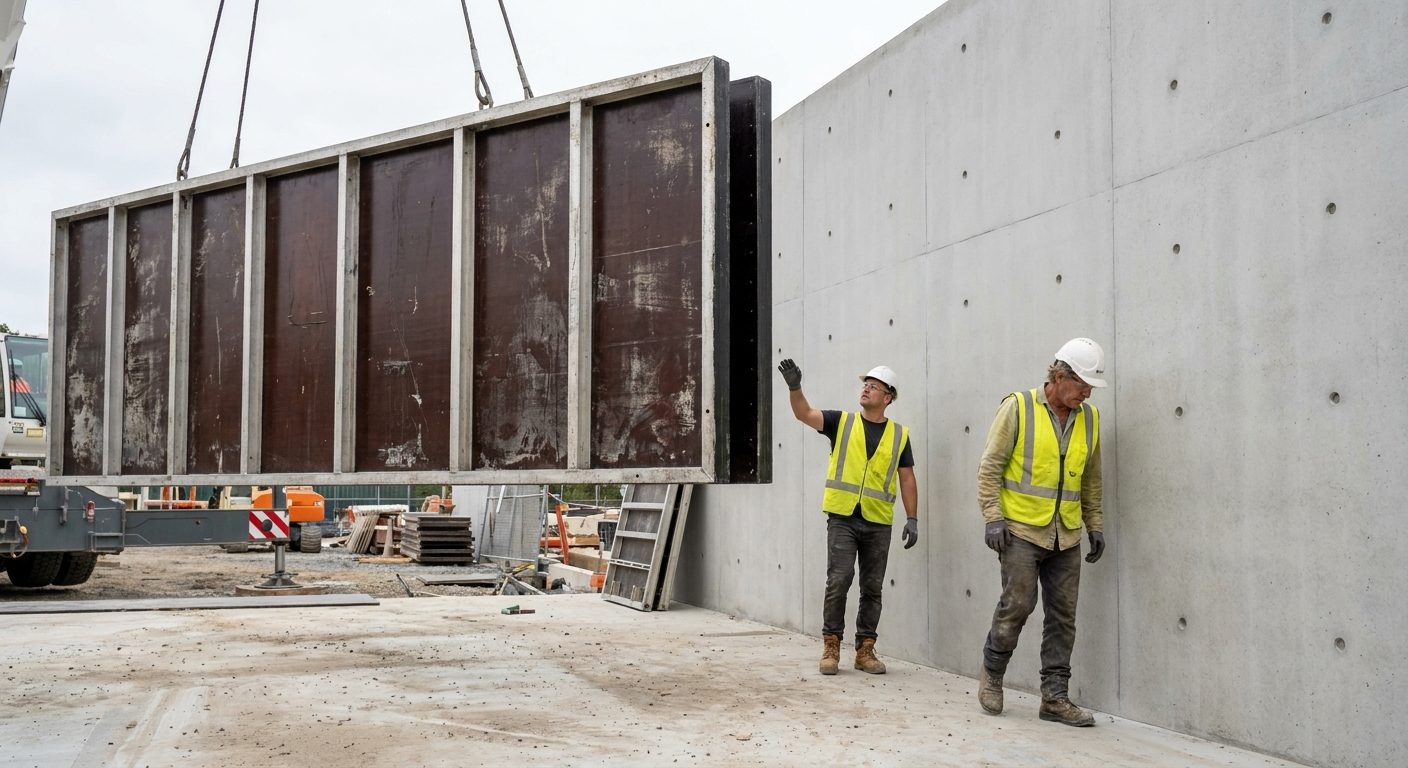
Stripped concrete almost always comes out the colour you expected. Standard grey portland against a film-faced or overlaid panel produces a clean grey wall, and the formwork plywood does its job without ceremony. The reason this article exists is the small minority of pours — a few percent at most across our shipments — where the new concrete reads pink, red or occasionally greenish blue at strip. It is rare. It is rarely a panel defect. And when it does happen, it has a chemistry explanation, a fade window and a fix.
The article walks through three uncommon-but-documented phenomena: pink-red blushing on MDO and HDO panels, blue-green staining on HDO against slag-cement mixes, and turkey-red staining on plain B-B Plyform with vegetable-oil release agent. APA's Technical Topics TT-059B (March 2012) is the anchor reference for all three. If a contractor encounters one of these on a job, this is what is happening and how to handle it.
What blushing actually is — the chemistry in plain English
Phenolic resin in MDO and HDO overlays contains a small fraction of unreacted free phenol molecules. Fresh concrete sits at roughly pH 12.5, strongly alkaline. In a small number of cases, while the concrete cures against the overlay, those free phenols migrate to the concrete-overlay interface. After the form is stripped, oxygen and ultraviolet light convert the migrated phenols into quinones — naturally occurring red dye compounds in the same family that produces colour in many natural and synthetic dyes. When the conditions line up, the cured concrete face reads pink to red.
The reaction needs three inputs together: free phenol from the overlay, alkalinity from the concrete, and air plus sunlight after the form comes off. Remove any one and blushing does not happen, which is why most pours never show it. The cases that do show it are usually first-pour use of a brand-new panel batch combined with a light-coloured mix or Type III cement.
Why blushing is more visible on light mixes and Type III cement
Most blushing reports come from a narrow combination of conditions. Light-coloured concrete shows any pink dye more vividly. White portland cement, light grey portland blends, and decorative architectural mixes all have less base pigment to mask a quinone tint, so the same dye loading reads as stronger pink. Standard grey portland mixes against the same panel typically show nothing at all, or only a faint blush that fades within days.
Type III cement (high early strength) is the second amplifier and the one that drives most reports. It hydrates faster and more aggressively at early ages, pulling more free phenol from the overlay during the first 24 hours. APA's TT-059B notes that severe blushing can occur with HDO Plyform specifically when Type III cement is in the mix. White-cement architectural mixes built around Type III for a quick strip schedule are the worst-case combination. Outside that narrow envelope, blushing is not what crews see on standard commercial pours.
First two reuses — why the problem is self-limiting
When blushing does appear, it almost always shows up on the first one or two pours of a brand-new panel batch. Free phenol concentration in the overlay is highest on a brand-new panel, and the first one to two pours pull most of it out. By the third or fourth reuse, the overlay has effectively self-conditioned and blushing becomes very rare. The issue is self-limiting in time.
We see this pattern in our own North American shipments — the small number of contractors who flag a pink tinge on the first wall of a project rarely flag it again on walls four or five of the same pour cycle, even though nothing about the panels themselves has changed. The panel did what panels do on the rare occasions the chemistry lines up: it gave up its surface phenols on the early pours and stabilised.
Three uncommon stain types — quick reference
APA TT-059B documents three separate phenomena that all read as "concrete is not quite the colour I expected." Each is uncommon in its own right; each has a different cause and a different fix, on a different family of panel.
| Type | Colour | Cause | Affected panel | Typical fade |
|---|---|---|---|---|
| Blushing (uncommon) | Pink to red | Concrete alkalies plus free phenols form quinone dyes; needs air and UV after stripping | MDO and HDO overlaid panels, first 1–2 reuses with light mix or Type III cement | About 2 weeks under UV |
| Blue-green staining (rare) | Greenish blue | Iron sulfides and ferrous oxides in slag cement, accentuated by air-tight smooth form surfaces | HDO panels (smooth face) on large continuous walls with slag-cement mixes | Fades with drying and exterior weathering |
| Turkey-red staining (rare) | Pink-red blotchy | Vegetable or castor oil release agents react with sulfonating agents in the system | Plain B-B Plyform without overlay; oiled with vegetable oil | Does not self-fade; release agent must change |
Five preventive measures for blushing on first-pour panels
For the small number of jobs where the conditions line up — brand-new HDO panels, light-coloured architectural mix, Type III cement — a few preventive steps drop the risk close to zero.
- Leave forms in place as long as the structural design allows. Air and sunlight drive the quinone reaction. Every extra hour the form stays in place is one less hour for the reaction to develop. This is APA's first-line recommendation in TT-059B.
- Pre-treat brand-new panels with an alkaline wash before the first pour. A mason-lime slurry or dilute sodium hydroxide solution wash neutralises surface phenols and bleeds off the worst of the free-phenol load before the panel ever sees concrete. APA-recommended for the first one to two cycles of a new panel batch where the architectural finish leaves no room for any blush risk.
- Match the release agent to the overlay. Some agents accelerate phenol migration, others suppress it. Talk to your form-release-agent supplier about the specific pairing for MDO or HDO. Generic recommendations are not reliable across product lines.
- Override the panel choice when Type III cement is mandatory. If Type III is non-negotiable for the mix design and the architectural finish cannot accommodate any blush risk, consider a different overlay system (heavier phenolic film, polypropylene overlay, or steel-faced formwork) for the visible portions of the pour. The panel supplier can recommend a Type-III-compatible spec.
- Brush off panel surface dust before each pour. Loose phenolic dust from sanded edges and cut lines adds to the free-phenol load at the concrete interface. A dry brush down before each cycle is cheap insurance.
Remediation if blushing has already happened
In the rare case where a pour does come out pink, the colour is not permanent. Two weeks under normal indoor or outdoor UV exposure is the standard fade window for a typical grey mix that picked up a faint blush. Architectural white-cement Type III pours with a stronger initial tint sometimes need three to four weeks. Document the colour at strip and again at two weeks before any conversation about rejection or claim gets started — the colour you see at strip is rarely the colour at the final inspection.
Three treatments are documented in TT-059B and used on the small number of architectural concrete jobs that need to accelerate the fade:
- Sodium hypochlorite (10–12% bleach) wash. Pool-supply-grade chlorine, brushed onto the affected concrete, accelerates quinone breakdown. PPE is non-negotiable: eye protection, nitrile gloves, ventilated area.
- Direct UV exposure. If the pour is exterior, leave it exposed to sunlight. UV breaks down the quinone dye on its own and most affected pours self-clear within two weeks.
- Time. The colour is not permanent. Resist the urge to mask with pigmented sealer (locks the pink in) or acid-etch (changes the cement matrix and creates a different problem). Pressure-washing with abrasive damages an architectural finish.
Blue-green staining on HDO — the rare slag-cement story
This one is uncommon enough that most concrete crews will never see it. Where it does show up, blueish-green discoloration on concrete cast against high-density overlaid plywood is caused by iron sulfides and ferrous oxides naturally present in slag cement, a common supplementary cementitious material in modern green-concrete mix designs. The iron salts produce the distinctive colour.
APA's research correlates the discoloration with air-tight smooth form surfaces. Overlaid plywood and steel forms both seal the early off-gassing inside the curing concrete, where the iron compounds can concentrate at the form face. Two countermeasures help on the rare project where this is observed: loosen or open the forms at the earliest structurally permitted moment to vent the surface, and treat the affected concrete with hydrogen peroxide (H2O2) immediately after stripping. Outdoor weathering and drying eventually fade the discoloration on their own as the iron compounds oxidise out.
Turkey-red staining — the vegetable-oil release-agent trap
This is a different mechanism on a different panel, and it shows up rarely now that mineral-oil and water-based release agents dominate the market. The fix is also different. Turkey-red discoloration is associated with oiled B-B Plyform (no phenolic overlay) where the release agent is a vegetable oil, typically castor oil. Sulfonating agents present in the system (sulfuric acid from chemically mineralised wood fibers, sulfur trioxide from the cement's calcium sulfate fraction) react with the castor oil to produce a compound called turkey-red oil. That compound transfers to the cured concrete as a pink-red blotchy stain.
The fix is direct: change the release agent. Mineral-oil, water-based, or proprietary chemical release agents rated for plywood formwork avoid the chemistry entirely. If vegetable oil has to stay (rare specialty cases), apply a barrier coating (form lacquer, epoxy, or urethane) to clean unoiled new Plyform before the release agent goes on. This phenomenon does not affect MDO or HDO panels. The overlay acts as the barrier that plain Plyform lacks.
When this is a panel issue versus when it is not
If a contractor does encounter one of these three rare phenomena, the question at strip is usually a buying decision: reject this batch, keep using it, escalate to the supplier? A simple decision tree built from APA's framework:
- First one to two reuses, MDO or HDO panel, pink-red colour, light mix or Type III cement → almost certainly normal first-pour blushing on a brand-new panel batch. Self-fades. Not a panel defect.
- Same panel batch, recurring strong colour past four or five reuses → uncommon, and worth checking with the panel supplier on overlay batch and storage history before the panels reached the site.
- Blueish-green discoloration on HDO with a slag-cement mix → slag-cement chemistry, not a panel issue. Vent forms earlier; peroxide treatment.
- Pink-red blotchy on plain Plyform with vegetable-oil release agent → release-agent reaction, not a panel issue. Switch release agent.
- Persistent stain that does not fade within four weeks under UV → rare. Worth investigating release-agent compatibility, overlay batch and storage conditions before assigning blame to the panel.
For a deeper read on which overlay class fits which pour programme, see the HDO vs MDO plywood comparison. For the underlying differences in adhesive systems behind the overlays, the melamine vs phenolic film-faced plywood piece covers the bond-class side. For the broader formwork pillar that anchors these sub-topics, see concrete form plywood.
About Vinawood
Vinawood has manufactured plywood in Vietnam since 1992 and exports MatteFace, HDO, Pro Form and the broader film-faced range to more than 55 countries. Our overlays are cured WBP phenolic film systems pressed under heat and pressure to international quality standards (EN 13986 with CE marking, CARB Phase 2, EPA TSCA Title VI). Free-phenol content in the overlay sits within typical industry ranges for phenolic-coated plywood, which on the rare combination of brand-new panels plus light-coloured or Type III-cement mixes can produce a mild first-pour blush. The vast majority of pours never show it.
For North American forming work, the relevant catalogue lines are the HDO plywood collection (heavier overlay, up to 30 reuse cycles, the fair-face workhorse) and the MatteFace collection (matte-finish concrete forming, up to 15 reuses — the panel often searched for as MDO formwork plywood). For projects where Type III cement is required and the architectural finish cannot accommodate any blush risk, the technical team can recommend an alternative overlay specification before ordering — quicker than working through a rare colour event after pour day.
Category
guides
Related Markets
Related Countries
Related Products
▶Sources & References (3)
- Staining of Concrete Poured Against Plyform (Technical Topics TT-059B) — APA – The Engineered Wood Association (2012-03)
- ACI 347R – Guide to Formwork for Concrete — American Concrete Institute (2014)
- Concrete Surface Defects and Repair Guideline — International Concrete Repair Institute (2022)