OEM Logo Film-Faced Plywood from Vietnam: Distributor RFQ Guide
An RFQ guide for distributors sourcing logo film-faced plywood from Vietnam: logo film vs stamp vs imprint, MUF or phenolic core under your brand, artwork and plate steps, documents and the OEM checklist.
Put simply, an OEM film-faced order is a normal formwork spec with three extra decisions stacked on it. Does your logo go into the face film? Do the pallets ship packed as your product? Whose name is on the export papers? Until those three and the panel spec are all written down, no mill can quote you honestly. Once they are, price and lead time and the sample route mostly fall out on their own.
What buyers mean by OEM, logo film and white-label
People use these words as if they meant the same thing. They don't, and each has its own cost and its own risk. Logo film means your mark is part of the phenolic face film itself. It's printed into the film before the plywood ever goes into the press, so it sits in the face rather than on it, and that's usually what someone searching for "custom logo formwork plywood" is after.
OEM is the bigger idea. The mill builds to your spec under your brand; logo film can be part of that, but so can the thickness, the core, the glue class, the colour of the edge seal and the packing. White-label is really about what turns up at your warehouse. Your name is on the pallet marks, the tape, the corner boards, maybe the invoice, and the face itself might still be plain mill film. Mix and match as you like. Custom film with mill packing works, so does plain film with your pallet marks. Just write down which combination you want, because "OEM" on its own doesn't tell anyone.
Logo film, a stamp, or a decorative imprint?
We see three face treatments mixed up on purchase orders more than anything else. Custom logo film is its own film item, and the printing plate (or cylinder) is what holds up the schedule. A corner stamp or stencil is put on after pressing; it's quicker and cheaper, but after a few strip-and-clean cycles it may not look the same as the rest of the face. Decorative imprints are another animal: wood-grain or geometric textures that are supposed to print into the concrete. An architect specifies those. A distributor doesn't brand with them. Our guide to imprinted film-faced plywood goes through them, plus factory stamps and batch codes.
| Approach | What the buyer gets | Typical use |
|---|---|---|
| Mill-brand film | Factory mark and grade or batch coding | Import under the mill's name |
| Custom logo film | Your artwork in the face film | Distributor or formwork-system brand |
| Corner stamp or stencil | A mark added after pressing | Lower-cost identification |
| White-label packing only | Mill film, your pallet marks and tape | A soft brand at the warehouse |
| Decorative imprint | A pattern meant for the concrete | Architectural work, separate RFQ |
If your customer wants your name on the pallet and a smooth concrete face, the answer is logo film or a stamp over a plain film. A patterned architectural film would be the wrong product entirely.
MUF core or phenolic core under your logo
Here's the part that trips up a lot of first OEM orders. The logo lives in the phenolic face film, but how many pours the sheet survives is decided by the glue in the core, and that's a separate choice. Put a sharp logo on a sheet with the wrong core and your brand still gets the blame when it delaminates on site.
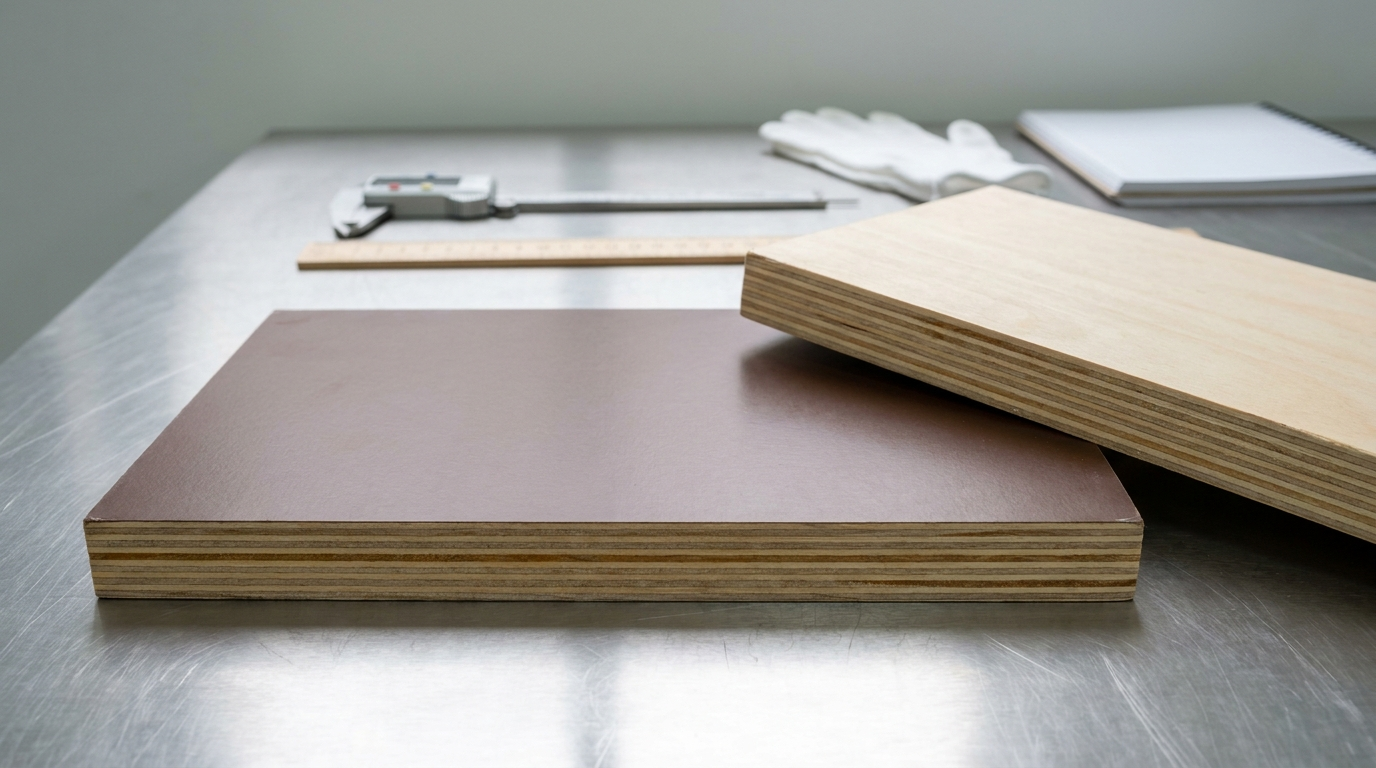
You're choosing between two core glues. MUF, short for melamine-urea-formaldehyde resin, passes EN 314-2 Class 2 (the EN 636-2 level for humid conditions) and it's a genuine formwork bond that copes with wet concrete. Phenolic (PF) glue passes Class 3, which is what EN 636-3 exterior panels have to meet, and it lasts longer after a face gets gouged or a cut edge drinks water. The face film is something else again. That dark brown phenolic layer covers both cores, so two sheets can photograph identically and still be different bond classes. (Decorative laminate, the third thing people call melamine, doesn't belong on a formwork face at all.)
Our film-faced grades map out like this:
- Form Basic: MUF core, 165 g/m² phenolic film, Class 2, up to 10 reuses.
- Form Extra: a stronger MUF glue under the same phenolic face film as Form Basic. It's still Class 2, not Class 3, and rated up to 15 reuses.
- Pro Form Lite: phenolic core, Class 3, up to 15 reuses, sitting between Form Extra and Pro Form.
- Pro Form: phenolic core and a 125 g/m² top-grade phenolic film, Class 3, up to 20 reuses.
Only Pro Form and Pro Form Lite in this range are Class 3; in HDO, the Standard and Premium grades are Class 3 too, while HDO Basic is Class 2. Which grades can carry custom logo film on a given order is confirmed on the quotation, so don't assume every grade is available with your artwork. If you want the longer version of the glue argument, read melamine vs phenolic film-faced plywood, and the full grade list sits in the film-faced plywood collection.
Market matters as well. Distributors in Europe, the UK and the Middle East mostly brand film-faced panels. North American distributors usually put their name on HDO or MatteFace Plywood (MTF) forming panels instead, and Vinawood keeps distribution warehouses in Toronto, Vancouver, Calgary, Montreal, Miami, Houston and Baltimore that supply ready stock to local distributors.
Artwork, plate and film lead time
Custom logo film is a film job that happens before the plywood press, and it adds steps that a mill-brand order simply doesn't have. The sequence usually runs like this:
- You send vector artwork (PDF, AI or EPS) with a placement sketch, colour intent, and whether it's one face or two.
- The artwork is checked for contrast and line weight on dark, resin-rich film, where fine type and big solid areas both struggle.
- A printing plate, cylinder or similar film tool is made.
- A film or panel sample is approved in writing.
- Production film is made and booked into a press run.
Step three usually takes longest, and it runs on its own clock, separate from press time. That's why we'd ask for two durations on the quote, artwork-approved-to-film-ready and film-ready-to-loaded-container. Sort out plate ownership at the same time. Can it be reused next container? What if the logo changes in June? The plate lead time, the film source and the minimum all belong on the quotation. One tip we give every new OEM buyer: sign off on a pressed sample, not a JPEG. Logos that look sharp on a white screen have a habit of vanishing into dark film.
Documents stay in the manufacturer's name
Private label doesn't let anyone reissue mill certificates under a new name. A test report or a declaration of performance names the manufacturer, so it gets attached as issued, never redrawn. Our own set is ISO 9001, FSC-COC, PEFC, CE marking to EN 13986 and EPA TSCA Title VI, with testing done in our in-house lab and by partners SGS, TUV, Eurofins and Quatest. Want to sell FSC or PEFC panels under your brand? Then you're having a chain-of-custody conversation, and packing has nothing to do with it.
Invoices and packing lists are more flexible. They can often carry your name or a nominated exporter's, depending on the Incoterm and who signs the contract. Origin certificates, phytosanitary papers and mill test reports normally stay with the manufacturer or legal exporter. If the destination wants heat-treated pallets under ISPM 15, write it on the order. And if you're going to publish a local data sheet, agree in writing which numbers come straight from the mill report and which are your own guidance.
Checking the mill before your name goes on it
OEM raises the stakes if the supplier turns out to be a trader. The logo on the film is yours, and so is the complaint when a bond fails in front of a contractor. Run the usual factory checks from our guide to plywood manufacturers in Vietnam, then add three questions that only matter for OEM: who prints the film and will that source repeat, can they show a previous custom-logo run (with the other brand cropped out) so you can judge placement tolerance, and what's the written approval step between artwork, sample and production? We'd be wary of any mill that takes a deposit for custom film but won't press a sample first.
We've made plywood in Vietnam since 1992, ship about 5,000 containers a year and sell into 55+ countries, and the OEM orders that go smoothly are nearly always the ones where the brand scope was settled before anyone talked price. Changing the logo after the plate is cut restarts the film clock, so freeze the artwork in the purchase order.
How to write the OEM RFQ
Tight RFQ in, tight quote out. Here's what we'd like to see on one:
- Destination country and port, and the standards your customers will ask about
- Panel construction: grade or equivalent, thickness, size, core glue and bond class, film colour
- Branding scope: logo film, corner stamp, packing marks, or a defined mix
- Artwork: vector files, clear space, minimum size, one face or two, and a photo of any sheet you want matched
- Volume in containers, and whether it's a one-off or a repeat programme
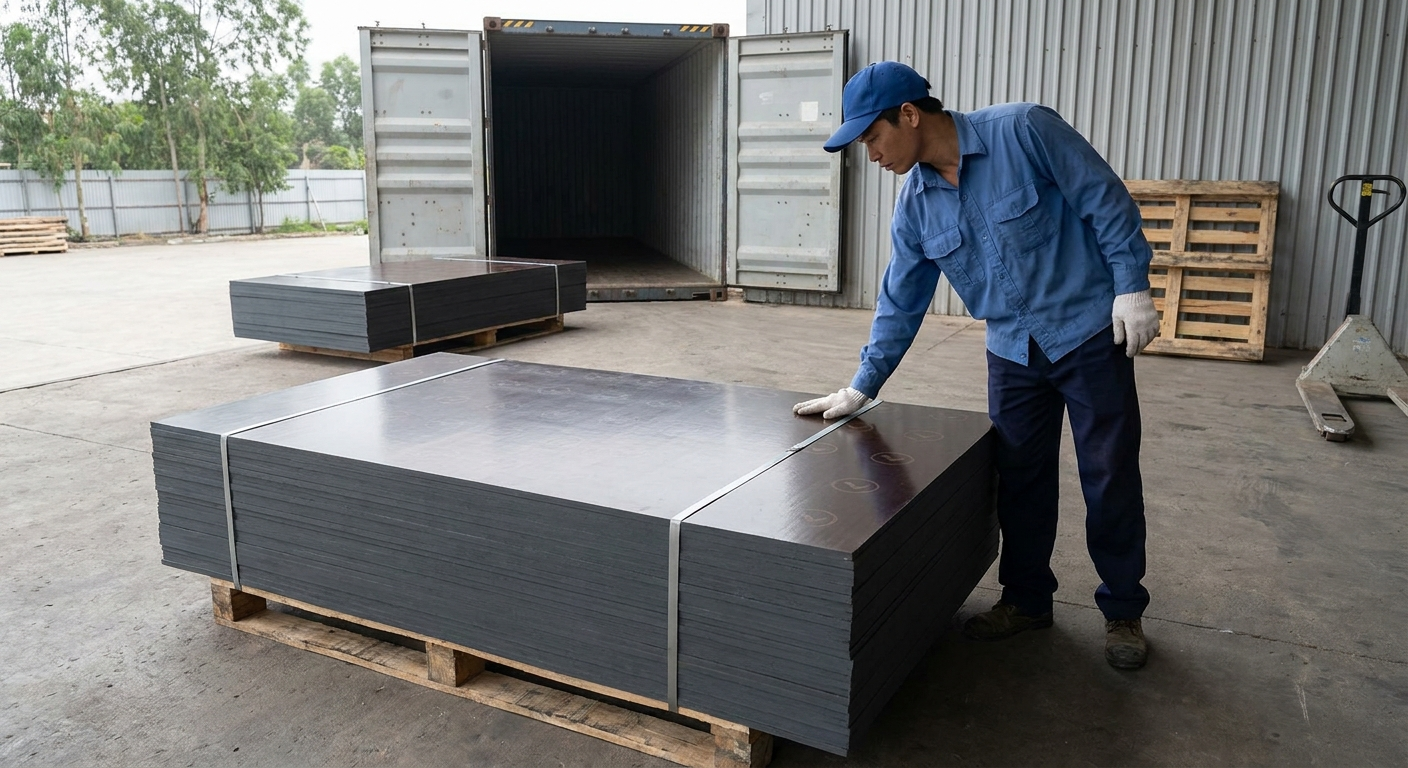
- Packing: pallet type, sheets per pallet, marks, and whether mill identity must be fully covered
- Documents: invoice name, packing-list name, which certificates travel with the shipment
- Sample path: film proof, swatch or full sheet before production film is locked
- Inspection: whether an independent inspector will check logo placement as well as thickness and bond
- Incoterm and ship window, with film lead time called out separately from press time
If a bid names a particular overlay film, put that on the RFQ and ask whether it can be supplied, rather than assuming it can. When you're ready, send the RFQ and attach your vector artwork so the film check can start straight away. For a general question first, the contact page reaches the same sales team.
Category
guides
▶Sources & References (4)
- EN 636:2012+A1:2015 Plywood - Specifications — European Committee for Standardization (CEN) (2015)
- EN 13986:2004+A1:2015 Wood-based panels for use in construction — European Committee for Standardization (CEN) (2015)
- ISO 12466-2:2007 Plywood - Bonding quality - Part 2: Requirements — International Organization for Standardization (2007)
- ISPM 15: Regulation of wood packaging material in international trade — International Plant Protection Convention (IPPC)