Plywood Adhesives Explained: UF, MUF, Phenolic & MR Glue for Buyers
What is the adhesive inside a plywood sheet, and what does it mean for moisture resistance, formaldehyde emissions, and reuse cycles? This guide walks through the four working classes — UF, MUF, phenolic, and the MR shorthand — and maps them to EN 636, TSCA Title VI, and REACH 2026.
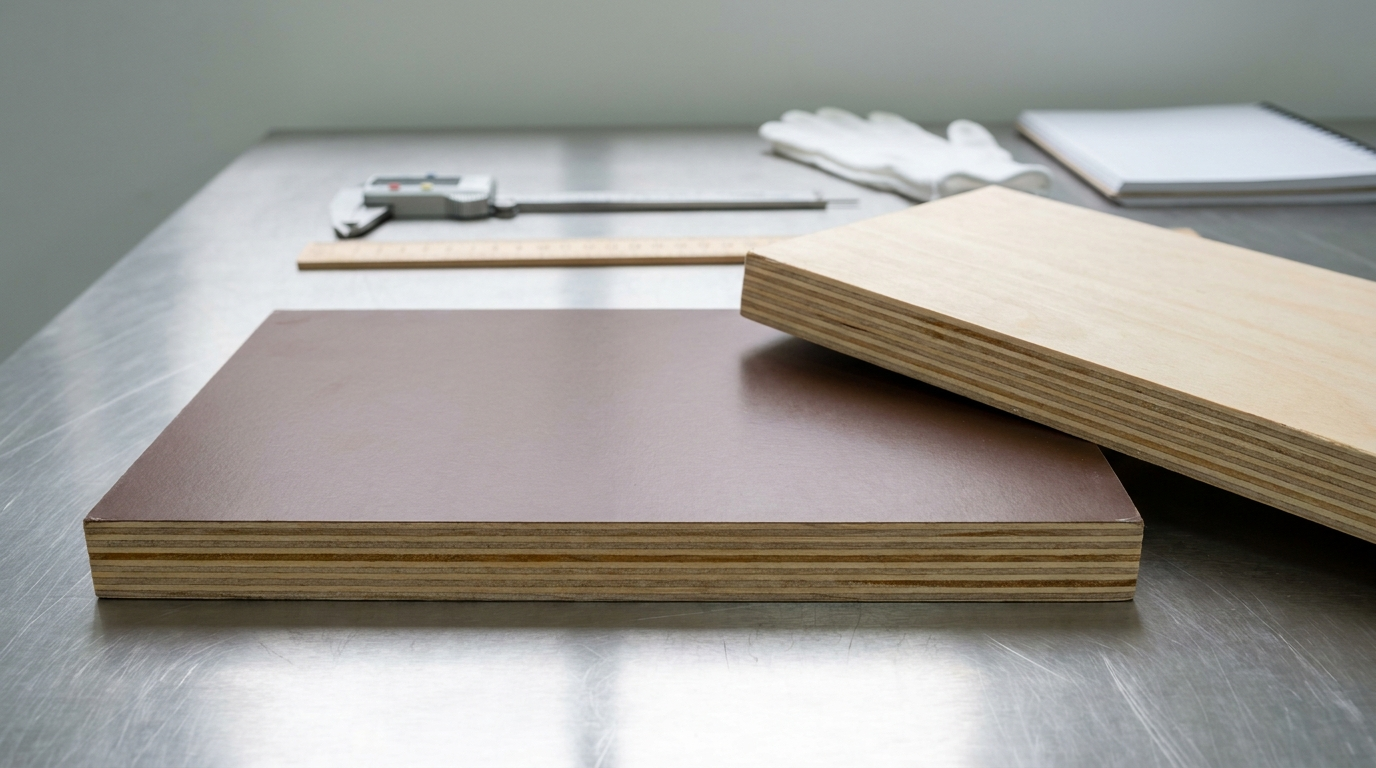
Bond class decides almost everything about how a plywood sheet behaves on a job site. It sets the moisture envelope the panel can survive, the formaldehyde emissions profile a buyer ends up with on a TSCA or REACH audit, and the number of pours a forming panel can deliver before the face lifts. The label printed on the spec sheet — EN 636-2, EN 636-3, Class 2, Class 3, WBP, MR — is a shorthand for which adhesive chemistry was pressed into the panel. This guide unpacks the four classes of adhesive used in plywood manufacturing today, and walks through the standards, emissions ceilings, and reuse expectations each one supports.
The four adhesive classes used in plywood manufacturing
Plywood adhesives sit in four working categories. Each one is a different resin chemistry with a different cure profile, different cost per kilogram, and a different envelope of conditions it can take.
UF — urea-formaldehyde
Urea-formaldehyde is the lowest-cost thermosetting resin used in panel bonding. It cures fast and cheaply under hot-press conditions and produces a strong dry bond, but the bond softens with moisture exposure and the resin off-gases more formaldehyde than the other three classes. UF plywood is interior-only, EN 636-1 service class, and it is the class buyers should expect to see scrutinized hardest under the new REACH 2026 ceiling.
MUF — melamine-fortified urea, also called melamine-urea-formaldehyde
Adding melamine to a UF formulation tightens the cross-linking network in the cured resin, raises the moisture resistance, and lowers the free formaldehyde profile substantially. MUF is the workhorse adhesive class for Class 2 plywood: it survives semi-exterior service, performs under repeated wetting and drying cycles, and supports the 10–15 cycle reuse window when paired with a heavy phenolic film overlay. Vinawood's Form Basic, Form Extra, Eco Form, and Consply ranges all use a MUF bond at the Class 2 / EN 636-2 level.
PF — phenol-formaldehyde, the phenolic class
Phenolic resin produces the strongest weather-and-boil-proof bond of the four. The cured resin is dark brown, fully water-insoluble, and stable under repeated boil-and-dry cycles. PF is the EN 636-3 / Class 3 adhesive: the bond can stay wet permanently, take 20 pour cycles in formwork service, and pass the boil-proof bond test. Vinawood's Pro Form, Pro Form Lite, and the full HDO range all use phenolic adhesive.
MR — moisture-resistant
MR is a market shorthand, not a separate resin family. In Australia, India, and parts of Southeast Asia, “MR plywood” almost always means a MUF bond — the Class 2 product line, not a third chemistry. Some retailers use “MR” for any UF panel that takes a damp-cloth wipe without failing, which is misleading. When a buyer asks for MR, the right follow-up question is whether the spec is Class 2 or merely a UF panel with a passable splash test.
Bond class to application — the working map
| Application | Right adhesive class | EN 636 | Why |
|---|---|---|---|
| Interior cabinets, furniture, shop fixtures | UF | EN 636-1 | Dry service, cheapest cured resin |
| Semi-exterior joinery, kitchen carcasses, light shop work | MUF | EN 636-2 | Tolerates splash and humidity, much lower emissions than UF |
| Light formwork, semi-exterior signage, packing | MUF | EN 636-2 | Class 2 with a heavy film overlay holds up to 10–15 cycles |
| High-rotation concrete formwork, exterior structural use | Phenolic (PF) | EN 636-3 | Class 3 bond survives 20 pour cycles, fair-faced finish |
| Marine, permanent submerged use | Phenolic (PF) + specialty timber | EN 636-3 or BS 1088 | Boil-proof bond, voids-free core |
EN versus ANSI — the standards crosswalk that trips up buyers
European and North American buyers read the same adhesive class through different stamps. The chemistry is the same; the label conventions are not.
| Adhesive class | EU (EN 636) | US softwood (PS 1 / PS 2) | US hardwood (ANSI / HPVA HP-1) |
|---|---|---|---|
| UF | EN 636-1 | Interior | Type II (lower) / Type III |
| MUF | EN 636-2 | Exposure 2 / some Exposure 1 | Type II |
| Phenolic (PF) | EN 636-3 | Exposure 1 / Exterior | Type I |
A panel labelled “APA Exposure 1” on a US load and EN 636-3 on a European load might be the same product with different stamps. That mapping is rough — a US Exposure 1 panel uses a phenolic resin, so it sits in the phenolic class, but the long-term-wet performance is rated below Exterior. The detail matters when a buyer is moving a container between markets and the inspector reads only one of the two stamps.
Formaldehyde compliance — what each adhesive class triggers
The compliance regime tightens at every link of the chain in 2026. North American buyers manage TSCA Title VI, which now supersedes the older CARB Phase 2 labelling system; European buyers add REACH Annex XVII to the existing CE / EUTR documentation. Asia-Pacific buyers track JIS F**** in Japan and the equivalent national stamps elsewhere.
UF plywood is the class that has had to move the most. EU testing under EN 717-1 (chamber method) has tightened to a 0.062 mg/m³ ceiling effective 6 August 2026 under REACH Annex XVII. MUF panels generally pass that ceiling with a healthy margin once the resin is fully cured and the formaldehyde scavenger is dialed in; UF panels almost always need a scavenger overlay and a longer post-press cure to meet the new limit. PF panels emit at the lowest level of the four — phenolic chemistry binds formaldehyde into the cured resin much more tightly than urea chemistry does.
From a Vietnamese mill perspective, Class 3 phenolic ranges came through the REACH 2026 transition without redesign. The MUF Class 2 ranges — Form Basic, Form Extra, Eco Form, Consply — are in qualification under the Path B framework, with adjusted resin formulations and tighter post-press cure protocols. The PF range was REACH-safe by chemistry; the MUF range gets there by formulation and process.
Adhesive class and reuse cycles in formwork
Reuse cycles is where adhesive chemistry shows up most directly on the job site. The phenolic bond holds under repeat soak-and-dry; the urea-fortified bond softens under the same cycles. A 220 g/m² phenolic film on a Class 3 phenolic-core panel like Pro Form delivers up to 20 pour cycles in disciplined site conditions. A 120 g/m² melamine film on a Class 2 MUF-core panel like Form Extra delivers up to 15 cycles in the same conditions — the gap comes from both the adhesive class and the film grammage working together.
What shortens cycles in practice is rarely the adhesive. It is the edges left unsealed after the first cut, the panel left face-down on wet plywood overnight, the missed release-agent application before the second pour, or the over-zealous stripping that lifts a face ply. Site discipline, not bond class, is the real lever once the right panel is on the job.
What “WBP” actually means
WBP stands for Weather and Boil Proof, and it describes a bond performance result, not a specific resin chemistry. Both well-formulated MUF panels and properly cured PF panels can pass the WBP boil test — a 72-hour cycle of boiling water immersion alternating with hot-press drying, after which the bond must hold. Some retailers and forum threads treat WBP as a synonym for phenolic; it isn’t. Vinawood manufactures both WBP melamine (Class 2) and WBP phenolic (Class 3); both pass the boil test, both serve real applications, and the right one is the one matched to the application envelope.
Bonding plywood to plywood on site — a short sidebar
Buyers arriving here looking for the glue to use on a site, rather than the glue inside the panel, generally want one of three product classes: a Type II PVA wood glue for interior trim, a polyurethane construction adhesive for general framing and panel-to-panel work, or a two-part epoxy for marine repairs. Brand selection is a separate guide. The takeaway is that site adhesives are a distinct topic from the adhesive class inside the plywood, and the two should not be confused on a takeoff sheet.
What to ask your supplier
A serious supplier should hand over four documents for any order: the bond class certificate (EN 636 / ANSI HP-1 / PS 1 / PS 2 as the market requires); the formaldehyde emissions test report keyed to EN 717-1 or the equivalent ASTM E1333; the REACH or TSCA Title VI compliance statement; and the batch traceability log linking your shipment back to the press date. Any vendor unable or unwilling to provide that paperwork is selling on price alone, and the buyer is carrying the compliance risk.
Match the adhesive class to the application envelope
Reading an EN 636 or ANSI stamp gets a lot easier once the chemistry behind it is visible. UF is interior, MUF is semi-exterior and the workhorse class, PF is the exterior and high-reuse class, and MR is a regional shorthand worth disambiguating before signing a PO. For European Class 3 / EN 636-3 specifications, Pro Form is Vinawood’s phenolic top-tier panel; Pro Form Lite sits between Form Extra and Pro Form for crews wanting a Class 3 bond at a lighter spec; Form Basic and Form Extra cover the Class 2 MUF segment with the higher reuse window of a heavier film overlay. For broader category browsing, the film-faced collection is the right entry point.
Category
how-to
Related Markets
Related Countries
Related Products
▶Sources & References (2)
- REACH Annex XVII — formaldehyde restrictions in articles — European Chemicals Agency (2026)
- TSCA Title VI — Formaldehyde Standards for Composite Wood Products — US Environmental Protection Agency (2025)