Plywood Markings: How to Read Every Stamp, Label and CE Mark on a Panel
Plywood markings decoded: APA grade stamps, CE marking under EN 13986, EN 636 service class, EN 314 bond class, TSCA Title VI / CARB P2 formaldehyde marks, BS 1088 marine, and fire-retardant Euroclass / DIN 4102. Manufacturer's reference for North American and European buyers.
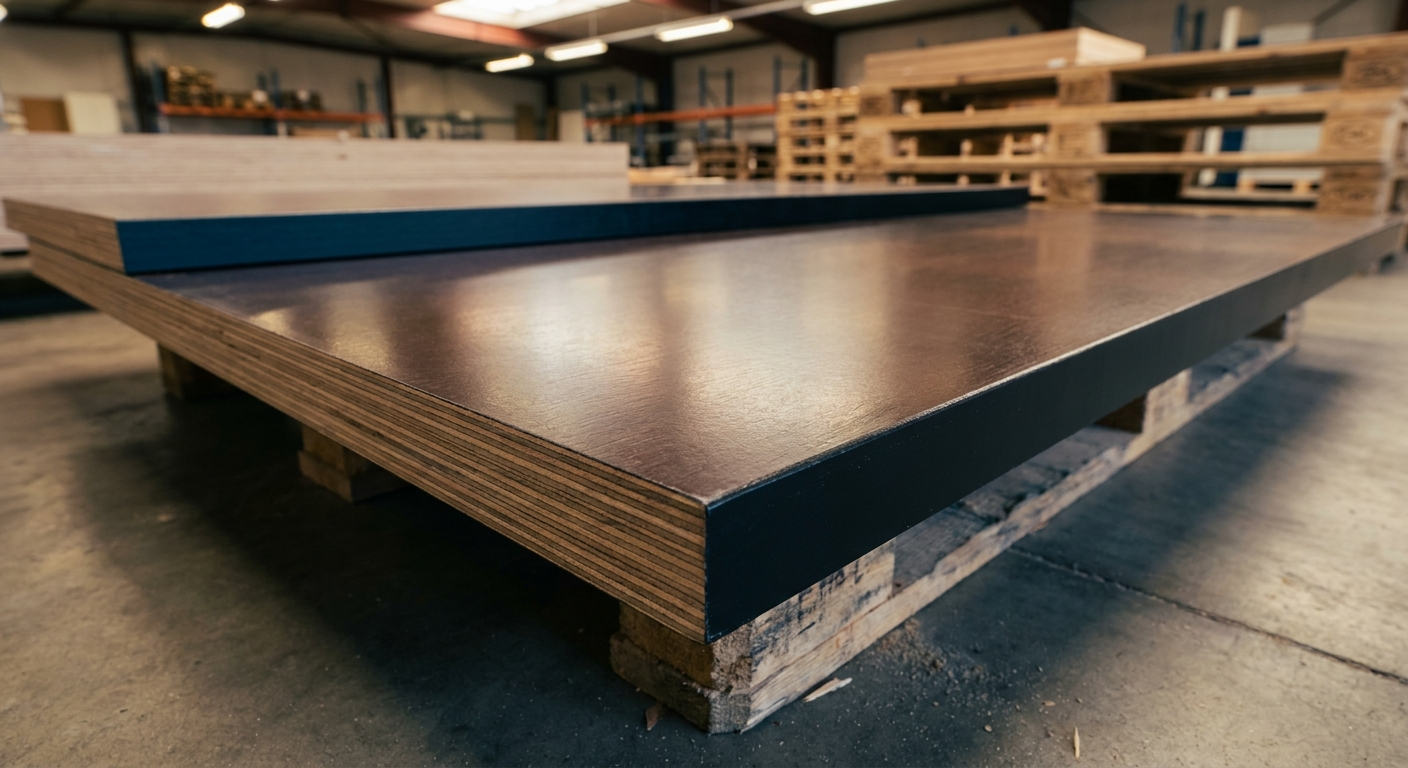
Pull a film-faced sheet off a pallet at a builder's yard in Birmingham and you may count three or four different stamps on its faces and edges — an APA-style block on one corner, a CE mark on another, a small E1 diamond next to a mill number, and a barcode strip down the long edge. Each one answers a different regulator's question, and none of them is decorative. The trouble for the buyer holding the panel is that the stamps overlap in places, contradict each other in others, and routinely use abbreviations the seller cannot explain.
This guide is the manufacturer-side translation. We make panels that carry both North American and European markings, so we will walk through every block the buyer is likely to see, what it certifies, and how to tell whether it is real.
Why a single panel carries so many markings
A plywood sheet is a regulated construction product almost everywhere it lands. North America runs on a Voluntary Product Standard system anchored by APA – The Engineered Wood Association, with formaldehyde overlaid by the EPA under TSCA Title VI. Europe runs on harmonised EN standards declared through CE marking under EN 13986. The UK has bolted UKCA on top of that, Japan uses JAS with its own F-class, and Korea uses KS. A panel built for export carries whichever marks its destination demands.
The result is a top face that reads like a passport with several visa stamps. None of them replace each other. A panel can be APA-rated and CE-marked simultaneously because the two systems test different things — APA covers structural and bond performance, CE covers reaction to fire and formaldehyde emission alongside structural data. Treat each block as answering one specific question, and the visual noise on the panel face starts to make sense.
The APA grade stamp (North America)
The APA stamp is the densest block on a North American-spec sheet. Six fields appear in a stable layout, though the type sizes shift between mills:
| Field | What it means | Example |
|---|---|---|
| Panel grade | Face / back veneer grade pairing (A, B, C, D) and panel use category | RATED SHEATHING, A-C EXTERIOR |
| Span rating | Two numbers: roof span / floor span in inches | 32/16, 48/24 |
| Bond classification | Exposure category: Exterior, Exposure 1, Interior | EXPOSURE 1 |
| Performance category | Nominal thickness in a code-recognised band | 15/32, 23/32 |
| Mill number | Three-or-four digit code that identifies the producing mill | PS 1-19 with Mill 0000 |
| PS standard | The Voluntary Product Standard the panel meets: PS 1 for structural softwood plywood, PS 2 for performance-rated panels | PS 1-19 |
The span rating is the field most buyers actually use. The first number is the maximum centre-to-centre rafter spacing in inches the panel can span as roof sheathing; the second is the joist spacing as floor sheathing. A panel marked 48/24 spans 48 inches on roof and 24 inches on floor when oriented across the supports. Our deeper walk-through of that system lives in our plywood span rating guide.
"Bond classification" is the field most confused with weather resistance. EXTERIOR means the panel meets fully waterproof bond requirements; EXPOSURE 1 means waterproof glue but not necessarily waterproof veneers, intended for protected applications that may get wet during construction. INTERIOR bond panels are now uncommon in retail channels.
CE marking and EN 13986 (Europe)
The CE block on a European-spec panel is more compact than an APA stamp but carries more legal weight. Under the Construction Products Regulation, CE marking is the manufacturer's declaration that the panel meets the harmonised standard EN 13986, Wood-based panels for use in construction. The mark must appear with these elements:
- The CE symbol itself
- Last two digits of the year the mark was first affixed
- Notified body number (four digits) if a third-party initial-type-test was involved
- Manufacturer name and registered address
- EN 13986 reference
- Product identification: for plywood, the EN 636 reference and use class
- Declared performance values: reaction to fire (Euroclass), formaldehyde emission class (E1 or E2), bond quality
A panel without all of these elements is not legally CE-marked, even if it carries the symbol. The full performance set lives in the Declaration of Performance (DoP), a document the manufacturer must make available for every CE-marked construction product. If a seller cannot hand you the DoP, or at least give you a stable URL where it lives, assume the CE on the panel is decorative.
EN 636 service class on the stamp
EN 636 sits inside the CE block as a small reference like EN 636-3 S. The number after the dash is the service class, and it is the European answer to APA's bond classification:
- Class 1: dry conditions only. Indoor furniture, interior cabinetry, dry partition walls.
- Class 2: humid conditions. Roof underlay under cover, kitchen carcasses, intermediate-humidity environments.
- Class 3: exterior. Full weather exposure, concrete formwork that meets weather, marine-adjacent applications.
The trailing letter (S for structural, G for general) tells you whether the panel carries declared mechanical properties for use under load. A structural Class 3 panel is the most common spec for concrete formwork in EU and UK construction. Our Pro Form film-faced plywood is supplied to that spec — EN 636-3 S, phenolic bond throughout, up to 20 reuse cycles depending on site discipline.
EN 314 bond class: the pre-treatment number
EN 314 governs the bonding quality test itself, that is, how a sample is pre-treated before its glue lines are stressed in shear. Three classes are recognised:
| Bond class | Pre-treatment | What it certifies |
|---|---|---|
| 1 | 24-hour soak in cold water | Interior, dry-environment bond |
| 2 | 72-hour soak in 20 °C water plus boil-dry-soak cycle | Humid-environment bond |
| 3 | Boil for several hours, dry, re-soak, re-boil | Fully weather-resistant bond — the "WBP" tier |
EN 314 Class 3 and EN 636-3 are linked but not identical. Class 3 is a glue-line durability test; EN 636-3 is the panel's declared service class, which combines bond, veneer durability and overall construction. A Class 3 bond is required for an EN 636-3 panel, but a panel can technically carry a Class 3 bond and still fail the broader EN 636-3 service-class spec if other elements are out of tolerance. When a stamp shows both, take that as the manufacturer telling you the pair has been tested together.
Formaldehyde emission marks: TSCA, CARB, E-class and F-class
Formaldehyde is the one regulator that genuinely overlaps the others. Every market keeps a separate emission system, and a panel built for export usually carries the relevant mark for each destination:
| Region | Mark | Ceiling |
|---|---|---|
| United States | TSCA Title VI / CARB Phase 2 | 0.05 ppm (hardwood plywood with composite core); 0.05 ppm (veneer core) |
| European Union | E1 or E2 (EN 13986) | E1: 0.124 mg/m³ steady-state; E2 is no longer permitted on the construction market under the 2026 REACH amendment |
| Japan | F☆☆☆☆ (four-star) under JAS | ≤ 0.3 mg/L average |
An E1 mark on an EN 13986 panel sits alongside the CE block. A TSCA Title VI or CARB P2 mark on a North-American-spec panel is usually a separate small block elsewhere on the face. The Japan F-stars appear as visible asterisks: four stars is the cleanest tier, two stars the lowest still permitted in many jurisdictions.
We've sat with buyers who assumed an "E1" panel was automatically clean enough for a Californian distributor. It is not. CARB P2 ceilings are tighter than E1 on some product groups, and US importers should verify the TSCA Title VI block rather than substitute one mark for the other. The marks measure related things, not the same thing.
BS 1088 marine plywood: the Lloyd's stamp
Marine plywood is the place where stamp inflation is most aggressive at retail. BS 1088:2018 is the British Standard for marine plywood — a tightly specified panel with mahogany or okoumé face veneers, full hardwood through-construction, no voids, and a WBP phenolic glue. Genuine BS 1088 panels carry a Lloyd's Register stamp confirming third-party verification, with the mill code and certificate number visible.
What you will find more often in DIY stores is panel marked marine grade without any BS 1088 reference. This is unregulated marketing language. A "marine grade" sticker on a sheet without a Lloyd's stamp tells you the seller thinks it is similar to marine plywood; it does not tell you the panel meets BS 1088. For boat repair and yacht work where the standard is what the surveyor will accept, the Lloyd's stamp is the only document that matters.
Fire-retardant marks: FR-S, Euroclass and DIN 4102
Fire-rated plywood is fire-retardant-treated wood, not "fireproof" wood. The marks identify both the treatment and the test result:
- FR-S (North America): fire-retardant treatment, surface burning Class A under ASTM E84 (Flame Spread Index ≤ 25)
- FR Class A / B / C: same Class system as above, lower tiers permitted in some occupancies
- Euroclass B / C / D-s2,d0 (Europe): reaction-to-fire class under EN 13501, with smoke (s) and droplets (d) sub-ratings
- DIN 4102: German fire classification, common on Schaltafel and structural panels for German sites; B1 is the building-code-relevant class for wood
For background on what these classes actually mean in practice, our piece on fire-rated plywood walks through the test method and where each class is required.
Cross-reference: same panel, different markets
The most useful way to read a stamp grid is by destination. The same Pro Form sheet shipped from Vietnam to four different markets ends up carrying different combinations:
| Destination | Stamps you will see |
|---|---|
| United States (formwork yard) | APA-format mill block (where applicable), TSCA Title VI, mill number, batch / production date |
| United Kingdom (construction site) | CE block (until UKCA-only transition), EN 636-3 S, EN 13986, E1, manufacturer block, batch code |
| Germany (Sichtbeton site) | CE block, EN 636-3 S, EN 13986, DIN 4102 B-class if treated, E1, DBV-Merkblatt reference for fair-face concrete |
| Japan (formwork importer) | JAS stamp, F☆☆☆☆ formaldehyde class, mill number, production lot |
The panel is the same; the stamp grid changes because the market changes. A buyer in Sydney looking at a sheet stamped to UK spec is looking at a perfectly compliant panel for UK use that simply does not carry the Australian AS/NZS 2269 mark the Australian customs broker is paid to check for.
Reading the mill number and date code
The mill number is the most under-used field on any stamp. It identifies which factory pressed the panel, which is the entry point to traceability for warranty, claim, and recall purposes. The mill number paired with a production date code, usually a Julian date, ISO week, or YYYY-MM-DD format, is what the manufacturer needs to pull the QC record for that specific pour, that specific batch, that specific log line.
Buyers who only check the headline grade rarely register the mill number, and then they discover its value when a claim arrives twelve months later and there is no batch information to anchor the conversation. The five seconds it takes to photograph the mill block when the container is unloaded saves an enormous amount of correspondence later.
What is not on a stamp (and why)
A panel stamp does not certify reuse cycles. A "up to 20 cycles" claim from a film-faced plywood manufacturer is a service-life expectation under disciplined site handling, not a stamped guarantee. Stamps also do not certify chain-of-custody: that is the FSC or PEFC mark, which is a separate small block usually on the long edge. Stamps do not declare adhesive type explicitly; you read adhesive class from the EN 314 / EN 636 reference, not from a free-standing "phenolic" mark.
Sustainability claims live in the FSC mark and the chain-of-custody certificate number, not in the stamp. Fire performance lives in the Euroclass or ASTM E84 reference, not in a separate "fire-rated" sticker. Anyone selling a panel on the strength of a free-floating sticker without a standards reference is selling marketing, not certification.
How to verify a stamp is real
Three checks catch most fake or stale marks. First, ask for the Declaration of Performance (DoP). Every CE-marked construction product must have one, and the manufacturer is obliged to make it available. Second, cross-reference the notified body number in the CE block against the EU's NANDO register; the four-digit number identifies the testing body, and a body that does not appear in NANDO does not issue valid CE marks. Third, check the mill code against the manufacturer's published mill list — a phantom mill code on a real-looking stamp is the classic counterfeit signal.
For US-bound panels, ask for the TSCA Title VI Third-Party Certifier (TPC) certificate. The certifier list is published by EPA, and a missing TPC reference on a panel claiming TSCA compliance is treated by US customs as a serious flag.
About Vinawood
Vinawood has manufactured plywood at its own mill in Vietnam since 1992, with full vertical integration from log peeling to surface lamination and exports to more than 55 countries. Our film-faced, MDO, HDO, marine and commercial ranges are stamped to the destination's standards: APA-format for North American shipments where applicable, CE / EN 13986 / EN 636 for EU and UK, JAS for Japan, KS for Korea, BIS for India. Every panel carries a mill number plus production date code for traceability. For the deeper buyer-education companion on grade systems and span ratings, see HDO vs MDO plywood and the film-faced plywood collection. North American buyers can browse the HDO range for matching specs.
Category
how-to
Related Markets
Related Countries
Related Products
▶Sources & References (6)
- APA Trademarks and Grade Stamp Anatomy — APA – The Engineered Wood Association (2024)
- EN 13986:2015 — Wood-based panels for use in construction — CEN (2015)
- EN 636:2012+A1:2015 — Plywood specifications — CEN (2015)
- EN 314-2 — Plywood bonding quality — CEN (1993)
- TSCA Title VI / 40 CFR Part 770 — Formaldehyde Emission Standards for Composite Wood Products — US EPA (2024)
- BS 1088:2018 — Marine plywood requirements — British Standards Institution (2018)