Phenolic Plywood for Scandinavian Construction: Formwork Guide
Complete guide to phenolic film-faced formwork plywood for Scandinavian builders — EN 636 standards, freeze-thaw performance, Nordic terminology (formplywood/formplyfa), reuse economics, and sourcing options including factory-direct import from Vietnam.

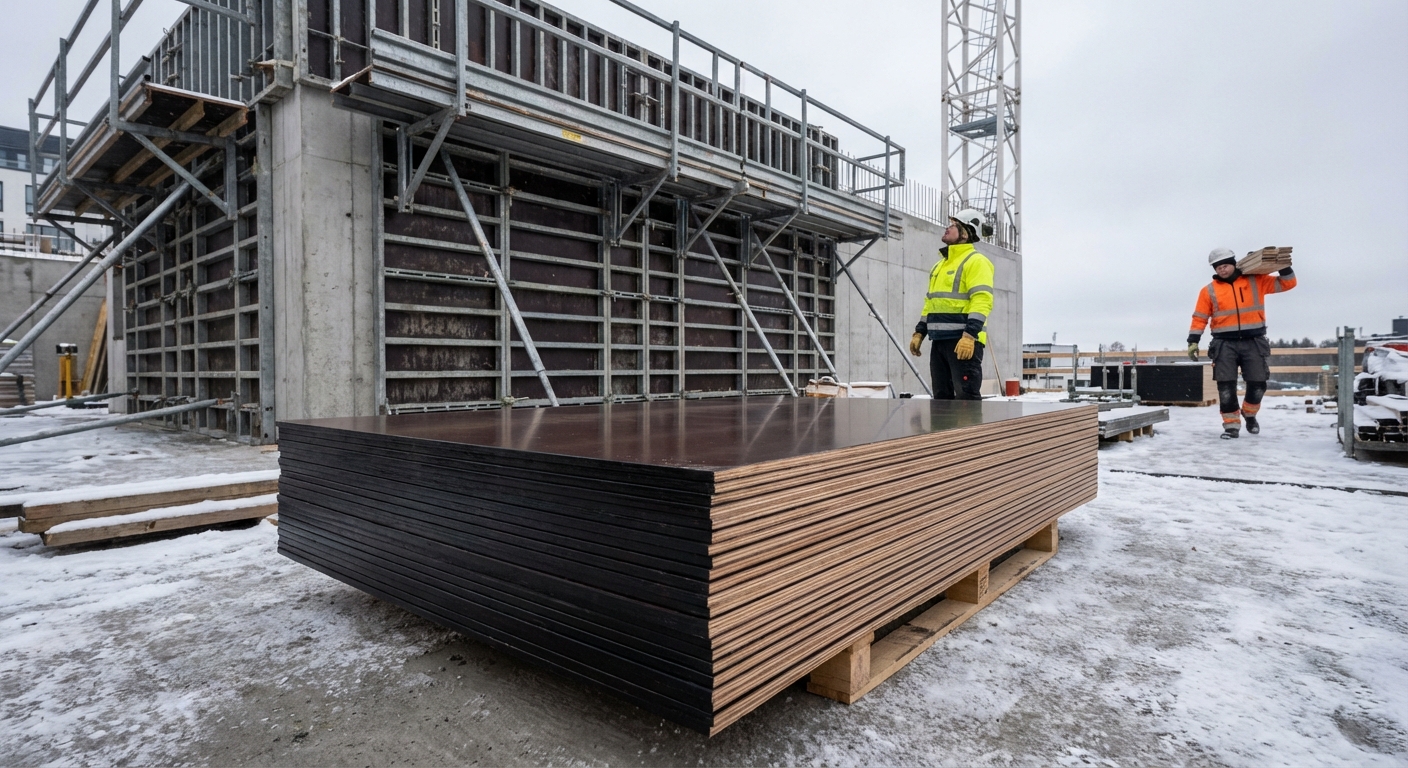
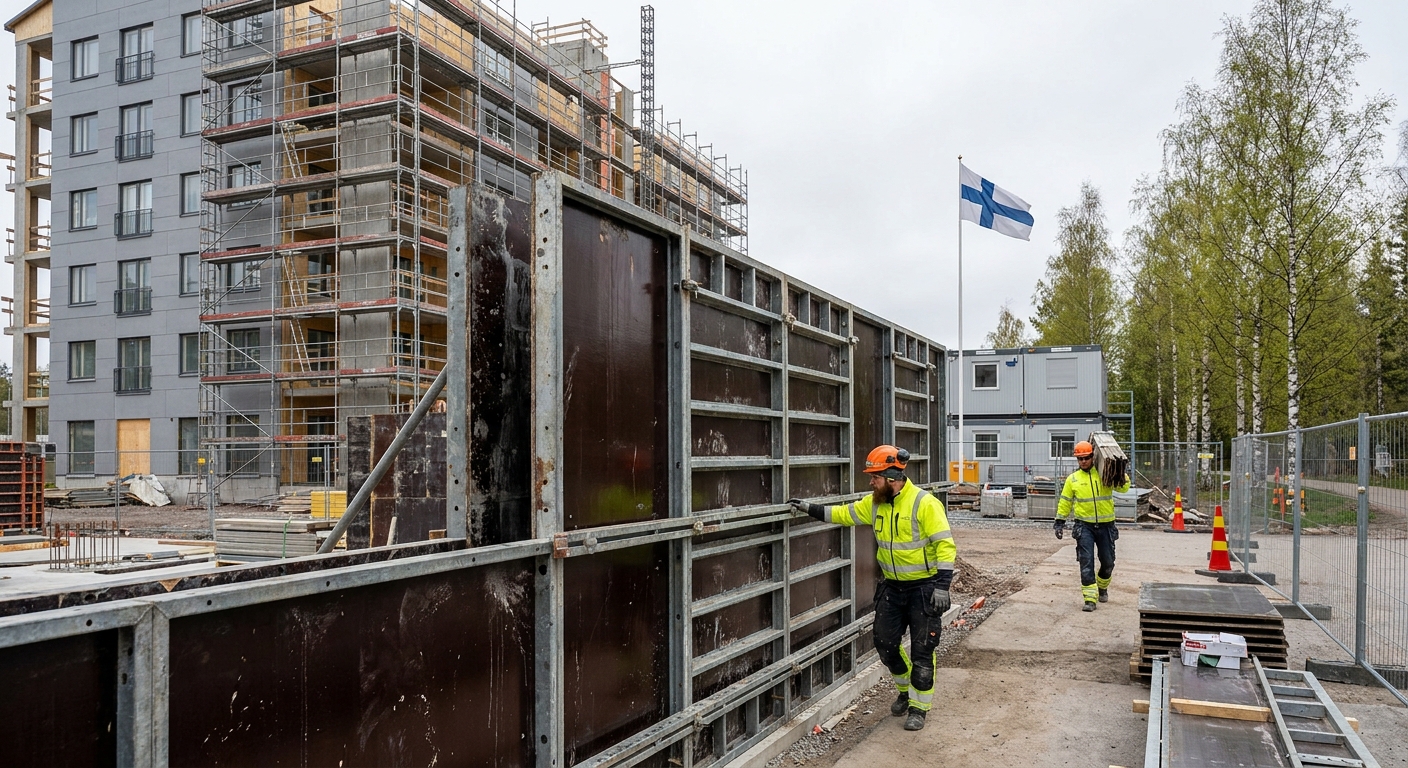
Scandinavian construction operates under conditions that most formwork plywood simply cannot survive. Freeze-thaw cycles that swing from −25°C to +15°C within a single week, extended exposure to rain and snow during Nordic winters, and the expectation of premium fair-face concrete finishes on commercial projects — these demands make phenolic film-faced plywood the default formwork surface across Sweden, Norway, Denmark, and Finland.
This guide covers what phenolic plywood is, why it outperforms alternatives in Nordic climates, the EN standards that govern its use, and how to source factory-direct panels in the sizes and specifications Scandinavian builders require. For a broader European perspective, see the full formwork plywood guide for European construction.
What Is Phenolic Film-Faced Plywood?
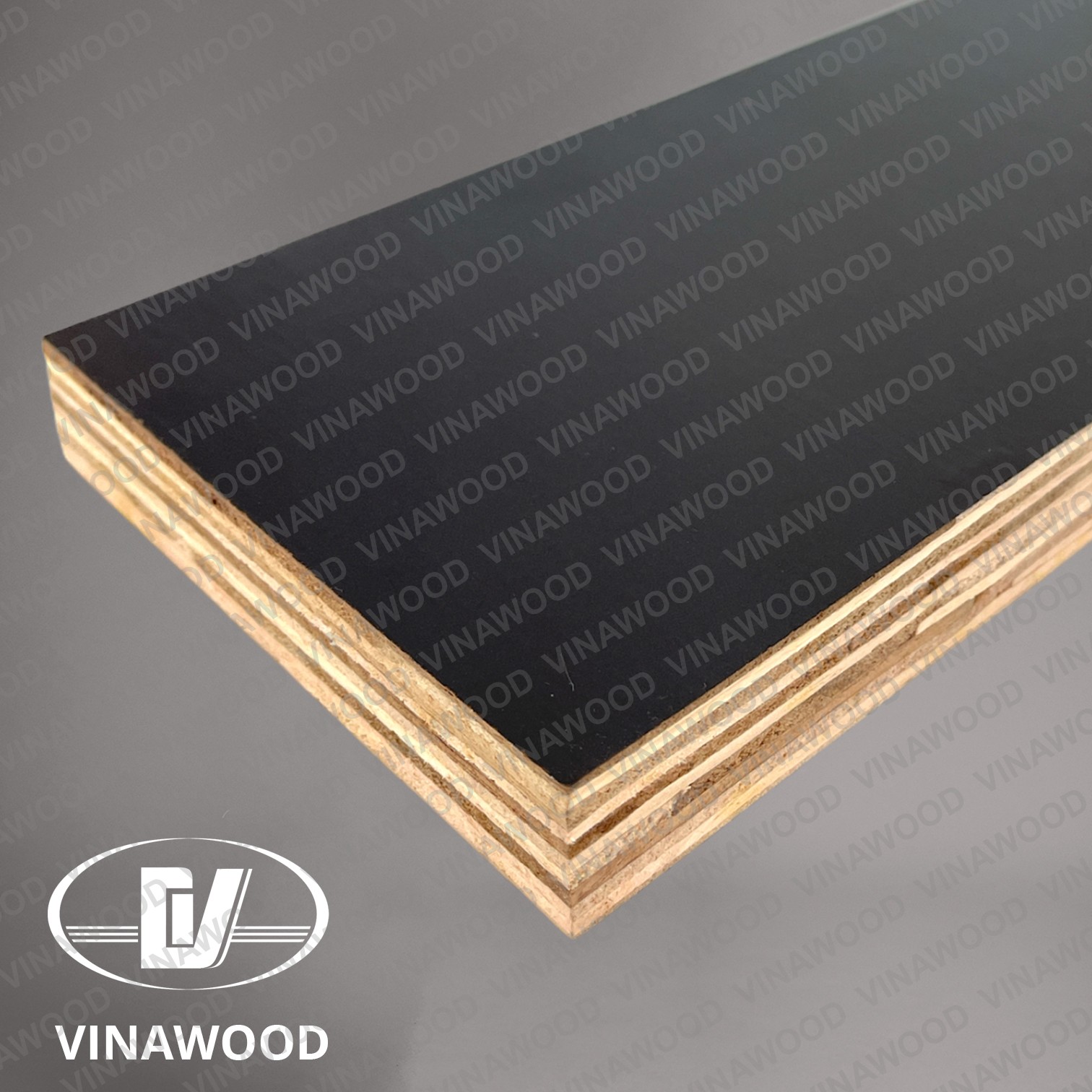
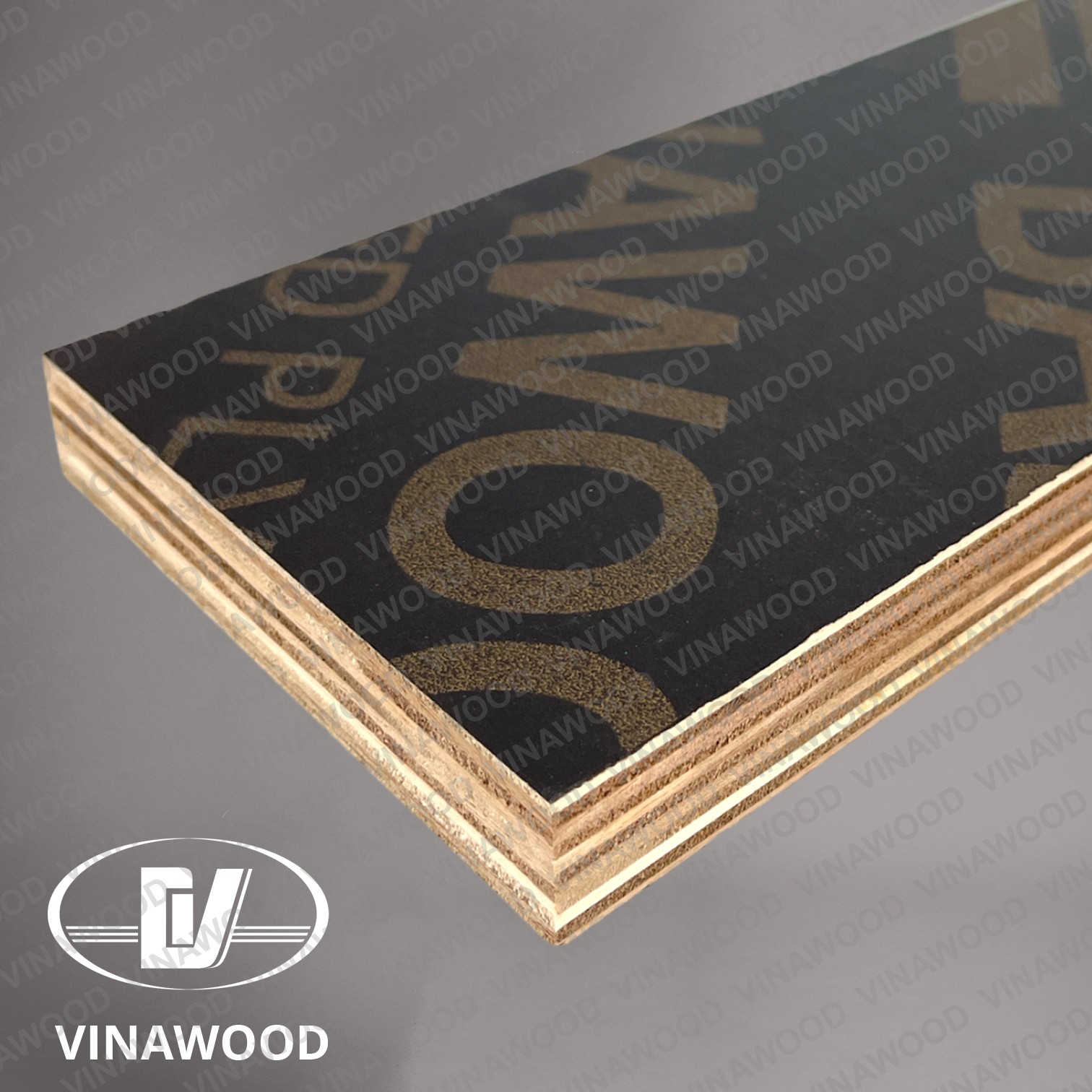
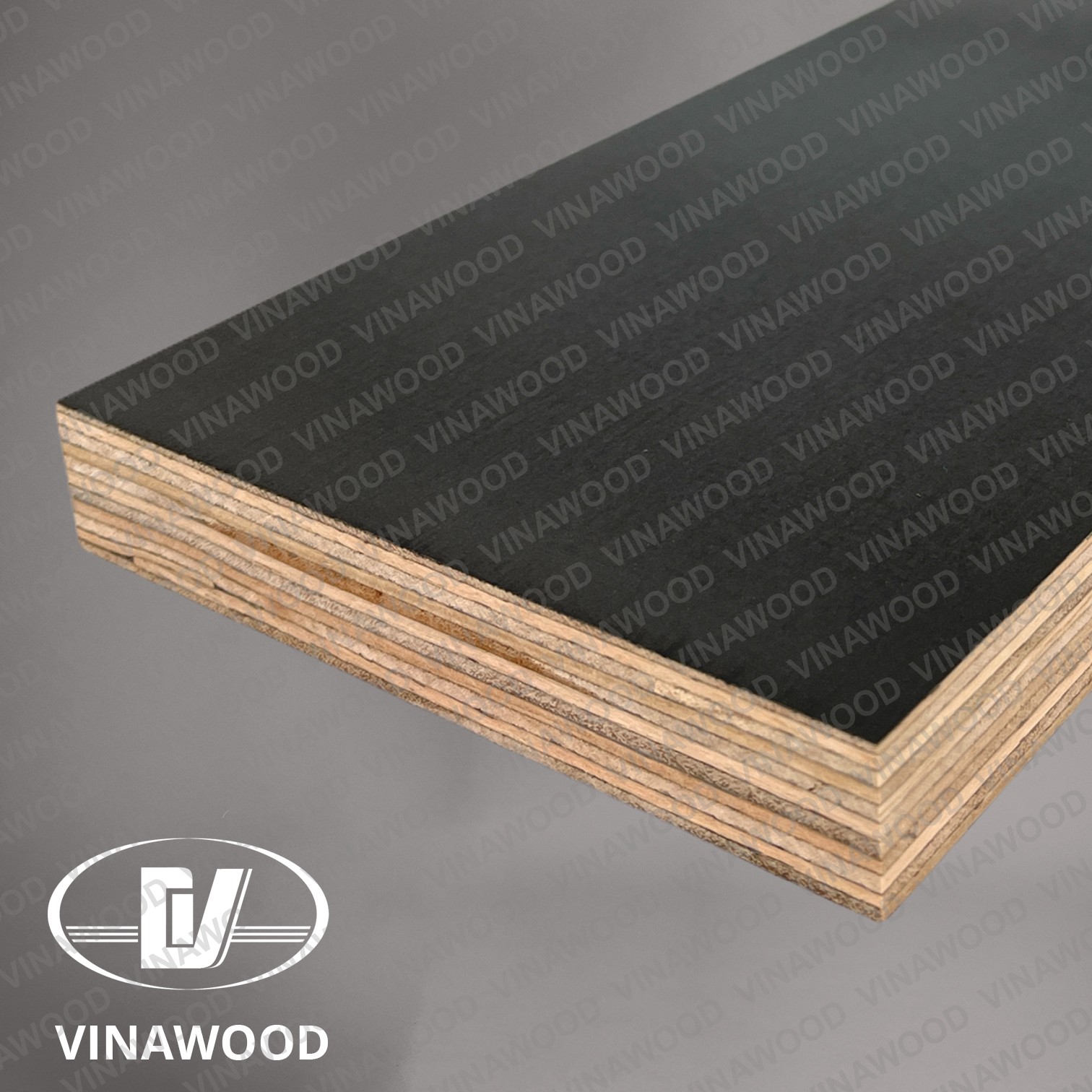
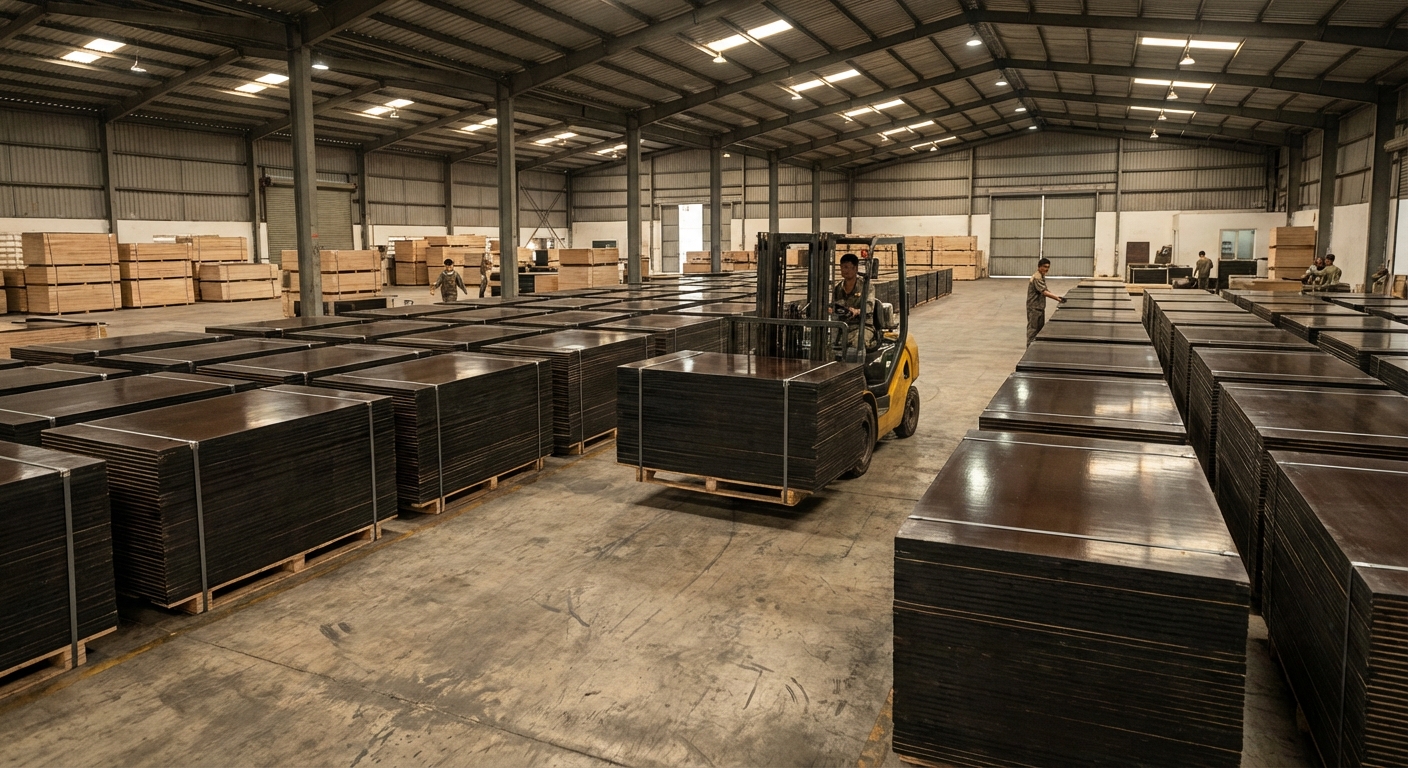
Phenolic film-faced plywood is an engineered wood panel with a cross-laminated hardwood veneer core bonded with WBP (Weather and Boil Proof) phenolic resin adhesive, overlaid on both faces with a phenolic film. The film — a paper-thin layer of 120–220 g/m² phenolic-impregnated paper — creates a smooth, moisture-resistant casting surface that releases cleanly from cured concrete.
The construction is what separates it from standard plywood: every veneer ply is cross-laminated at 90° to adjacent plies, distributing load across both axes. The WBP phenolic adhesive maintains full bond strength under prolonged moisture exposure — critical in Scandinavian conditions where panels may remain exposed to rain, snow, and sub-zero temperatures for weeks between pours.
Key characteristics relevant to Nordic formwork applications:
- Surface: Glossy dark brown phenolic film — smooth casting surface that produces fair-face concrete quality
- Adhesive: WBP phenolic resin — waterproof bond survives freeze-thaw cycling without delamination
- Core: Cross-laminated hardwood veneers — dimensional stability under moisture and temperature variation
- Film weight: 120 g/m² (standard) to 220 g/m² (heavy-duty) — heavier films deliver more reuse cycles
Why Scandinavian Builders Choose Phenolic Formwork Plywood
Three performance factors drive phenolic plywood adoption across the Nordic construction industry.
Freeze-Thaw Resistance
The WBP phenolic adhesive bond does not weaken through repeated freeze-thaw cycles — a property tested under EN 314-1 (bond quality) and EN 314-2 (bond classification). Standard MR (Moisture Resistant) adhesives use urea-formaldehyde resin, which degrades when moisture penetrates the glue line and then freezes. In a typical Stockholm winter, panels on an exposed slab soffit may experience 20–30 freeze-thaw cycles before stripping. Phenolic adhesive panels maintain full structural integrity throughout; MR-bonded panels delaminate within 5–10 cycles.
Reuse Economics
Phenolic film-faced panels deliver significantly more reuse cycles than uncoated alternatives, and the cost-per-pour difference is substantial at Scandinavian labour rates.
| Panel Type | Typical Reuse Cycles | Approx. Cost/Panel (€) | Cost Per Use (€) |
|---|---|---|---|
| Uncoated birch plywood | 3–5 | €15–20 | €3.00–6.67 |
| Film-faced 120 g/m² | 10–20 | €18–25 | €0.90–2.50 |
| Film-faced 220 g/m² | 25–50+ | €25–35 | €0.50–1.40 |
At Nordic labour rates — where a carpenter's loaded cost exceeds €50/hour — the time saved by not replacing damaged panels after every few pours adds significantly to the economic case for phenolic film. Each panel change requires stripping, disposal, fitting a new panel, and realigning — roughly 15–20 minutes of carpenter time per panel on a wall form system.
Fair-Face Concrete Quality
Commercial projects across Scandinavia increasingly specify fair-face (synligt betong / sichtbeton) concrete finishes for interior walls, stairwells, and architectural features. The phenolic film surface produces the smooth, pore-free concrete finish these specifications demand — something uncoated plywood or OSB-faced forms cannot reliably achieve. The film's consistent release properties also reduce surface defects like bug holes and blow holes that require costly remedial work.
Formwork Plywood Standards in the Nordics
All formwork plywood sold in Sweden, Norway, Denmark, and Finland must carry CE marking under the EU Construction Products Regulation. The relevant standards for phenolic formwork plywood are:
| Standard | What It Covers | Relevance |
|---|---|---|
| EN 636-2 | Plywood for use in humid conditions | Standard formwork — protected from direct weather |
| EN 636-3 | Plywood for use in exterior conditions | Exposed formwork — direct rain, snow, freeze-thaw |
| EN 314-1/2 | Bond quality and classification | Adhesive performance — Class 3 required for exterior |
| EN 13986 | Wood-based panels for construction | CE marking framework for structural panels |
| EN 12369-2 | Characteristic values for plywood | Structural design values — bending, compression, shear |
For Nordic formwork specifically: EN 636-3 with Class 3 bond quality (EN 314) is the appropriate specification for exposed formwork that will experience direct weather during the pour cycle. EN 636-2 is acceptable for protected or temporary formwork with short exposure periods.
Sustainability certifications also matter in Nordic procurement. PEFC and FSC Chain of Custody certification are frequently specified in tender documents, particularly for public-sector and municipal projects in Sweden and Norway where sustainable forestry sourcing is a contractual requirement.
Formplywood vs. Formplyfa: Understanding Nordic Terminology
Buyers searching in Swedish encounter several terms for formwork plywood. Understanding the terminology prevents specification errors in procurement:
| Swedish Term | English Equivalent | Search Volume (SE) |
|---|---|---|
| Formplywood | Formwork plywood (general) | 3,600/mo |
| Formplyfa | Formwork plywood (alternative term) | 1,600/mo |
| Konstruktionsplywood | Structural/construction plywood | 1,300/mo |
| Marinplywood | Marine plywood | 1,600/mo |
| Björkplywood | Birch plywood | 1,300/mo |
| Plyfaskiva | Plywood sheet/board | 2,400/mo |
Formplywood and formplyfa both refer to phenolic film-faced plywood used for concrete formwork. The terms are interchangeable in practice, though formplywood is more commonly used in product listings from major Swedish retailers like Byggmax, Beijer Bygg, and Hornbach.
Konstruktionsplywood refers to structural plywood for general construction — sheathing, subflooring, and load-bearing applications. It is NOT the same as formwork plywood and typically lacks the phenolic film overlay needed for concrete casting.
Marinplywood (marine plywood) uses similar WBP adhesive but is manufactured to BS 1088 or equivalent marine specifications. While its moisture resistance is comparable, marine plywood lacks the phenolic film surface and is not optimised for concrete release.
In Norwegian, the equivalent terms are forskalingsplater (formwork panels) and filmbelagt kryssfiner (film-faced plywood). Danish usage follows closely: forskallingskrydsfiner or simply forskallingsplade.
Sizes, Thicknesses & Specifications for Nordic Projects
European-standard formwork plywood is available in metric sheet sizes that align with Nordic construction module dimensions:
| Size (mm) | Application | Availability |
|---|---|---|
| 2500 × 1250 | Standard EU formwork — walls, columns, slabs | Standard stock |
| 2440 × 1220 | Imperial equivalent (4×8 ft) | Available on request |
| 3000 × 1500 | Large-format slab soffit and wall panels | Special order |
The 2500 × 1250 mm size is the preferred specification for Scandinavian projects. It aligns with European modular construction dimensions and reduces cutting waste compared to the imperial 2440 × 1220 mm sheet. The extra 60 mm in length and 30 mm in width provides meaningful coverage gains across large slab pours.
Thickness options for formwork:
- 18 mm: Standard specification for wall, column, and beam formwork at normal stud spacing (400–600 mm). The workhorse thickness across Nordic construction.
- 21 mm: Heavy infrastructure — deep-lift retaining walls, bridge abutments, and pours where concrete head pressure exceeds 3 metres.
- 12 mm: Light-duty applications — slab edges, kickers, curved formwork where panel flexibility is needed.
Sourcing Phenolic Plywood for Scandinavian Projects
Scandinavian builders have three primary sourcing channels for phenolic formwork plywood:
Nordic building merchants (Byggmax, Beijer Bygg, XL-Bygg, Hornbach) stock formplywood in 18 mm × 2500 × 1250 mm as standard. Pricing reflects retail margins — typically €25–40 per sheet depending on film weight and brand. Convenient for small-to-medium projects with immediate stock availability.
European distributors carry broader ranges from Finnish manufacturers (UPM/Wisa, Metsä Wood) and Central European mills. Volume pricing for 100+ sheet orders, 1–2 week lead times within the Nordic region.
Factory-direct import from Vietnam offers the strongest value at container volumes (400+ sheets per 40HC container). Vietnamese manufacturers produce EN 636-2/3 certified phenolic plywood with WBP adhesive, CE marking, and FSC Chain of Custody — the same standards required for Nordic projects, at 20–35% below equivalent European-manufactured panels.
Transit time from Vietnam to Gothenburg or Stockholm is approximately 30–35 days ocean freight. For projects with 6–8 week planning horizons, direct import delivers significant cost savings without compromising specification compliance.
Vinawood Film-Faced Plywood for Nordic Builders
Vinawood has manufactured film-faced plywood in Vietnam since 1992 and exports to construction markets across Scandinavia. Three products in the film-faced range are specified for European formwork applications:
- Eco Form Plus — EN 636-2, 120 g/m² phenolic film, 8+ reuse cycles. Entry-level formwork panel for standard applications.
- Form Basic — EN 636-2, 120 g/m² phenolic film, 10+ reuse cycles. The most widely specified panel across European markets.
- Form Extra — EN 636-3, 220 g/m² phenolic film, 15+ reuse cycles. Heavy-duty panel for exposed conditions and high-reuse requirements.
All panels are available in the 2500 × 1250 mm European metric size at 18 mm and 21 mm thickness. Certifications include FSC Chain of Custody, CARB Phase 2, and CE marking under EN 636. The full range is available in the film-faced plywood collection.
For Nordic projects, Form Extra (EN 636-3) is the recommended specification — the heavier 220 g/m² film and Class 3 bond quality provide the freeze-thaw durability that Scandinavian winter conditions demand.
Frequently Asked Questions
Is phenolic plywood the same as formplywood in Sweden?
Yes. In Swedish construction terminology, formplywood (and the variant formplyfa) refers to phenolic film-faced plywood used for concrete formwork. The phenolic film overlay — a paper-thin layer of phenolic-impregnated paper on both faces — is what distinguishes formwork plywood from standard construction plywood (konstruktionsplywood) in the Nordic market.
Can phenolic formwork plywood survive Scandinavian winters?
Phenolic film-faced plywood with WBP adhesive (EN 636-3, Class 3 bond) is specifically designed for exterior exposure including freeze-thaw cycling. The phenolic resin adhesive does not weaken through repeated freeze-thaw cycles, unlike urea-formaldehyde (MR grade) adhesives which delaminate when moisture freezes within the glue line. Panels meeting EN 636-3 are the correct specification for Scandinavian formwork applications.
What thickness should I use for wall formwork in Sweden?
18 mm is the standard specification for wall, column, and beam formwork at normal stud spacing (400–600 mm). For heavy infrastructure with concrete head pressure exceeding 3 metres — deep retaining walls, bridge abutments — step up to 21 mm. The 12 mm thickness is suitable only for light-duty applications such as slab edges and kickers.
How does Vietnamese plywood compare to Finnish plywood for formwork?
Vietnamese and Finnish phenolic formwork plywood are manufactured to the same EN 636 standards with WBP phenolic adhesive and CE marking. The core species differ — Vietnamese panels use tropical hardwood veneers (acacia, eucalyptus) while Finnish panels use birch — but the cross-laminated construction and phenolic adhesive bond performance are equivalent under EN 314 testing. Vietnamese panels offer a 20–35% cost advantage at container volume, making them increasingly common on Nordic projects where specification compliance is verified through mill test reports rather than brand familiarity.
What is the minimum order for direct import to Scandinavia?
One 40-foot high-cube container holds approximately 400–500 sheets of 18 mm × 2500 × 1250 mm plywood, depending on exact specifications. This is the practical minimum for direct ocean freight from Vietnam to Gothenburg, Stockholm, or Oslo. Transit time is 30–35 days. For smaller quantities, European distributors who stock Vietnamese-manufactured panels offer partial pallet orders with 1–2 week delivery within the Nordic region.
Category
guides
Related Markets
Related Products
▶Sources & References (2)
- EN 636 — Plywood specifications — European Committee for Standardization (2012-01-01)
- EN 314-1 — Plywood bonding quality — European Committee for Standardization (2004-01-01)