Formwork Plywood Defects vs Normal Wear: What's Actually a Problem?
Not every mark on a formwork plywood panel is a defect. This diagnostic guide covers 8 common observations that are actually normal — plus when to investigate further and how to work with your supplier.
Not Every Mark on a Panel Is a Problem
You open a delivery of film faced plywood, pull back the strapping, and immediately spot something: edges that look swollen, color differences between panels, or fine marks on the film surface. Your instinct says defect. But is it?
Most buyers and site teams lack a clear framework for separating normal material behavior from genuine quality concerns. Without one, two things go wrong. Panels that are performing exactly as designed get flagged for replacement — wasting money. Or panels with real issues get overlooked because nobody is sure what to look for.
This guide provides that framework. Part 1 covers eight common observations that look alarming but fall within normal behavior for formwork plywood. Part 2 covers the situations that do warrant further investigation — and how to approach them constructively with your supplier. The goal is practical: know what you are looking at, and respond appropriately.
1. Edge Swelling After the First Pour
What you see: Panel edges swell 1–3 mm after the first concrete pour, especially along cut edges and around drill holes.
Why it happens: Formwork plywood leaves the factory at approximately 8–12% moisture content. The first contact with wet concrete introduces moisture through any unprotected edge. The phenolic film prevents absorption on the face surfaces, so edges absorb disproportionately — particularly where the panel has been cut or drilled on site, exposing the wood core.
Why it is normal: This initial swelling stabilizes after two to three pours as the panel reaches moisture equilibrium with its working environment. It does not affect the panel's structural performance or the quality of the concrete finish produced. Every veneer-core plywood panel on the market — regardless of manufacturer, price point, or origin — exhibits this behavior to some degree.
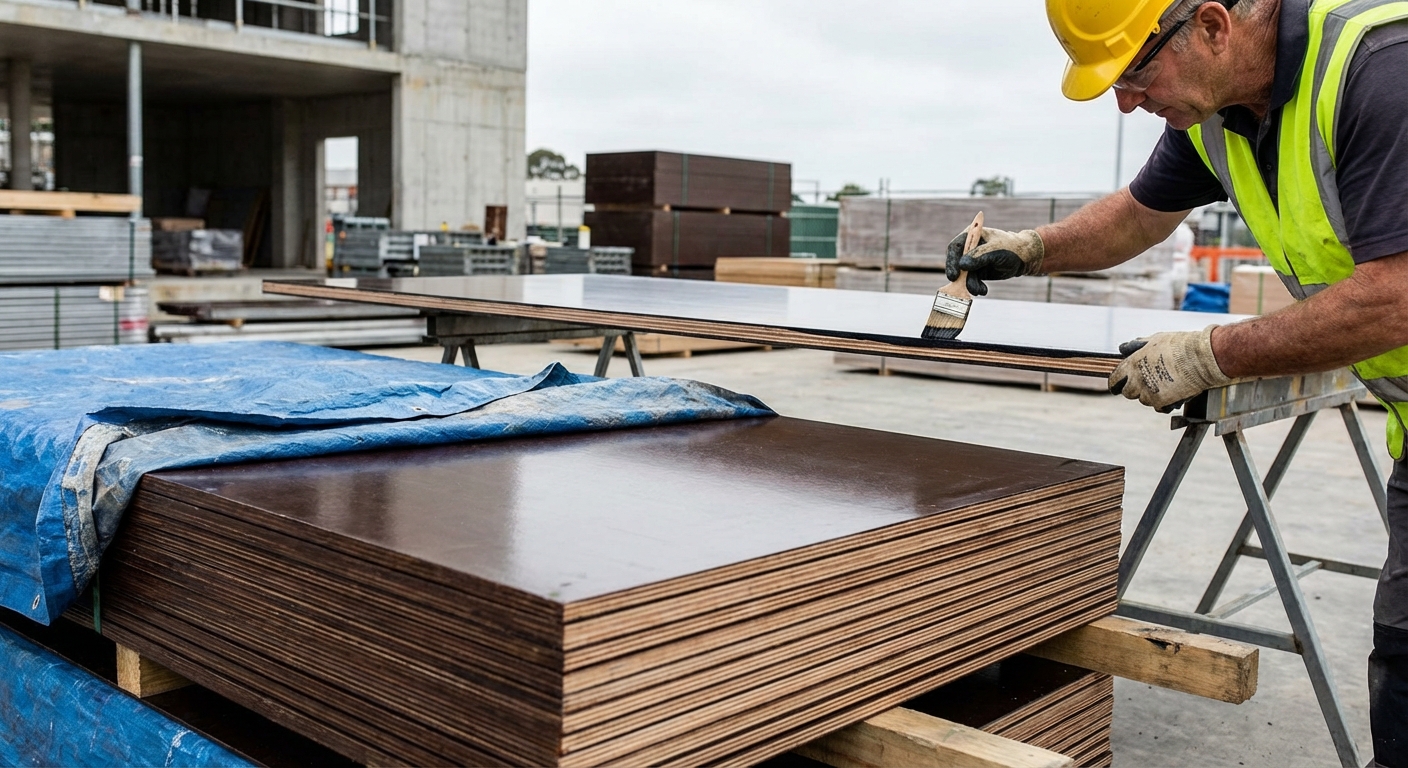
What to do: Seal all cut edges and drill holes with a compatible edge sealant before first use. This reduces first-pour swelling significantly, though it cannot eliminate it entirely. For detailed storage and sealing guidance, see our formwork plywood storage and maintenance guide.
2. Film Color Variation Between Panels
What you see: Panels in the same shipment range from dark brown to near-black, or show slight color differences across a single panel face.
Why it happens: Film color depends on resin formulation, paper weight, pressing temperature, and pressing duration. Small batch-to-batch variations are inherent to the manufacturing process across all producers worldwide. Two panels pressed five minutes apart in the same production line can show visible color differences.
Why it is normal: Color does not indicate quality grade, reuse potential, or bond strength. A lighter brown panel performs identically to a darker one from the same product line. The properties that matter — film adhesion, moisture resistance, surface hardness — are determined by resin chemistry and pressing parameters, not by the resulting visual appearance.
What to do: Nothing. If color consistency matters for aesthetic reasons — which is rare in formwork applications — specify it in your purchase order ahead of time.
3. Surface Scuff Marks After Stripping
What you see: Light abrasion marks, fine scratches, or concrete residue patterns on the film face after stripping formwork.
Why it is normal: Concrete adhesion and the mechanical stripping process create superficial surface marks. This is expected wear from normal use. The phenolic film is engineered to withstand this — minor surface marks do not compromise the film's moisture barrier or its ability to produce a smooth concrete finish on subsequent pours.
When it becomes a concern: If the film is torn through to expose the wood core beneath, that section will absorb moisture on the next pour and degrade faster. Spot-repair small areas with release agent, or retire that panel to non-critical forming areas where surface finish quality is less important.
4. Bowing, Curving, or Distortion
What you see: Panels develop a bow, curve, or slight twist — particularly common on panels thinner than 15 mm.
Why it happens on thin panels: Panels at 12 mm and 15 mm thickness are inherently more flexible and more sensitive to environmental conditions. Even minor differences in humidity between the two faces, uneven stacking, or panels left leaning upright will cause visible deflection. This is a physical property of thin sheet material — not a manufacturing defect.
Why it also happens on thicker panels: Even 18–21 mm panels will bow if stored on uneven surfaces, leaned against walls, or exposed to one-sided moisture or heat over extended periods. Thicker panels resist distortion more effectively, but no wood-based panel is immune to poor storage conditions.
Why this is not a manufacturing claim: A manufacturer cannot control how panels are stored, transported, or handled after they leave the factory. Distortion from environmental exposure and handling is inherent to all wood-based products and results from post-factory conditions. This applies across all manufacturers and price points.
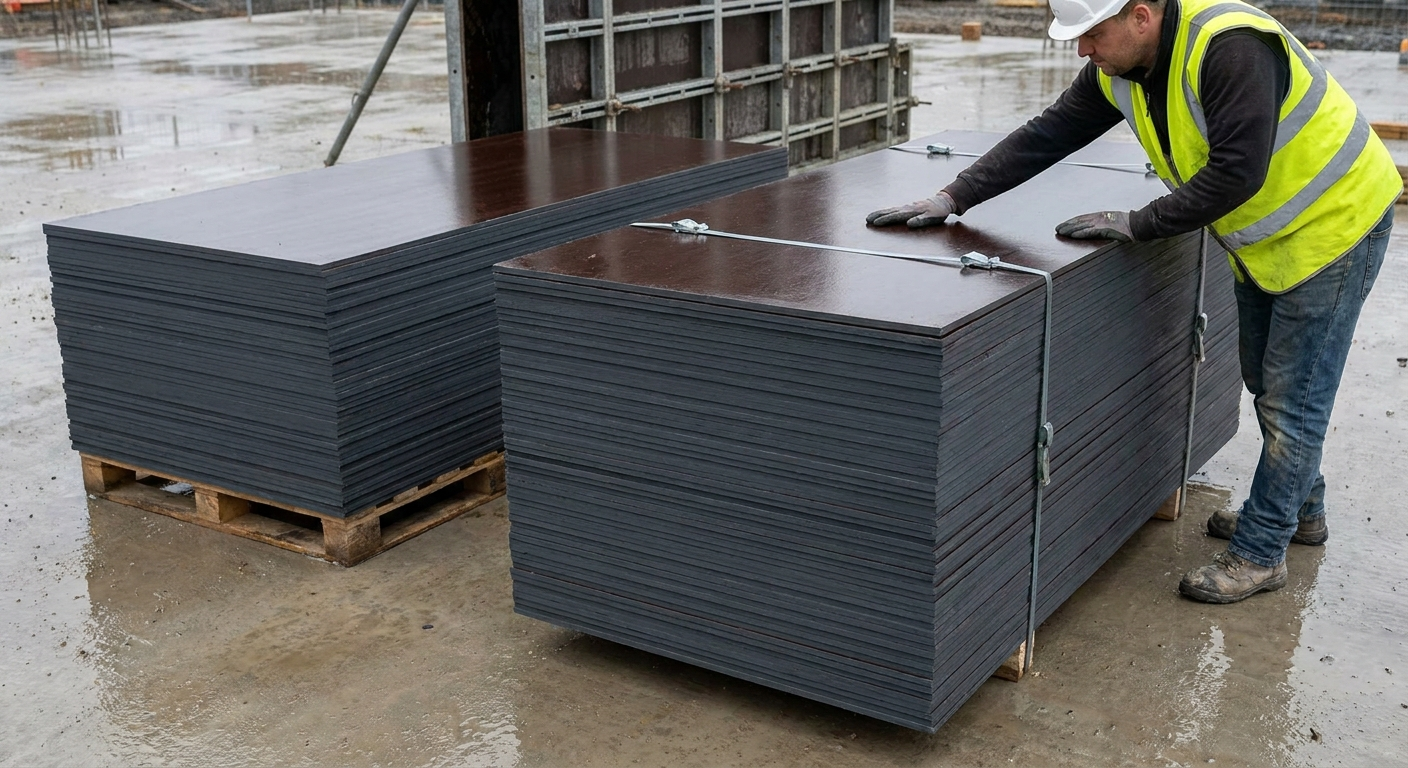
What to do: Store all panels flat on level bearers, off the ground, with support at 400 mm intervals, under cover. Bowed panels typically flatten once installed on formwork bearers under load — this is reversible deflection, not permanent damage. For thin panels under 15 mm, proper storage discipline is especially critical.
5. Film Whitening or Chalking After Sun Exposure
What you see: Panels left in direct sunlight develop a hazy, whitened, or chalky surface appearance.
Why it happens: UV radiation degrades the surface layer of phenolic resin over time. This is cosmetic degradation only — the same process that affects any resin-coated surface left in prolonged direct sun exposure.
Why it is normal: The concrete contact surface quality and bond strength are unaffected. Sun-bleached panels still produce a smooth concrete finish when used with standard release agent application.
What to do: Store panels under cover when not in use. If panels are already sun-bleached, use them normally — apply release agent as standard. For guidance on protecting panels between uses, see our storage and maintenance guide.
6. Core Veneer Color Differences at Cut Edges
What you see: Looking at a cut edge, you see alternating layers of different wood colors — some lighter (eucalyptus), some darker (acacia or mixed tropical hardwood).
Why it is normal: Multi-species core construction is standard practice for tropical hardwood plywood. Different veneer species have different natural colors, and manufacturers select species based on density, availability, and mechanical properties — not visual uniformity. The structural performance of the panel depends on species density and glue bond quality, not on whether every ply looks the same color.
What to do: Nothing. If all veneers are tightly bonded with no visible gaps or separation between layers, the core is performing as designed.
7. Lower Reuse Count Than Expected
What you see: Panels rated for "up to 20 reuses" show significant wear by pour 8–10.
Why it happens: Reuse ratings assume proper handling throughout the panel's life — consistent release agent application before every pour, careful stripping without pry bars on the film face, edge sealing after every cut, and flat covered storage between pours. Omit any of these steps and actual reuse life drops quickly. Site handling is the single largest factor determining how many pours a panel actually delivers.
Why it is not a product defect: "Up to 20 reuses" is a maximum under proper conditions, not a guarantee under any conditions. A Pro Form panel (WBP phenolic, EN 636-3, up to 20 reuses) will reach that number only with disciplined site practices. The same panel on a site with no release agent, steel pry bars, and outdoor storage may not make it past 8 pours — and the panel is not at fault.
What to do: Before concluding the panel is underperforming, audit your site handling practices. The most common culprits are: no release agent application, aggressive stripping with steel tools, panels left in rain between pours, and unsealed cut edges allowing moisture ingress.
8. Minor Core Gaps or Veneer Overlaps at Cut Edges
What you see: Looking at a cut edge, small gaps between core veneers or slight overlaps where veneer sheets meet within the same ply layer.
Why it happens: Veneer-core plywood is made from rotary-peeled sheets that are laid up side by side within each layer. Minor gaps and overlaps at veneer joints are inherent to this construction method — they occur in all veneer-core plywood regardless of manufacturer, origin, or price point. During hot-pressing, adjoining veneers compress into any small gaps, which further reduces their structural impact.
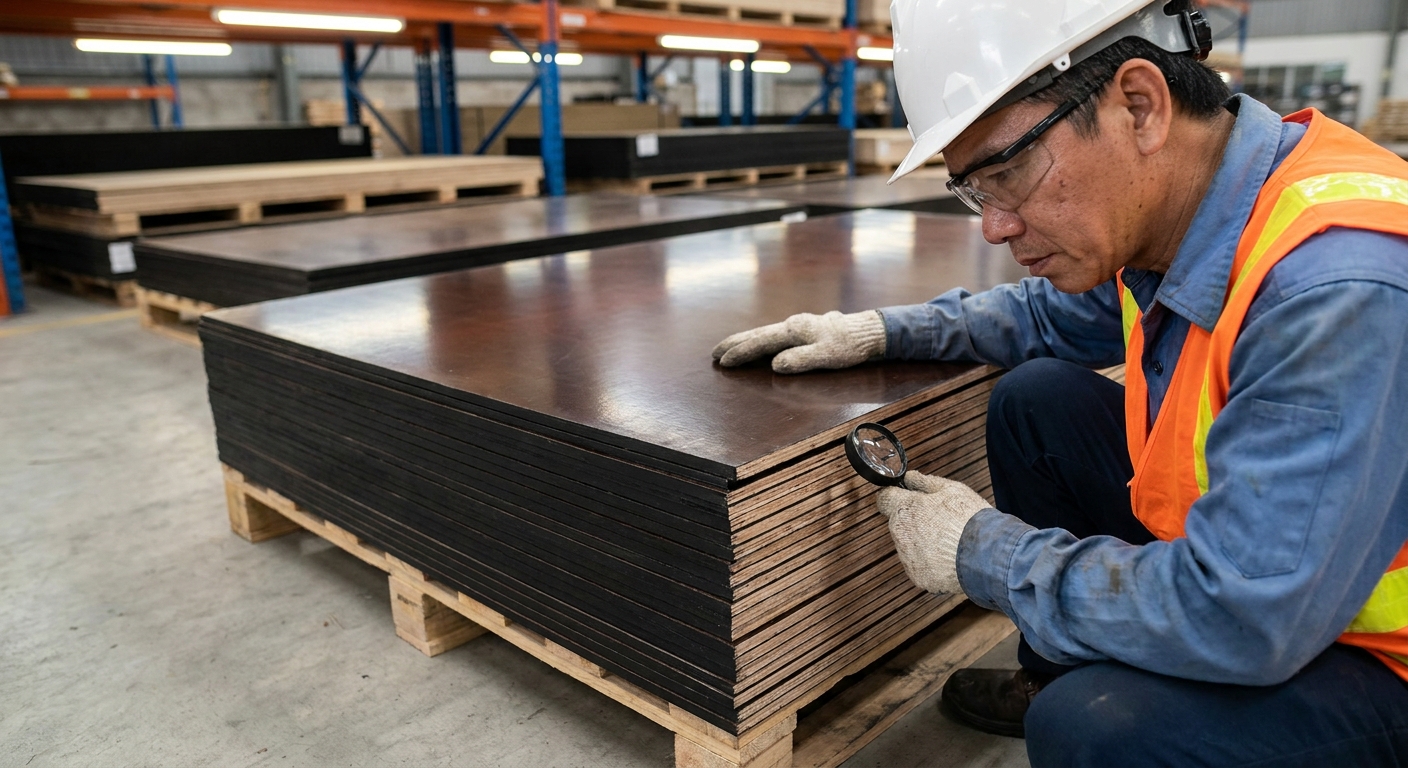
Why it is normal: International grading standards — including EN 635 and ANSI/HPVA HP-1 — allow for a defined degree of core gaps within each grade classification. Small, well-distributed gaps do not meaningfully affect bending strength or panel stiffness because load is distributed across multiple plies in cross-grain orientation.
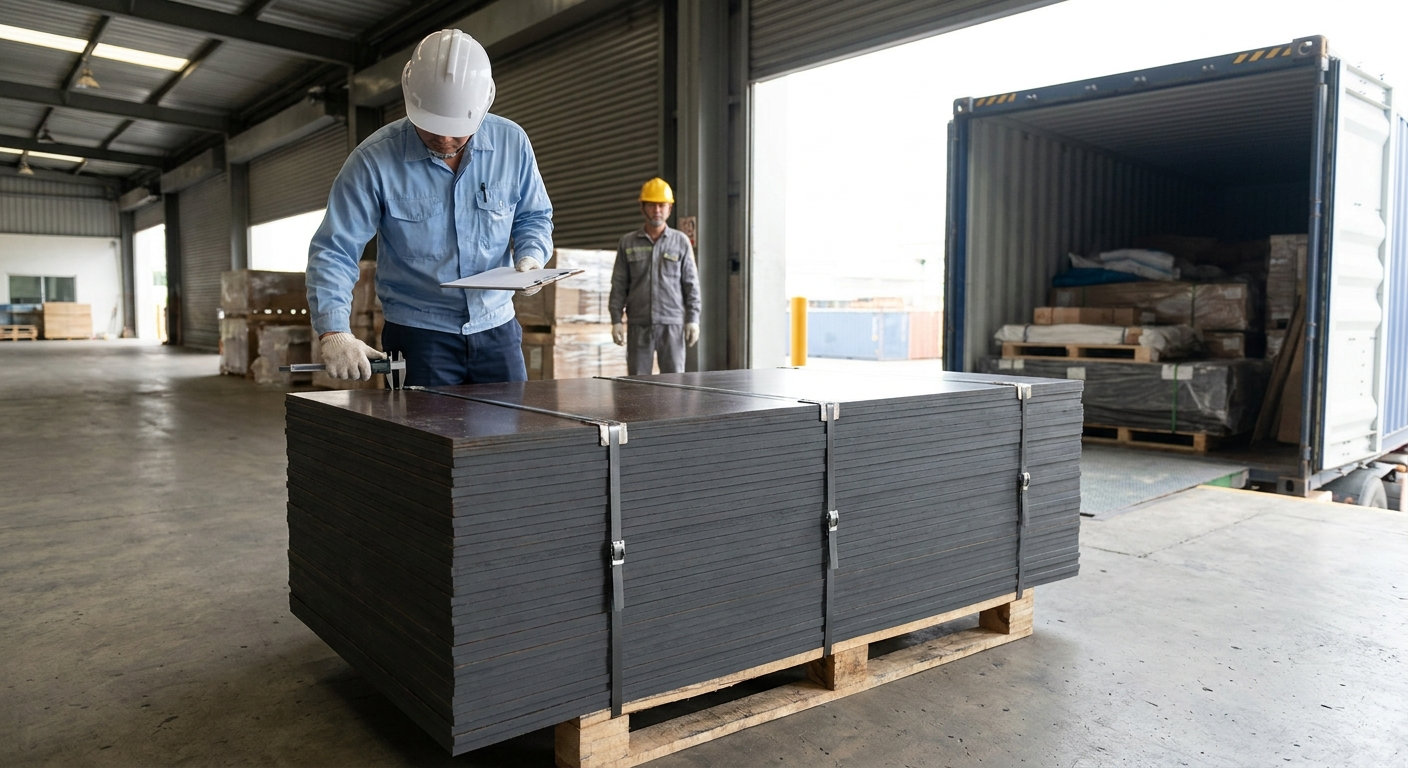
What to do: Judge by performance, not by appearance at the edge. If the panel meets its rated thickness tolerance (per EN 315) and the veneers are well-bonded, it is performing within specification. Concentrated or unusually large voids in a single area may warrant further inspection — see the next section.
When to Investigate Further
In our experience supplying formwork plywood to 55+ countries, the vast majority of panel issues reported from site trace back to storage conditions, transport damage, or handling practices — not to manufacturing. Before concluding that a panel is defective, it is worth investigating the full chain of custody from delivery to discovery.
This is not about assigning blame — it is about finding the real cause so the problem does not repeat on the next shipment or the next project.
Edge Separation — Delamination or Moisture Damage?
What you see: Veneer layers appear to be separating, especially at edges or corners.
Most common cause: Moisture ingress through unsealed cut edges, drill holes, or damaged film. When water repeatedly enters the edge grain, it causes the wood to swell and shrink cyclically, which can weaken the glue line over time. Panels stored on site in rain or standing water are especially vulnerable. Prolonged exposure to high humidity above 75% combined with low temperatures below 5°C can also reduce bond performance.
Less common cause: Insufficient adhesive application or inadequate press time during production can occur with suppliers who reduce glue spread or pressing cycles to cut costs. This is uncommon in quality-controlled factories but may occur with low-cost sources.
How to investigate: Check where the separation is occurring. Edge-only separation that starts at cut or drilled areas almost always indicates moisture damage from site handling. Face-wide separation across the middle of a panel — especially on unused panels that have been stored correctly — may indicate a bonding issue worth raising with your supplier.
What to do: Document the location, extent, and whether the panel was cut or drilled on site. Check storage conditions. If separation is widespread across multiple unused panels from the same batch, contact your supplier with photos and batch numbers for joint investigation.
Film Bubbles or Blisters
What you see: Raised areas in the phenolic film — either on new panels out of packaging, or developing after a few uses.
On new or unused panels: Small isolated bubbles under 20 mm in non-critical areas are cosmetic and can be monitored during use. They may result from minor steam pocket formation during pressing — a known occurrence in high-volume production that does not affect the panel's structural performance or forming capability.
After site use: Bubbles that develop during use are almost always caused by moisture penetrating through a damaged area of the film — a scratch, edge nick, or unsealed cut — and getting trapped under the film during heat exposure from the next concrete pour.
When to escalate: Widespread blistering across multiple new, unused panels from the same batch is uncommon and worth raising with your supplier with documentation. Isolated bubbles on used panels are a handling and maintenance issue, not a manufacturing concern.
Film Surface Cracking or Crazing
What you see: A network of fine cracks in the film surface, sometimes described as a "spider web" pattern.
Most common cause: UV exposure. Panels stored in direct sunlight for extended periods develop surface crazing as UV degrades the phenolic resin layer. This is the same degradation mechanism described in Part 1, but more advanced. The panel typically remains usable, though the damaged film offers less moisture protection going forward.
After repeated use: Film cracking at high-wear areas — around tie holes, at panel edges, along stripping lines — is normal end-of-life wear. The panel has served its purpose and should be retired from critical forming work.
On new panels stored under cover: If crazing appears uniformly across new, unused panels that have been stored correctly under cover and away from direct sunlight, this may indicate a film quality concern. Document the batch information and storage conditions, and raise with your supplier for investigation.
Key point: Always check the storage history before attributing film cracking to manufacturing. Panels left in full sun for even a few weeks will show UV crazing regardless of quality grade.
When Should You Contact Your Supplier?
Contact is warranted when the issue appears on multiple unused panels from the same batch, when panels were stored correctly (flat, covered, off the ground) and still show problems, or when the issue is clearly unrelated to site handling — for example, face-wide delamination on an uncut, undrilled, unused panel.
What to document: Batch or lot number, photos of the face, edge, and detail of the issue, a description of storage conditions on site, and the timeline from delivery to discovery.
A fair approach: A good supplier will investigate jointly rather than dismissing or automatically accepting a claim. The goal is finding the root cause — which protects both parties on future orders. For products engineered for demanding forming conditions, consider Pro Form (WBP phenolic, EN 636-3, up to 20 reuses) or Form Basic (WBP melamine, EN 636-2, up to 10 reuses) depending on your project requirements. Understanding the difference between melamine and phenolic overlays can also help you set appropriate performance expectations from the start.
Quick Inspection Checklist
| What You See | Verdict | Action |
|---|---|---|
| Edge swelling 1–3 mm after first pour | Normal | Seal cut edges before use |
| Film color varies between panels | Normal | No action needed |
| Light surface scuffs after stripping | Normal | Continue using; apply release agent |
| Bowing or curving (especially panels under 15 mm) | Normal | Store flat on level bearers; flattens under load |
| Surface haze after sun exposure | Normal | Store under cover; panel still usable |
| Different wood colors at cut edges | Normal | No action needed |
| Minor core gaps at veneer joints | Normal | Within grade tolerance per EN 635 |
| Reuse count lower than rated maximum | Normal (usually) | Audit handling practices first |
| Edge separation on cut or drilled panels | Investigate | Check moisture exposure history |
| Isolated small film bubble under 20 mm | Monitor | Cosmetic; track during use |
| Film crazing after sun or weather exposure | Site-related | UV damage; panel still usable |
| Widespread blistering on unused panels | Investigate | Document batch; contact supplier |
| Face-wide delamination on unused panel | Investigate | Document and contact supplier |
The Bottom Line
Most observations flagged as "problems" on formwork plywood trace back to normal material behavior or site handling conditions — not to manufacturing defects. Understanding the difference saves money, avoids unnecessary claims, and builds a more productive relationship with your supplier.
When issues do warrant investigation, document thoroughly and work with your supplier to find the root cause together. A collaborative approach protects both parties and prevents repeat issues on future orders.
Have a panel you are unsure about? Vinawood's technical team can help you assess it — contact us with photos and batch details for a joint evaluation.
Category
how-to
Related Markets
Related Countries
Related Products
▶Sources & References (4)
- EN 635 — Plywood — Classification by surface appearance — CEN (European Committee for Standardization) (2014-01-01)
- EN 314 — Plywood — Bonding quality — CEN (European Committee for Standardization) (2001-12-01)
- EN 315 — Plywood — Tolerances for dimensions — CEN (European Committee for Standardization) (2000-01-01)
- ANSI/HPVA HP-1 — American National Standard for Hardwood and Decorative Plywood — Hardwood Plywood & Veneer Association (2020-01-01)