Plywood Bracing for Australian Walls: AS 1684 F-Grade Spec, Thickness Tables & Wind-Zone Selection
AS 1684 plywood bracing decoded for Australian licensed builders: how wind zones drive bracing demand in kN/m, how F-grade panels carry it, and a practical thickness-by-stud-spacing reference for N1 through C4. Plus the EWPAA marks to look for, the fixing detail that decides whether the panel…
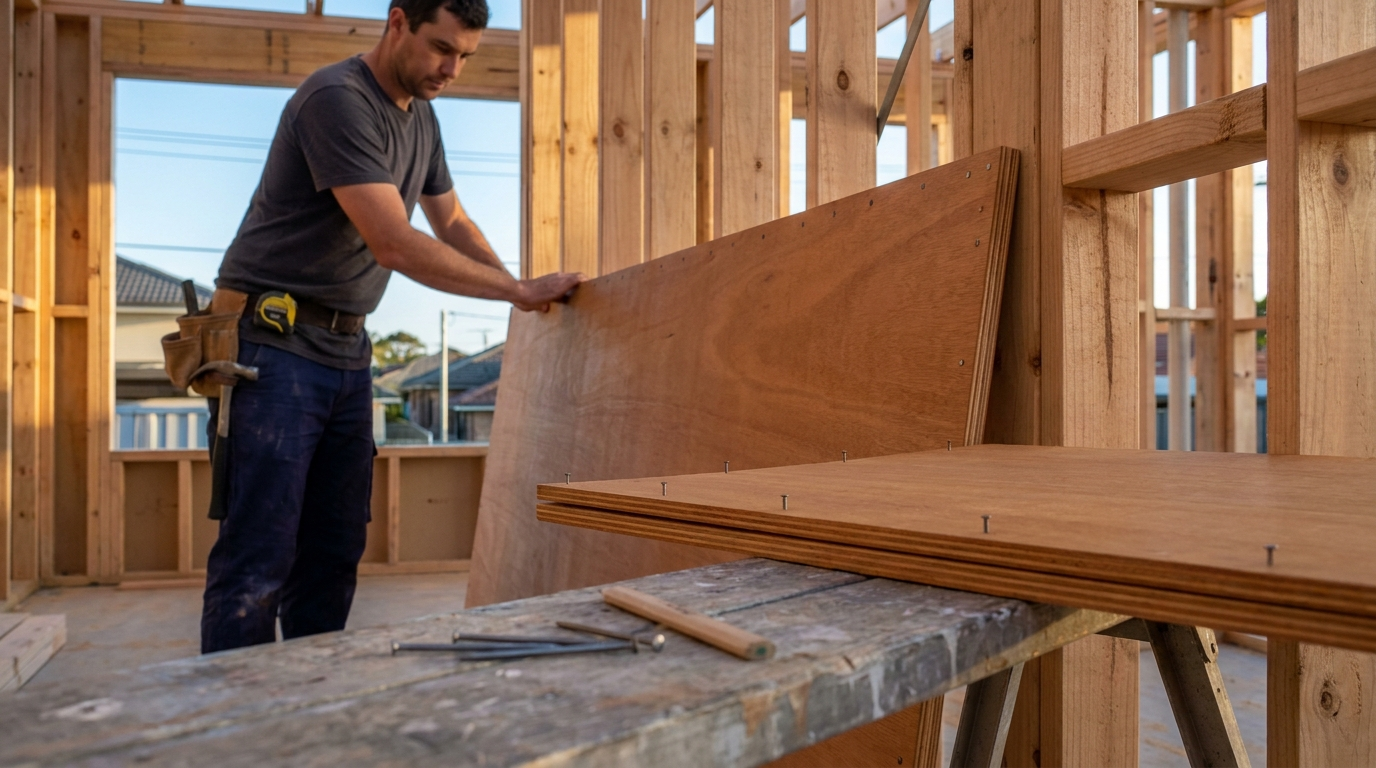
On any AS 1684 site, the wall sheathing earns its keep when the wind hits. A bracing wall is a load path, not a finish. The panel takes the racking force from the cladding, transfers it through the stud frame, and hands it off to the hold-down hardware at the top and bottom plates. Pick the wrong panel grade or skip the fixing detail and the wall passes inspection by chance, not by design.
This guide ties the AS 1684 wind classification language to F-grade plywood, thickness and stud-spacing tables, and the fixing details that decide whether the panel actually delivers its rated racking capacity. Written for licensed builders, certified carpenters and volume residential framers, not for DIY.
What plywood bracing actually does
A bracing wall acts as a shear diaphragm. Lateral wind loads on the cladding push horizontally against the studs; the studs cannot resist that push on their own because they pivot at the plates. The plywood skin, nailed or screwed to the stud framing on a tight perimeter pattern, locks the studs into a stiff rectangle that resists racking. The panel transfers the wind load along its face and into the framing edges, which then carry it down to the bottom plate and out to the slab or footings via the hold-down hardware.
That is the load path. Any weakness in it — wrong panel grade, wide fixing spacing, missing hold-down at the plate joint — collapses the diaphragm and the wall racks in the wind.
AS 1684.4 wind classification primer
The first decision is not about plywood. It is about how much wind the wall has to resist. AS 1684.4 and the National Construction Code split the country into wind classifications:
| Wind class | Typical exposure | Bracing demand |
|---|---|---|
| N1, N2 | Sheltered to suburban inland | Low (typ. 1.0–2.5 kN/m) |
| N3 | Exposed suburban / coastal sheltered | Moderate (typ. 2.5–3.5 kN/m) |
| N4 | Exposed coastal non-cyclonic | High (typ. 3.5–5.0 kN/m) |
| C1, C2 | Cyclonic coastal (Northern QLD, NT) | High to severe (typ. 5.0–7.0 kN/m) |
| C3, C4 | Severe cyclonic | Severe (typ. 7.0–9.5 kN/m) |
The site engineer or designer issues the bracing schedule based on these zones before the panel decision starts. A plywood spec that is correct for an N2 build in suburban Adelaide is undersized for an N4 build in Wollongong.
F-grade structural plywood explained
F-rating is the Australian / New Zealand stress grade for structural timber and plywood under AS/NZS 2269. The number is the characteristic bending strength in MPa. F11, F14, F17, F22 and F27 are the grades you see in bracing supply.
| Grade | MoE (GPa) | Bending strength (MPa) | Typical use |
|---|---|---|---|
| F8 | 9.1 | 22 | Light structural, formwork |
| F11 | 10.5 | 31 | Interior bracing protected |
| F14 | 12.0 | 36 | Standard bracing |
| F17 | 14.0 | 42 | Heavier bracing, floors |
| F22 | 16.0 | 55 | Workhorse AU bracing grade |
| F27 | 18.5 | 69 | High-demand bracing, cyclonic |
F22 hardwood plywood is the AU bracing default for a reason: it gives substantial racking capacity at a thin section (4 mm or 7 mm), it tolerates site humidity during construction, and the supply chain through Bunnings, Bowens, Hurfords and the trade merchants is set up around it. F27 appears in coastal and cyclonic builds where the bracing demand exceeds F22 capacity in the thickness available.
Thickness tables — panel section vs stud spacing
The panel section determines the racking capacity for a given fixing pattern and stud spacing. Two stud spacings dominate AU framing: 450 mm centres (heavier loaded walls, two-storey) and 600 mm centres (single-storey, lighter loaded).
| Panel thickness | Studs at 450 mm | Studs at 600 mm |
|---|---|---|
| 4 mm F22 | Up to ~3.5 kN/m | Up to ~2.7 kN/m |
| 7 mm F22 | Up to ~4.5 kN/m | Up to ~3.5 kN/m |
| 9 mm F22 | Up to ~5.5 kN/m | Up to ~4.5 kN/m |
| 12 mm F22 | Up to ~6.5 kN/m | Up to ~5.5 kN/m |
The values above are indicative for an interior-protected wall with the standard fixing pattern (perimeter 150 mm, field 300 mm). For the binding bracing capacity on any specific build, the certifier reads the EWPAA panel-rated table against the engineer's bracing schedule, not a generic article like this one. Use the table for selection conversations with the supplier, then verify against the panel's EWPAA technical note for the actual build.
Nail spacing and panel fixing
The fixing pattern is half the diaphragm. A panel of the right grade and thickness with a sloppy nailing pattern carries less than a thinner panel with the correct schedule.
The standard AS 1684 fixing pattern for plywood bracing:
- Perimeter spacing: 150 mm centres along all four edges of every panel.
- Field spacing: 300 mm centres along intermediate studs and noggings.
- Edge distance: Minimum 10 mm from the panel edge to the centre of the fixing.
- Fastener: Type 17 wood screws or flat-head clouts (2.8 × 30 mm typical for 4 mm and 7 mm panels).
Gun-driven flat-head nails are the production-rate default; hand-driven clouts give better edge control but slow the framer down significantly. On a wind-classified build where the bracing schedule pushes panel capacity hard, the perimeter spacing matters more than the field spacing — sloppy edge nailing is the most common reason bracing audits fail.
Hold-down details
The diaphragm only works if the plate connection works. A correctly specified F22 panel that's fixed to a top plate with no hold-down to the studs above (or no hold-down to the slab below) cannot transfer the racking load. The wall passes a casual visual inspection, then fails the wind it was rated for.
The hold-down detail varies by wall type. Single-storey N1–N3 walls typically rely on the M12 bolt and washer at the bottom plate plus standard top-plate joint fixings. Two-storey or N4-plus walls need an explicit hold-down bracket (a strap or a proprietary bracket like Pryda or MiTek) that connects the bottom of the upper-floor stud to the top of the lower-floor stud through the floor joist line. Cyclonic zones (C1–C4) require continuous tie-down from rafters to footings.
EWPAA grading marks — what to look for
An EWPAA-stamped panel is the audit-friendly proof point. Look for the EWPAA panel mark on the face or edge of the sheet, including the F-grade, the manufacturer code, the AS/NZS 2269 reference, the bond type (Type A for phenolic, Type B for melamine), and the formaldehyde emission class (E0 or E1). Where a panel is sold as "structural" without the EWPAA stamp, the certifier may refuse to credit it against the bracing schedule.
Plywood bracing vs steel angle vs metal strap
Plywood is not the only AS 1684 bracing solution. Steel angle bracing (a diagonal piece bolted across the wall stud face) and metal strap bracing (a tensioned strap let into the stud line) both have a place. The choice usually comes down to wall geometry, available bracing capacity in the schedule, and trade preference.
| Bracing type | Best for | Watch out for |
|---|---|---|
| Plywood sheathing | Continuous walls, high bracing demand, weatherboard backing | Fixing schedule discipline |
| Steel angle | Short walls, retrofit, narrow panels | Lower capacity per metre, install precision |
| Metal strap | Open walls, cost-driven builds | Tensioning, panel-line straightness |
From our manufacturing side, we see the F22 hardwood bracing volume hold steady year on year while the lighter F-grade categories see more substitution to strap bracing on cost-driven builds. The plywood option keeps its edge wherever the bracing schedule is dense and the framer wants one product across multiple wall types.
Three failure modes to avoid
- Non-structural ply used as bracing. Decorative plywood or interior-grade panels look similar at the bin but lack the F-grade certification. The EWPAA stamp is what separates structural ply from cabinet-grade.
- Right thickness, wrong adhesive class for the exposure. Site humidity during construction degrades a Type B (melamine) bond more than a Type A (phenolic) bond. For AU bracing applications that may sit open to weather for weeks, phenolic-bonded panels survive better.
- Skipping the hold-down detail. The most common audit failure isn't the panel itself — it's the missing or wrong hold-down at the plate connection. The diaphragm is only as strong as the load path out of it.
At-a-Glance — picking the right bracing panel
- N1–N2 suburban build, single-storey: 4 mm F22 hardwood ply at 600 mm stud centres covers most bracing schedules.
- N3 exposed suburban, two-storey: 7 mm F22 at 450 mm centres, with explicit hold-down at the upper-storey plate line.
- N4 coastal non-cyclonic: 7 mm or 9 mm F22, perimeter fixing at 150 mm enforced, hold-down at every plate joint.
- C1–C4 cyclonic: F27 panel, continuous tie-down from rafter to footing, separate engineer's bracing schedule.
Where Vinawood structural plywood fits
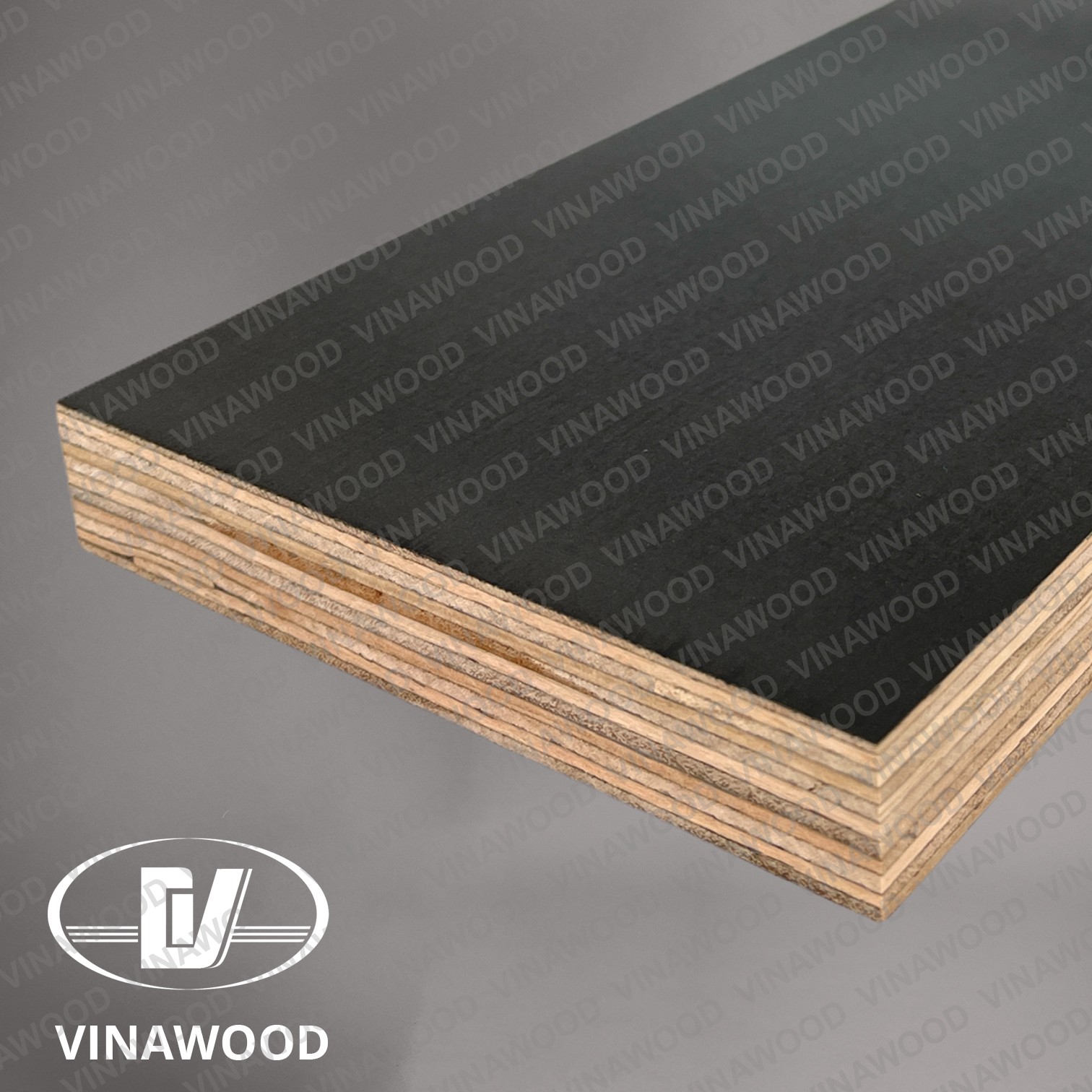
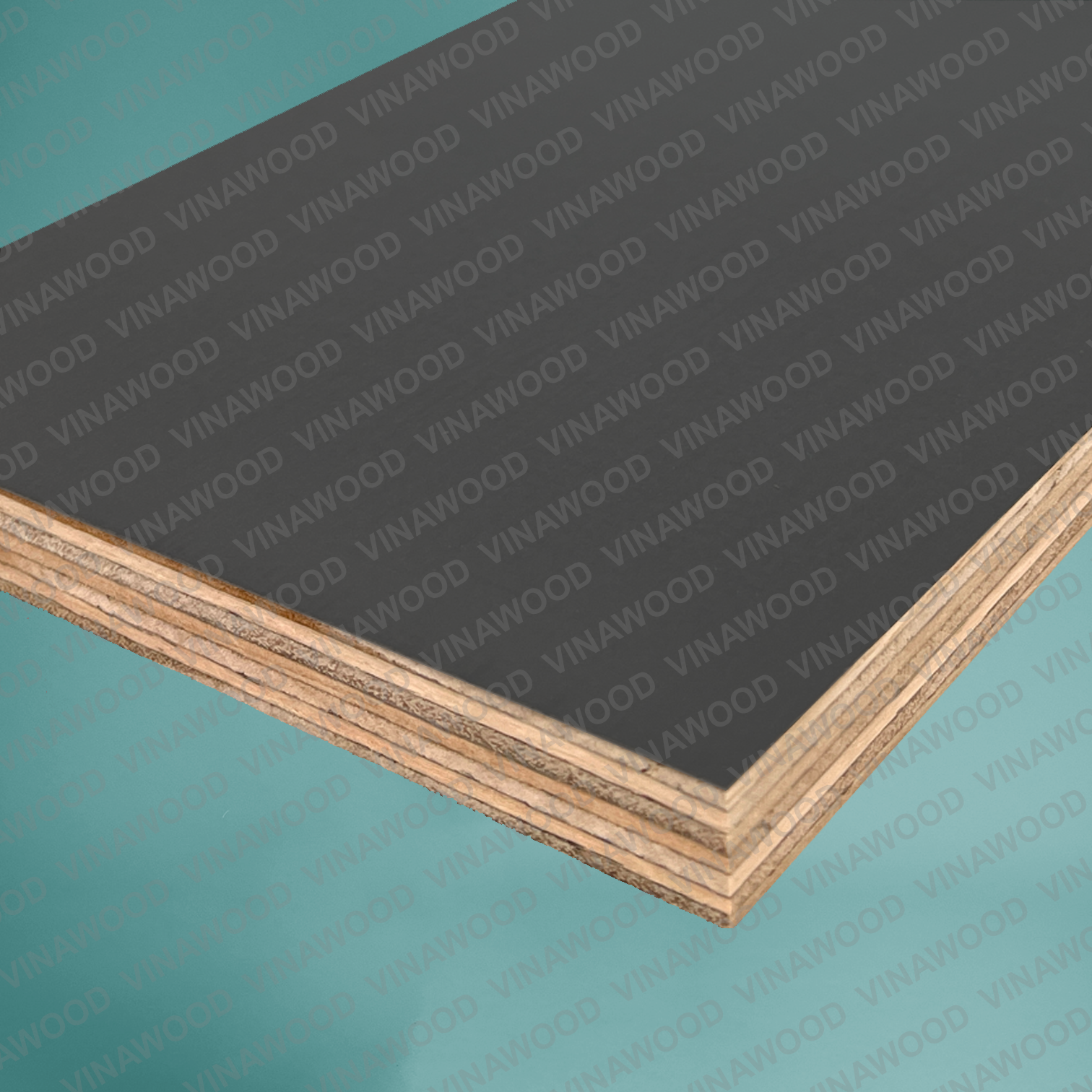
Vinawood is a Vietnamese plywood manufacturer with a structural range that supplies the F11–F14 segment for interior-protected bracing and the phenolic Class 3 line (Pro Form) for exposed-edge or weather-exposed bracing scenarios. Our HDO Premium 2S panel is used where the wall sheathing doubles as a weather face during a long build window. We don't compete with EWPAA F22 hardwood ply on the dominant AU bracing slot — that's a market the local mills serve well. Where we add value is on heavier-duty exposure cases, on container builds that need a structural skin with a phenolic face, and on price-sensitive structural builds where the EN 636-3 phenolic spec is acceptable to the certifier.
For context on related AU formwork specs, see our notes on form ply Australia and formwork plywood Australia. For sheet dimensions and standard formats, plywood sizes.
About Vinawood
Vinawood is a Vietnamese plywood manufacturer founded in 1992, exporting to 55+ countries and over 5,000 containers per year. Structural range covers F11–F14 (interior-protected use) with the option to spec phenolic Class 3 (EN 636-3) for exposed cases via the Pro Form and HDO Premium 2S products. Certifications: FSC-COC, CE per EN 13986, CARB Phase 2, ISO 9001. Factory-direct to Australia via Port of Melbourne, Sydney and Brisbane container traffic. Contact for technical data sheets, EWPAA-equivalent specifications, and bracing-application advice at vinawoodltd.com.
Category
guides
▶Sources & References (4)
- AS 1684.4 — Residential Timber-Framed Construction (Simplified, Non-Cyclonic) — Standards Australia (2010)
- AS/NZS 2269 — Plywood Structural — Standards Australia / Standards New Zealand (2012)
- Structural Plywood — Technical Note — Engineered Wood Products Association of Australasia (EWPAA) (2023)
- National Construction Code Volume Two — Wind classification — Australian Building Codes Board (2022)