Plywood vs Lumber: When Sheet Goods Beat Dimensional Lumber (and When They Don't)
Plywood vs lumber is the wrong framing — they don't replace each other in any meaningful application. This guide maps the decisive properties (stability, strength direction, cost per board-foot, workability), explains where LVL and lumber-core fit, and gives a side-by-side application matrix from…
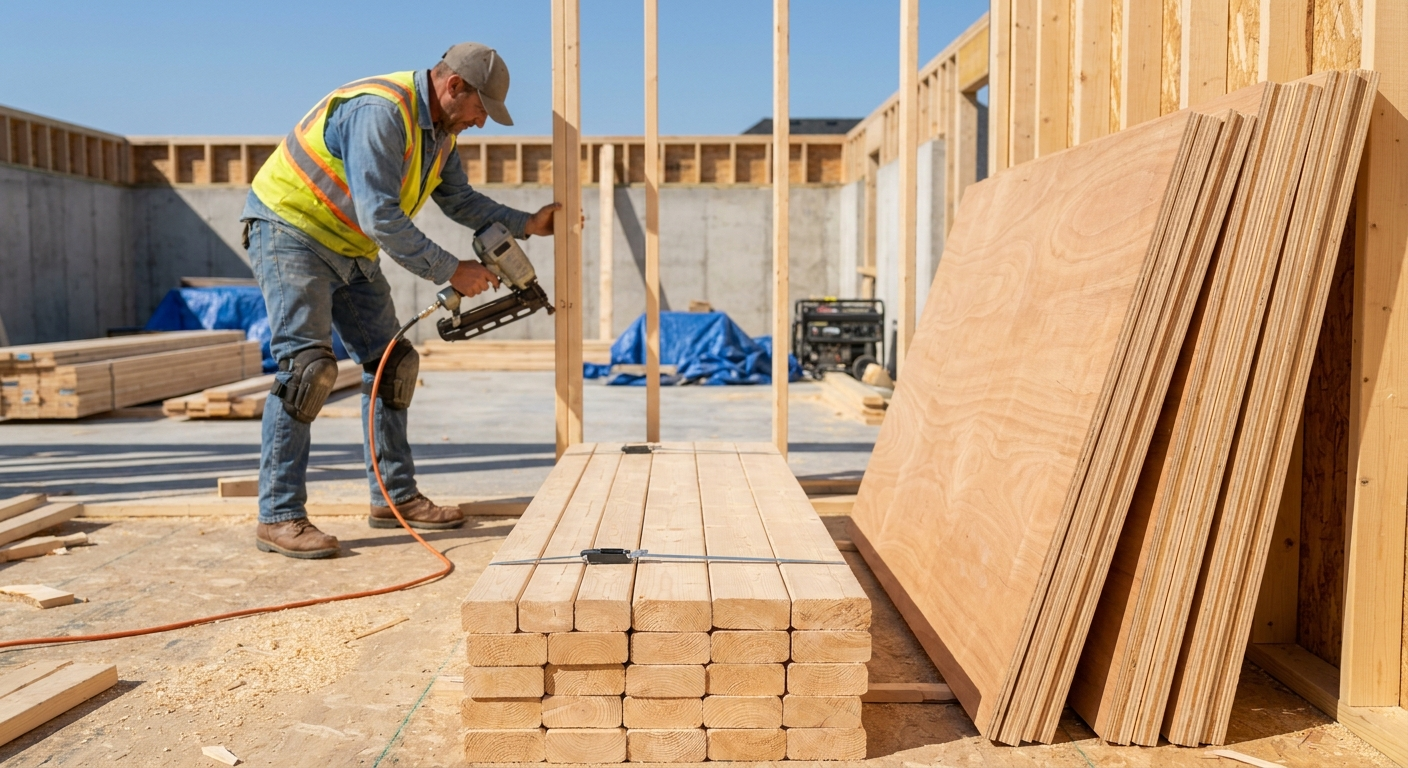
A 2×6 floor joist and a 19/32 in plywood subfloor are both wood, both structural, and neither replaces the other. The framer who tries to substitute one for the other ends up with a building that either flexes underfoot or collapses sideways under wind load. The question buyers actually ask in the lumberyard — plywood or lumber? — is the wrong question. The right question is which one belongs in which slot, and the answer depends on whether the application loads the wood along its grain, across its grain, or in two directions at once.
Vinawood manufactures plywood in Vietnam and ships over 5,000 containers a year to North American, Australian, and UK distributors. We make plywood. We don't make dimensional lumber. The article below is the manufacturer-honest take on when sheet goods beat solid sawn wood and when they don't — written by a company that loses every framing job to spruce-pine-fir 2×4s and every fine furniture job to solid hardwood boards.
What “lumber” actually means
Lumber is wood sawn directly from logs into rectangular sections. Three sub-categories cover most North American and Australian construction.
Dimensional lumber. The framing lumber found at every yard — 2×4, 2×6, 2×8, 2×10, 2×12 in nominal dimensions, sawn from softwood species (Douglas fir, hem-fir, southern pine, spruce-pine-fir). The actual section is smaller than the nominal call (a 2×4 measures about 1½ × 3½ inches). Sold by the linear foot or the board-foot. The structural workhorse of North American light-frame construction.
Boards. 1× stock sawn from softwood or hardwood. 1×2, 1×4, 1×6, 1×8, 1×10. Used for trim, casework, shelving, paint-grade interior carpentry. Hardwood boards (oak, maple, cherry, walnut) are the substrate of fine furniture.
Timbers. 4×4 and larger heavy sections, used for posts, beams, columns, and structural framing where dimensional lumber is undersized. Often pressure-treated for ground-contact applications.
The British and Australian usage of “timber” is broader — it covers all sawn wood including dimensional lumber. The North American convention treats “lumber” and “timber” as separate categories. For species selection across the lumber family, see our hardwood vs softwood guide.
What plywood actually is
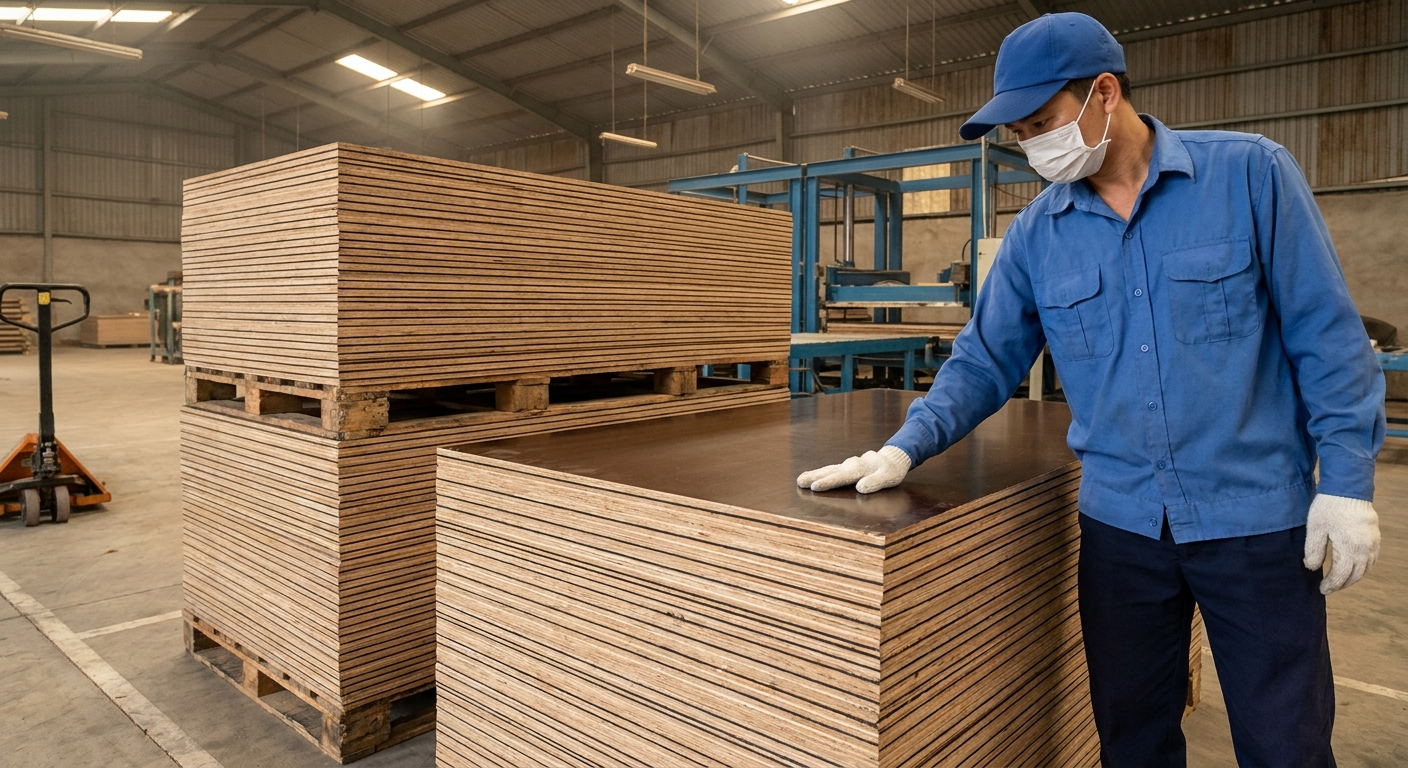
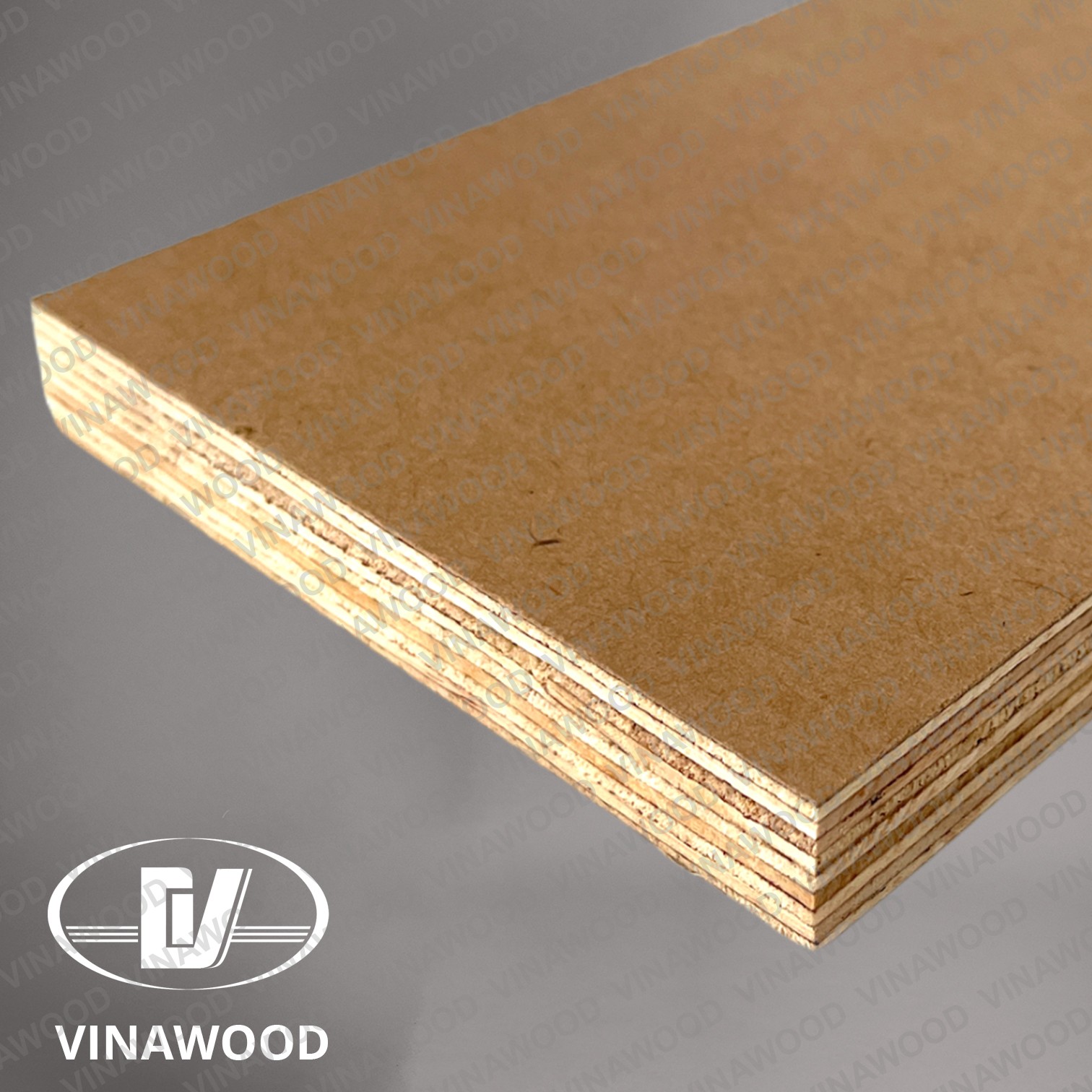
Plywood is an engineered panel of cross-laminated wood veneers bonded with thermoset adhesive under heat and pressure. Each veneer ply runs grain-perpendicular to its neighbours, and the layup is always an odd number of plies (3, 5, 7, 9, 11, 13). The cross-banding is the entire point. Wood is strong along the grain and weak across it. Stack veneers with their grains crossed and the composite resists splitting, warping, and the seasonal humidity movement that solid wood cannot avoid.
Plywood ships in large panel sizes — the standard 4×8 ft sheet (1220 × 2440 mm) or the metric 1250 × 2500 mm — with thicknesses from 6 mm to 30 mm. For background on grade systems and what the stamps mean, see plywood grades explained, and for density data across species see our plywood density reference.
Stability: the central difference
Solid wood moves with humidity. The technical term is tangential and radial shrinkage — the wood swells across the grain when it absorbs moisture and shrinks when it dries. The movement is roughly 6 to 10% across the grain between 0% and 25% moisture content, depending on species. For a 12-inch-wide oak board, the difference between a humid Florida summer and a dry Phoenix winter is on the order of ¼ inch of width change. The board doesn't fail, but joints loosen, panels split at fasteners, and wide tabletops cup unless they're built with engineered movement.
Plywood doesn't move that way. The cross-grain layup cancels most of the seasonal movement vector — every ply that wants to swell across its grain is restrained by neighbouring plies whose grain runs perpendicular. A 4×8 sheet of plywood between Florida summer and Phoenix winter changes dimension by a fraction of a percent. For wide spans, cabinet sides, panels, and any structural application where dimensional consistency is critical, this difference is decisive.
Engineers call the property “dimensional stability,” and it's the reason cabinet shops switched away from solid-wood-panel carcase construction to plywood carcase construction in the mid-20th century. The drawer that opens smoothly in July still opens smoothly in January.
Strength comparison: where each material wins
Wood is stronger along the grain than across it by a factor of 10 to 30, depending on the property being measured. Dimensional lumber takes advantage of this anisotropy. A floor joist loaded across its long axis carries the load along the grain in the bottom fibres (tension) and along the grain in the top fibres (compression). That's why a 2×10 spans 16 to 18 feet under a residential floor load while a 2×10 of the same wood loaded across its width would deflect badly under the same load.
Plywood wins in different loading conditions. Subfloor and roof sheathing carry load in two directions at once — a foot landing on a subfloor between joists distributes through the panel in both axes. Wall sheathing resists racking (wind shear forces) along both axes simultaneously. A solid-board sheathing layer would fail along the grain direction long before the plywood. The cross-banded layup gives plywood biaxial structural capacity that dimensional lumber doesn't have.
The rule of thumb: lumber for point loads along the grain direction, plywood for distributed loads in two axes. Joists are lumber. Subfloor is plywood. Studs are lumber. Wall sheathing is plywood. The two materials serve different structural roles in the same building. For deeper structural depth on plywood, see plywood bracing for the Australian AS 1684 framework and plywood span rating for the US IRC framework.
Cost comparison: per board-foot and per square foot
Cost comparisons between plywood and lumber require unit alignment. Plywood sells by the sheet, lumber by the linear foot or board-foot. The unit that lets the two compare directly is the board-foot, defined as 144 cubic inches of wood (12 × 12 × 1 inch).
For framing applications, dimensional lumber wins on cost. Construction-grade SPF 2×4s in 2026 US retail run roughly $0.65 to $0.85 per linear foot, which works out to $0.44 to $0.57 per board-foot. There is no engineered panel at that price point for the framing role.
For wide-panel applications, plywood is competitive. A 4×8 sheet of ¾ in (18 mm) B/B cabinet-grade plywood at $80 per sheet works out to roughly 2.5 board-feet of useful wood at $32 per board-foot of equivalent finished panel — less than the equivalent solid hardwood panel by 40 to 60% before you account for the labour of edge-joining and finishing solid boards.
Worked example. A cabinet side panel measuring 22 × 30 in (about 4.6 square feet) costs roughly $14 in cabinet-grade B/B birch plywood and roughly $30 to $45 in solid hardwood (maple, cherry, oak) for the equivalent visible-grade panel. For visible-but-not-decorative casework, plywood wins by 40 to 60% on material cost. For decorative show surfaces where the buyer specifies a continuous-grain solid hardwood look, solid wood wins on appearance even at the cost premium.
Workability and joinery
Solid lumber takes traditional joinery better than plywood. Mortise-and-tenon, dovetail, dado, rabbet — the techniques developed over centuries of solid-wood furniture making depend on the wood having a grain direction. The mortise side wall must be cut along the grain to hold under load. A dovetail relies on the pin tail's long-grain orientation to resist withdrawal. Cut these joints in plywood and the cross-grain plies delaminate where the joint stresses the wood. Plywood is a poor substrate for traditional joinery.
Plywood takes screw-and-glue construction better than wide solid lumber does. A panel screwed to a face frame holds its dimension regardless of humidity. A wide solid panel screwed at multiple points will eventually break the fasteners as it expands and contracts seasonally — the same property (cross-grain movement) that makes solid wood beautiful makes it incompatible with screwed-down construction. Cabinet shops know this and design accordingly: plywood for the structural carcase, solid wood for face frames and doors where movement is engineered into the design.
The rule of thumb: traditional joinery wants solid lumber; modern screw-and-glue assembly wants plywood. Mixing the two within the same piece is the standard cabinet-shop approach — plywood carcase with a solid hardwood face frame and solid hardwood doors.
The engineered-lumber middle ground: LVL, glulam, lumber-core
Three engineered products split the difference between plywood and dimensional lumber. Each has a specific structural role that neither pure plywood nor pure dimensional lumber can fill cost-effectively.
LVL (laminated veneer lumber). Thick veneer plies (2 to 3 mm) parallel-laminated with phenolic adhesive. All plies run grain-parallel, unlike plywood's cross-laminated layup. The result is a beam-grade engineered lumber with point-load capacity higher than the same dimensions of sawn lumber, because the manufacturing process eliminates the natural defects (knots, splits, slope of grain) that limit sawn-lumber strength. LVL spans longer than sawn lumber at the same depth and resists the loading variations of multi-storey wood-frame construction. The “laminated veneer lumber vs plywood” query (90/mo US search volume) is mainly asked by structural engineers comparing LVL to plywood I-joist flanges — they're complementary, not substitutes. LVL is the flange material; plywood or OSB is the web material in the same beam.
Glulam. Glued laminated timber. Solid hardwood or softwood laminations bonded with structural adhesive into beams, columns, and arches. Used for clear-span timber roofs, post-and-beam construction, and architectural exposed-timber framing. Glulam isn't plywood and isn't dimensional lumber — it's a third category of engineered wood that fills the structural role of large solid timbers without the supply constraint of single-piece old-growth timber.
Lumber-core plywood. The traditional cabinet-grade plywood with a solid hardwood core (edge-glued narrow strips of poplar, basswood, or similar) sandwiched between thin veneer faces. The lumber core gives the panel screw-holding equivalent to solid wood at the face while the cross-banded veneers stabilise the panel dimensions. Used for premium cabinet doors, slab tabletops, and high-end architectural casework. The query “lumber-core vs veneer-core plywood” (10/mo) is asked by cabinet shops choosing between traditional lumber-core construction and modern all-veneer construction. The answer depends on whether the screw-holding at the panel face matters more than the cost premium.
The engineered-lumber middle ground is rarely covered in plywood-vs-lumber comparisons online. It matters because real residential and commercial builds use all three families (dimensional lumber, plywood, engineered lumber) and the routing decisions between them are what experienced framers and cabinet shops make every day.
Application decision table
A side-by-side mapping of where each material wins.
| Application | Right material | Why |
|---|---|---|
| Wall studs | Dimensional lumber (2×4 SPF) | Point load along the grain, lowest-cost framing material |
| Floor joists, roof rafters | Dimensional lumber (2×8 to 2×12) or LVL for long spans | Bending load along the grain |
| Subfloor | Plywood (19/32 in or 23/32 in) | Distributed loading in two axes, panel-size economy |
| Wall sheathing, roof decking | Plywood (15/32 in to 19/32 in) | Racking resistance, two-axis stiffness |
| Cabinet carcase | Plywood (18 mm B/B or A/B face) | Cross-grain dimensional stability, screw-and-glue assembly |
| Cabinet face frames, drawer fronts | Solid hardwood | Traditional joinery, visible decorative surface |
| Heirloom furniture, fine joinery | Solid hardwood boards | Mortise-and-tenon, dovetail, exposed grain |
| Beams, headers, long structural spans | LVL or glulam | Engineered strength beyond sawn lumber, predictable spans |
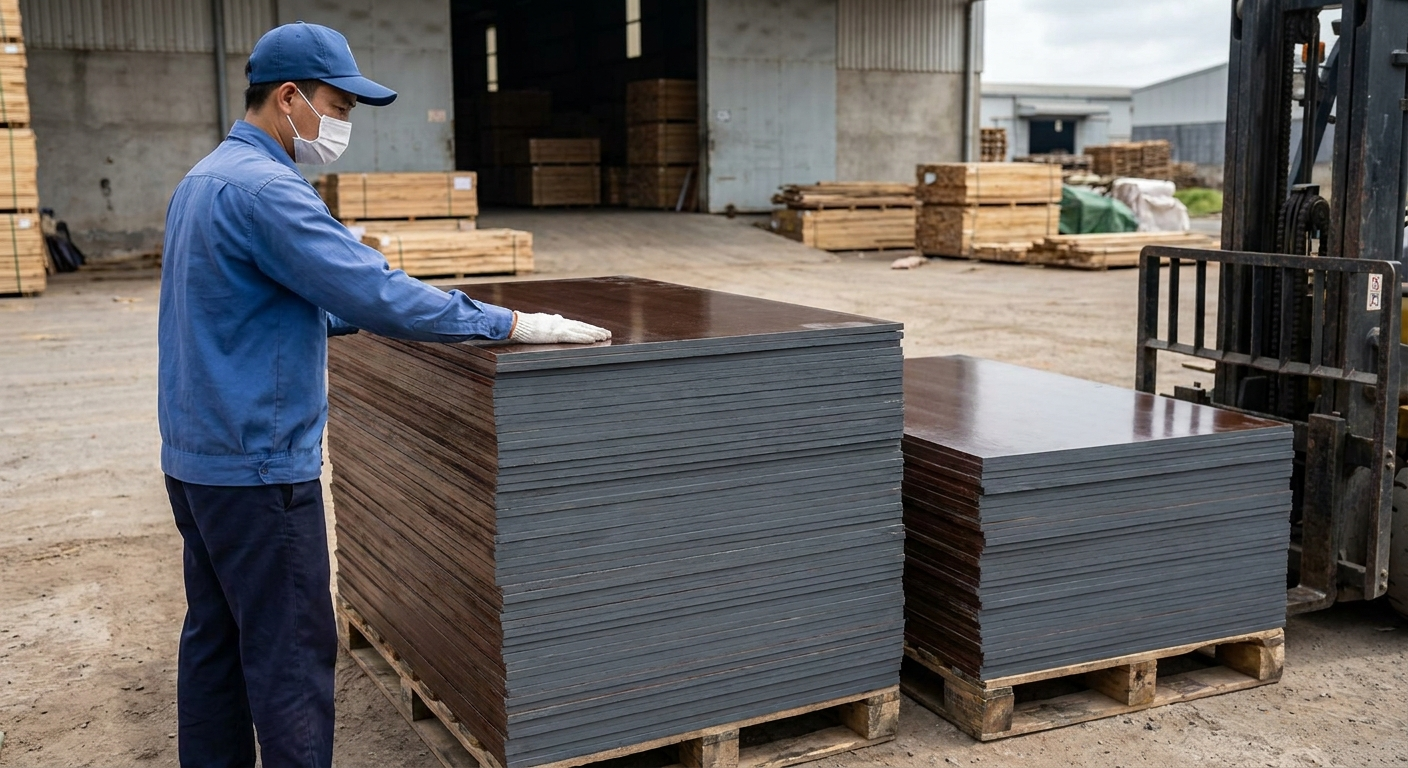
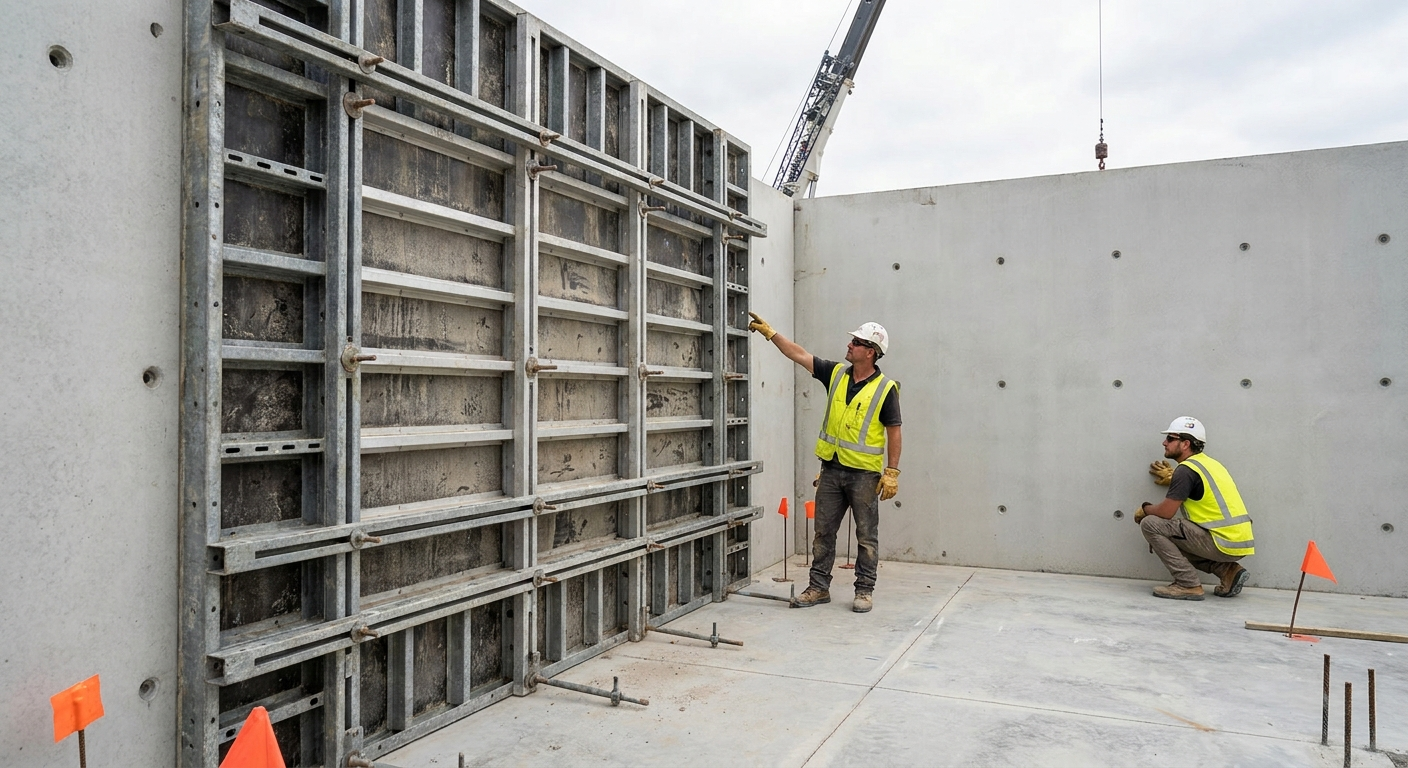
| Concrete formwork | Film-faced plywood (HDO or MDO range) | Reuse cycles, surface finish, biaxial loading |
| Heavy posts and timbers | Dimensional timbers (6×6, 8×8) or glulam | Compressive load along the grain at heavy section |
The pattern: dimensional lumber is the skeleton of light-frame construction; plywood is the skin and the structural panel system; engineered lumber is the upgrade path where sawn-lumber dimensions fall short.
Vinawood's position: we make plywood, not lumber
Vinawood manufactures plywood at Vietnamese factories and ships to 55+ countries through container-volume export. The factory-honest framing is that we would lose every framing job to North American spruce-pine-fir and every wide-board furniture job to solid hardwood from FSC-certified mills. We win on cabinet boxes, subfloor and sheathing, concrete formwork, and structural panels where the cross-grain stability and wide-format economics are what the application needs. Trying to replace dimensional lumber with plywood in a framing application costs more, weakens the structure, and wastes wood; trying to replace plywood with solid lumber in a sheathing application loses the racking resistance that makes light-frame buildings work in seismic and wind zones.
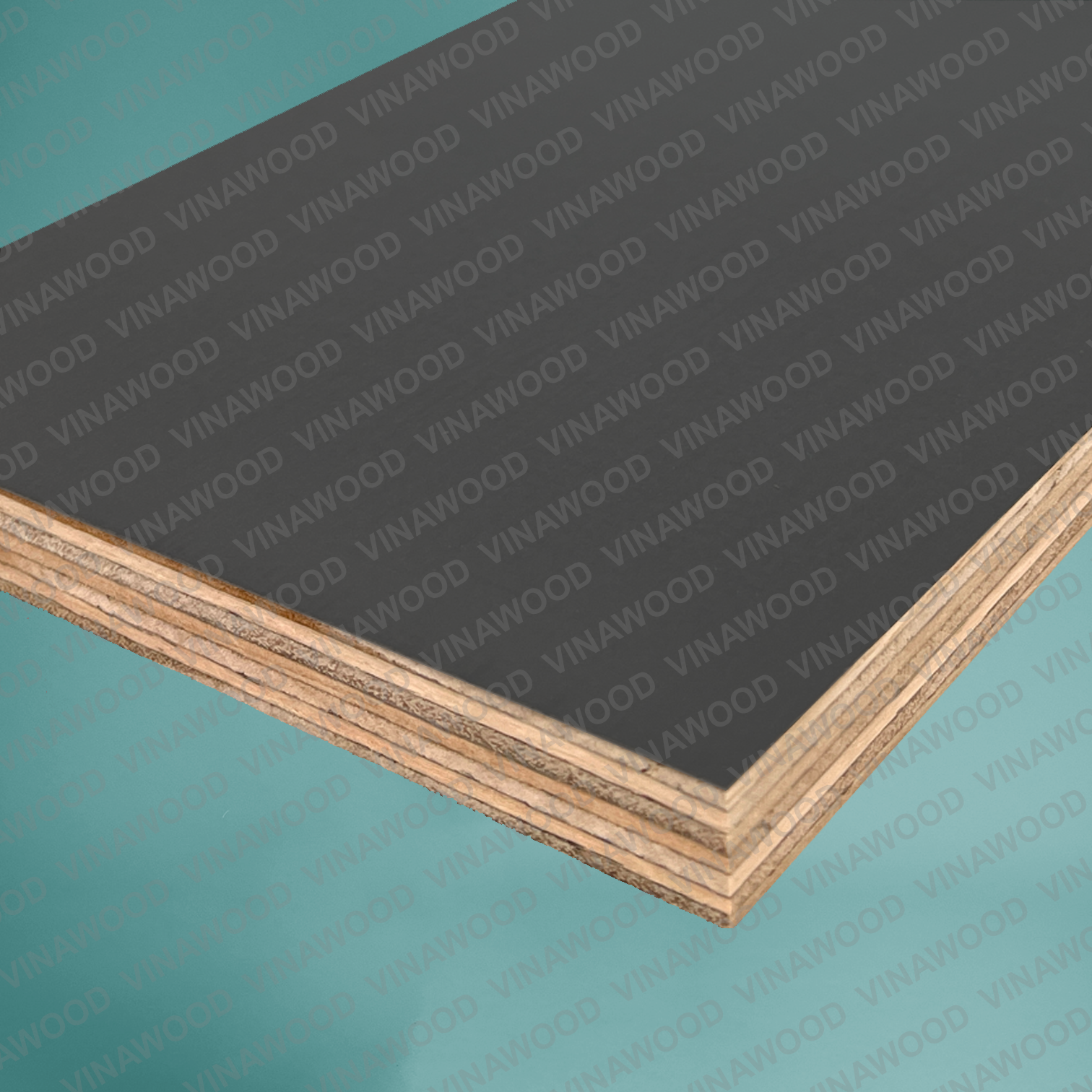
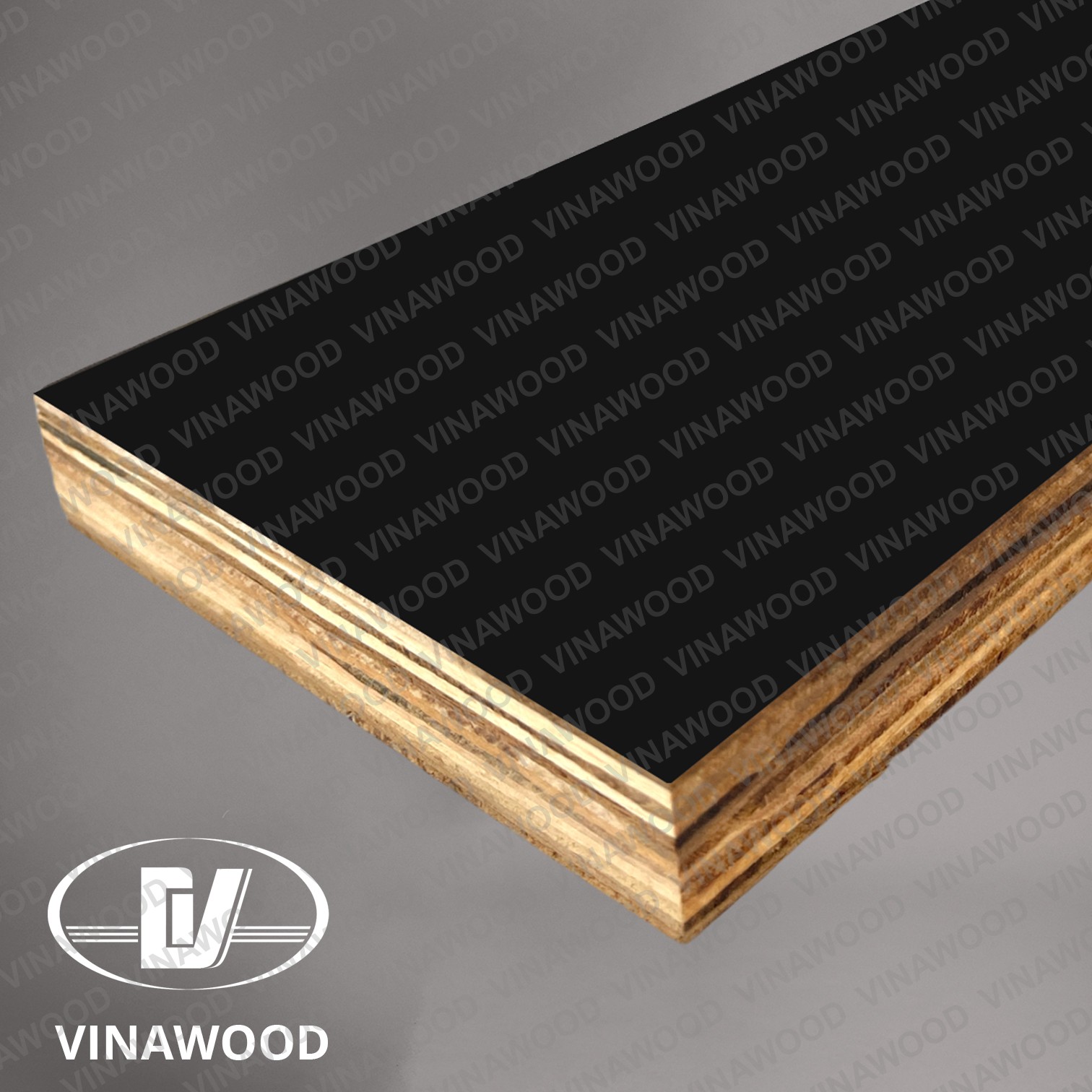
For US, Canadian, and Australian markets, the Vinawood plywood range covers two main families relevant to lumber-comparison discussions. The HDO plywood collection is the high-density-overlay range for concrete formwork — phenolic-bonded core with HDO surface overlay, up to 20 reuse cycles, used where formwork sheathing needs to perform across many pour cycles. The MDO plywood collection covers the medium-density-overlay range for matte concrete finish work and outdoor signage substrate. Both ranges are CARB Phase 2 (EPA TSCA Title VI) compliant for the US market and FSC-COC certified. For background on engineered panel categories in general, see our plywood vs solid wood comparison (a furniture-focused angle distinct from this lumber-focused article) and plywood adhesives for the glue-chemistry depth.
About Vinawood
Vinawood is a Vietnamese plywood manufacturer established in 1992. We export over 5,000 containers a year to 55+ countries, with sales offices and distribution partners across North America, Europe, Australia, and Asia. Product certifications include ISO 9001 quality management, EPA TSCA Title VI / CARB Phase 2 for the United States, FSC-COC and PEFC chain-of-custody for sustainable forestry, EN 13986 CE marking for Europe, UKCA for the UK, KS Mark for Korea, BIS for India, and EPD for green building credits (LEED, BREEAM).
For US, Canadian, and Australian project quotes — plywood sheathing, formwork, cabinet-grade, or structural panel applications — the Vinawood sales desk responds within 24 hours through the contact form at vinawoodltd.com. Container-volume orders ship FOB Ho Chi Minh or Hai Phong with the documentation package included for every shipment.
Category
guides
Related Markets
Related Countries
Related Products
▶Sources & References (6)
- PS 1-19 Voluntary Product Standard — Structural Plywood — APA / U.S. Department of Commerce (2019)
- PS 2-18 Performance Standard for Wood Structural Panels — APA / U.S. Department of Commerce (2018)
- Wood Handbook — Wood as an Engineering Material, Chapter 11 (Plywood) — USDA Forest Products Laboratory (2021)
- Wood Handbook — Chapter 12 (Structural Composite Lumber Products) — USDA Forest Products Laboratory (2021)
- EN 13986:2004+A1:2015 — Wood-based panels for use in construction — CEN (2015)
- AS 1684 — Residential timber-framed construction — Standards Australia (2010)