How to Evaluate a Vietnam Plywood Supplier: Due Diligence Checklist
A systematic due diligence framework for evaluating Vietnam plywood suppliers — covering factory verification, quality assessment, certification validation, and warning signs.

Why Due Diligence Matters
Vietnam has hundreds of plywood manufacturers — ranging from world-class operations shipping thousands of containers annually to small workshops with inconsistent quality. Selecting the right supplier directly impacts your product quality, delivery reliability, compliance status, and ultimately your business reputation.
This checklist provides a systematic framework for evaluating Vietnam plywood suppliers, whether you are sourcing for the first time or adding a new supplier to your approved vendor list.
Phase 1: Desktop Research (Before Contact)
Company Verification
- Verify business registration on Vietnam's National Enterprise Registration Portal
- Check company age — established manufacturers (5+ years) are lower risk
- Look for the company on industry directories (Vietnam Timber and Forest Products Association — VIFORES)
- Check if they exhibit at trade shows (VietnamWood, Interzum, DOMOTEX)
- Search for the company on import databases (US Customs data, trade intelligence platforms)
Online Presence
- Professional website with detailed product information and factory photos
- LinkedIn company page with verifiable employee profiles
- Product certifications displayed (FSC, ISO, CARB P2) with certificate numbers
Phase 2: Initial Communication
Responsiveness and Professionalism
- Response time: Professional suppliers reply within 24-48 hours
- Communication quality: Clear English, detailed technical responses
- Company email domain (not generic @gmail.com for main contact)
- Willingness to provide references from existing customers in your market
Initial Information Request
Send a detailed inquiry including your specific product requirements and ask for:
- Company profile with production capacity information
- Product catalog with specifications
- Price list (FOB terms) for your required products
- Current certification documents
- Production lead time for your order size
- Available payment terms
Phase 3: Certification Verification
Checklist by Certification
- FSC: Verify certificate number on info.fsc.org — check scope (products covered) and validity dates
- CARB P2: Confirm TPC name and check against EPA's TPC list
- ISO 9001: Request certificate — verify issuing body is accredited
- CE marking: Request Declaration of Performance and test reports
Visit our Certifications page to understand what each certification covers and why it matters.
Phase 4: Sample Evaluation
What to Request
- Full-size production samples (not specially prepared showroom pieces)
- Samples from current production run (not stock held for exhibitions)
- Cross-section cut sample to inspect core construction
- Test reports matching the sample batch
What to Evaluate
| Check | Method | Acceptable |
|---|---|---|
| Film adhesion | Try to peel at corners | Film should not separate |
| Core construction | Inspect cross-section | Minimal gaps between plies |
| Thickness | Measure with caliper at 4 points | Within ±0.5mm of spec |
| Squareness | Measure diagonals | Difference ≤2mm |
| Moisture content | Pin-type meter | 8-14% |
| Surface quality | Visual inspection | Per agreed grade (A/B, B/C, etc.) |
| Flatness | Place on flat surface | Minimal bow or twist |
Phase 5: Factory Verification
Factory Visit (Ideal)
If possible, visit the factory in person. Key areas to inspect:
- Log yard: Species identification, volume of raw material
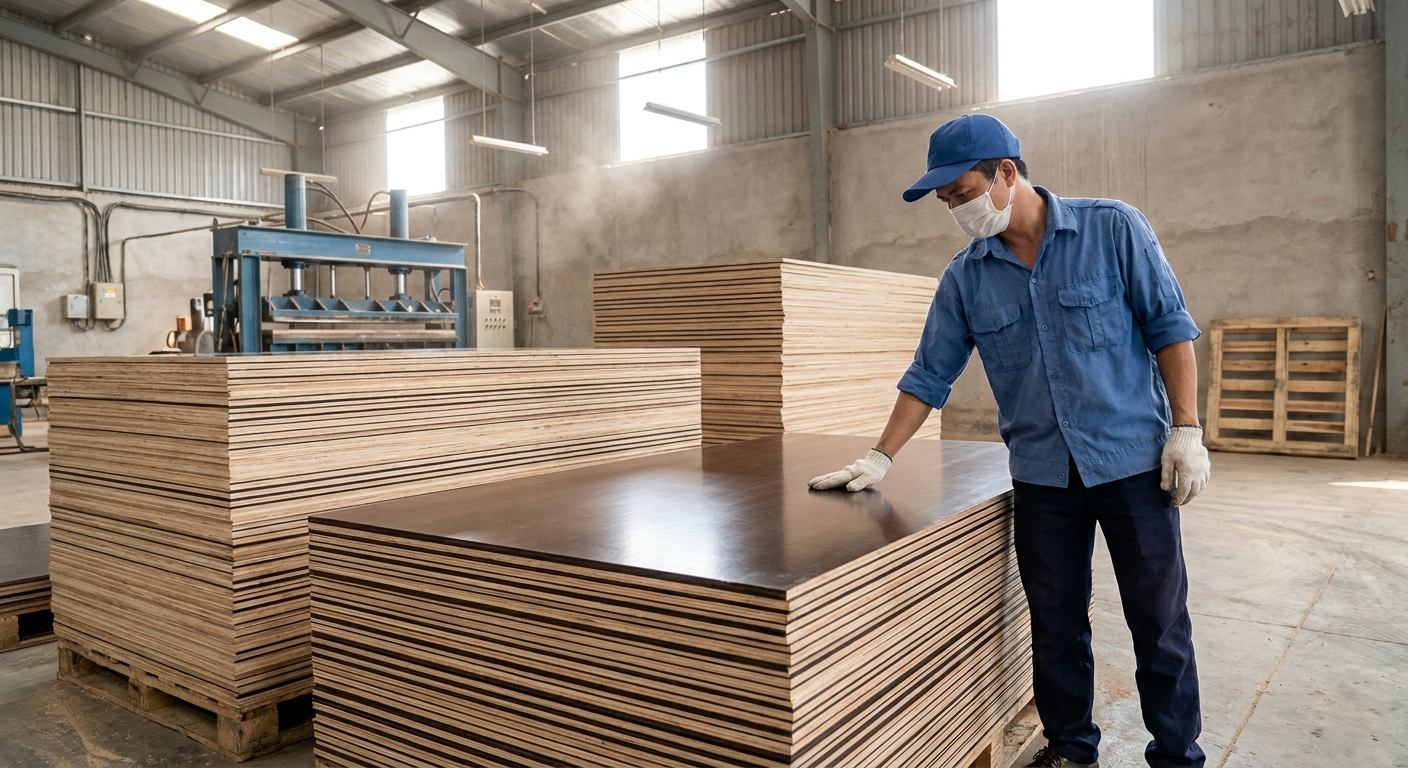
- Veneer line: Rotary lathe operation, veneer drying
- Glue application: Adhesive type, mixing process
- Press section: Hot press capacity, temperature/pressure controls
- Quality lab: Testing equipment (bonding test machine, moisture meters, formaldehyde chamber)
- Finishing line: Trimming, sanding, grading station
- Packing: Palletizing, steel strapping, storage conditions
Virtual Factory Tour (Alternative)
If travel is not feasible, request a live video tour. Professional manufacturers will accommodate this. Have your quality team prepare specific questions and areas to inspect during the video call.
Third-Party Audit
Engage SGS, Bureau Veritas, or Intertek for an independent factory audit. This typically includes facility assessment, production process review, quality management system evaluation, and a written report.
Phase 6: Trial Order
Always start with a trial container before committing to volume:
- Order one 40HC container with your standard specification
- Arrange pre-shipment inspection (PSI) by a third-party agency
- Inspect the container upon arrival — document everything with photos
- Test panels in your application (formwork reuse count, surface quality, etc.)
- Provide feedback to the supplier and evaluate their response
Red Flags to Watch For
- 🚩 Pricing significantly below market average (potential quality or compliance issues)
- 🚩 Unable or unwilling to arrange factory visit (may be a trading company)
- 🚩 Certification documents with expired dates or untraceable certificate numbers
- 🚩 Inconsistent information between sales team and documentation
- 🚩 Pressure for full payment upfront (standard is 30% deposit)
- 🚩 No in-house quality lab or testing capability
- 🚩 Very short company history with claims of large capacity
Supplier Evaluation Scorecard
Rate each area 1-5 and calculate a weighted score:
| Category | Weight | Key Questions |
|---|---|---|
| Quality | 30% | Sample quality, test reports, QC process |
| Certifications | 20% | Valid certs for your market, lab capability |
| Capacity & Reliability | 20% | Monthly output, on-time delivery history |
| Communication | 15% | Responsiveness, English capability, transparency |
| Pricing | 15% | Competitive pricing, clear terms, volume flexibility |
Suppliers scoring 4.0 or higher across all categories are strong candidates for your approved vendor list.
Frequently Asked Questions
How many suppliers should I evaluate before choosing?
Contact at least 5-8 suppliers, request samples from your top 3-4, and do a trial order with 1-2 finalists. This gives you a backup supplier and competitive pricing leverage.
Should I use a buying agent in Vietnam?
Agents can be helpful for first-time buyers unfamiliar with Vietnamese business culture. However, for direct manufacturer relationships, working with the factory's export sales team is often more efficient and eliminates agent margins. Many Vietnamese manufacturers have English-speaking teams experienced with international buyers.
How long does the evaluation process take?
From initial contact to completing a trial order evaluation: approximately 3-4 months. Desktop research (1 week), communication and samples (2-3 weeks), sample evaluation (1-2 weeks), trial order and shipping (6-8 weeks), arrival inspection (1 week).
What if quality drops after the trial order?
This is why ongoing QC is important. Arrange periodic pre-shipment inspections, maintain clear quality specifications in your contracts, and build a relationship with the factory's QC department — not just the sales team. Having a qualified backup supplier keeps your primary supplier accountable.
Category
how-to