Plywood for Concrete Forms: Complete Contractor's Guide
A contractor's guide to plywood for concrete forms: film-faced vs HDO vs MDO-style MatteFace, Vinawood reuse figures by grade, the Class 3 map, thickness and sheet sizes, and when imported containers beat yard stock.
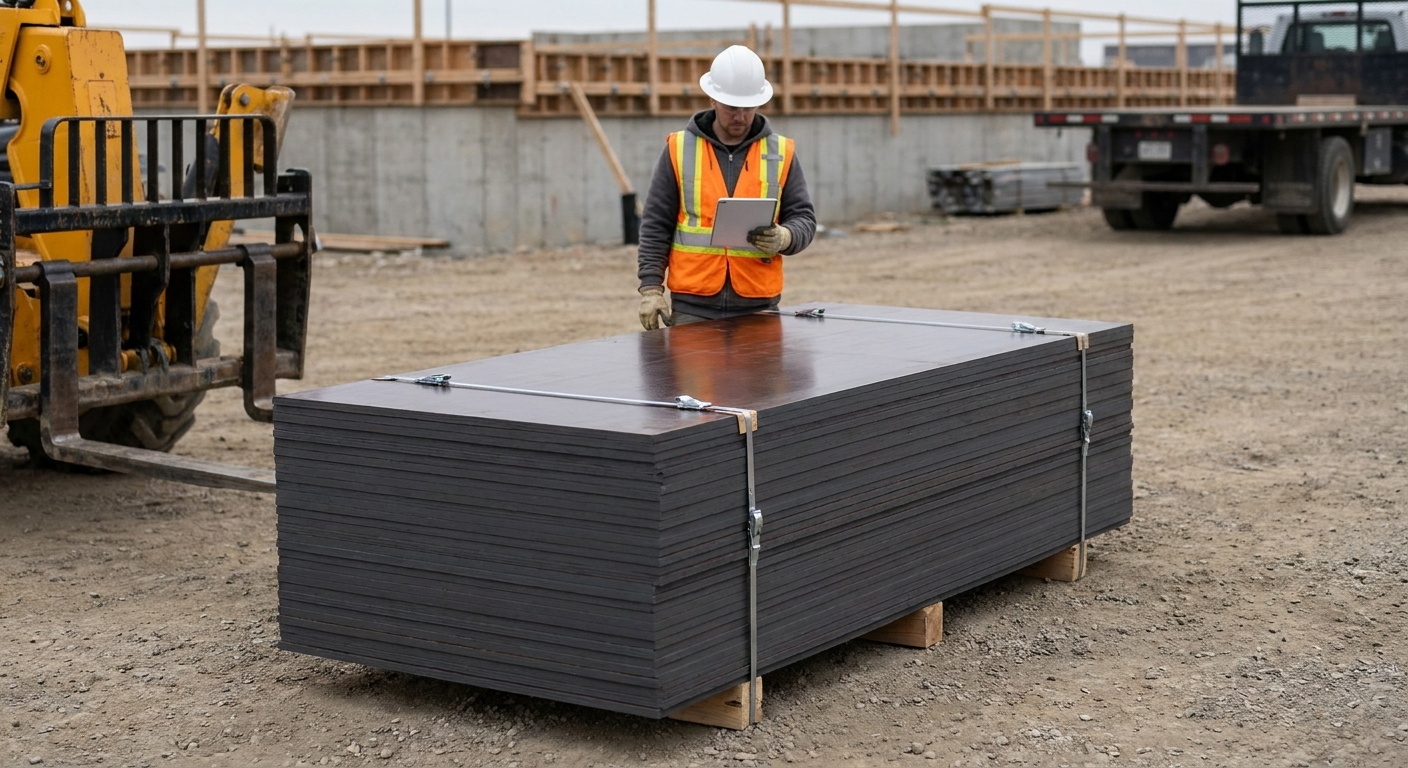
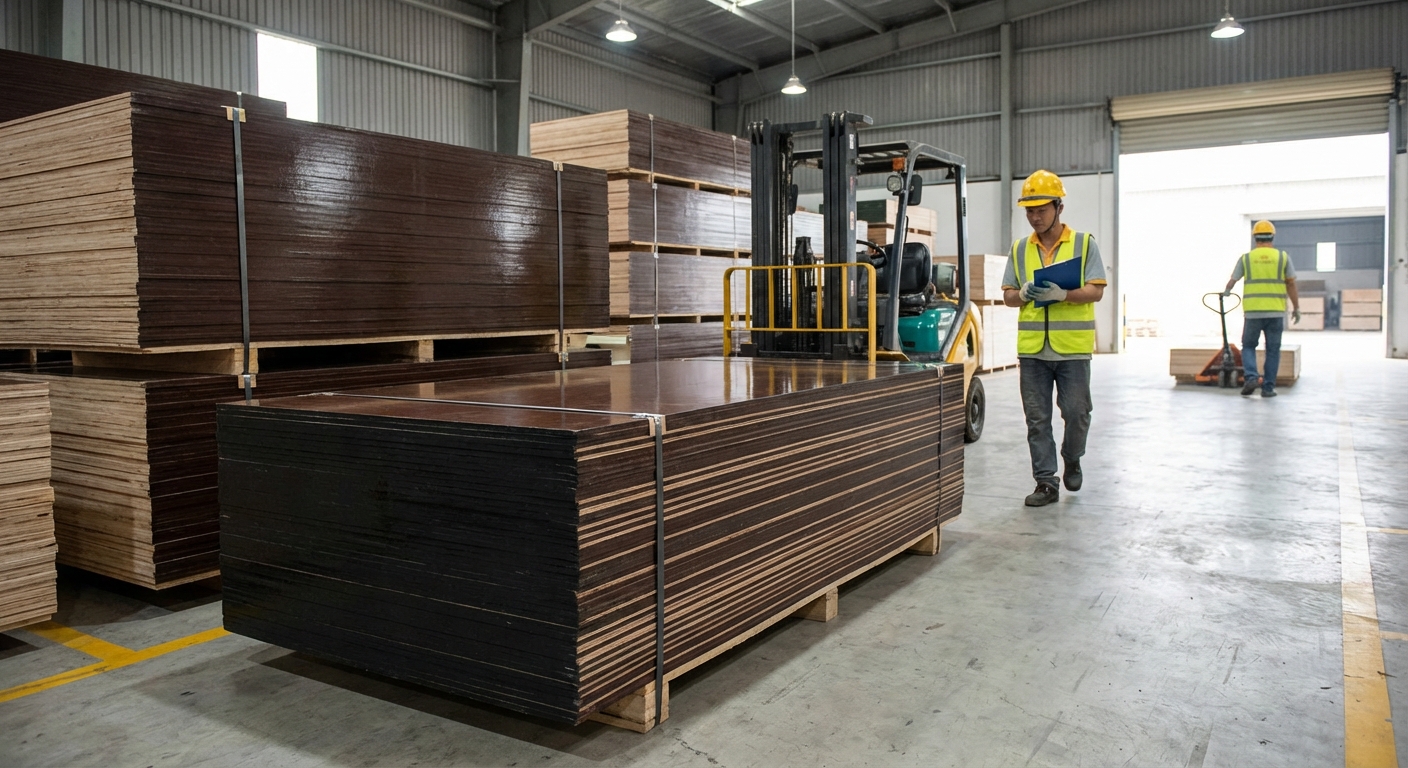
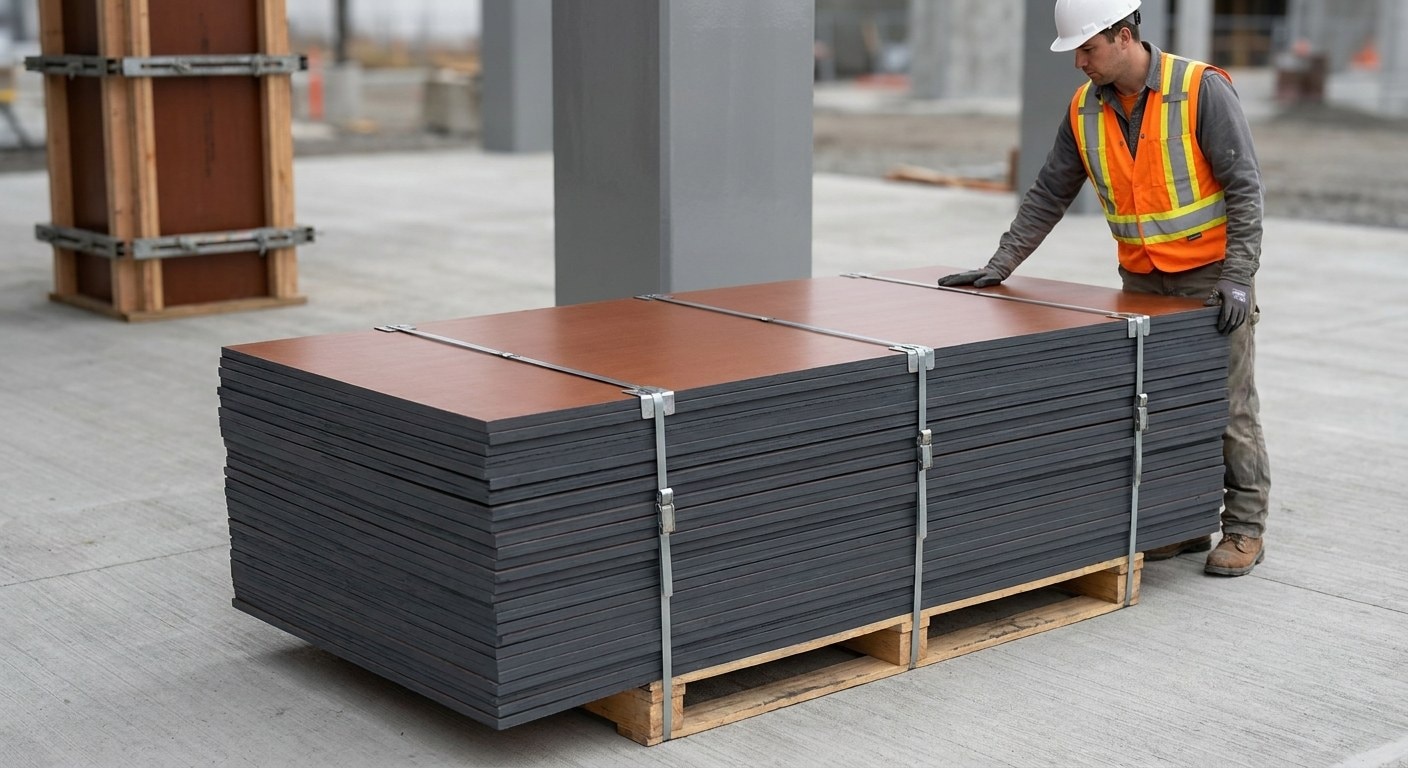
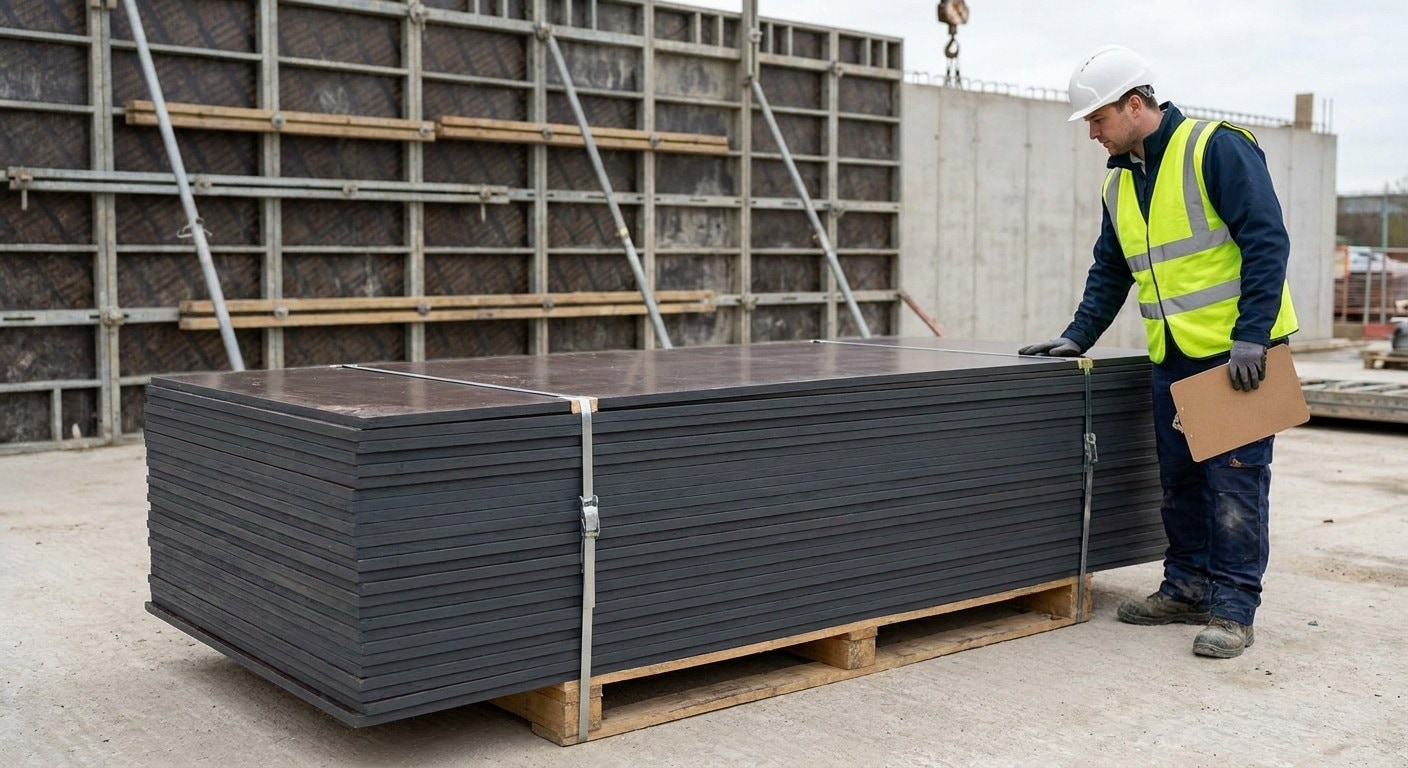
Plywood for concrete forms is bought as cost per pour, not as a lumber-yard ticket. The sheet is the temporary mould face crews pour against: it takes fluid pressure, holds the finish the architect will see, and strips so the gang can move. Overlay, core bond, thickness, and edge care decide both that finish and how many pours the panel still earns before it leaves the stack.
Film-faced means a resin-impregnated paper film hot-pressed onto the face; on our forming grades that film is phenolic. Formwork plywood (form ply, plyform) is the job name: any panel built to hold wet concrete. MDO is an APA overlay class many North American buyers still search; Vinawood’s matte forming face is sold as MatteFace Plywood (MTF): formwork only, matte phenolic face, WBP phenolic core. Plenty of buyers find it by typing MDO, and that is fine. The panel on the order is still called MatteFace. P-Form is polypropylene overlay, not Pro Form. Consply is commercial Bintangor face stock, not film-faced formwork.
Four families show up on North American takeoffs: BB/OES plyform, overlaid panels (MatteFace sits here for crews who asked for MDO), HDO, and film-faced phenolic. Thickness, stud spacing, and whether you seal cut edges after the saw move the reuse number more than the brand stamp. For the type ladder and overlay chemistry in one place, start with the concrete forming plywood hub, then come back here for contractor sizing and cost-per-pour choices.
What makes plywood suitable for concrete forms?
Wet concrete pushes on the form face like a fluid. A sheathing sheet that drinks mix water, opens at the glue line, or dishes between studs will print that failure into the wall. Forming plywood is built for that load, so four checks belong on the spec before price.
Moisture resistance starts with the adhesive bond. It must be rated WBP (Weather and Boil Proof), which means water-resistant under boil and wet tests. The core resin is phenolic (PF) or melamine-urea-formaldehyde (MUF), depending on grade. Interior urea glues break down when wet concrete sits against them. Structural rigidity means the panel resists deflection between studs and walers under the full fluid head: dense, well-bonded core and consistent veneer thickness. Surface smoothness is the face film or overlay that sets the concrete finish — a rough or patched face transfers every imperfection. Edge stability matters because unsealed edges wick moisture into the core; quality forming plywood arrives with sealed or film-wrapped edges, and you reseal after every site cut.
Standard CDX sheathing (C and D veneers with exterior glue) can survive a single pour in a pinch. Rough face, open knots, thinner core. APA-rated plyform, HDO, MatteFace, and film-faced panels are built as form panels. CDX is not. When the bond class itself is the open question, read WBP plywood before you lock the RFQ.
Types of plywood used for concrete forms
Short version first. Phenolic film-faced plywood is the glossy, high-reuse forming standard, and it is what most crews outside North America mean by form ply. HDO carries a harder resin overlay, so it gives the most pours and the smoothest face. MDO in the APA sense is a kraft-paper overlay made to take paint, which makes it a short-run forming option at best. Buyers often search for MatteFace as MDO formwork plywood: it is a matte phenolic film panel for concrete forms.
Price per sheet and cycles per panel move in opposite directions, which is why buyers compare constructions at all. Our reuse figures below come from product data. They are maxima, written as “up to N”, under decent site practice. Skip the release agent and you will not see them.
BB/OES plyform (Class I and Class II)
Baseline APA-rated forming panel. Class I uses Group 1 species for maximum stiffness; Class II allows Group 2 or 3. Sanded B-grade face, OES back. Typically a handful of pours with care. Widely stocked at US yards for residential foundations. Not a Vinawood film-faced SKU.
MDO search term vs MatteFace
MDO (Medium Density Overlay) is the APA and search label for a resin-impregnated fiber overlay; the full definition is on what is MDO plywood. Commercial crews often land here when the spec wants a smoother face than sanded veneer. Vinawood does not sell “Vinawood MDO.” The formwork product is MatteFace Plywood (MTF): matte phenolic face, PF core, Class 3, formwork only. Reuse depends on the build. MatteFace 1SF and MatteFace Panel 1S run up to 15 pours. MatteFace HD 1SF goes up to 17. MatteFace Panel 2S, matte on both faces, runs up to 25. Compare overlays on the film-faced vs MDO vs HDO page and browse the MatteFace collection.
HDO plyform
HDO (High Density Overlay) uses a denser, higher-resin overlay for a hard, abrasion-resistant face. US mills sell HDO into high-rotation forming. Vinawood presses HDO in more than one overlay grade. HDO Basic 2S Formply is Class 2, good for up to 10 reuse cycles. HDO Premium 2S Formply is overlaid both faces and runs up to 20. Those are maxima. Release agent, cleaning, and sealed edges decide whether a crew gets near them. HDO Standard and HDO Premium carry a Class 3 / EN 636-3 phenolic bond, the same class as Pro Form, Pro Form Lite and MatteFace. HDO Basic does not. See the HDO plywood collection.
Film-faced phenolic grades
Film-faced plywood uses a phenolic film bonded to the face and back. It dominates international forming markets. Film weight (g/m²) and core resin both matter. When a quote just says “melamine”, ask which one it means: MUF resin in the core, the chemistry of the face film, or a decorative laminate meant for furniture. Those are three different things.
Vinawood film-faced ladder (plantation-grown hardwood core):
- Eco Form Plus — 165 g/m² phenolic face film, MUF core, EN 636-2: up to 8
- Form Basic — 165 g/m² phenolic face film, MUF core, EN 636-2: up to 10
- Form Extra — same phenolic face as Form Basic, Superior Glue MUF, EN 636-2: up to 15. Not Class 3.
- Pro Form Lite — 165 g/m² phenolic face film, WBP PF core, EN 636-3 Class 3: up to 15. Sits between Form Extra and Pro Form.
- Pro Form — 125 g/m² top-grade phenolic film, WBP PF, EN 636-3 Class 3: up to 20
The Class 3 group is Pro Form, Pro Form Lite, HDO Standard, HDO Premium and MatteFace. HDO Basic and Form Basic are Class 2, and so is Form Extra, whose longer life comes from the stronger glue rather than a heavier film. Browse the film-faced plywood collection for sizes and overlays.
Comparison table: forming plywood types
| Panel type | Overlay / face | Vinawood reuse (max) | Concrete finish | Notes |
|---|---|---|---|---|
| BB/OES plyform | Sanded veneer | handful of pours (yard stock) | Fair — grain transfer | APA baseline; not Vinawood film-faced |
| Eco Form Plus | Phenolic face film | up to 8 | Smooth sealed | MUF EN 636-2 |
| MatteFace (MTF) | Matte phenolic face | up to 15 (1SF, Panel 1S); 17 (HD 1SF); 25 (Panel 2S) | Smooth matte | PF Class 3; found under “MDO” searches |
| HDO Basic | High-density overlay | up to 10 | Near-glossy | Class 2 |
| HDO Standard / Premium | High-density overlay | up to 20 | Near-glossy | Class 3 PF |
| Form Basic | Phenolic face film | up to 10 | Smooth sealed | MUF EN 636-2 |
| Form Extra | Phenolic face film (same as Form Basic) | up to 15 | Smooth sealed | Superior Glue MUF EN 636-2, Class 2 |
| Pro Form Lite | Phenolic face film | up to 15 | Smooth sealed | PF Class 3 EN 636-3 |
| Pro Form | Phenolic face film | up to 20 | Smooth sealed | PF Class 3 EN 636-3 |
Plywood thickness for concrete forms
Panel thickness sets how much load a sheet can carry between supports. Too thin for your stud spacing means deflection and a fat wall. The full support map lives in the concrete formwork plywood thickness guide; the short version for North American walls is below.
18 mm (3/4 inch) is the standard for most wall and foundation pours. Typical studs sit 12–16 inches on center for walls up to about 8 feet. 15 mm (5/8 inch) is light-duty for short stem walls, curbs, and low-height pours. It is not for full-height wall forms. 25 mm (1 inch) and 28 mm (1-1/8 inch) cover heavy foundation walls, deep beams, and high fluid head when studs are wider or pour height climbs.
As stud spacing increases, thickness must follow. On 3/4-inch plywood, keep studs at 12–16 inches on center for standard wall pours. Metric twin: 18 mm with 300–400 mm centers.
Standard plywood sizes for concrete forming
1220 × 2440 mm (4 × 8 ft) is the North American standard. It fits lumber-framed systems and minimizes waste on 8-foot walls. 1250 × 2500 mm is European metric stock, common on international film-faced lines. Modular systems (Doka, Peri, Alsina and peers) often need system-specific blank sizes; pre-cut from the mill cuts waste on container lots.
Map the pour before you buy. Panel layout that avoids random rips saves material and labour. Vinawood can cut to order on container-quantity RFQs.
How to choose the right plywood for your project
Four variables drive the match: finish requirement, reuse target, jobsite handling, and budget. Match the Vinawood row to the pour. The reuse targets below are the same “up to” maxima as the tables above.
| Project type | Finish | Reuse target | Recommended direction |
|---|---|---|---|
| Residential foundation | Structural (below grade) | few pours | BB/OES, Eco Form Plus, or Form Basic |
| Commercial walls | Smooth, minimal patching | up to 10–15 | Form Extra, MatteFace, or HDO Basic |
| Architectural / fair-face | Near-perfect finish | up to 15–20 | Pro Form Lite, Pro Form, or HDO Premium |
| High-cycle commercial | Consistent across many pours | up to 20 | Pro Form or HDO Premium |
| Humid / wet climate sites | Any | Any | Prefer sealed film-faced; WBP bond; plantation-grown core |
For most US crews on residential and light commercial, HDO plywood or MatteFace balances finish and reuse. For container-scale commercial import, film-faced Pro Form or Pro Form Lite from Vietnam is the usual cost-per-pour conversation. Ask sales for a quote.
Form accessories that decide panel life
The sheet is one part of the form. Ties, walers, release agent, and edge sealer decide whether the overlay survives the next pour.
Form ties and snap ties hold opposing walls at spacing under pressure. Drill cleanly; avoid splitting the face. Release agents need a thin coat before every pour — skip it and cement paste bonds to the face. Use commercial form oil, not motor oil or diesel. Edge sealant is the top killer when skipped: paint, polyurethane, or purpose edge sealer on every cut. Factory-sealed Vinawood panels still need resealing after site cuts. Walers and studs back the panels and feed load to the ties; spacing must match thickness and pour height.
How to extend forming plywood life
Clean immediately after stripping with a plastic scraper and rinse while green — never a metal blade on the film. Apply release agent every pour, even on new panels. Seal all edges after every site cut. Store flat, off the ground, under cover, with bearers under the stack; a tarp is the minimum. Patch minor damage: small gouges and film tears with epoxy wood filler or formwork patch compounds beat replacing a sheet.
I have seen return pallets where the glue line was still sound and the film was shredded at the corners. That is a site file, not a mill file. Nine times out of ten it is the edges and the scraper.
Domestic plyform vs imported film-faced — think cost per pour
The real cost is not a USD sticker on a sheet. It is cost per pour after reuse, freight, and handling. Resin, veneer and ocean freight all move, so we quote against your programme instead of printing a price list that would be stale in a month.
Domestic yard stock wins on speed and small lots. Vietnam factory-direct wins when the take-off fills a container and the bond class is written down. Lead times follow vessels and inspection slots — plan the pour date with sales, not with a blog paragraph.
Vinawood has manufactured plywood in Vietnam since 1992. About 5,000 containers a year go to 55+ countries. Plantation-grown Acacia, Eucalyptus, or Hevea cores. WBP adhesive systems. FSC-COC when the project asks. For North American distributors who need ready stock between containers, Vinawood maintains distribution warehouses in Toronto, Vancouver, Calgary, Montreal, Miami, Houston, and Baltimore to supply local distributors.
Send the pour programme and the grade table above through /rfq or the quotation form. Put thickness, size, grade, bond class in writing, expected reuse, and discharge port on the same message. The lot closes on the DoP and the mill report, not on a colour photo of the film.
Thickness, regular plywood, and reuse — short answers
What thickness? Eighteen millimetres (3/4 inch) is the North American default for walls up to about 8 feet with studs at 12–16 inches. Use 15 mm only for light, low pours. Use 25 mm+ for deep lifts and high fluid head.
Can you use regular plywood? CDX can cover one emergency pour. Rough face, fast moisture uptake, poor reuse. For any programme that needs a clean finish or repeated cycles, specify plyform, HDO, MatteFace, or film-faced form panels.
How many reuses? Yard BB/OES: a handful. Vinawood maxima: Eco Form Plus up to 8; Form Basic and HDO Basic up to 10; Form Extra and Pro Form Lite up to 15; Pro Form and HDO Premium up to 20. MatteFace runs from up to 15 on the single-face panels to up to 25 on Panel 2S. Cleaning, release agent, edge sealing, and flat storage decide how close you get.
Smoothest finish? HDO Premium and Pro Form (PF Class 3) lead for near-glossy architectural faces. MatteFace gives a smooth matte for crews who searched MDO. Form Extra is a strong mid-cycle MUF option, and it stays Class 2.
OSB? Not recommended. Strand texture prints; edges swell. If budget is the constraint, BB/OES plyform still beats OSB for forming.
Category
guides