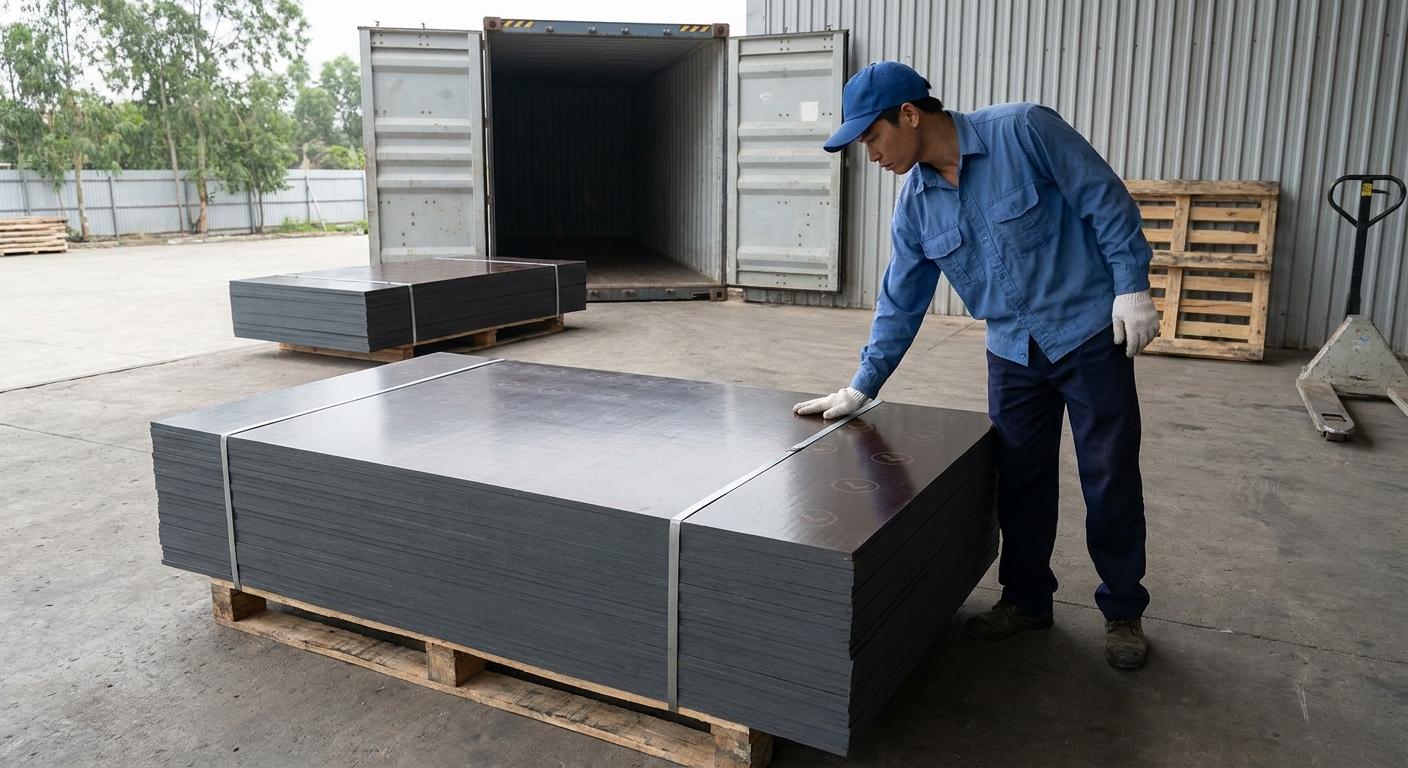
Plywood for Trailer Flooring: Apitong vs HDO vs Anti-Slip Film-Faced — A Decking Guide
Trailer floors fail one of three ways: edge swell from unsealed cuts, fastener pull-through from undersized cross-members, or surface rot at the front wall from an unrelated roof leak. This guide covers HDO, Apitong, marine and anti-slip film-faced plywood for cargo, RV, flatbed and horse trailers —…
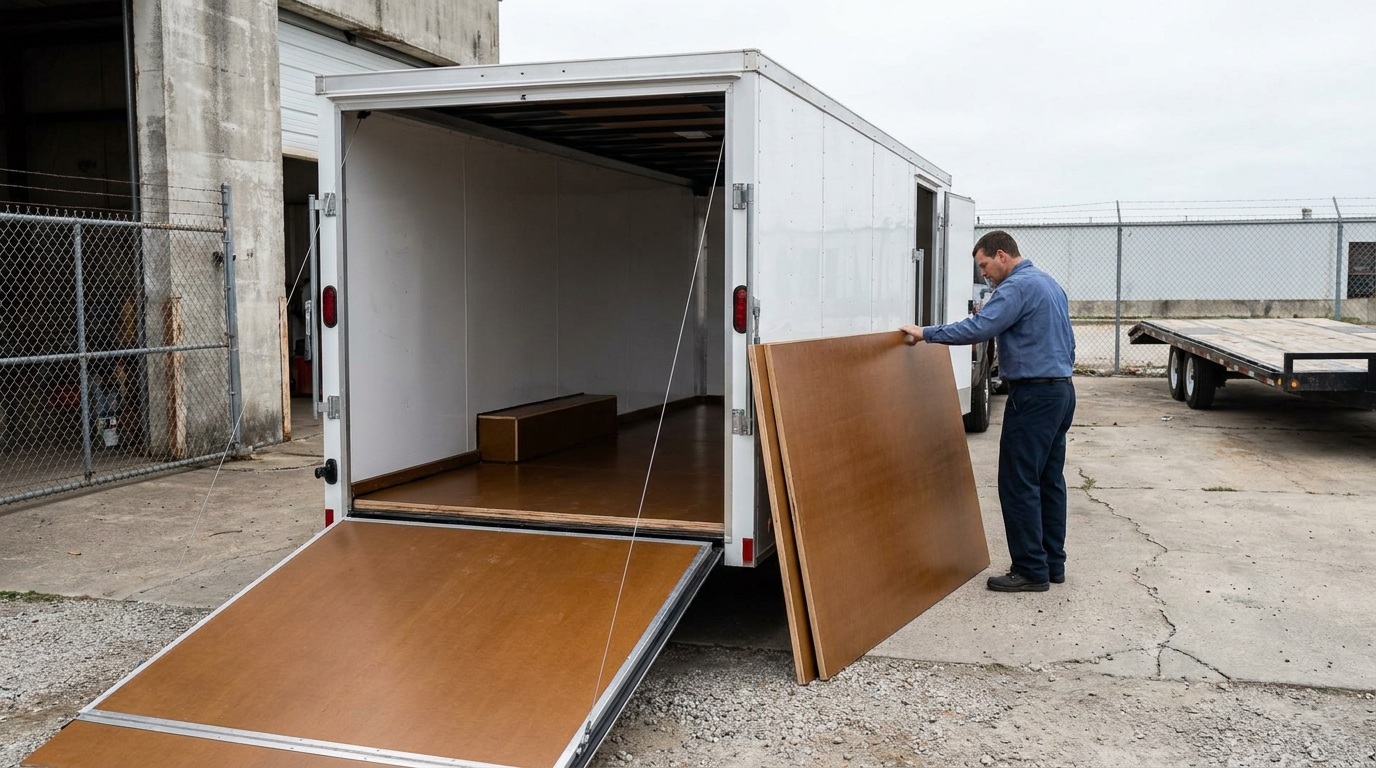
A trailer floor sees more abuse in a year than a residential subfloor sees in a decade. Road spray underneath, point loads from forklift tires above, urine and manure in livestock applications, fastener cycling from every speed bump and pothole, and the constant flex of a chassis that twists slightly differently from any building. The plywood spec that survives this is not the same plywood that goes into a residential build.
This guide walks the grade choices, the thickness and fastener rules, the edge treatment that decides whether the floor lasts five years or fifteen, and the trailer-type-specific calls. Written for owner-operators, fleet maintenance, RV builders and horse-trailer rebuilders, not for the homeowner doing a one-off plywood project.
Trailer flooring at a glance — quick reference
| Trailer type | Recommended grade | Typical thickness |
|---|---|---|
| Enclosed cargo (V-nose) | HDO or marine | 1/2 to 3/4 in |
| Flatbed deck-over | Apitong / dense hardwood | 1-1/8 to 1-1/2 in |
| Gooseneck cargo | HDO Premium 2S | 3/4 in |
| RV subfloor | Structural exterior | 5/8 to 3/4 in |
| Horse trailer stall | Hardwood face + anti-slip overlay | 3/4 in minimum |
| Motorcycle / ATV ramp | Anti-slip hex film-faced | 3/4 in |
| Open utility / landscape | HDO Basic 1SF | 1/2 to 5/8 in |
What makes trailer plywood different from construction plywood
A house subfloor sees a static gravity load distributed over a continuous joist plane, in a controlled humidity envelope. A trailer floor sees three loads that residential construction never sees:
- Point loads with abrasion. A forklift tire concentrates 2,000-4,000 lb on a 6-inch footprint and then drags across the surface. A house subfloor never sees this.
- Cyclic moisture from underneath. Road spray, salt brine in winter, and the constant condensation that forms on the underside of a sealed cargo floor. Construction plywood is built for top-down moisture protection, not bottom-up.
- Fastener pull-through. A trailer floor cycles thousands of times per mile as the chassis flexes. Pan-head screws into undersized cross-members work loose; flat-head nails pull through when the panel deflects.
The grades that handle this profile share three things: phenolic resin bonding (not melamine), face overlay or species selection for abrasion resistance, and tight veneer grading to keep the core voids that cause panel collapse out of the build.
Plywood grade options for trailers
Five real options dominate the market, plus one that gets confused into the list:
- Apitong (also marketed as Keruing or IronBark) — dense hardwood plywood from South-East Asia, the traditional flatbed deck choice. 60-70 lb/cu ft density, exceptional abrasion resistance, holds spike-and-clamp loads without crushing. Premium price.
- HDO (high-density overlay) — phenolic resin overlay (90-120 g/m²) bonded to a Douglas-fir or hardwood core. Smooth, water-resistant face, takes pallet jacks well. Workhorse for enclosed cargo, gooseneck and utility trailers.
- Marine plywood (BS 1088 or APA marine per PS 1) — exterior phenolic glue, low core voids, hardwood face. Best where the floor sees standing water (boat trailer, fish-hauling) or constant condensation.
- Anti-slip film-faced — phenolic film with a molded hex or mesh pattern, typically 120 g/m². Built for ramps, livestock decks, motorcycle and ATV haulers where shoe and hoof grip matters.
- Pressure-treated (PT) plywood — chemically treated against rot. Acceptable on open utility and landscape trailers; not appropriate inside enclosed cargo where the treatment chemistry can off-gas into the cargo.
One option gets pitched into trailer rebuilds and shouldn't: residential CDX sheathing. The glue line passes the exposure-1 spec for occasional weather exposure during construction; it does not survive constant road spray plus point loads.
Thickness guide by trailer type
| Trailer type | Cross-member spacing | Minimum thickness |
|---|---|---|
| Enclosed cargo | 16 in OC | 1/2 in |
| Enclosed cargo | 24 in OC | 3/4 in |
| Flatbed deck-over | 12-16 in OC | 1-1/8 in |
| Flatbed deck-over (heavy) | 16-24 in OC | 1-1/2 in |
| Gooseneck | 16 in OC | 3/4 in |
| RV subfloor | 16 in OC | 5/8 in |
| RV subfloor (Class A) | 16 in OC | 3/4 in |
| Horse trailer stall | 12 in OC | 3/4 in |
| Motorcycle / ATV ramp | 12 in OC | 3/4 in |
These are minimums for sound floors with sealed edges and dry under-storage. A floor that sees winter road salt, frequent wash-down or persistent moisture from the cargo (livestock, wet aggregate) should step up one increment from the minimum.
Anti-slip surfaces — when you need them and when you don't
Anti-slip film-faced plywood is the right call in three scenarios: livestock decks (cow, horse, sheep), motorcycle and ATV ramps where boot or tire grip on a wet panel matters, and open utility trailers used in landscaping where mud and wet leaves are constant. The hex-pattern phenolic film typically delivers a friction coefficient around 0.40-0.55 when dry and holds most of it when wet.
Smooth HDO is better for enclosed cargo where pallet jacks and hand trucks are part of the daily operation. The wheels skid on hex pattern; the smooth phenolic face lets them roll. We've shipped both anti-slip and smooth HDO formats to the same fleet operator on the same container in the past, with the anti-slip going on the horse trailers and the smooth HDO going on the enclosed cargo lineup.
Fastener and edge treatment
The fastener and the edge treatment matter as much as the panel. Five rules that come out of warranty claims more than design tables:
- Pan-head screws, not flat-head clouts. The pan head sits flush, distributes the clamping load across the panel face, and resists pull-through under cyclic flex.
- Screw length 1.75 to 2 times panel thickness. For 3/4-inch plywood into a 1/8-inch steel cross-member, that's a 1-1/2 to 2-inch self-tapping screw.
- Sealed edges on every cut. Bondo or two-part epoxy on the cut edge stops capillary moisture migration. This is the single most common failure point on every trailer type.
- Drainage at the lowest point. Enclosed cargo trailers need at least two 1/2-inch weep holes at the rear; livestock trailers benefit from continuous drainage gutters under the stall floor.
- Undercoating after installation. A rubberized undercoat applied from below seals the panel underside against road spray and salt brine. Skipping this step on a winter-region trailer halves the floor life.
Common failure modes
Three failure modes account for most trailer floor replacements:
- Edge swell from unsealed cuts. Water wicks into the cut edge through the exposed end grain, the inner plies swell, the panel face delaminates from the core. By the time the surface looks bad, the structural failure is already complete. Sealed edges stop this.
- Fastener pull-through from undersized cross-members. Light-gauge cross-members flex more than the panel, the panel cycles around the fastener, the screw head eventually punches through the face veneer. Visible as a starburst pattern around the screw.
- Front-wall rot from an unrelated roof leak. Water enters through a failing roof seam, runs down the front interior wall, and pools where the wall meets the floor. The floor failure is downstream of the roof leak. Inspect the roof first on any front-wall rot complaint.
For horse trailers specifically, urine bleed-through is a fourth mode. Even sealed-edge hardwood plywood eventually wicks ammonia into the core if the stall mat layer fails. Annual mat inspection and edge re-sealing extends the floor by years.
Cost, lifespan and replacement cycle
Service life by grade and care, in honest ranges:
| Grade | Service life (sealed edges, dry storage) | Service life (rough use) |
|---|---|---|
| Apitong | Up to 15 years | 8 to 12 years |
| HDO Premium 2S | Up to 12 years | 6 to 10 years |
| HDO Basic 1SF | Up to 10 years | 5 to 8 years |
| Marine | Up to 12 years | 6 to 10 years |
| Anti-slip film-faced | Up to 10 years | 5 to 8 years |
| PT plywood (open utility) | Up to 8 years | 4 to 6 years |
The decision between full replacement and overlay (a second 3/8-inch panel screwed over the worn original) usually comes down to whether the original substrate is structurally sound. If the substrate is solid but the face is worn, overlay is faster and cheaper. If the substrate has soft spots or fastener pull-through, full replacement is the only honest answer.
Vinawood plywood for trailer flooring — North America range
For North American buyers, our trailer-applicable products are in the HDO and anti-slip families. Three primary SKUs:
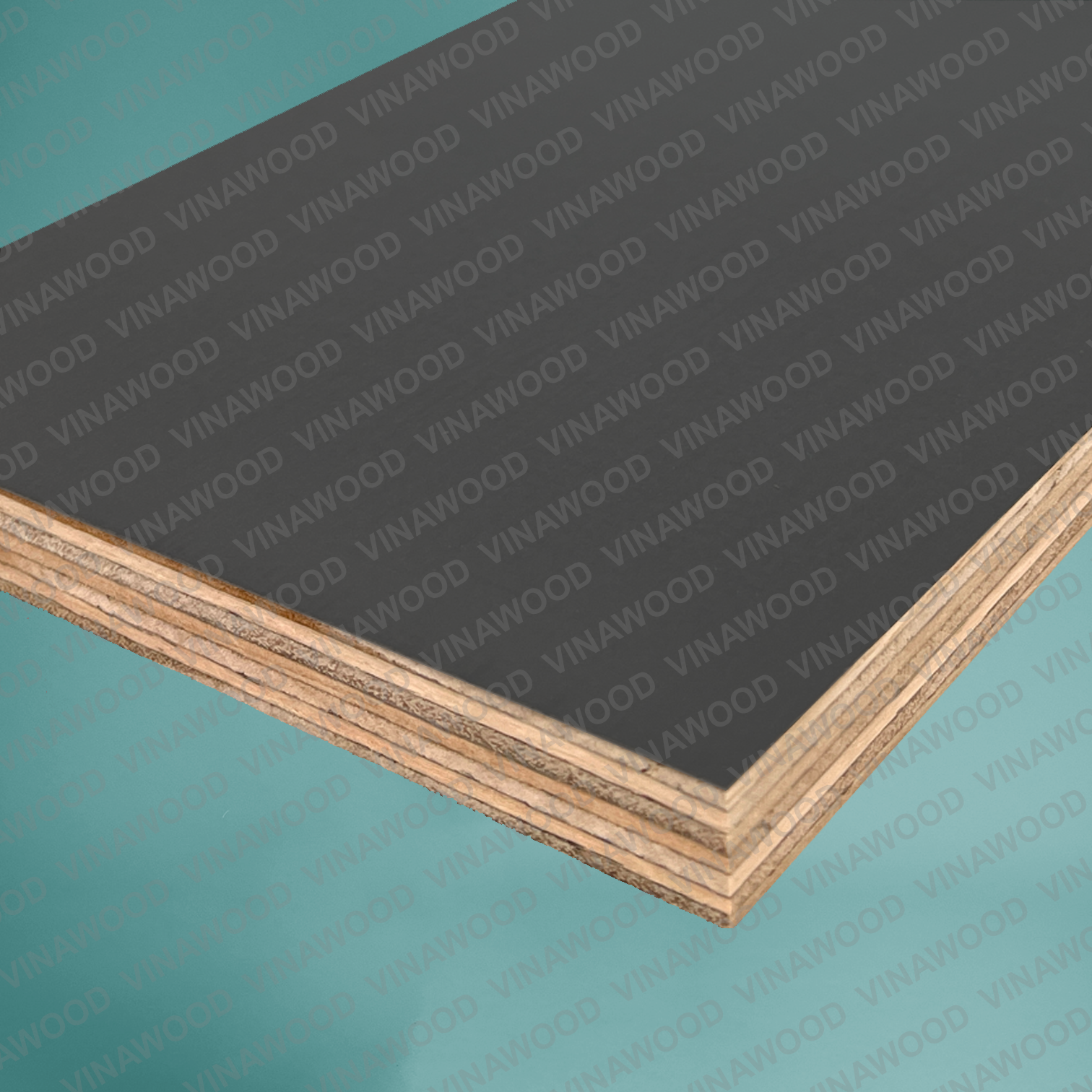
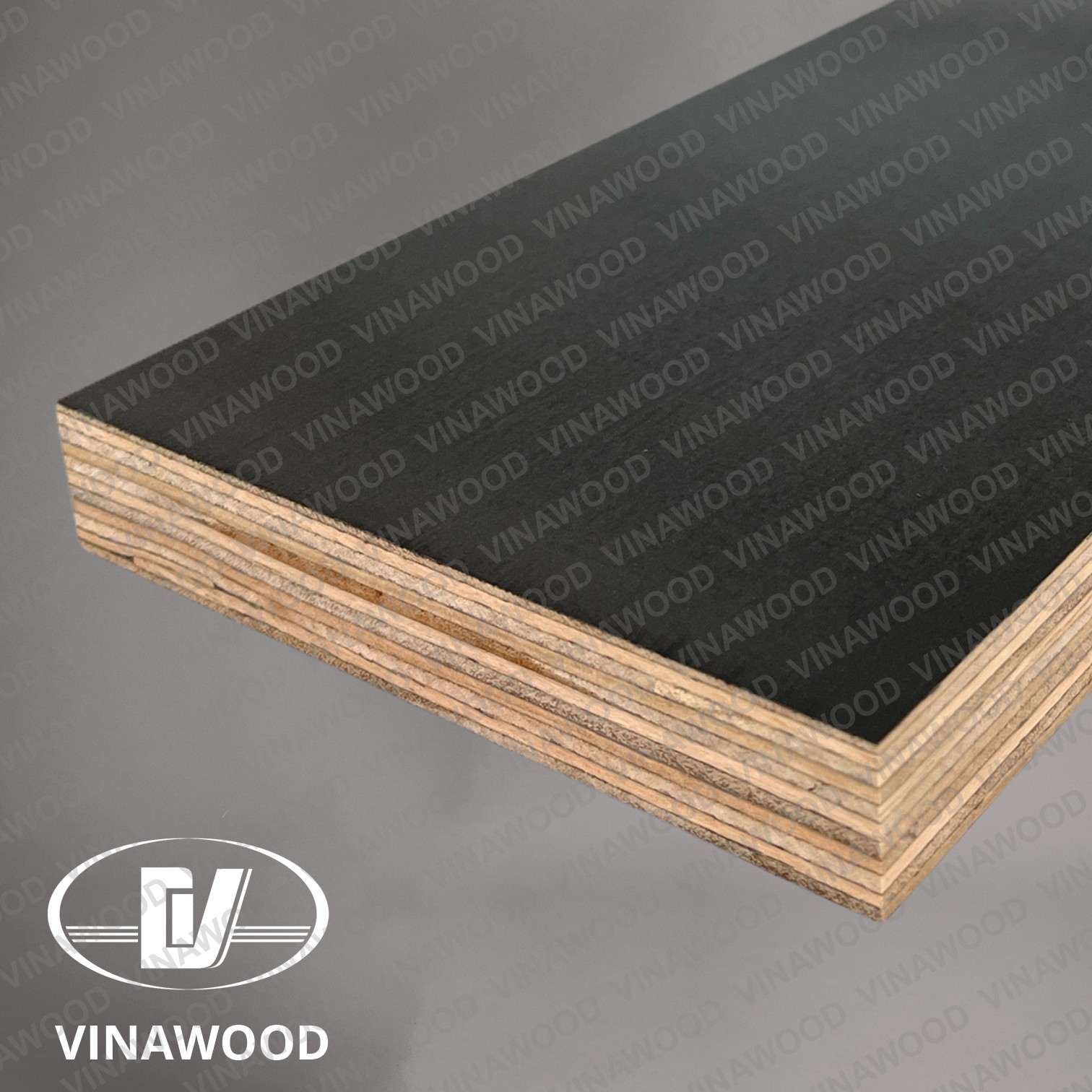
- HDO Basic 1SF — single-face high-density overlay, the most economical phenolic plywood deck for open utility, landscape and light cargo trailers.
- HDO Premium 2S — two-face high-density overlay with a heavier phenolic film. Built for cargo and gooseneck applications where both faces see abrasion (the underside hits dock edges, the top hits cargo).
- HDO Basic 2S — two-face HDO at a lower film weight than Premium. Cargo applications where budget matters but two faces are still better than one.
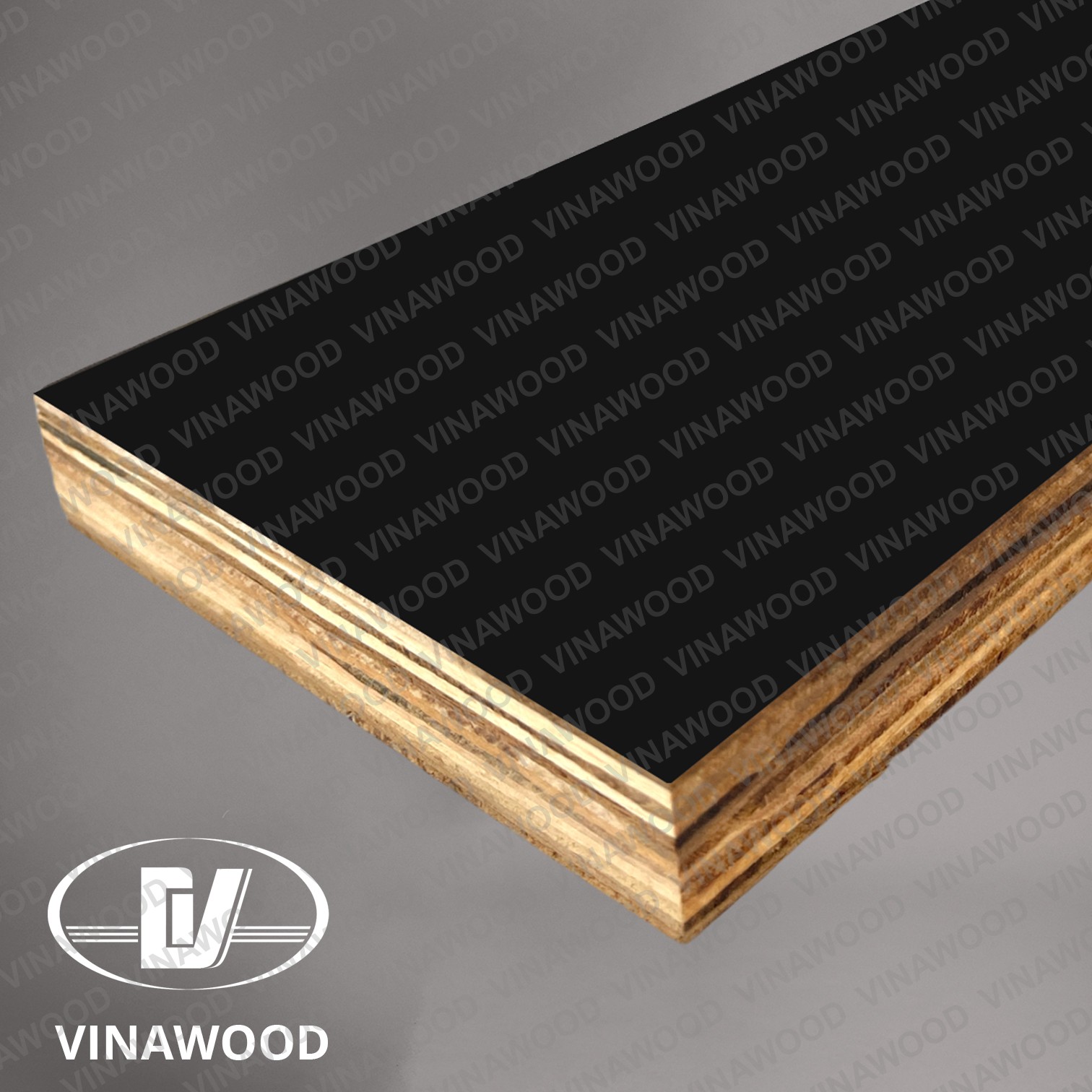
The Vinawood HDO range is built on phenolic resin glue lines and a phenolic film face. Anti-slip film-faced variants in the hex pattern are available on the same HDO base with a different overlay specification.
For context on the HDO grade choice see HDO vs MDO plywood and on the anti-slip face spec see anti-slip film-faced plywood. On the marine vs pressure-treated decision, marine plywood vs pressure-treated walks the call.
Buyer's checklist when the freight arrives
Seven inspection items before signing the delivery receipt:
- Face grade. No visible film blisters, no AI-grade-stamp issues, overlay color uniform across the bundle.
- Edge condition. Cuts square, no delamination at the corners.
- Sheet flatness. Stack should be flat; a bow exceeding 1/4 in across 8 ft means moisture exposure in transit.
- Thickness verification. Caliper at three points per sheet for sample sheets. Spec tolerance is typically ± 1/64 in on 3/4-inch panel.
- Glue line. Cut edge should show continuous, uniform glue lines with no powder or chips.
- Smell test. A strong urea-formaldehyde off-gas may indicate the wrong glue type was shipped — phenolic plywood has a faint smoky resin smell, not the sharp acidic UF smell.
- Pack moisture. Edge moisture meter should read under 14% for HDO and under 16% for marine on receipt.
About Vinawood
Vinawood is a Vietnamese plywood manufacturer founded in 1992, exporting to 55+ countries and over 5,000 containers per year. North American product range covers the HDO and MDO families plus anti-slip film-faced specifications. Certifications include FSC-COC, EPA TSCA Title VI / CARB Phase 2, and ISO 9001. Factory-direct from Vietnam via Pacific container traffic to LA, Long Beach, Tacoma and east-coast ports. Technical data sheets, friction-coefficient certificates for anti-slip lines, and CARB compliance documentation available at vinawoodltd.com.
Category
guides
Related Markets
Related Countries
Related Products
▶Sources & References (3)
- APA — Voluntary Product Standard PS 1-19 — APA — The Engineered Wood Association (2019)
- ANSI/HPVA HP-1 — American National Standard for Hardwood and Decorative Plywood — HPVA (2020)
- 49 CFR 393.106 — Cargo Securement Standards — FMCSA — Federal Motor Carrier Safety Administration (2023)