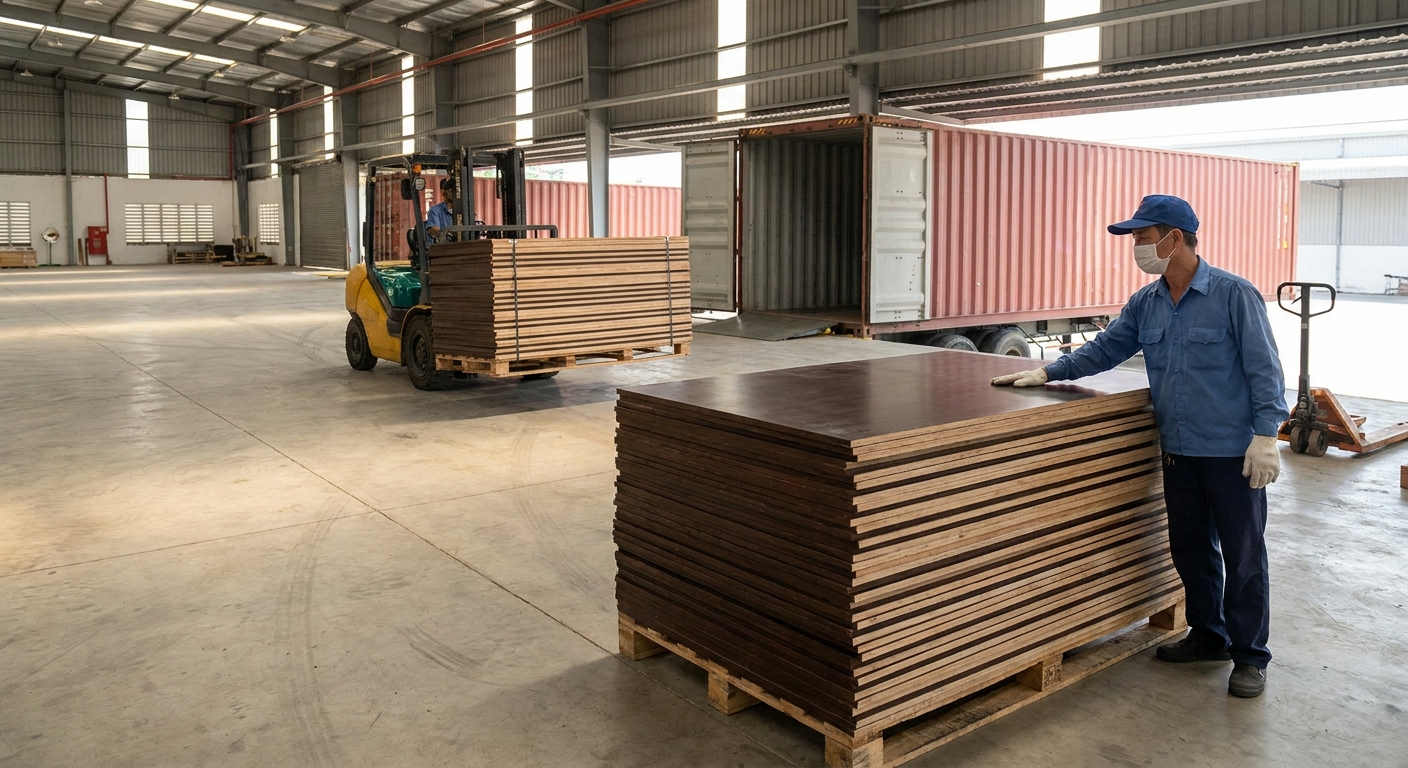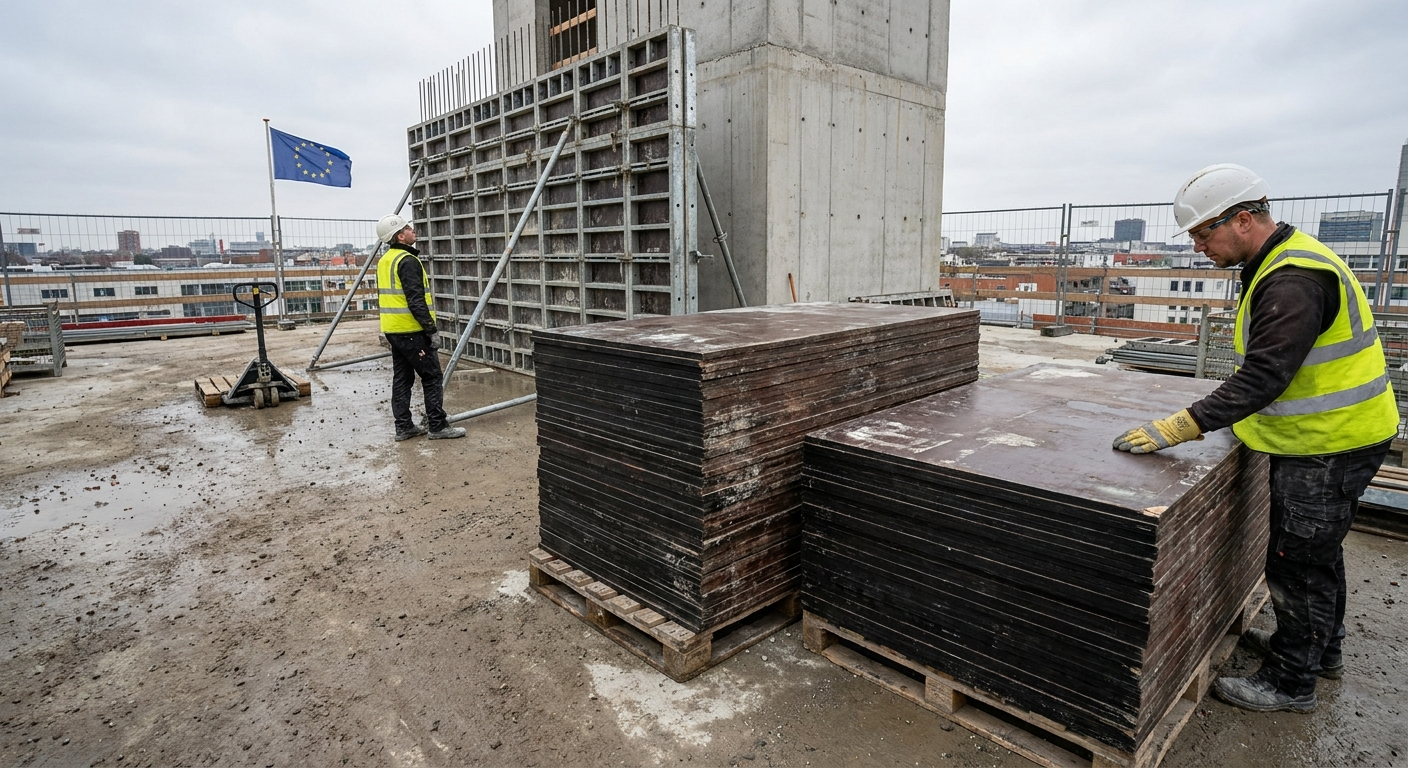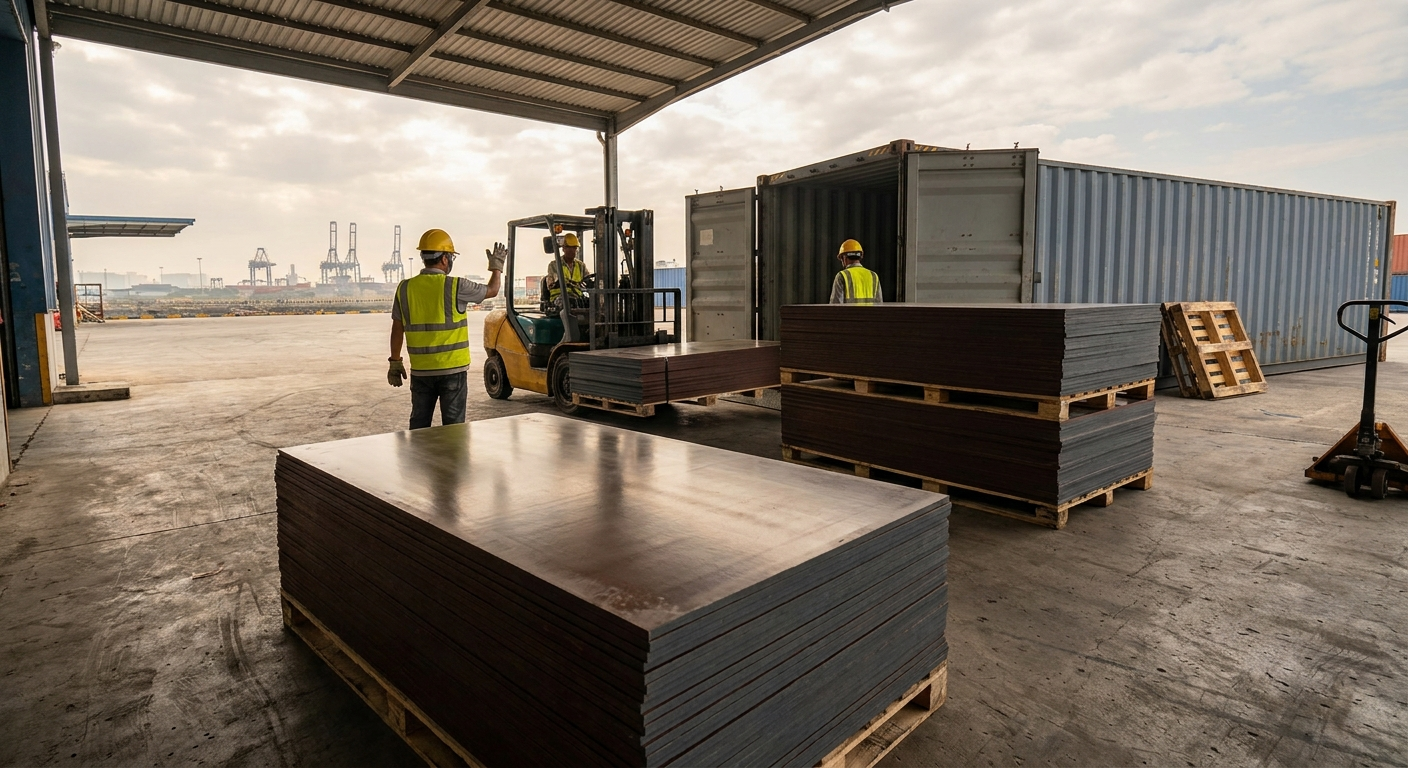
Book Q4 Formwork Now. Ocean Boxes Are Not Coming Down
Shanghai–Ningbo waits stretch to 11 days and 4.3 million TEU sits at anchorage. Drewry’s composite eased 1% to $4,473. That is not a cheaper Q4 box. Book now.
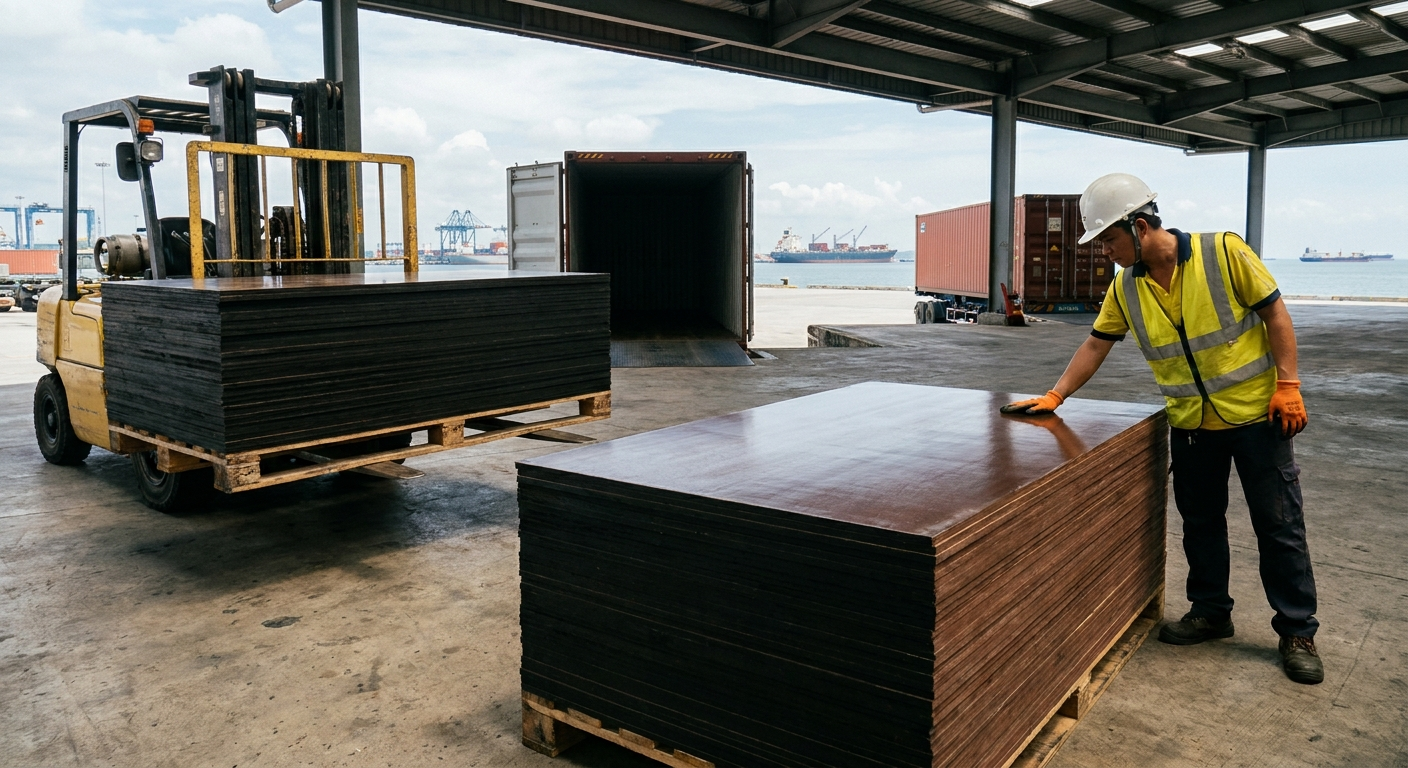
A one-percent dip on Drewry’s World Container Index is not a reason to wait. The composite fell to $4,473 per 40ft on 27 August. Shanghai to New York eased 2% to $9,333. Shanghai to Rotterdam fell 3% to $4,287. Shanghai to Los Angeles held at $6,818. The US East Coast box is still more than twice North Europe. The print moved a little. The capacity that would actually cut that print is still sitting at anchor, still steaming the Cape, and still queued for a Panama slot.
Book Q4 film-faced plywood against that stack. Waiting for a cheaper box is a bet that the queue, the Cape diversion and the canal cap unwind together. None of those is on a published unwind date.
Our 24 August flood brief already had the transpacific premium on the worksheet. This week the premium is still there and the wait is worse.
Why the box is still high
Three things are holding effective capacity down. None of them is a one-week weather story.
First, ships are not moving. Linerlytica said on 25 August that more than 4.3 million TEU of containership capacity was waiting to berth worldwide. That is above the 2022 pandemic peak in absolute tonnes, even if it is a smaller share of a larger fleet (about 12.6% of 34.4 million TEU). Linerlytica’s 16 August snapshot counted 328 containerships at anchorage across Shanghai and Ningbo, nearly 1.89 million TEU in that complex alone. Hapag-Lloyd’s Week 35 update, issued 26 August, put average waits at Shanghai’s Yangshan at 7 to 11 days for ships outside the Gemini network, and 5 to 10 days inside it. Ningbo was 3 to 6 days. A week earlier the upper end at Yangshan was 8 days. Typhoons Bavi, Dolphin and Saudel stacked the backlog before the last one had cleared. Drewry’s own Shanghai average wait jumped to 96 hours from 35 the week before. Different rulers. Same queue.
Second, the long way around Africa is still the default on many Asia–Europe and Asia–US East Coast strings. Freightos’ 18 August note said Maersk, Hapag-Lloyd, CMA CGM and COSCO are trying to put some ships back through the Red Sea, not because the waterway is safe, but because Cape fuel burn got more expensive after the Hormuz disruption. Cautious Suez trials do not free the 8 to 12% of global boxship capacity that Cape routing still soaks up. Until that capacity is actually back in the rotation, a lower composite is a weekly wiggle, not a market turn.
Third, carriers are still blanking sailings to defend the rate. Drewry logged four transpacific blanks for next week (down from seven) and four Asia–Europe blanks (up from two). Kuehne+Nagel, citing Seaexplorer, put global schedule reliability at 51.9% in July, with late ships arriving about six days late. Sea-Intelligence put July reliability at 56.4%, the weakest month of 2026, with late arrivals delayed 6.06 days. A rolled container is a more expensive container even when the tariff looks softer.
The wait will not clear on a reopen notice
Kuehne+Nagel’s late-August note is the operational line a buyer should keep. Reopening a terminal after a typhoon is step one. The queue, the missed berth windows and high yard utilisation can run for weeks. Further weather before the backlog clears starts the clock again. Omissions at Shanghai and Ningbo are already pushing cargo through Hong Kong, Singapore and Busan. Hapag-Lloyd reported Gemini waits around 48 hours in Singapore and up to 47 hours at Busan’s PNC terminal. The delay leaves eastern China and shows up on the next rotation.
That is why a cheaper Q4 box is not in sight. New ships keep arriving. They cascade into ports that already run with little spare berth and yard room. Kuehne+Nagel called the next two years a risk of “burst congestion”: delayed vessels arriving in clusters. Maersk, in Freightos’ 18 August roundup, named congestion as a major market fact, not a side-effect: more headhaul cargo, more empties to process, more time tied up. Freightos also flagged bunker up about 15% since the ceasefire collapsed, and emergency fuel surcharges of about $90 per 40ft from some carriers in mid-September. None of that is a path to a cheaper box.
Panama tightens from 3 September. Europe still has the inland problem.
The Panama Canal Authority will cut daily Neopanamax slots to nine from 3 September, gCaptain reported, with Panamax slots at 25, then 23 from 15 September. Ships without a reservation wait longer. US East Coast and Gulf strings that still use the canal pick that up first. Freightos said some carriers have filed Panama transit surcharges of $200 to $1,000 per 40ft from mid-September. Daily Cargo News’ reprint of Drewry’s 27 August note said the same thing in plainer words: book early and allow extra lead time.
Europe is not the cheap escape hatch it looks like on Drewry. The ocean line to Rotterdam is lower. The ship still sits in the Shanghai–Ningbo queue. Inland, Drewry flagged low Rhine water as a cargo-flow problem in the same 27 August note. A formwork lot that makes the ocean window can still miss a German site if barge draft is cut and the cargo shifts onto a tight truck or rail path. Write the inland move on the PO with the ocean line.
FOB Vietnam contracts are almost always in dollars. The State Bank of Vietnam set the daily reference rate at 25,611 VND per USD on 27 August, unchanged from the prior session, VietnamPlus reported. Vietcombank and BIDV opened that morning at 25,910 buy and 26,290 sell. A European buyer converting euros into a dollar invoice feels that even when mill FOB holds.
Duty scope is settled. Mixing lines is not.
The US International Trade Commission voted on 19 August that hardwood and decorative plywood from China, Indonesia and Vietnam injures the US industry. Commerce will issue antidumping and countervailing duty orders on that product. Softwood structural plywood investigations were terminated as negligible. Film-faced formwork sits outside the hardwood-and-decorative case. There is no blanket duty-free claim in that sentence. A US importer who puts decorative and formwork on one PO is the party who creates the deposit problem.
Keep glue class off the freight worksheet. Phenolic Class 3 / EN 636-3 product such as Pro Form belongs on exterior or long wet-storage pours. Form Extra is a higher-melamine-content MUF panel in the EN 636-2 envelope and is not Class 3. A delayed box does not change the bond.
What to do this week
From our mill desk: place the Q4 formwork order now. Confirm the mill’s production week, then the vessel, then the stuffing date. Do not hold a deposit for a freight print that needs Cape capacity back in the rotation, a cleared Shanghai–Ningbo queue, and an uncut Panama slot at the same time. Price the ocean line, the origin wait and the FX conversion as three rows. For US East Coast and Gulf, lock space against the $9,333 Shanghai–New York print and the September Panama cap, and keep formwork out of the decorative duty drawer. For Europe and the Mediterranean, a cheaper box is only cheaper if the ship stays on the schedule you bought. For Australia and other eastbound strings, the Shanghai queue still applies even when Panama does not.
About Vinawood
Vinawood is a Vietnamese plywood manufacturer established in 1992. The mill ships more than 5,000 containers a year to 40+ export countries across Asia, the Americas, Europe, the Middle East, Africa and Australia, with film-faced and formwork panels built on a documented production process and individual sheet inspection. Core certifications include ISO 9001, FSC-COC, PEFC, EN 13986 CE marking, and EPA TSCA Title VI for US-bound orders. Wood is plantation-grown. For Q4 and Q1 formwork enquiries, request a quote.
Category
market-insights
Related Markets
Related Countries
Related Products


▶Sources & References (12)
- World Container Index – 27 August 2026 — Daily Cargo News / Drewry (2026-08-27)
- World Container Index — 27 August 2026 — Drewry (2026-08-27)
- Shanghai-Ningbo Delays Stretch to 11 Days as Typhoon Backlog Spills Into Liner Networks — Xinde Maritime News / Hapag-Lloyd (2026-08-28)
- Port Congestion Sets New Record at 4.3M TEU in Stranded Volume — Maritime Executive / Linerlytica (2026-08-25)
- Global port congestion at new high as more typhoons hit China — The Loadstar / Linerlytica (2026-08-25)
- Congestion playing a bigger role in container rates — 18 August 2026 Update — Freightos (2026-08-18)
- Panama Canal to Cut Daily Transits as Optimistic Water Outlook Fades — gCaptain (2026-08)
- USITC Votes on Hardwood and Decorative Plywood from China, Indonesia, and Vietnam — U.S. International Trade Commission (2026-08-19)
- Reference exchange rate remains stable on August 27 — VietnamPlus (2026-08-27)
- Port congestion set to remain a moving target — Kuehne+Nagel / Seaexplorer (2026-08)
- seaexplorer Schedule Reliability Report – July 2026 — Kuehne+Nagel / Seaexplorer (2026-08)
- Global schedule reliability falls to 56.4% in July — Container News / Sea-Intelligence (2026-08)