What Is Marine Plywood? Grade, Uses & How to Choose
Complete guide to marine plywood: BS 1088 standards, void-free core construction, WBP phenolic adhesive, grade comparisons, common uses, and how to verify quality before buying.
Marine plywood occupies the top tier of the plywood quality hierarchy — and commands a price premium to match. But the term is widely misunderstood. Many panels sold as "marine plywood" across Asia and the Middle East are simply exterior-grade plywood with a marketing upgrade. Understanding what genuine marine plywood actually is, which standards define it, and when the premium is justified helps buyers avoid overpaying for the wrong product — or underpaying for a panel that will fail in service.
This guide covers the technical definition, grading standards, specifications, common applications, and a practical framework for choosing marine plywood. It serves as the hub article for Vinawood's marine plywood knowledge base.
What Is Marine Plywood?
Marine plywood is a cross-laminated hardwood panel manufactured to marine-grade standards. Three characteristics distinguish it from regular exterior plywood: a void-free core, WBP phenolic adhesive, and tighter veneer grading.
Void-free core construction means no gaps, overlaps, or missing veneer sections are permitted anywhere in the panel cross-section. Standard plywood allows core voids within grading tolerances — marine plywood does not. This eliminates internal weak points where water could pool and accelerate decay.
WBP phenolic adhesive (EN 314 Class 3) bonds all veneer layers. The adhesive survives prolonged boiling water immersion without delamination — the definitive test for a boil-proof WBP bond. For a technical deep-dive into adhesive types and testing, see the WBP glue guide.
Tighter veneer grading requires face veneers of A/B quality minimum. Back veneers must be B grade or better. Lower-grade veneers (C, D) with knots, splits, or patches are not permitted, even on the back face.
The primary international standard for marine plywood is BS 1088. Not all plywood labelled "marine" actually meets BS 1088 — a critical distinction explored in the identification section below.
Marine Plywood vs Regular Plywood: Key Differences
The differences between marine plywood and regular plywood are structural, not cosmetic. A marine panel and a standard exterior panel may look identical on the surface, but their internal construction and long-term moisture performance diverge significantly.
| Parameter | Marine Plywood (BS 1088) | Regular Exterior Plywood |
|---|---|---|
| Core construction | Void-free — no gaps permitted | Voids allowed within grade tolerances |
| Adhesive | WBP phenolic (EN 314 Class 3) | May be MR, BR, or WBP |
| Face veneer grade | A/B minimum | C/D allowed |
| Species requirement | Hardwood veneers (BS 1088) | Any species |
| Moisture performance | Permanent water contact | Intermittent moisture only |
| Price | 2–4× standard exterior plywood | Baseline |
| Typical use | Boat building, docks, permanent wet installations | Exterior cladding, general construction |
The cost premium reflects the raw material waste involved in achieving void-free construction (more veneer is rejected during grading), the higher-cost phenolic adhesive, and the tighter quality control throughout manufacturing.
Marine Plywood Grades Explained
Several national and international standards define marine plywood. They share common principles but differ in species requirements, test methods, and terminology.
BS 1088 (International) is the most widely referenced marine plywood standard globally. It requires hardwood veneers with a minimum density of 560 kg/m³, WBP phenolic adhesive (tested per EN 314 Class 3 or BS 1088 72-hour boil test), void-free core, and A/B face grade minimum. BS 1088 is the benchmark specification cited in boat building, marine construction, and high-end joinery worldwide.
EN 636-3 (Europe) defines the structural performance grade for plywood used in exterior conditions. While not marine-specific, EN 636-3 requires WBP adhesive and is often cited alongside BS 1088 for panels used in European marine and coastal construction.
IS 710 (India) defines BWP (Boiling Water Proof) grade marine plywood for the Indian market. IS 710 specifies Group 1 hardwood species, phenolic adhesive, and the cyclic boil test. In India, "marine plywood" and "BWP plywood" are used interchangeably in the trade — though not all panels carrying these labels genuinely meet IS 710.
AS/NZS 2272 (Australia/NZ) specifies marine grade plywood with F-grade structural ratings. Australian marine plywood must meet bond Type A (equivalent to WBP) and demonstrate structural performance under the AS/NZS framework.
Face grade designations describe the veneer quality on each panel side. AB means the front face is A grade (sanded, defect-free) and the back is B grade (minor repairs allowed). BB means both faces are B grade — suitable for structural applications where surface finish is less critical.
Marine Plywood Specifications and Properties
Standard marine plywood specifications across most manufacturers and standards:
| Property | Typical Range |
|---|---|
| Standard thicknesses | 4, 6, 9, 12, 15, 18, 25 mm |
| Sheet sizes | 2440×1220 mm (global), 2500×1250 mm (EU) |
| Density | 550–700 kg/m³ (species dependent) |
| Adhesive | Phenolic formaldehyde — WBP / EN 314 Class 3 |
| Core construction | Void-free, cross-laminated veneers |
| Formaldehyde class | E1 or CARB Phase 2 |
| Moisture content (delivery) | 8–14% |
The most common thickness for boat building and structural marine use is 18 mm. Thinner panels (4–6 mm) are used for interior paneling, modeling, and lightweight marine cabinetry. Thicker panels (25 mm) serve heavy-duty marine construction and dock decking.
Common Uses of Marine Plywood
Marine plywood was originally developed for boat building and remains the standard panel for hull construction, deck surfaces, and interior bulkheads. Beyond marine applications, its void-free core and boil-proof, water-resistant WBP bond make it suitable for several demanding construction scenarios.
Boat building and hull construction is the defining use case. The void-free core prevents water retention within the panel structure, and the WBP adhesive withstands permanent water immersion. Most marine craft constructed from plywood specify BS 1088 or equivalent.
Dock and marina structures benefit from marine plywood's resistance to constant splash zone exposure and tidal cycling. Decking, handrails, and access ramps in marina environments require the moisture durability that only marine-grade construction provides.
Bathroom and kitchen cabinetry in tropical and humid climates — particularly in the Philippines, India, and Southeast Asia — frequently uses marine plywood. In these markets, standard MR-grade plywood deteriorates within a few years due to sustained humidity. Marine plywood extends cabinet life significantly.
Outdoor furniture and playground equipment exposed to rain, UV, and temperature cycling benefits from marine plywood's dimensional stability. The void-free core prevents the internal delamination that causes standard plywood furniture to warp and split outdoors.
Concrete formwork in coastal environments may use marine plywood where salt spray and sustained wet conditions exceed the design parameters of standard film-faced plywood. For standard formwork applications, however, film-faced plywood is more cost-effective — the phenolic film surface provides the concrete release properties that marine plywood's bare veneer face does not.
When Marine Plywood Is Worth the Premium
Marine plywood costs 2–4× more than standard exterior plywood and 1.5–2.5× more than film-faced formwork plywood. The premium is justified only in specific scenarios.
Use marine plywood when: the application involves permanent water contact (boat hulls, dock structures), the panel core must be completely void-free for structural or water-barrier reasons, or the application requires BS 1088 or equivalent certification for regulatory or insurance compliance.
Consider alternatives when: the application is concrete formwork (film-faced plywood with WBP adhesive is more cost-effective and provides better concrete release), the exposure is intermittent moisture only (standard WBP exterior plywood is sufficient), or the installation is interior-only in a climate-controlled environment (commercial plywood is appropriate).
For a detailed comparison of marine plywood pricing across markets, see the marine plywood price guide.
How to Choose the Right Marine Plywood
Selecting the right marine plywood panel follows a five-step framework:
Step 1: Define the moisture exposure level. Permanent immersion (boat hull) requires BS 1088 with hardwood veneers. Intermittent splash zone exposure (dock surfaces) may accept BS 1088 or equivalent national standards. Humidity-only exposure (bathroom cabinets) can use BWP-grade plywood that meets IS 710 or similar — full BS 1088 may be unnecessary.
Step 2: Check the species. BS 1088 requires hardwood veneers with a minimum density of 560 kg/m³. Eucalyptus, acacia, and meranti are commonly accepted species. Lighter species (poplar, softwoods) do not meet BS 1088 regardless of adhesive quality.
Step 3: Verify the adhesive. The adhesive must be WBP phenolic (EN 314 Class 3). Dark brown or black glue lines at the panel edge indicate phenolic adhesive. Light cream or white glue lines indicate urea formaldehyde (MR grade) — not acceptable for marine applications. For detailed adhesive verification procedures, see the WBP glue guide.
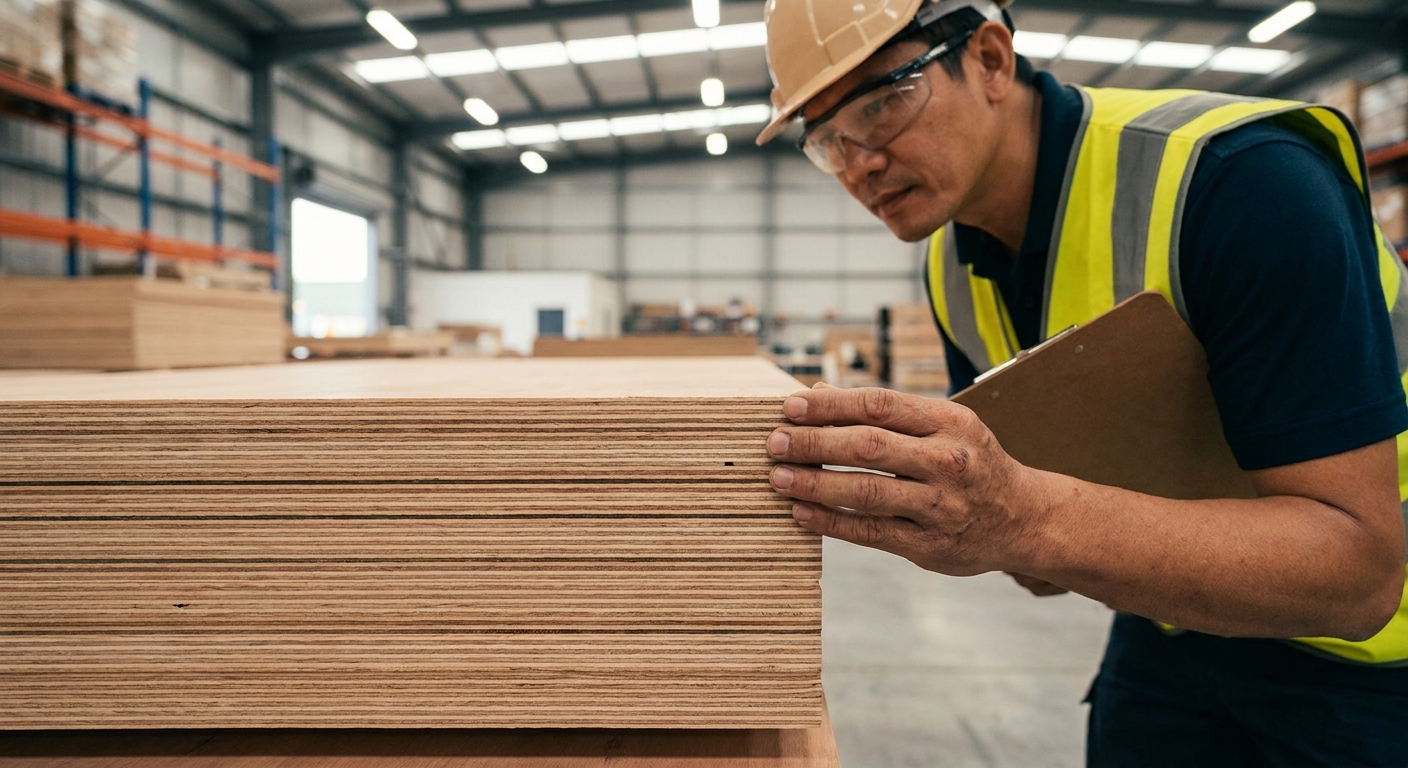
Step 4: Inspect for core voids. Examine the cross-section edges of sample panels. Genuine marine plywood shows tightly laminated veneer layers with no visible gaps, overlaps, or missing sections. Any visible void disqualifies the panel from marine-grade classification, regardless of what the label says.
Step 5: Request test certificates. BS 1088 or EN 314 Class 3 certification from an accredited third-party laboratory (SGS, Bureau Veritas, Intertek) confirms that the specific product was independently tested. Self-declared compliance without laboratory documentation should be treated with caution.
How to Identify Genuine Marine Plywood
The gap between "marine plywood" as a marketing label and genuine BS 1088 compliance is wide — particularly in markets where the term is used loosely.
Visual checks: Inspect the panel edge cross-section. Genuine marine plywood shows tightly laminated veneer layers with dark phenolic glue lines and zero visible core voids. If you can see gaps between veneers, light-coloured glue lines, or uneven veneer thickness, the panel does not meet marine-grade construction standards.
Documentation: Request a BS 1088 or equivalent test certificate issued by an accredited laboratory. The certificate should reference the specific product grade, thickness, and species being purchased — not a generic certificate covering a different product line.
Common relabelling: Standard exterior plywood relabelled as "marine" is especially prevalent in India and Southeast Asia, where the term carries significant price premium potential. In these markets, always verify through documentation and visual inspection rather than relying on supplier declarations alone.
Vinawood Marine Plywood Range
Vinawood manufactures marine plywood using eucalyptus and acacia hardwood core species sourced from managed plantations in Vietnam. The range is designed for export markets including the Philippines, India, Australia, the Middle East, and the United Kingdom.
Key specifications across the Vinawood marine plywood collection: BS 1088 compliance, EN 314 Class 3 WBP phenolic adhesive throughout all plies, void-free core construction, available thicknesses from 4 mm to 25 mm in both imperial (2440×1220 mm) and European (2500×1250 mm) sheet sizes, and certifications including FSC chain-of-custody, CARB Phase 2 formaldehyde compliance, and CE marking documentation for European markets.
For construction formwork applications, Vinawood recommends the film-faced plywood range rather than marine plywood. Film-faced panels provide superior concrete release, higher reuse cycle counts, and more cost-effective performance for forming applications. For information on phenolic plywood properties and product options, see the dedicated guide.
Frequently Asked Questions
Is marine plywood waterproof?
The adhesive bond in marine plywood is a boil-proof, water-resistant WBP-type bond — it survives boil testing and prolonged wetting without delamination. However, the wood veneers themselves absorb moisture over time. Marine plywood resists water at the bond level but is not impervious. Coating or sealing extends the life of the wood component in permanently wet applications.
Can I use marine plywood outdoors?
Yes. Marine plywood is designed for exterior and marine exposure. For maximum outdoor lifespan, seal cut edges and apply a UV-protective coating. Uncoated marine plywood exposed to full weather shows surface veneer degradation within 3–5 years, though the adhesive bond and structural integrity remain intact much longer.
What is the cheapest marine plywood?
Lower-cost options labelled "marine" or "BWP" exist in most markets, but buyers should verify they meet a recognized standard (BS 1088, IS 710, or equivalent). The cheapest panels often use lower-density species, thinner veneers, or MUF adhesive rather than phenolic — all of which reduce long-term performance. For verified quality at competitive pricing, factory-direct import from manufacturers like Vinawood offers the best value per sheet.
How long does marine plywood last?
In protected marine applications (boat interiors, sealed hull construction), marine plywood can last 25+ years. In exposed applications (dock decking, outdoor furniture), lifespan depends on coating maintenance and climate — typically 10–20 years with periodic refinishing. The WBP adhesive bond itself does not degrade; the limiting factor is always the wood veneer surface.
Is marine plywood stronger than regular plywood?
Marine plywood has similar bending strength and stiffness to regular hardwood plywood of the same species and thickness. The advantage is not raw strength but moisture durability and structural integrity — the void-free core eliminates internal weak points, and the WBP adhesive maintains bond strength through moisture cycling that would cause standard plywood to delaminate.
Category
guides
Related Markets
Related Countries
▶Sources & References (3)
- BS 1088-1:2003 — Marine plywood — Requirements — British Standards Institution (2003)
- EN 314-1: Plywood — Bonding Quality — Test Methods — European Committee for Standardization (2004)
- IS 710:2010 — Marine Plywood — Specification — Bureau of Indian Standards (2010)