MDO Plywood vs Steel, Aluminum and Plastic Formwork
MDO plywood vs steel, aluminum and plastic formwork. Overlay grades (film-faced, MatteFace searched as MDO, HDO) are not alternatives. True systems differ on crane, geometry and capex. Vinawood mill, est. 1992, 55+ countries.
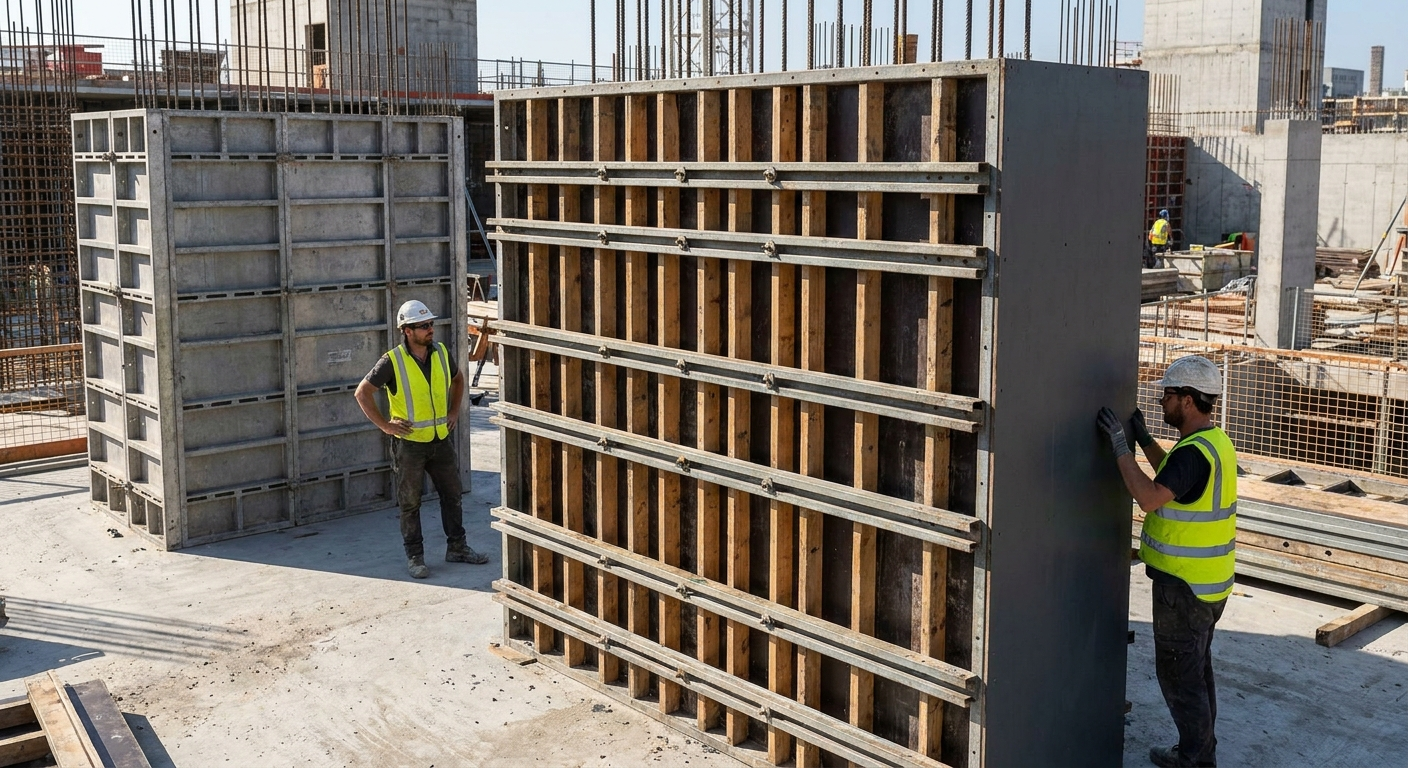
Formwork plywood is the timber forming family: film-faced sheets, MatteFace (buyers often search it as MDO formwork plywood), and HDO overlay. Steel, aluminum, and ABS plastic are system alternatives. They are not overlay grades. Do not put MDO and HDO on an "alternatives to plywood" list — they are plywood. Treat them as grades inside the timber family, not as substitutes for it.
This page splits those two piles for buyers comparing formwork plywood alternatives. Overlay comparison also lives on film faced vs MDO vs HDO. Types and bond class sit on concrete forming plywood.
Why crews still start with overlay plywood
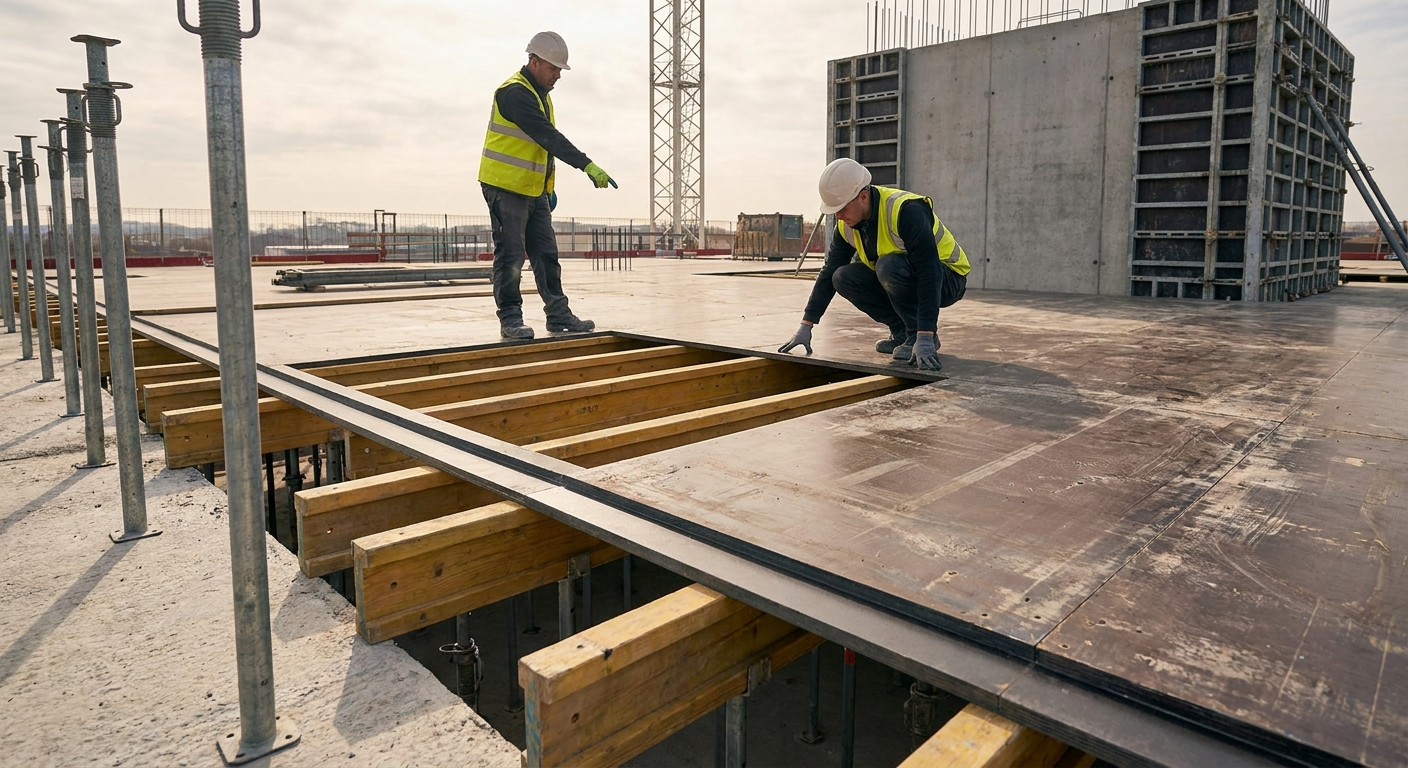
Plywood formwork is a light, water-resistant panel that takes pour pressure and leaves a repeatable face. It is not a sponge. WBP glue and a sealed overlay keep moisture at the edge and the face. Bare veneer still needs oil and cover. No forming plywood on this page is waterproof — WBP means water-resistant glue class, not a marine seal.
You pick overlay plywood when the gang is timber or timber-on-steel frames, when you need a replaceable face, and when crane time is limited. You pick a metal or plastic system when the geometry repeats for months and the capex is already approved. Wildfires and vessel queues make sheet supply noisy. That is a procurement problem. It does not turn HDO into an "alternative to plywood."
Same job, different nickname. North America says forming plywood or plyform. The UK says shuttering. Export catalogues say film-faced. Spec the overlay and the glue. Not the nickname.
Overlay plywood (not alternatives)
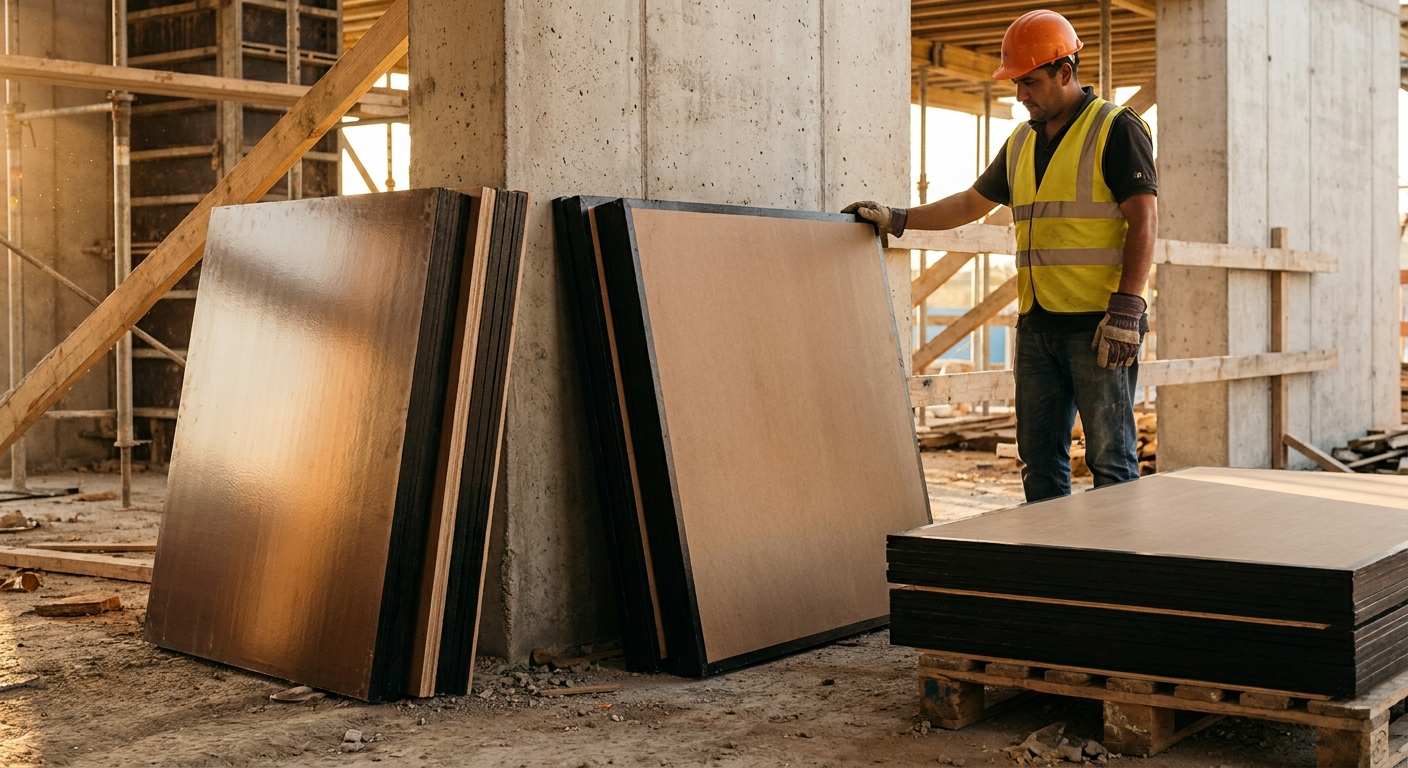
Three overlay families do the forming job. Reuse is "up to N" under decent site practice, and site handling spends that life first. Calibration before the overlay goes on keeps thickness honest — a fat sheet next to a thin sheet is a step in the wall. Ask for EN 315 on film-faced lots when thickness tolerance matters.
Melamine on a quote is three different things: MUF resin in the core, a lighter face film, or a printed laminate on furniture. Name which one. Form Extra is Superior Glue MUF in the core and the same phenolic face family as Form Basic. It is not Class 3.
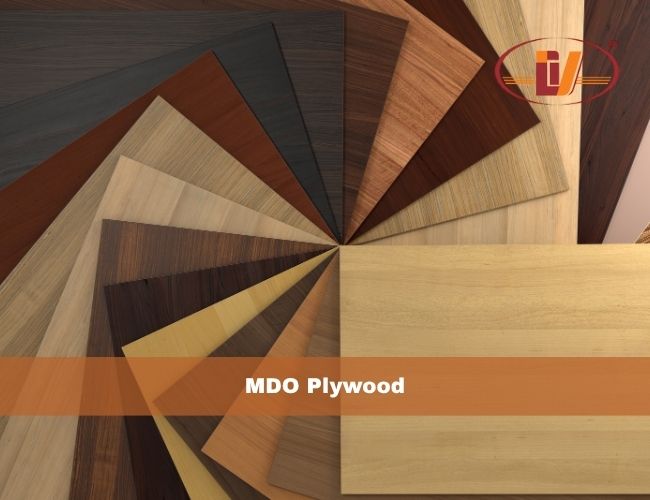
MDO plywood (search token) and MatteFace
Two products share the MDO label in the market. Kraft-paper MDO is paint and signage — it is not the formwork CTA here. The formwork product is MatteFace Plywood (MTF): a matte phenolic surface film, reuse up to 15. Soft bridge: buyers often search for MatteFace as MDO formwork plywood. Not kraft paper. Not paintable. Not signage. Education hub: MDO plywood. Overlay vs HDO: HDO vs MDO plywood.
I still see take-offs that list "MDO alternative to film-faced." Wrong pile. MatteFace is a formwork overlay. It belongs next to HDO and film, not next to ABS boxes.
HDO forming panels
HDO plywood is the North American fair-face overlay — a denser phenolic face than kraft MDO, with a glossy strip when the pour allows it. Vinawood HDO Basic reuses up to 10. HDO Premium and Premium HD reuse up to 20. Phenolic Class 3 sits on the HDO range. Collection: HDO plywood.
Film-faced Europe line
Split film from core when you read a TDS. Pro Form is WBP phenolic, EN 636-3, reuse up to 20. Pro Form Lite sits between Form Extra and Pro Form: PF / Class 3, 165 g/m², reuse up to 15. Form Extra is Superior Glue MUF, EN 636-2, reuse up to 15 — not Class 3. Form Basic up to 10. Eco Form and Eco Form Plus up to 8. Collection: film-faced plywood.
P-Form is polypropylene. Not Pro Form. Consply is commercial Bintangor, not a film-faced formwork grade. Plantation-grown Acacia, Eucalyptus, or Hevea cores.
True system alternatives
These replace the timber face, or the whole gang. Cost, weight, and geometry decide. Vinawood overlay maxima are in the section above.
Wood-polymer and wood-cement
Permanent or stay-in-place boards. Porous. Lower flexural modulus than an 18 mm overlay sheet unless you thicken them. Useful in warm, humid yards where termites eat untreated timber. Not a drop-in for a steel wall form that already takes plywood.
Fiber-reinforced / fabric
Glass-fiber or textile sheets for curved or freeform pours. High strength-to-weight. The point is geometry the flat sheet cannot make, not a cut-price 4×8. Keep it short. If the wall is planar, stay on overlay plywood.
ABS plastic
ABS (acrylonitrile butadiene styrene) modular boxes are light and stackable. Plastic is waterproof by its nature and does not rust, so it fits underground work and wet pits. Many more cycles than a timber face if the moulds stay in the same module — that is a system cost, not a knock on mill plywood. Contrast on weight, crane, and repeating geometry rather than inventing a cycle number.
People like the mass. Two workers move a panel without a forklift. The trade is module lock-in. Odd column sizes and one-off walls still want a sheet you can cut.
Fiber tubes (columns only)
Fiber tubes for columns, footings, posts, and light poles are specialty pieces. Not a plywood replacement for walls or slabs. Use up to a few feet above and below grade per the product note. They degrade in place on some details. Leave them off a wall-form RFQ.
Reinforced polyurethane foam and printed foam
Boards from leftover polyurethane foam, sometimes with fiberglass skins, bring low thermal conductivity. The foam itself can be described as waterproof — that claim does not transfer to plywood. Stay-in-place or insulating form, not a fair-face overlay. Printed foam moulds (F3DP) help when the shape is the product. Not a substitute for a 2440×1220 gang on a shear wall.
Aluminum and steel systems
Aluminum systems dominate repetitive floors and typical apartment layouts. High capex. Crane every cycle. Fast once the crew knows the kit. Form finish can skip plaster on some specs. The plywood question still appears at infill, stairs, and make-up pieces, because overlay sheets patch what the kit does not cover. A first tower on aluminum is a finance decision. A one-off shear wall is not.
Steel gangs sit in the same bucket: repetitive geometry, crane access, high first cost. Finish quality depends on the face plate, not on a timber overlay. If the job is already a steel system, this page is not the buy. If the job is timber frames, stay in the overlay section.
How to choose overlay vs system
Ask overlay vs system first. Then pour count, geometry, and crane. Planar walls and slabs on timber or steel frames stay on overlay plywood — pick HDO, MatteFace, or film by finish and reuse target. Repeating typical floors with a crane and a kit budget point to aluminum or steel. Wet pits and light modules with no crane point to ABS plastic. Round columns only want fiber tubes, not a wall answer. Freeform architecture wants fabric or printed foam.
If you stay on overlay, the RFQ still needs four fields: overlay (HDO grade vs MatteFace vs film gsm), bond class (EN 636-2 MUF vs EN 636-3 PF), size (2440×1220 vs 2500×1250), and emission class (CARB P2 / TSCA Title VI, or EN 13986). UK synonym: shuttering plywood guide.
North America still buys 4×8 for gangs. Metric frames often want 1250×2500. Mixing the two on one wall leaves a lip. Thickness workhorse is 18 mm; 12 and 15 mm show up on lighter pours; 21 mm on heavy walls. Span and deflection are a different problem from overlay colour. Do not spec a wall-form HDO for a tableform deck just because the photo matches.
Release agent is not optional on a new film. Plastic scrapers at strip-out. Store on bearers, faces together, under cover. Those habits decide whether "up to 20" is a real number. Only Pro Form, Pro Form Lite, and the HDO range are phenolic Class 3. Form Extra is not. Reuse maps to overlay: up to 10, up to 15, or up to 20. Never stretch the spec sheet past the printed maximum.
Request mill specs, not a catalogue nickname
Vinawood has made plywood in Vietnam since 1992. About 5,000 containers a year to 55+ countries. Twelve-step process from peel through overlay or film, seal, and pack, with 100% sheet inspection and ISO 9001. Factory-direct mill. Not a plywood store. Cores are plantation-grown.
For North American distributors who need ready stock, Vinawood maintains distribution warehouses in Toronto, Vancouver, Calgary, Montreal, Miami, Houston, and Baltimore to supply local distributors. Mill CTA remains factory-direct: send overlay, bond class, size, and emission class on the RFQ form or quotation form. Packing list, mill test report, and DoP travel with the lot. No published list prices. The lot closes on the overlay and the DoP.
Category
guides