Formwork Plywood Supplier for France & French-Speaking Markets
France / EU formwork plywood RFQ guide for contreplaqué coffrage. Mill vs trader vs local stock, EN 636 / NF DTU 21 diligence, Vinawood European-grade ladder, and shipping to Le Havre and Marseille — factory-direct from Vinawood.
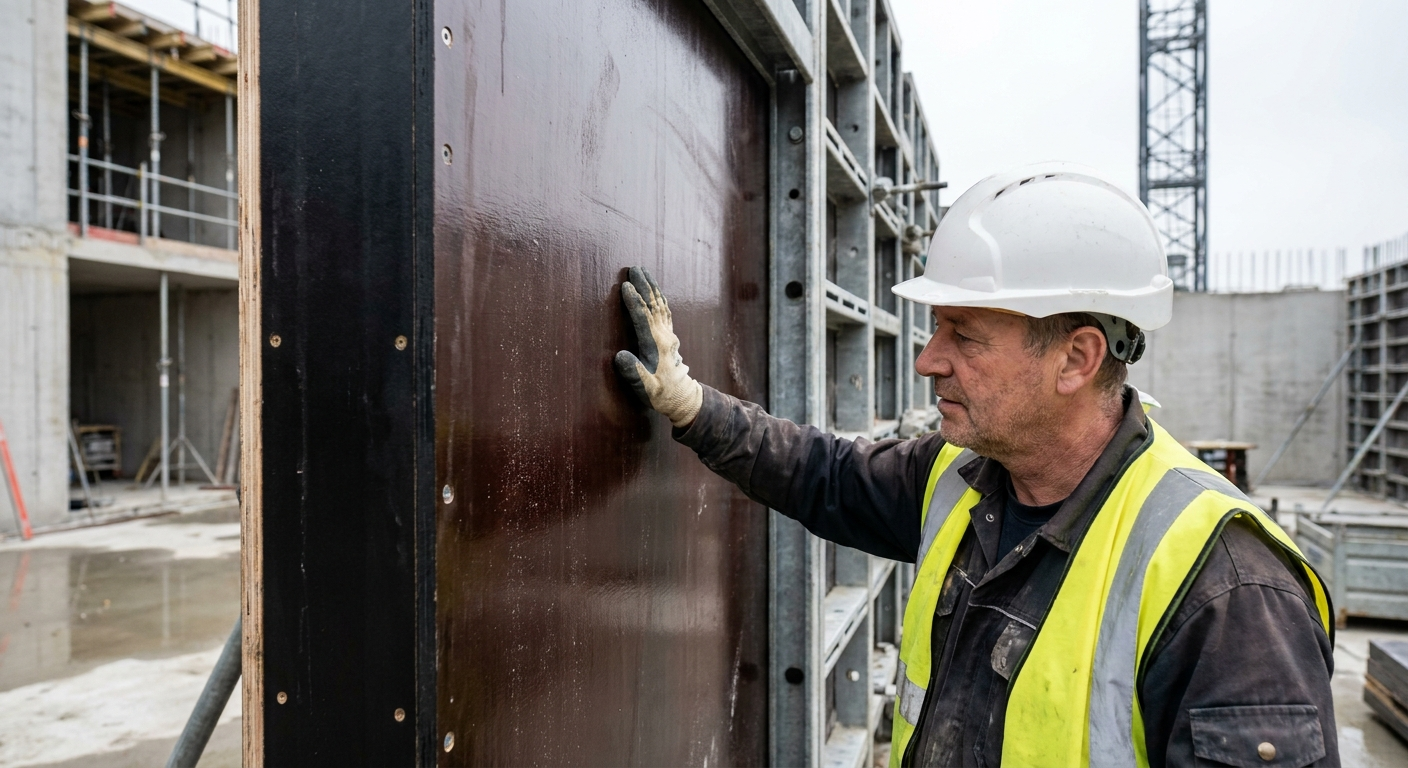
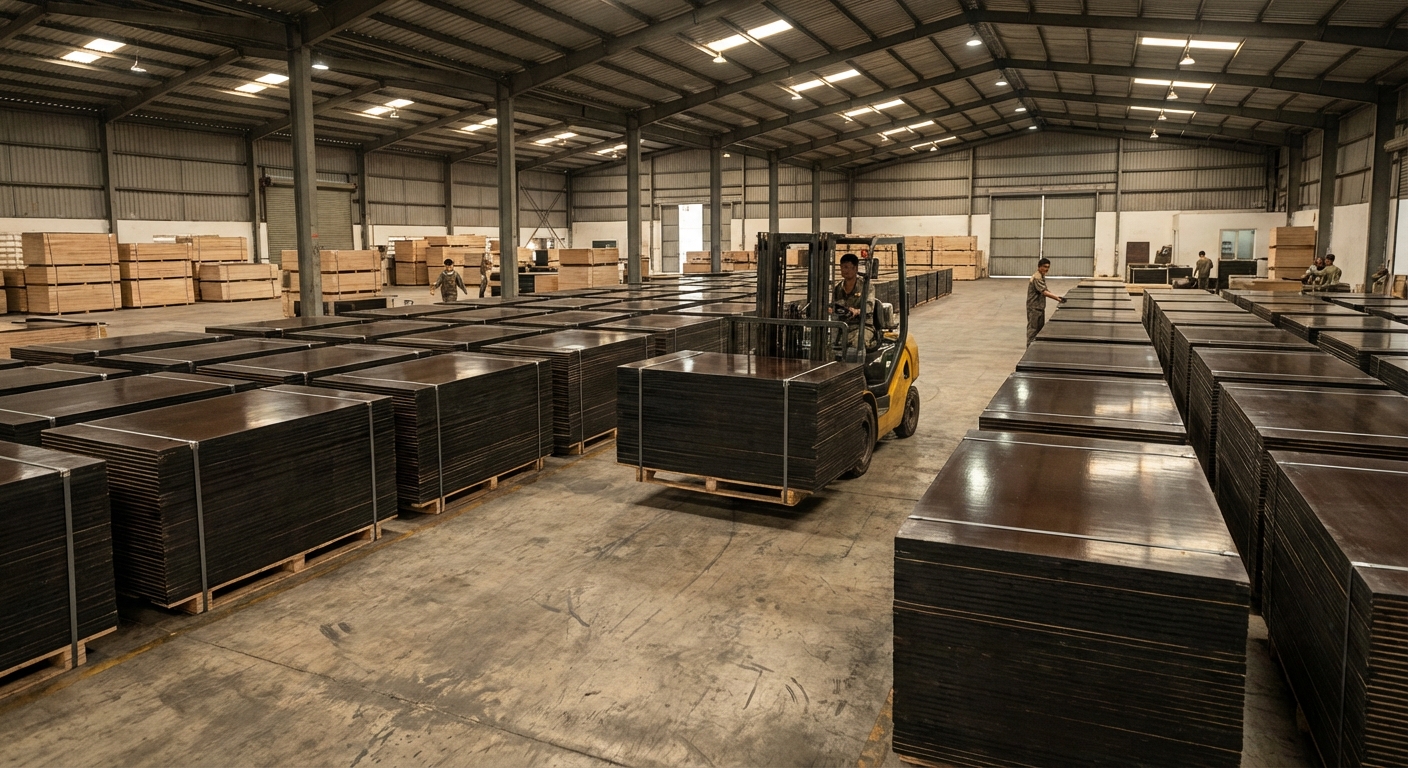
French contractors and Francophone importers who search formwork plywood supplier France are not hunting a retail aisle map. They need a mill RFQ for contreplaqué coffrage that names EN 636 class, film weight, format, and documents before the deposit. Vinawood is a Vietnam mill, established in 1992. We ship about 5,000 containers a year to 55+ countries. This page is a France / EU formwork buyer diligence hub for Vinawood panels, not a shop-here list for domestic builders’ merchants.
A Paris or Lyon take-off that only says “acheter contreplaqué filmé” without thickness, 2500 × 1250 versus 1220 × 2440, glue class, and reuse as up to N is not ready to price. Local yard stock solves one-off footings. Repeating voile and dalle programmes need mill identity.
Why French programmes still RFQ Vietnam formwork plywood
France keeps large formwork volumes on the calendar. Grand Paris Express civil works, bridge rehab, and residential voile/dalle cycles all burn film-faced packs. Buyers compare landed cost under EVFTA (zero tariff on most Vietnamese plywood into the EU) against domestic retail. Factory-direct from a named mill is usually the lane that makes the unit cost work on multi-pour programmes.
Domestic builders’ merchants and European formwork system houses sit in different lanes. Merchants hold ready sheets for metro jobs. System houses (Doka, Peri, Alsina) supply frames and pour programmes; Vinawood panels also run in those frames when the overlay matches the system. Those are partnerships and system context, not a plywood buy-from list. Do not treat a formwork brand as your plywood mill.
For origin diligence without a competitor directory, stay on plywood manufacturers in Vietnam. Overlay and bond language sit on the concrete forming plywood hub and the phenolic plywood guide. Cost-per-pour math lives on advantages of film faced plywood.
French terminology — contreplaqué coffrage, panneau de coffrage, banche
French RFQs and NF DTU 21 specs use local terms. Align the data sheet language with how the site and the tender speak.
| French Term | English Equivalent | Usage Context |
|---|---|---|
| Contreplaqué coffrage | Formwork plywood | General plywood used in concrete formwork |
| Panneau de coffrage | Formwork panel / shuttering board | The panel unit in a formwork system |
| Contreplaqué filmé | Film faced plywood | Phenolic film overlay for a cleaner cast face |
| Banche | Wall formwork gang / formwork unit | Frame plus plywood facing for walls |
| Coffrage de dalle | Slab formwork | Horizontal formwork for floors and foundations |
| Décoffrage | Stripping / striking | Removing formwork after the pour cures |
| Voile béton | Concrete wall | Cast-in-place wall formed with banche systems |
Write those terms into the RFQ notes when the buyer’s French tender already uses them. It cuts a round of “what did you mean by filmé?” email.
Mill vs trader vs local stock
French and Francophone buyers reach imported formwork plywood three ways. The paperwork differs in each lane.
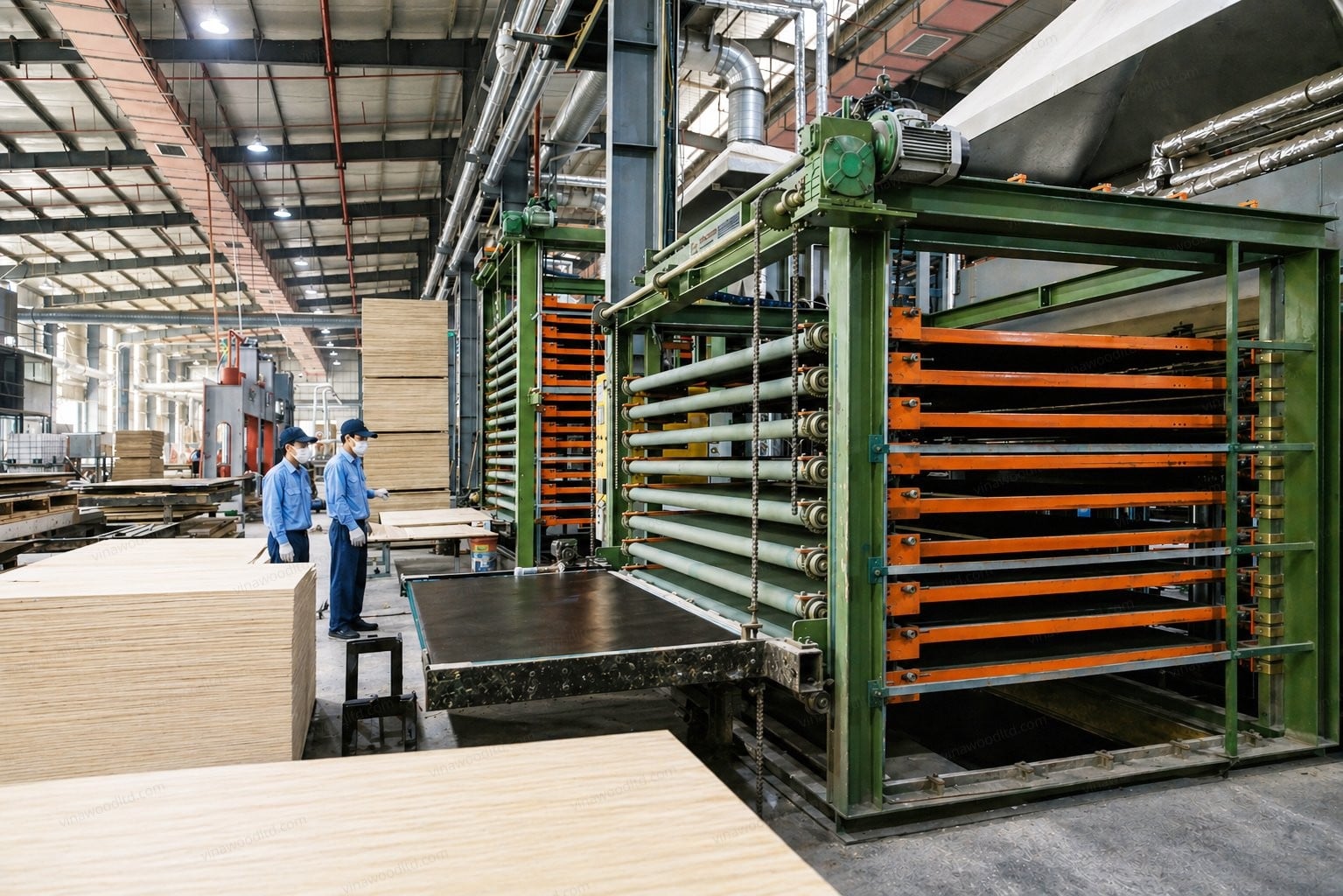
A mill peels veneer, lays glue, presses the panel, and films the face. A trader buys finished packs and resells. A local stockist holds sheets for metro delivery. All three can appear under “formwork plywood supplier France.” Only the mill controls bond class and overlay on the day the press runs.
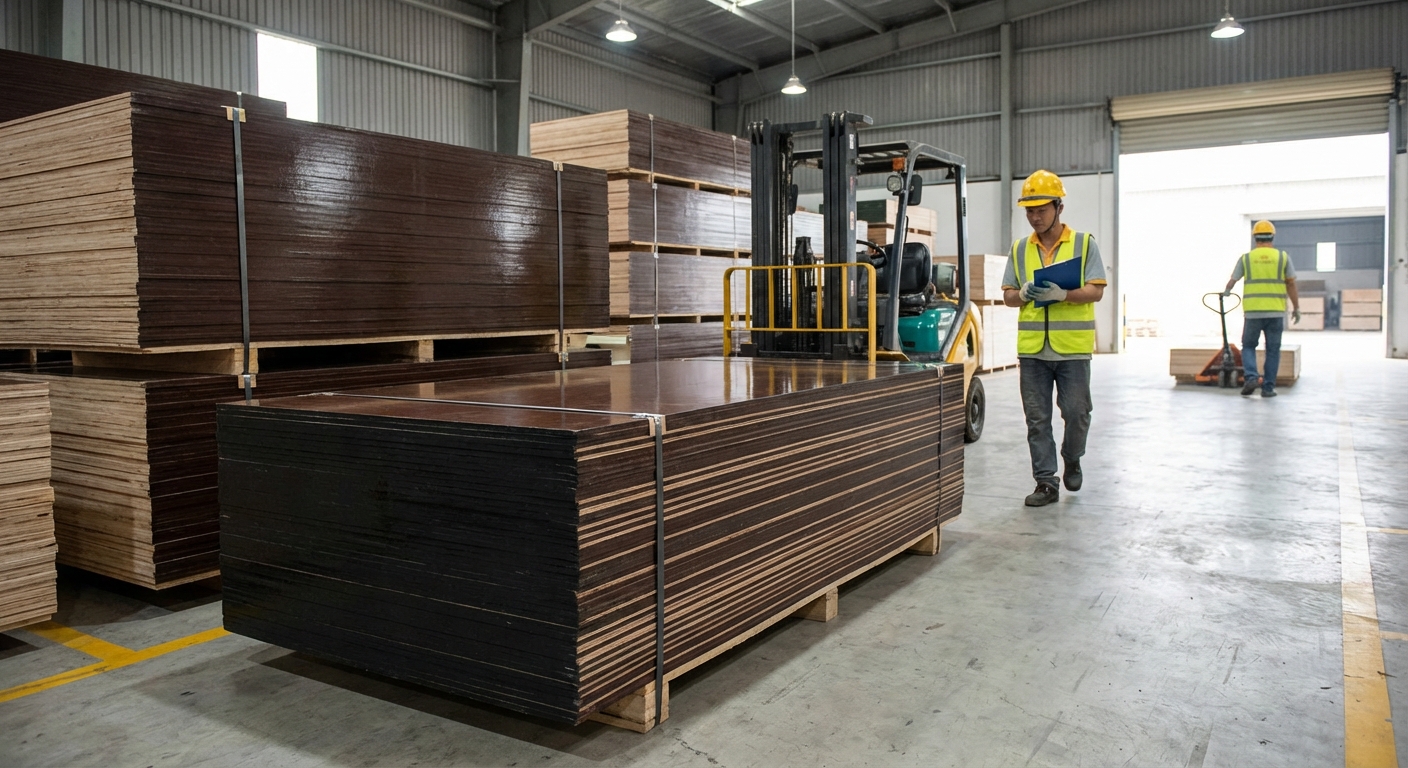
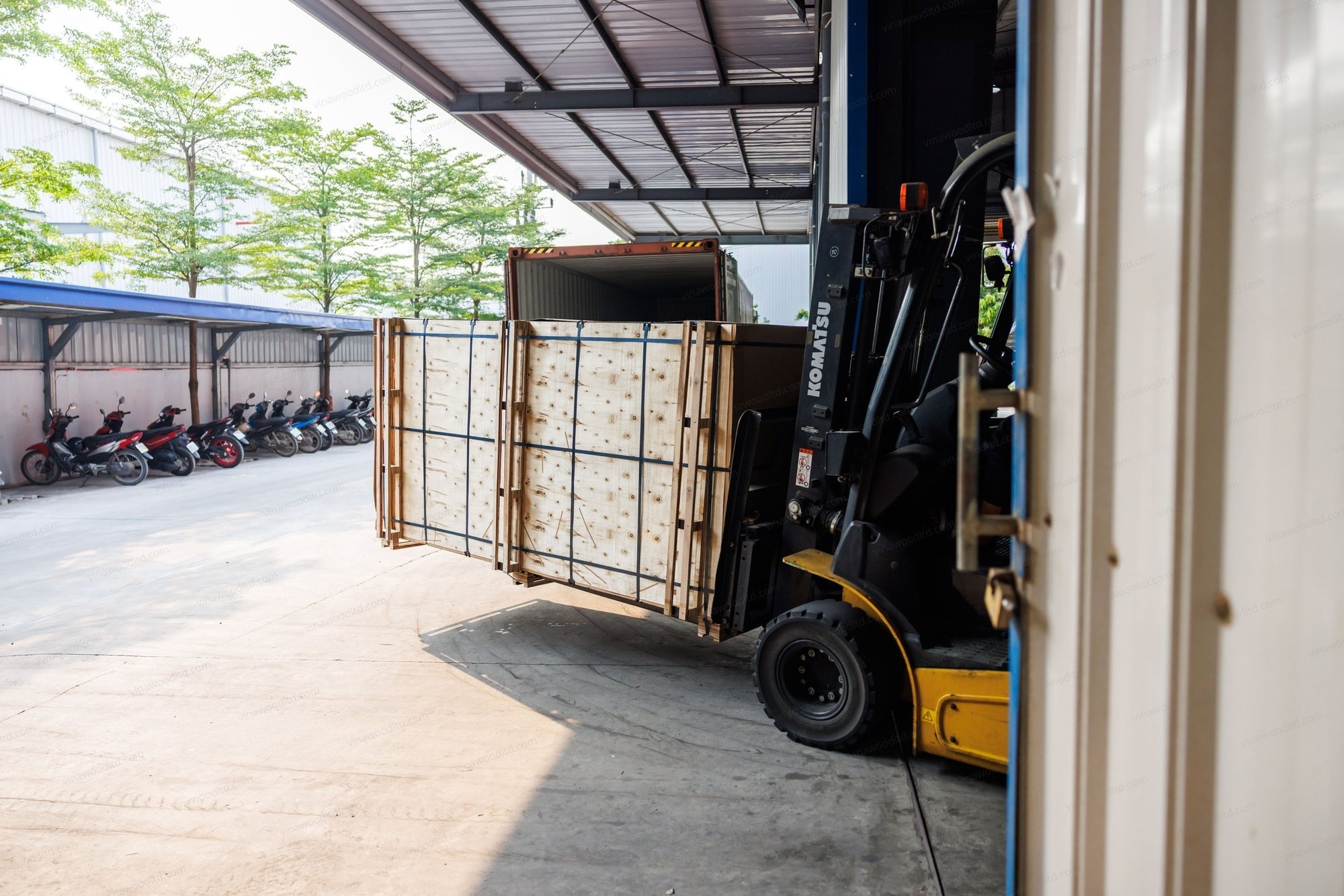
Factory-direct container. You RFQ the mill. You name thickness, size (often 2500 × 1250 for EU systems), film weight, glue class, edge seal, and reuse as up to N. A 20 ft load is a common first order for mid-size programmes; larger distributors take 40 ft. Lead time includes production plus ocean to Le Havre or Marseille / Fos-sur-Mer.
Ready stock through a local distributor. Useful when a project needs a few packs this week. Ask for a Vinawood pack label and a current mill test report. Vinawood keeps distribution warehouses in Toronto, Vancouver, Calgary, Montreal, Miami, Houston, and Baltimore to supply ready stock to local distributors in those networks. That is not an exclusive stockist claim for France, and it is not a shop-here list for one merchant brand.
Retail counter sheet. Fine for a one-off footing. Wrong for a high-reuse Grand Paris or nuclear-adjacent pour programme. You rarely get mill test reports, film gsm, or a named EN 636 class at the counter.
Traders who cannot name the mill, the glue class, and the film type are not a substitute for a factory-direct RFQ. I still see French RFQs land with “fournisseur contreplaqué France” in the subject and a Class 3 reuse programme in the body. Those two requests do not match. Answer the spec, not the subject.
Vinawood panels also run in Doka and Peri frames. Alsina programmes use the same mill packs when the overlay matches the system. Partnerships and system fit only. Never “buy plywood from Doka/Peri.”
How to vet a Vietnam mill for French / EU formwork
Write the sheet before anyone prices a load. A usable France RFQ names these fields.
Documents. Mill test report (thickness, density, glue class, film type), glue class on the data sheet, CE / EN 13986 when the job needs it, packing list, and Vietnam origin statement. FSC or PEFC CoC when the owner asks. EUDR due diligence package when the EU buyer needs plantation coordinates and DDS language.
Bond class. EN 636-2 / Class 2 for WBP melamine (Eco Form Plus, Form Basic, Form Extra). EN 636-3 / Class 3 for WBP phenolic (Pro Form Lite, Pro Form). If the engineer named Class 3, do not substitute Form Extra. Form Extra is Superior Glue MUF, EN 636-2, not Class 3. It uses the same phenolic face film as Form Basic. The extra reuse comes from glue chemistry, not a thicker overlay.
Overlay and film gsm. Phenolic face film gsm for EU film-faced grades. Film colour is not bond class. A dark brown face on a Class 2 MUF core is still Class 2. For North American overlay language that sometimes appears on mixed RFQs, MatteFace Plywood is the matte cast face; buyers often search it as MDO formwork plywood. HDO Basic is up to 10 reuses and HDO Premium up to 20 when a NA drawing names HDO — we do not push HDO as the default EU ladder link on this page.
Thickness and format. State 15, 17, 18, or 21 mm, and 2500 × 1250 versus 1220 × 2440. EU banche systems often prefer 2500 × 1250. Do not assume a mill will pack your preferred size unless you asked.
Lead time and port. Factory-direct equals production plus ocean. Name Le Havre, Marseille / Fos-sur-Mer, or a Francophone African discharge port so quotes stay comparable. State pieces per bundle and whether you want logo film or a plain brown face.
Edge seal and reuse. Painted or sealed edges before the first pour. Cut edges and tie holes are the usual moisture paths. Write reuse as “up to N.” Eco Form Plus up to 8. Form Basic up to 10. Form Extra up to 15. Pro Form Lite up to 15. Pro Form up to 20. Site handling decides whether those numbers hold. Call every panel water-resistant / WBP, not waterproof.
Vinawood European-grade formwork ladder
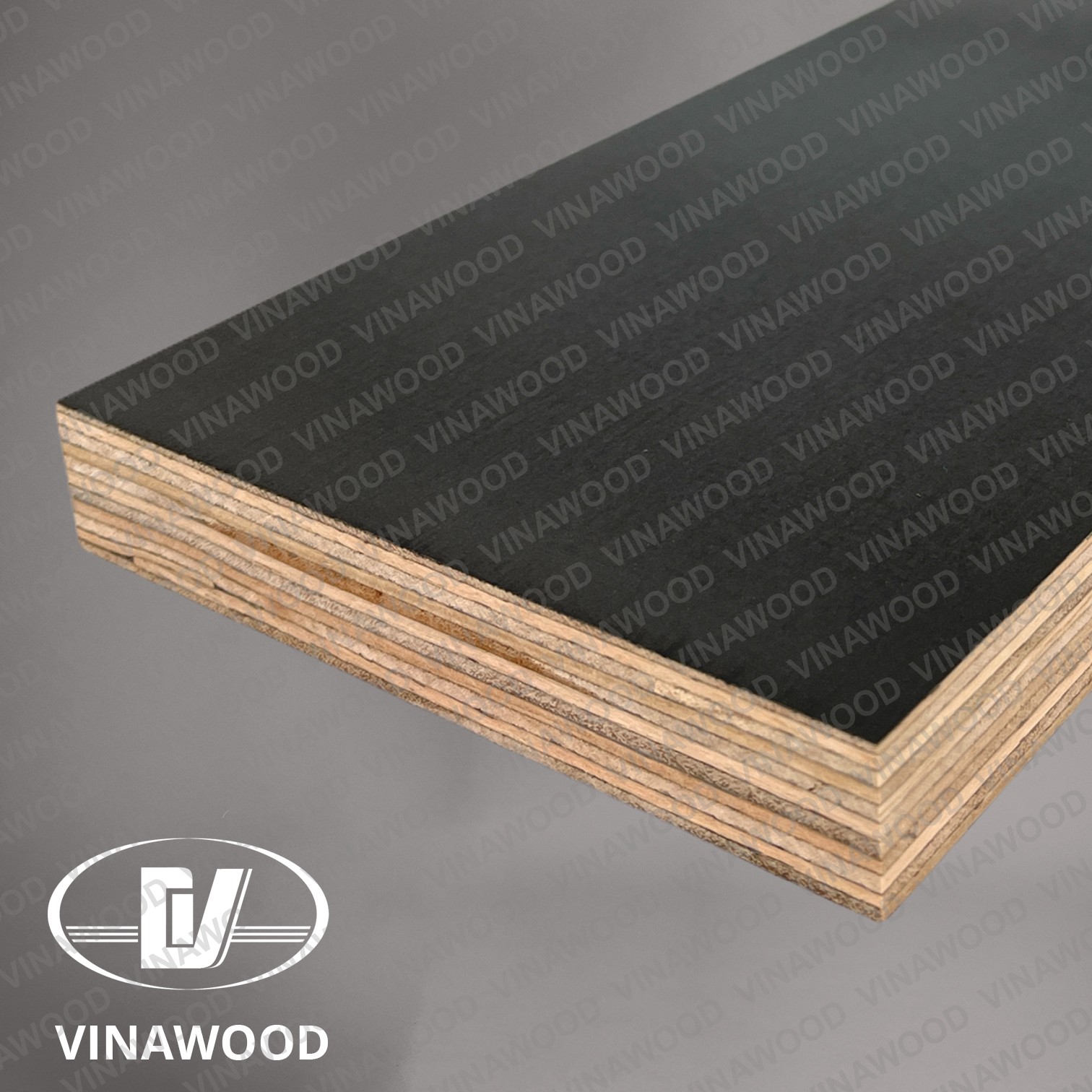
Pick glue class to match the pour, then pick overlay. Vinawood runs a 12-step process with 100% individual sheet inspection on plantation-grown cores. Reuse figures below are maxima written as up to N. Cores are Acacia or Eucalyptus.
| Product | Standard | Glue | Reuse | Thicknesses | Best for |
|---|---|---|---|---|---|
| Eco Form Plus | EN 636-2 | WBP melamine | up to 8 | 15, 17, 18, 21 mm | Residential, short-cycle |
| Form Basic | EN 636-2 | WBP melamine | up to 10 | 15, 17, 18, 21 mm | General multi-use sites |
| Form Extra | EN 636-2 | Superior Glue MUF | up to 15 | 15, 17, 18, 21 mm | Higher reuse without Class 3 |
| Pro Form | EN 636-3 | WBP phenolic | up to 20 | 15, 17, 18, 21 mm | Infrastructure, high-reuse |
Only Pro Form (and Pro Form Lite on the Class 3 side) are phenolic Class 3. Form Extra is not Class 3. Generic film-faced plywood category interest can land on the collection page first. We do not put Consply on this formwork page as a pour face. P-Form is a polypropylene overlay, not Pro Form. Plantation-grown hardwood.
EN standards and French construction documents
Formwork plywood used in France has to sit under both European harmonised standards and French national application documents. EN 636 classifies plywood by service conditions: EN 636-2 for humid service (most formwork), EN 636-3 for exterior / exposed programmes. EN 13986 is the harmonised product standard that enables CE marking for wood-based panels in construction. Panels with CE under EN 13986 satisfy the usual French building-permit plywood path without inventing a second national mark.
NF DTU 21 is France’s national document for concrete work execution. It cares about formwork surface quality, tolerances, and stripping practice. Contractors who cite NF DTU 21 need a face that delivers a consistent fair-face finish; heavier film weights help when the cast face is architectural. Formaldehyde for Vinawood European-grade formwork products meets E1 under EN 717-1. Ask for the class on the data sheet, not in a brochure slogan.
Applications French buyers actually pour
Film-faced packs show up across French civil and building work. Grand Paris Express tunnel and station structures burn high-reuse panels; Pro Form with up to 20 reuses is the usual Class 3 ask on those programmes. Residential voiles and dalles often run mid-range Class 2 packs such as Form Basic (up to 10) or Form Extra (up to 15) when the reuse schedule is longer but the engineer did not lock Class 3.
Commercial towers in Paris, Lyon, and Marseille want a consistent cast face across large wall areas. Bridge and autoroute work uses flat and curved form systems where the plywood facing quality shows in the finished concrete. Nuclear-adjacent containment and heavy civil work that names EN 636-3 should stay on phenolic Class 3 (Pro Form), not a Class 2 substitute with a dark film.
Francophone markets — same mill packs, same EN language
Vinawood’s European-grade range also serves Francophone programmes where French construction language remains the professional norm. Morocco, Algeria, and Tunisia keep infrastructure and urban work that asks for EN-facing documentation. Senegal and Ivory Coast run growing urban pours with the same contreplaqué filmé vocabulary.
A single mill source keeps pack labels, test reports, and film language consistent between a French domestic job and a Maghreb or West African follow-on order. Marseille / Fos-sur-Mer often acts as the Mediterranean hub for onward distribution. Write the discharge port on the RFQ so freight quotes stay comparable.
Logistics — Le Havre, Marseille, and Francophone ports
Vinawood ships FOB from Vietnamese ports on established routes into France and Francophone discharge points. Transit windows below are planning ranges, not a guarantee for a single booking.
| Destination Port | Transit Time | Best For |
|---|---|---|
| Le Havre | 28–35 days | Northern France, Paris region, Belgium |
| Marseille / Fos-sur-Mer | 22–28 days | Southern France, Mediterranean, North Africa |
| Casablanca | 25–30 days | Morocco |
| Dakar | 30–38 days | Senegal, West Africa |
| Abidjan | 32–40 days | Ivory Coast, West Africa |
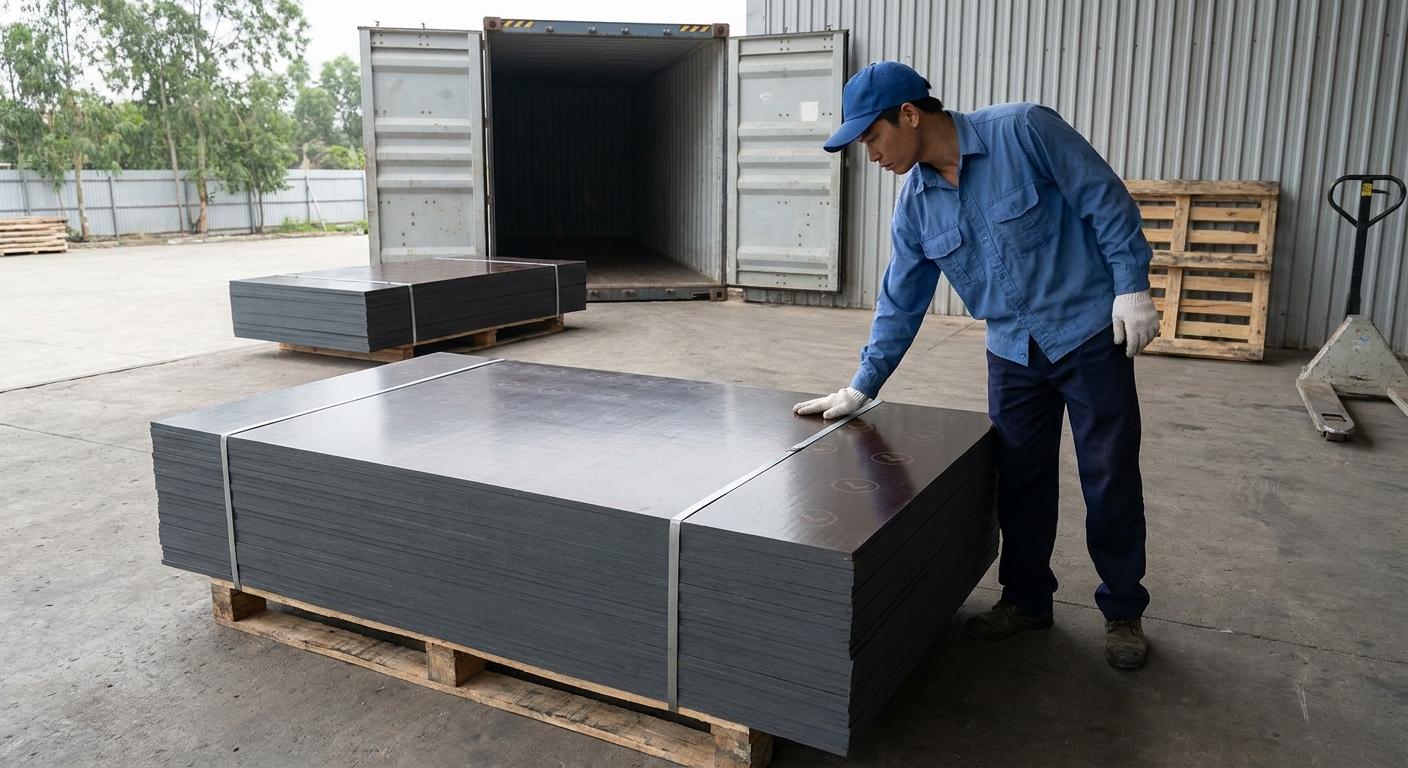
A 20 ft container typically holds about 22–24 m³ of plywood (roughly 42–48 sheets of 2500 × 1250 × 18 mm). Minimum order is usually one 20 ft container. Payment is T/T with deposit-balance structure; L/C is accepted for first-time buyers. Pricing is FOB Vietnamese port unless the RFQ asks for a different Incoterm.
Documents before the deposit
Ask for documents that travel with the load. A logo on a website is not proof.
- Mill test report: thickness, density, glue class, film type
- CE / EN 636 class on the data sheet when the French or EU spec uses European bond language
- FSC chain of custody when the job or owner asks for certified fibre
- EUDR package / DDS when the EU buyer needs plantation-grown proof
- Packing list and origin statement that the panels were made in Vietnam
If a prior pack delaminated early on a French site, send the failed-panel photo with the new RFQ. Say whether the pour was covered or open, and whether the bond class on the old invoice matched Class 3 or Class 2. That context saves a week of email. Broader mill checklist: plywood manufacturers in Vietnam.
Request a quote
Ready to RFQ formwork plywood supplier France as a mill conversation? Send application first: voile / dalle formwork, infrastructure fair-face, or Francophone project stock. Then overlay and bond class. Add film gsm where the catalog lists it, thickness, format (2500 × 1250 preferred for many EU systems), pieces per bundle, and whether you need a factory-direct 20 ft or 40 ft container. Write reuse as up to N.
Vinawood has made plywood in Vietnam since 1992, ships about 5,000 containers a year to 55+ countries, runs a 12-step process with 100% inspection, and sources plantation-grown veneers. Start the mill RFQ at /contact?type=quotation or /rfq.
Category
guides
Related Markets
Related Products
▶Sources & References (3)
- EN 636: Plywood — Specifications — European Committee for Standardization (CEN)
- EN 13986: Wood-based panels for use in construction — European Committee for Standardization (CEN)
- NF DTU 21: Exécution des ouvrages en béton — Travaux de bâtiment — AFNOR