Slipform Construction: How Continuous-Pour Formwork Works (and the Panel Behind It)
Slipform construction casts concrete continuously as a hydraulic rig climbs without stopping, leaving no cold joints. Here is how the method and rig work, where it is used, how it differs from climbing formwork, and where plywood genuinely belongs in the system.
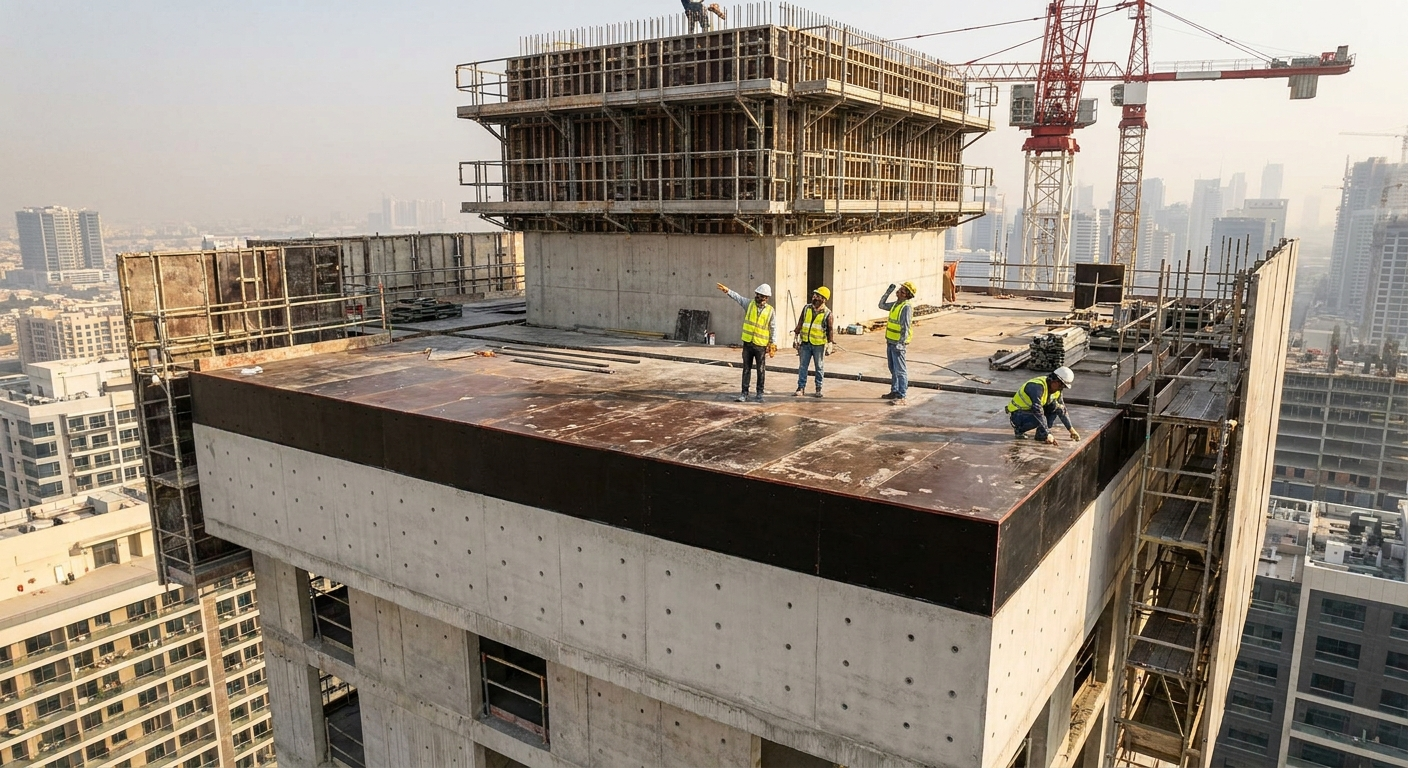
A slipform rig never stops. The concrete goes in at the top, the form crawls upward on hydraulic jacks a few centimetres at a time, and what slides out the bottom is a wall with no horizontal joints anywhere in it. That continuous climb is the whole point of the method, and it is what separates slipform from every other way of casting a tall concrete structure.
This guide walks through what slipform construction actually is, how the rig is built, where the method earns its keep, and where plywood genuinely belongs in the system. That last part matters, because a lot of writing on this topic overstates the panel's role. On the biggest civil rigs the sliding face is steel. Plywood does real work on slipform jobs, just not always the work people assume.
What slipform construction is
Slipform construction casts concrete with a moving formwork rig that is raised continuously by hydraulic jacks climbing on steel rods embedded in the fresh pour. Concrete is placed in shallow lifts at the top of a short form, roughly a metre tall, while the form slides up at a rate matched to how fast the mix sets. The concrete that emerges below the form has just gained enough strength to hold its own shape. The result is a monolithic structure with no cold joints, cast around the clock until the section is complete.
That non-stop rhythm is the defining trait. Once a slip starts, it runs day and night until the wall, core, or shaft reaches its planned height. Stopping mid-slide risks bonding the form to the concrete, so the crew, the concrete supply, and the jacking system all have to keep pace with each other for the duration.
Slipform versus climbing formwork
The two methods get confused often, and the difference is simple once you see it. Slipform moves continuously during the pour. Climbing formwork, also called jump form, moves in discrete steps between separate pours.
A climbing system casts one lift, lets it cure, then lifts the whole form bracket up to the next level and casts again. Each lift is its own pour with a construction joint between it and the one below. Slipform skips those joints entirely by never stopping. Climbing formwork suits work where the geometry changes floor to floor and the schedule can absorb a curing pause; slipform suits tall, uniform sections where an unbroken cast is worth the logistics of a continuous operation. The companion piece on climbing formwork covers the jump-form side in detail, so this article stays on the continuous-pour method.
Anatomy of a slipform rig
A slipform rig is a stack of parts that move together. From the concrete face outward:
- The form face — the short panel, around 1.0 to 1.2 m tall, that contacts the concrete. It is slightly tapered, wider at the bottom, so the form releases as it climbs rather than dragging against the set concrete.
- Wales (walings) — horizontal members that stiffen the form face and hold its line.
- Yokes — the inverted-U frames that straddle the wall and transfer the jacking load from the rods to the form.
- Jacks and climbing rods — hydraulic jacks grip steel rods cast into the wall and lift the whole assembly. The rods carry the rig's weight until the concrete around them can take over.
- Working deck — the platform where the crew places concrete and steel.
- Hanging scaffold — the suspended platform below the form where finishers reach the freshly exposed concrete to patch and cure it.
The form face is the part that decides surface quality. Everything above and around it exists to keep that face moving smoothly and on line.
Vertical and horizontal slipform
Slipform splits into two families by direction of travel.
Vertical slipform is the one most people picture. It builds upward: building cores and lift shafts, silos and grain elevators, chimneys and cooling towers, bridge pylons and water towers. Anywhere a tall, continuous concrete section repeats the same cross-section for tens of metres, vertical slipform is in the conversation.
Horizontal slipform travels sideways along the ground instead of climbing. A paving machine drags a form along a prepared base to cast continuous concrete: highway safety barriers, kerbs and channels, canal and ditch linings. The principle is the same continuous extrusion, just turned on its side, and the form face here is almost always a shaped steel mould rather than a board.
The continuous-pour rhythm
Climb rate is governed by one thing: how fast the concrete gains enough strength to stand unsupported as it leaves the bottom of the form. Typical vertical slips run somewhere around 150 to 300 mm per hour, though the real figure is set by the mix design, the ambient temperature, and the wall thickness on the day. Climb too fast and green concrete slumps out below the form. Climb too slow and the concrete sets hard against the face, and the form binds.
That single constraint ripples through the whole operation. Concrete has to arrive in a steady, uninterrupted stream, which means batching, transport, and placing all have to be planned as a continuous chain rather than a series of separate deliveries. Crews work in shifts because the slide does not pause for nightfall. Reinforcement is fed in continuously as the form rises. A slip that stalls for a equipment fault can lose the whole section, so redundancy in the concrete supply and the jacking system is normal practice, not luxury.
Where the form face and plywood actually appear
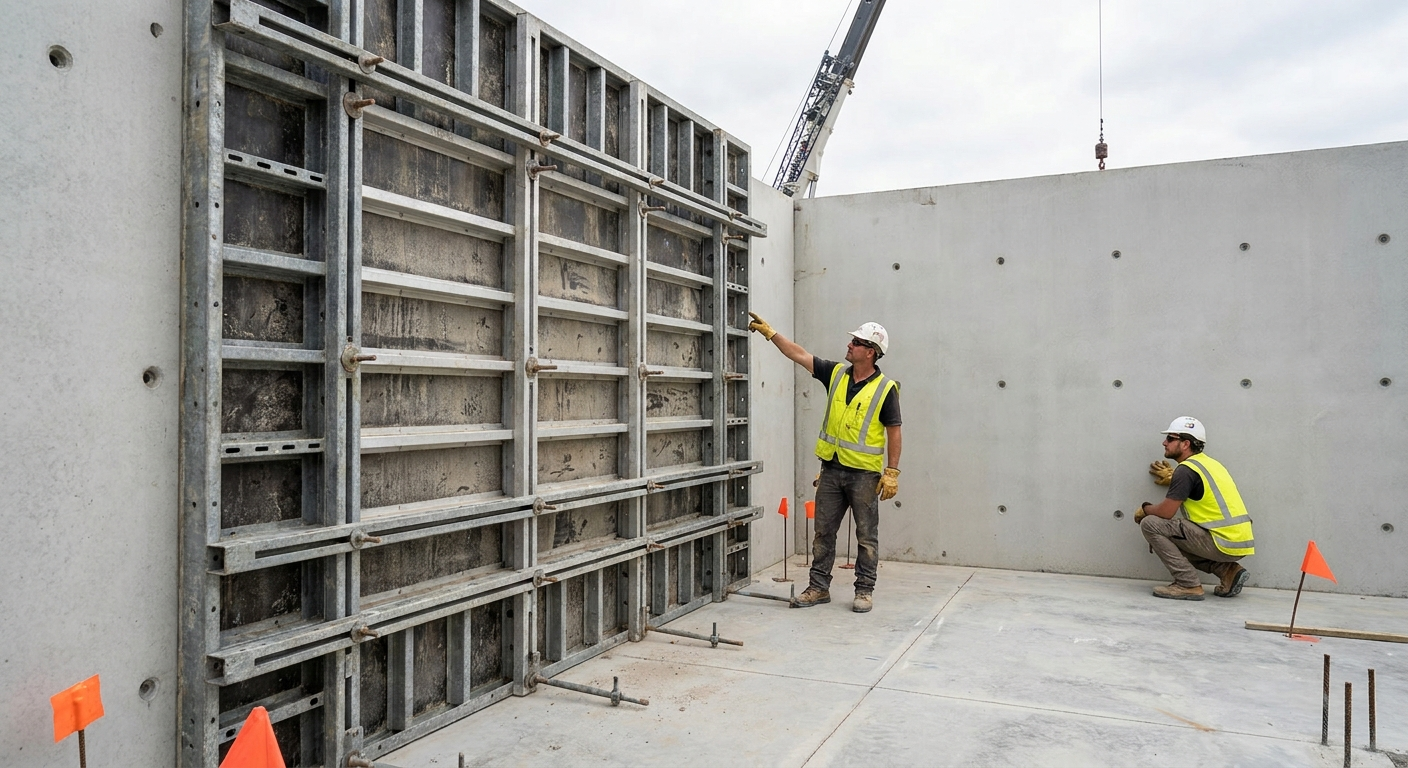
Here is the honest version, because it is where most plywood-vendor writing oversells. On large heavy-civil slipform rigs, silos, chimneys, big building cores, the sliding form face is frequently steel. Steel holds its dimension across a long continuous climb and shrugs off the constant sliding contact that would wear a board down.
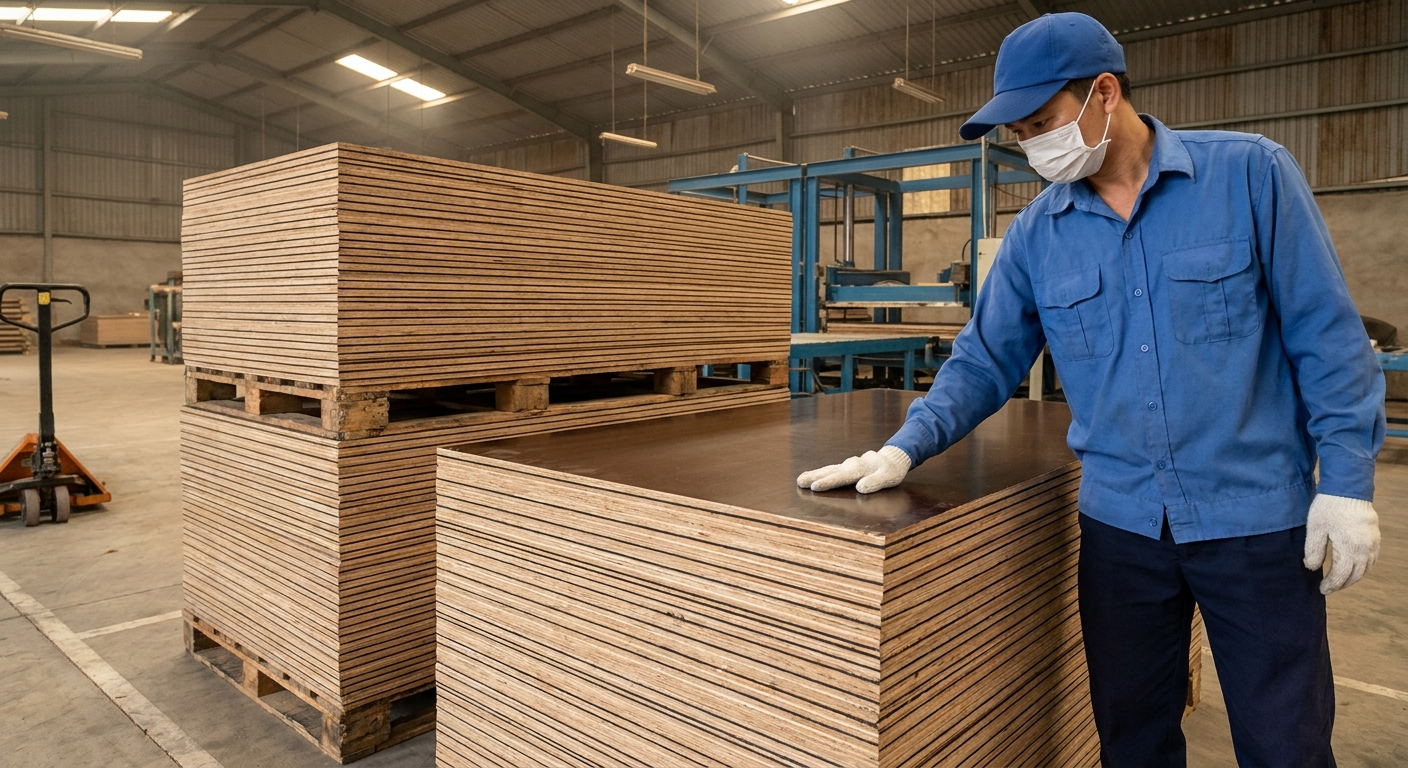
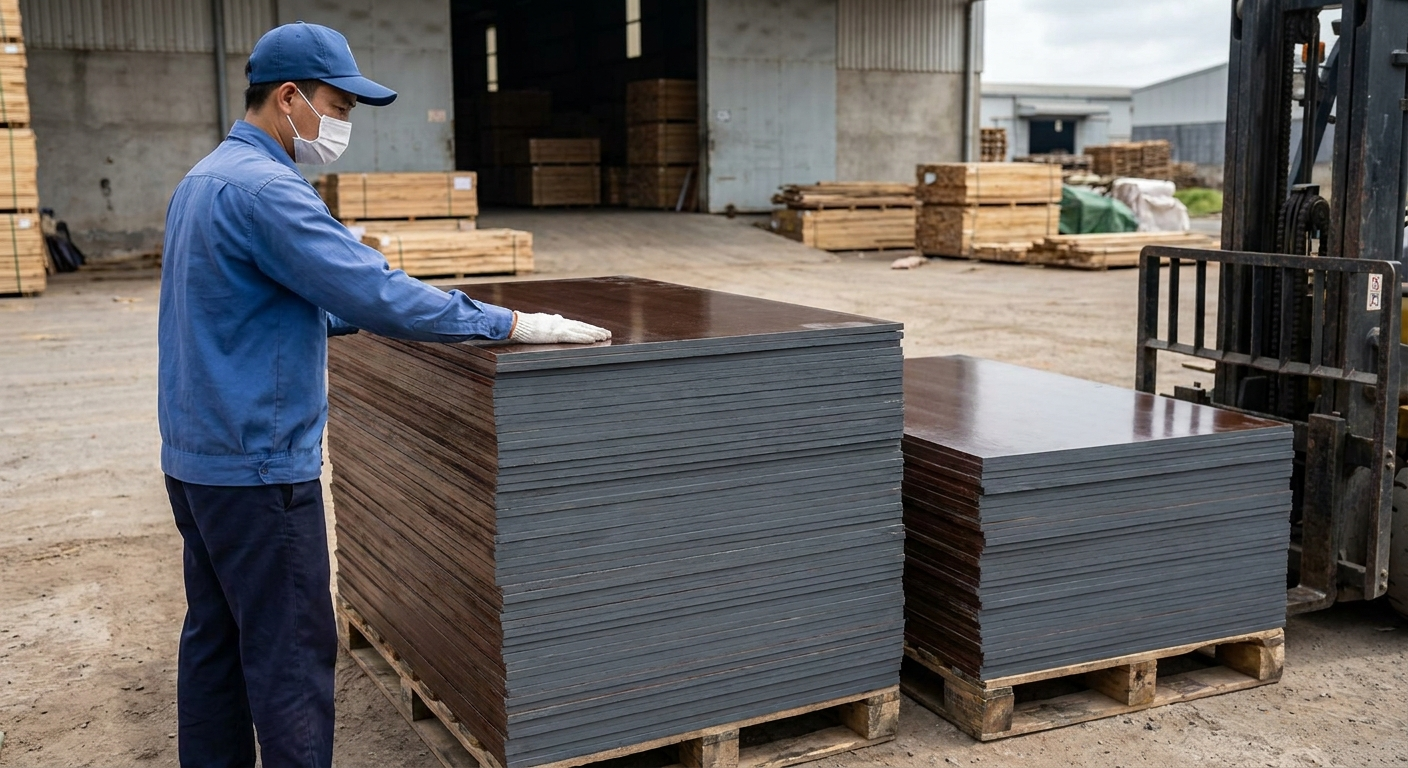
Plywood and film-faced board still do real work on slipform jobs. The form face on smaller or bespoke slipform sections is often a phenolic film-faced panel, because plywood is cheaper to fabricate into a one-off form and easier to shape. Beyond the slip face itself, plywood is the routine material for the working deck, for blockouts and recesses cast into the wall, and for bespoke infill around yokes and openings where a standard steel panel will not fit. So the right way to position plywood on a slipform job is as the form-face panel on lighter and custom work, and as the deck-and-detail material almost everywhere else, not as the universal slip face on every rig.
Panel selection when plywood is the face
When the slip face is plywood, the continuous sliding contact changes the selection logic. A static wall form sees the concrete press against a still panel. A slip face is dragged against curing concrete for the entire climb, which is far harder on the film and especially on the film edge.
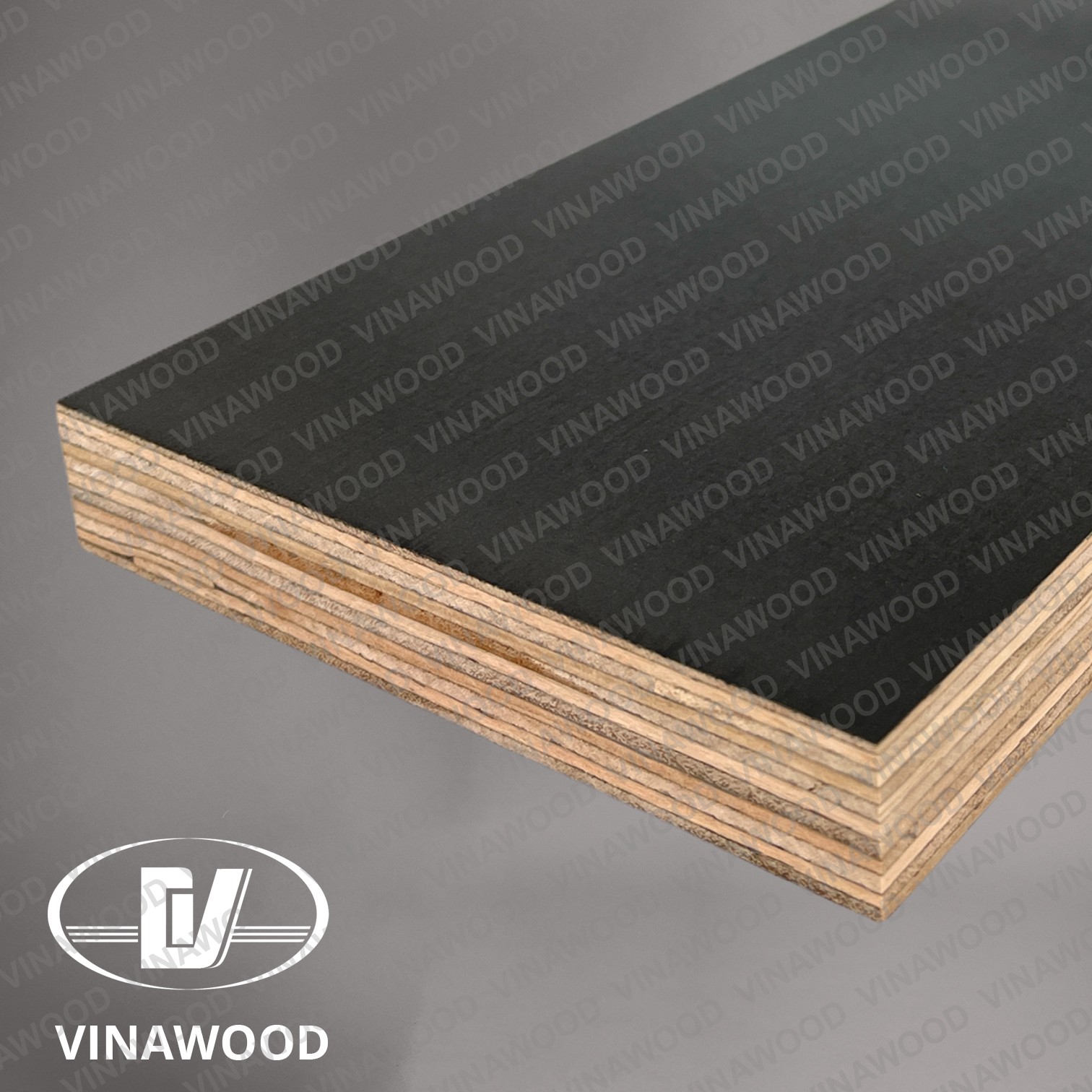
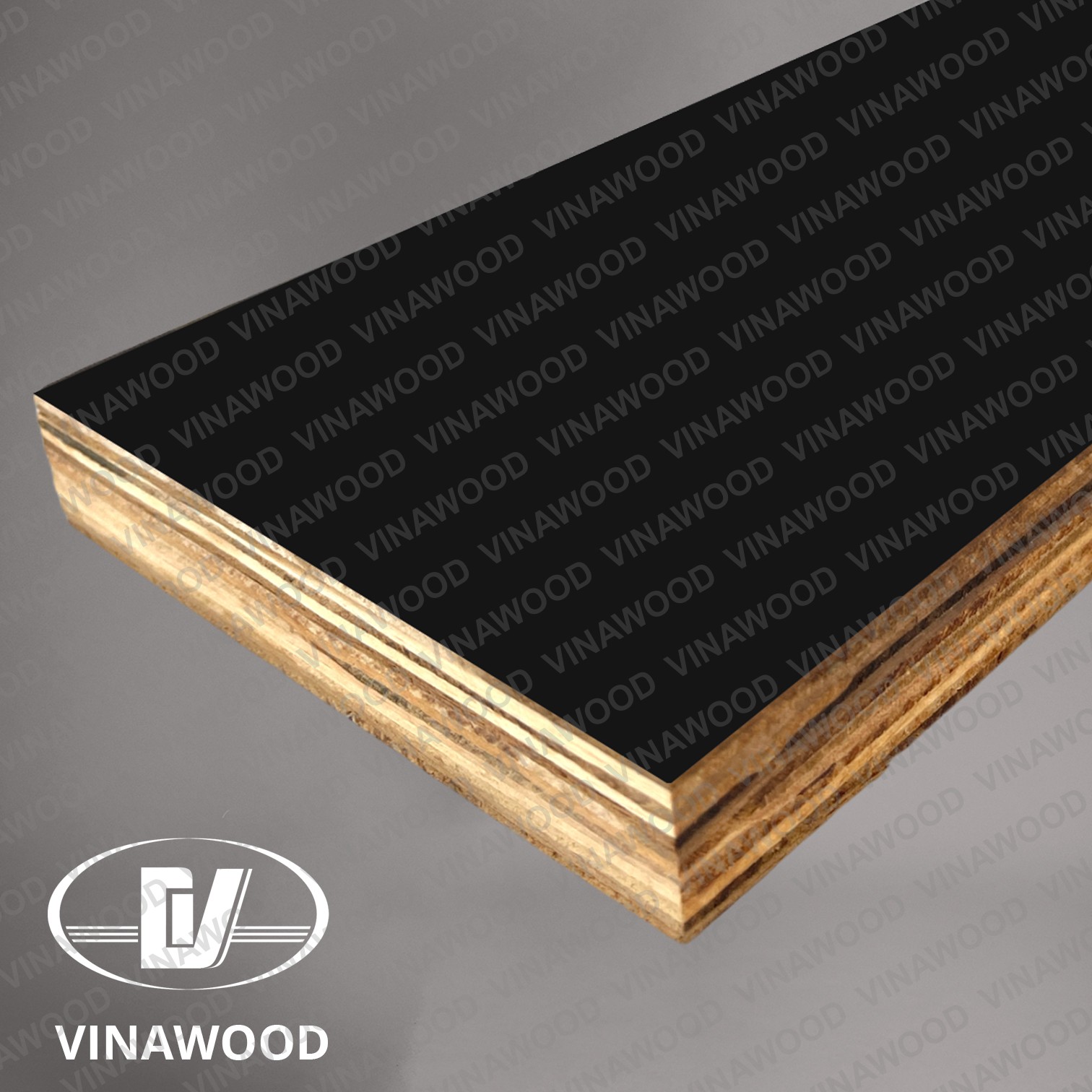
That points to a phenolic-bonded, phenolic film-faced panel at EN 636-3, Class 3. Pro Form is the EN 636-3 panel in Vinawood's range, phenolic-bonded and rated up to 20 reuses; the HDO range is the equivalent choice on North American formply programmes. The phenolic bond resists the repeated soak-and-drag cycle a slip face takes, and the harder film face survives more sliding abrasion before the wood underneath is exposed. A melamine-core panel, the WBP MUF range at EN 636-2 such as Form Basic or Form Extra, is built for static and lower-cycle forming; it can face short bespoke slip sections but will not match the phenolic panel's abrasion life on a long continuous slide. One clarification worth making: "melamine" in that range means the melamine-urea-formaldehyde core resin bonding the plies, weatherable at EN 636-2, not the interior decorative laminate of the same name. Form Extra outlasts Form Basic because of a more durable, higher-melamine-content core glue, not a heavier face film.
Smooth versus textured face follows the finish spec, the same way it does on static forms. A smooth phenolic film casts a fair-face surface; the trade-off between overlay types is covered in our concrete form plywood guide. The edge is the vulnerable part on a slip face, so every cut edge needs sealing before the panel goes into the form.
Reuse economics on a slip face
Reuse counts on a slip face run shorter than the same panel would deliver on a static wall form, and the reason is simple: continuous contact and constant sliding wear the face faster than the press-and-strike cycle of a static form. The catalogue figure, up to 20 reuses for a Class 3 phenolic panel, is a maximum earned under correct release-agent use and disciplined edge care. It is not a floor, and it is not what a slip face will return if the panel is run dry or stripped roughly.
We see this pattern in our own claims data: the panels that come back early from slipform work almost never failed on a manufacturing fault. They failed because the face ran short of release agent on a long climb, or an unsealed edge drank water and swelled. The deeper treatment of grade-by-grade reuse life sits in our guide to how many times you can reuse formwork plywood. For slip-face planning, bid against the lower part of the panel's band, not the top of it.
Release agents and surface finish
Release agent does more on a slip face than on a static form, because the panel is in motion against curing concrete the whole time. A thin, even film of release agent lets the form slide clean and keeps the concrete from grabbing the face. Two failure modes sit either side of the right amount. Too little, and the concrete bonds to the panel, tearing the surface as the form climbs. Too much, and the surplus oil bleeds onto the slid face and stains the concrete, which on an exposed pour is a finish the client will notice. The application is a craft skill on a slip job: consistent coverage, no pooling, reapplied steadily as the form rises.
When the finish goes wrong
Surface problems on slipform concrete, tearing, sand streaks, vertical lifting marks, are most often a site-side cause before they are ever a panel question. The usual order of likelihood:
- Release agent. Patchy or missed application is the first thing to check when the face tears or the concrete grabs.
- Climb rate against set time. Climbing too slow lets the concrete set against the face and drag; too fast pulls green concrete out below the form. Sand streaks and tearing often trace back to this mismatch.
- Mix design. A mix that sets too fast or too slow for the planned climb rate will not slide cleanly regardless of the panel.
- Panel condition. Only after the first three check out does a worn or damaged face become the likely cause, and an unsealed edge that swelled is more common than a manufacturing fault.
A torn or streaked slip-face finish may indicate a panel at the end of its life, but it far more often points to release agent, climb rate, or mix on that particular pour. Check the site variables first.
About Vinawood
Vinawood has manufactured plywood in Vietnam since 1992, shipping more than 5,000 containers a year to 55+ countries. The film-faced forming range covers EN 636-2 melamine-core panels (Form Basic, Form Extra, Eco Form, Consply) and EN 636-3 phenolic-bonded boards (Pro Form and the HDO range, each up to 20 reuses), all with a phenolic face, factory-sealed edges, and 100% individual sheet inspection. Every shipment carries CE marking under EN 13986 for European and UK projects and EPA TSCA Title VI / CARB P2 documentation for the United States. For a slip-face panel, lead with the phenolic Class 3 grade; for the working deck and blockouts, the wider film-faced plywood collection covers the detail work. Send us the section profile and the finish class and we will quote the right panel factory-direct.
Category
guides