Which Country Has Best Plywood? A Global Comparison
No country wins every plywood job. How Vietnam, China, Indonesia, Russia and Brazil compare for formwork buyers, how to check that Vietnamese plywood is really made in Vietnam, and what to put in your RFQ.
Put the question to ten importers and you'll get ten different countries back, usually depending on whose last container arrived in good shape. Our view, after a long time on the mill side, is that no country takes every job. On a formwork order you're paying for a core species plus a glue line plus a face, and a folder of documents. The flag just tells you where to start.
The searches we see on this page are more specific than the headline anyway. People want to know whether Vietnam beats China, whether Vietnamese plywood is quietly made in China, and how it stacks up against Indonesia. So that's the order we'll go in, and at the end there's a short note on what to put in an RFQ so both the origin question and the quality question are settled before anything is loaded.
The short answer: judge the panel first
Site engineers who phone us about a bad batch almost never mention geography. They mention a face that tore on strike number three. Sometimes it's a core that puffed up where a carpenter cut it, or plies that came apart after a soaking weekend, and all of that can be written into a spec and tested before shipping. Species and veneer grade drive stiffness and weight. Glue decides what happens when the sheet sits in water, while film weight mostly decides your pour count.
So we'd rephrase it. Which origins keep sending the bond class and face you ordered, with the right papers, order after order? Vietnam, China, Indonesia, Russia and Brazil all export plywood in serious volume. Each has mills that do this well. Each has some that don't.
Is Vietnamese plywood made in China?
Real Vietnamese plywood is peeled, laid up, pressed and faced in Vietnam, from timber grown there. What people are really worried about is transshipment: sheets pressed in another country, relabelled or given a token bit of work in Vietnam, then sent out on Vietnamese origin papers. Customs in the US and the EU have gone after exactly that, and if you're the importer of record you can get dragged in even though the documents looked fine when you paid.
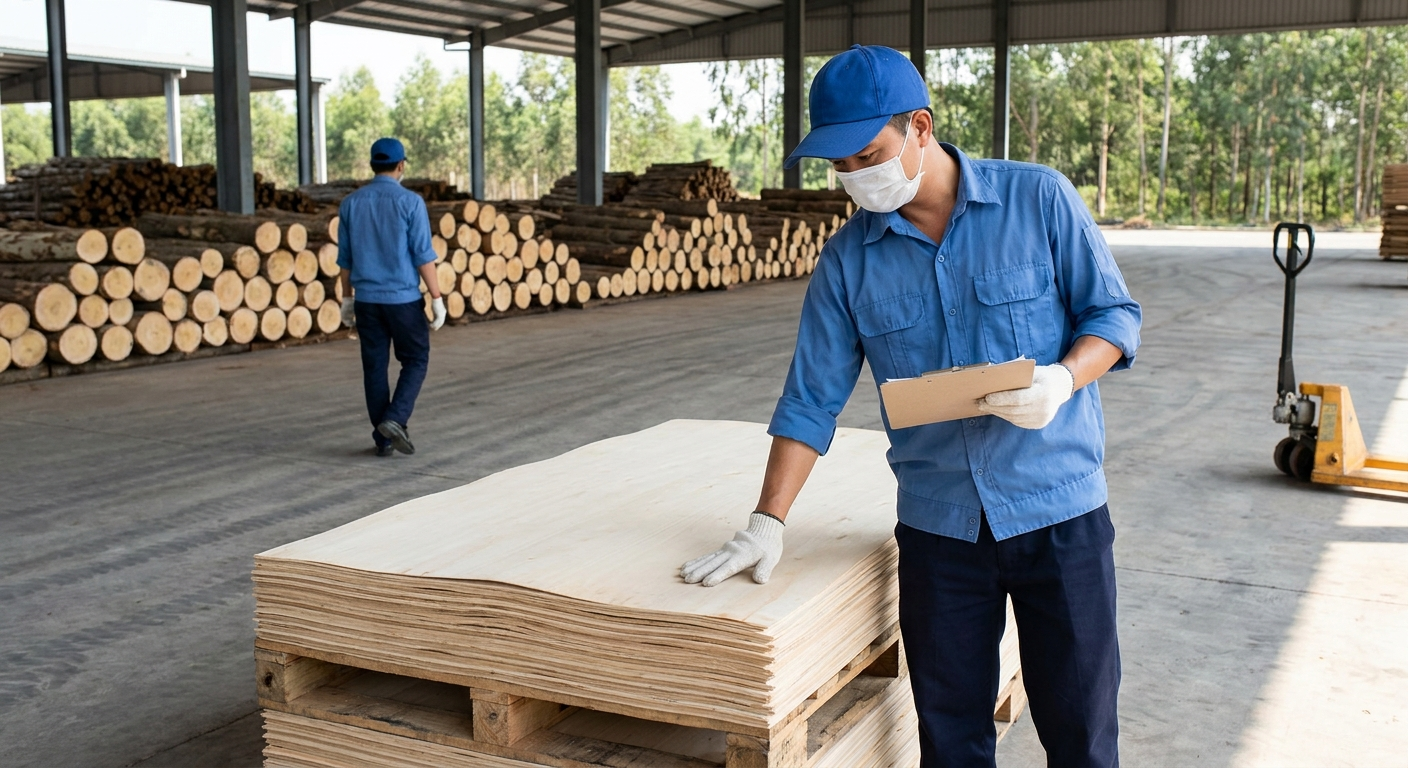
The fix is to deal with a mill that will let you see the whole line and can tie its documents to your batch. Have a look at the wood. Our formwork cores are plantation-grown acacia, eucalyptus and hevea, and that's what the edge of a Vietnamese sheet ought to show, not poplar and not softwood. After that, ask for the paper a trader can't easily fake. That means a certificate of origin from the Vietnamese issuing body and bond and moisture reports printed with your batch number, plus FSC or PEFC chain-of-custody records running from log to finished sheet.
We also put a QR code on every bundle. Each Vinawood bundle carries its own QR code, so an importer can scan a pack on the dock and get back to its production record and the inspection that passed it. If a supplier can't say which press your order ran on, or hands over a certificate of origin with no mill reports behind it, you've probably got your answer. Our page on picking a Vietnam plywood supplier goes through the checks in more detail.
Vietnam vs China plywood: what actually differs
China is the world's biggest plywood producer and makes the lot, from packing grade up to very good formwork panels. That range is the thing to remember. With an industry that large the gap between the best and the weakest mills is huge, and two containers from two Chinese suppliers can behave like different products. The buyers who do well there tend to hold one qualified mill for years and audit it hard.
Vietnam's formwork trade grew up around fewer species and fewer export mills, a lot of them built to sell into Korea, Japan, North America and Europe. What you tend to see is a more even core. Acacia and eucalyptus peel into dense, stiff veneer, so the sheet stays flatter under a wet pour and nails hold better. Where low-priced Chinese formwork often uses poplar or a mixed core to meet a price, a full hardwood core from Vietnam will usually weigh more and bend less at the same thickness. That's not a rule, mind you. It's a tendency you should still check on the sample.
Glue is where good and bad part company, in both places. EN 314 Class 2 handles damp sites and normal turnover. If the forms will sit wet for days or go round and round outdoors you want Class 3, which means phenolic resin. Both countries make both. Comparing two quotes only works when they name the same bond and you hold the report that backs it up.
Vietnam vs Indonesia plywood: quality and price
Indonesia's reputation was built on meranti and other natural-forest hardwoods, with falcata and sengon filling the lighter grades. A good meranti face is lovely to look at, and boatbuilders and joiners have trusted it for decades. Those logs have got harder to source, though, which pushes prices up and makes it worth checking the core on every order, since a fine face can hide a lighter mixed core underneath.
Vietnam works from plantation stock that's cut on short rotations and replanted. For a formwork buyer, the benefit is boring in the best sense. The same species turn up season after season, and that's most of what batch-to-batch consistency comes from. Plantation timber with chain-of-custody records is also simpler to document for the EU Deforestation Regulation than mixed natural-forest supply. Our overview of plywood manufacturers in Vietnam explains how the export mills are set up.
On price the two usually land close together for comparable formwork grades. Any gap on a given quote tends to come from species, glue class and film weight, not the country. If one offer names a phenolic Class 3 bond and a 220 g/m² film while the other says nothing about either, you aren't looking at the same sheet.
Russia and Brazil in brief
Russia and Brazil still get asked about. Birch from Russia has that tight, even core furniture makers and truck-body builders loved, but sanctions mean most Western buyers can't get it now. Brazil sends mostly southern plantation pine. Fine for sheathing. For forms that go round twenty times, most contractors would sooner have a hardwood core, since pine is lighter and dents more easily.
What makes plywood good, whatever the origin
Forget the flags for a minute. Whether a sheet pays for itself on site comes down to a handful of things, and the core is first. If veneers go in too wet, or with gaps and overlaps, you get voids, and voids are where water collects and where a sheet cracks when someone leans a poker vibrator on it. It's easy to check. Look down a cut edge for holes, then weigh a sheet and compare it with the density on the quote.
Next comes the bond. Ask which resin holds the plies and which EN 314 class it passes, then ask for the boil-test report. A water-resistant WBP bond still isn't a sheet that can't take on water, and every raw cut edge will drink if it's left bare, which is why we seal edges at the mill and why crews should reseal after each site cut.
Then the face and the paperwork. Film or overlay weight decides how many times the face lets go cleanly before the finish starts to show it. On the paper side you want CE marking under EN 13986 for Europe, EPA TSCA Title VI or CARB Phase 2 for North American emissions, and forest certification for the timber. A mill that'll send all of it before you pay is telling you something.
| What to check | Why it matters | Document to ask for |
|---|---|---|
| Core species and grade | Stiffness, weight, nail hold | Data sheet naming the species |
| Bond class (EN 314 Class 2 or 3) | How the sheet copes with wet days and many pours | Boil-test report for your batch |
| Face film weight and type | Clean pours, finish quality | Written on the quotation |
| Country of production | Customs risk, traceability | Certificate of origin with mill test reports |
| Emissions and legality | Access to EU and North American markets | CE / DoP, TSCA Title VI, FSC or PEFC |
How we make formwork panels in Vietnam
Vinawood has been making construction plywood in Vietnam since 1992. We ship around 5,000 containers a year to more than 55 countries, and each panel goes through 12 production steps between veneer drying and edge sealing. Every single sheet gets looked at before it's packed. Our own lab tests bond, moisture and formaldehyde, with outside labs including SGS, TÜV, Eurofins and Quatest checking alongside us, and our panels run on formwork systems from Doka, Peri and Alsina.
The film-faced range is laid out by reuse and bond class. Eco Form Plus is rated for up to 8 pours and Form Basic for up to 10, both on a Class 2 bond. Form Extra keeps Form Basic's phenolic face but uses a stronger MUF core glue, which gets it to up to 15 pours while it stays Class 2. Pro Form Lite (up to 15) and Pro Form (up to 20) step up to a phenolic Class 3 bond. In North American formply, HDO Basic is rated up to 10 on a Class 2 bond, and HDO Standard and HDO Premium carry Class 3 and go up to 20.
We hold ISO 9001, FSC-COC, PEFC, CE marking under EN 13986, EPA TSCA Title VI (CARB P2), the Korean KS mark, UKCA, BIS and an EPD. In Canada and the US, our distribution warehouses in Toronto, Vancouver, Calgary, Montreal, Miami, Houston and Baltimore keep ready stock for local distributors. New to buying from Vietnam? Our step-by-step buying guide runs from sample to container.
What to put in your RFQ
I'd honestly rather get one precise enquiry than five vague ones, and a precise enquiry happens to be your best defence on origin too. Tell us the product or bond class, the face film or overlay, thickness and sheet size, the reuse you're planning on, and which documents you'll need at the port. Ask in the same note for the certificate of origin and batch test reports to travel with the goods. Our list of certifications held by Vietnamese exporters is handy when you're comparing offers side by side.
When you're ready, send it through the request-for-quote form or get in touch with sales. You'll get back a written spec, the list of documents that will ship with your order, and samples if you'd like to test a panel first.