Concrete Delamination: Why the Surface Separates and Where Forming Fits In
Concrete delamination is a thin troweled top layer separating from sound concrete below, usually because the surface was closed before bleeding finished. Here are the causes, how to find a drummy slab by sounding, how to repair it, and why it is a finishing issue rather than a formwork panel fault.
Concrete delamination is a thin layer of the finished top surface separating from the sound concrete underneath. You often cannot see it at first. The slab looks fine, then weeks or months later a patch flakes off, blisters, or sounds hollow when you tap it. Run a steel bar or a chain across it and the delaminated area answers with a dull, drummy note instead of a clean ring. For a slab finisher or a floor owner, the questions are the usual three: what caused it, how do I find all of it, and is the form to blame?
The honest answer, from a panel manufacturer's seat, is that delamination is a troweled-surface problem. It is decided in the finishing window, by the timing of the trowel against the rise of bleed water and air, and it has nothing to do with the formwork panel or the formed face. The layer that lifts is the trowel-finished top, not the surface a plywood panel shapes. Here is what delamination is, how to identify it, how to keep it from happening, and where forming practice honestly fits.
What delamination is
Delamination is a separation plane: a thin crust of mortar at the top of the slab loses its bond to the concrete a few millimetres below it. The space between the two is filled with bleed water or bleed air that was trapped when the surface was closed too early. The crust may stay in place for a while, held by friction and its own stiffness, then break free under traffic, point loads, or its own drying. On hard-troweled interior floors it often shows as blisters first, small raised domes that later crack and pop.
The key point: the separation sits just under the troweled finish, in the top few millimetres. The bulk of the slab below it is sound. That is what makes delamination a surface-finishing story rather than a structural one in most cases.
How to identify it: sounding and chain drag
Delamination is found by ear before it is found by eye. The standard field method is sounding: tap the surface with a hammer or steel rod, or drag a chain or a sounding wheel across it, and listen. Sound concrete gives a sharp, ringing tap. A delaminated area gives a hollow, drummy, lower-pitched response because the detached crust vibrates against the void below. Mapping the drummy zones with chalk gives you the extent of the problem, which is almost always larger than the visible blisters or flaked patches suggest.
Visually, look for blistering on hard-troweled floors, flaking or peeling crusts, and isolated raised domes that crack open. A surface that looks intact can still be delaminated underneath, which is exactly why the sounding test matters: you cannot judge the extent by sight alone.
What causes delamination
Delamination has one core cause and several aggravating conditions, and they all sit on the placement and finishing side.
- Finishing before bleeding has finished (the core cause). If the surface is floated or troweled and closed while bleed water and air are still rising, that water and air get trapped under a sealed crust. As they collect, they form the weak plane that later delaminates. This is the dominant mechanism behind almost every case.
- Rapid surface drying and premature crusting. Wind, sun, low humidity, and heat dry the very top of the slab faster than the body. The surface crusts and feels ready to finish while the concrete below is still bleeding, which tempts the crew to close it too soon.
- Excess entrained air in hard-troweled interior slabs. Air-entrained concrete is for freeze-thaw exterior work. Hard-steel-troweling an air-entrained mix indoors drives the entrained air toward the surface, where it collects under the densified crust and promotes blistering and delamination. Interior floors that will be hard-troweled should not be air-entrained.
- Cool or slow-setting subgrade. A cold base or a retarded set keeps the lower concrete bleeding longer, so the window where the surface looks ready but the body is not stays open longer.
Every one of those is a placement, weather, mix, or timing variable. None of them is the form panel.
Delamination, spalling, and blistering: name the difference
These get confused because all three involve the surface coming apart, but the mechanism and the fix differ.
| Surface condition | What separates | Typical depth | Cause | Sound test |
|---|---|---|---|---|
| Delamination | A thin troweled crust from the sound concrete below | Top few millimetres | Finishing before bleeding finished; trapped bleed water/air | Hollow, drummy |
| Blistering | Small raised domes of the troweled crust | Surface skin | Early sealing of the surface over bleed water/air; the early stage of delamination | Hollow under the dome |
| Spalling | Chips and flakes, sometimes to aggregate or steel | Variable, can be deep | Corrosion, freeze-thaw, impact, fire | May ring or sound dull depending on depth |
Blistering and delamination are the same family at different stages; spalling is a different and usually deeper problem. For the wider flaking condition and the localized aggregate version, see our guides to concrete spalling and concrete pop-outs.
How to prevent delamination
Prevention is finishing discipline first, with the weather and the mix managed around it.
- Time the finishing to the concrete, not the clock. Wait until bleeding has effectively stopped and the bleed sheen has gone before floating and troweling. Do not close a surface that is still bringing water up.
- Control surface evaporation. Use windbreaks, sun screens, fogging, or an evaporation retarder when conditions are drying the top faster than the body, so the surface and the slab stay in step.
- Match the mix to the finish. Do not air-entrain interior concrete that will be hard-troweled. Keep entrained air for exterior freeze-thaw work where it belongs.
- Watch the subgrade and the set. On a cool base or with a retarded mix, allow more time before finishing, since the bleeding window runs longer.
- Train the crew to read the slab. Delamination is overwhelmingly a judgement-and-timing failure, so the finishers' read of when the surface is genuinely ready is the most important control on the job.
How to repair delamination
Repair starts with the sounding survey, because you have to remove all of the delaminated crust, not just the visible part. Chip or grind back the drummy areas to sound concrete, then mechanically profile the exposed surface so the repair material can key in. For shallow, broad delamination, a polymer-modified cementitious resurfacer or a bonded topping restores a wearing surface. For tighter or partial separations, low-viscosity epoxy or polyurethane injection can re-bond the crust to the substrate where full removal is not warranted.
Match the repair to the exposure and the use. A warehouse floor with forklift traffic needs a repair rated for that loading; a visible architectural surface needs a colour and texture match trialled on a sample first. Whatever the method, the principle is the same: get back to sound concrete, give the repair a profiled surface to grip, and cure it properly.
Where forming practice fits in
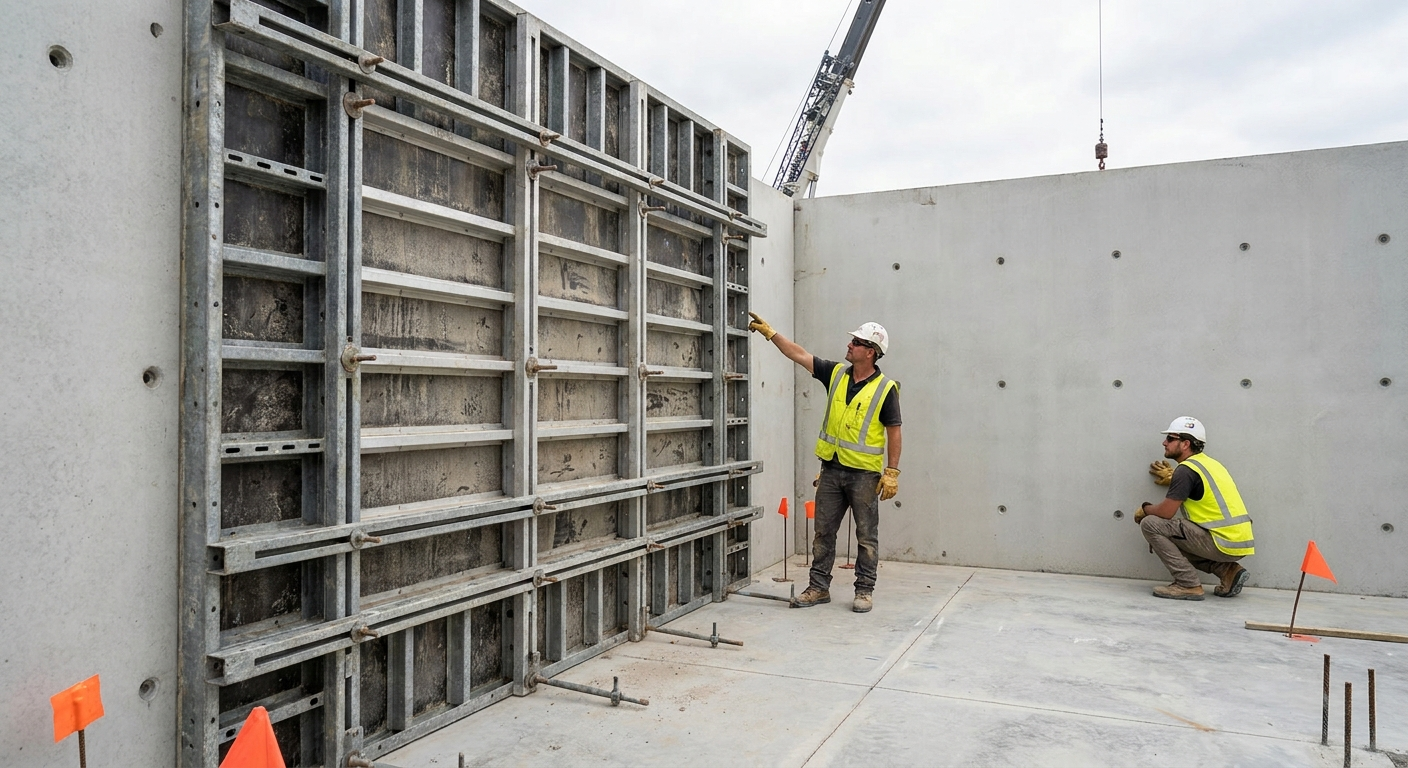
This is where a plywood maker should narrow the claim rather than stretch it. Formwork shapes and supports the vertical faces and edges of a pour and the soffit of an elevated slab. The delaminated layer is the trowel-finished top surface, which on a ground slab is the face that never touches a form at all. Different surface, different mechanism, different trade.
From a Vietnamese mill's perspective, this is one of the cleaner separations in the defect family: when a customer reports a drummy, delaminating floor, the conversation belongs with the finishing crew and the weather log, not the panel supplier. What forming genuinely controls is the formed face and the edge quality, where a dense, smooth panel face produces a clean as-cast surface. For the marks and conditions that do belong to the formed face, our guides to bug holes in concrete and honeycomb in concrete draw those lines. A panel governs the face it casts; it has no contact with the troweled top that delaminates.
When to investigate further
Treat isolated, shallow delamination as a surface repair and move on. Investigate further when the drummy area is extensive, when delamination recurs across successive pours, or when it appears alongside other surface problems that suggest a mix or curing issue. The productive order is to review the finishing record and the weather on the day, the air content and mix design, and the subgrade conditions, before anyone looks for a product to blame. Delamination is diagnostic of the finishing window and the conditions around it, and that is where the answer almost always sits. Loaded floors and any structural worry belong with the engineer of record rather than a panel datasheet.
Build on a sound face and a well-timed finish
Delamination is won or lost in the finishing window, not at the form. What a formwork panel does is shape a dense, smooth formed face and hold the edges true while the slab is placed; the troweled top is the finishers' responsibility. Vinawood manufactures film-faced and phenolic formwork plywood in Vietnam with factory edge-sealing and 100% individual sheet inspection across the range. For finish-critical, repeat-use forming, Pro Form is a WBP phenolic panel to EN 636-3 rated up to 20 reuse cycles, and the broader film-faced plywood range covers lighter-duty work. North American contractors working to imperial sizes can look at the HDO plywood range, where the high-density overlay holds a clean formed face across high-rotation pours. None of these has any bearing on a delaminating troweled surface, which is a finishing matter. Where a smooth, sound formed face matters to your project, request a quote with your panel sizes and project volume.
Category
guides
Related Markets
Related Countries
Related Products
▶Sources & References (2)
- CIP 20 - Delamination of Troweled Concrete Surfaces — National Ready Mixed Concrete Association (2021)
- Guide for Concrete Floor and Slab Construction (ACI 302.1R) — American Concrete Institute (2015)