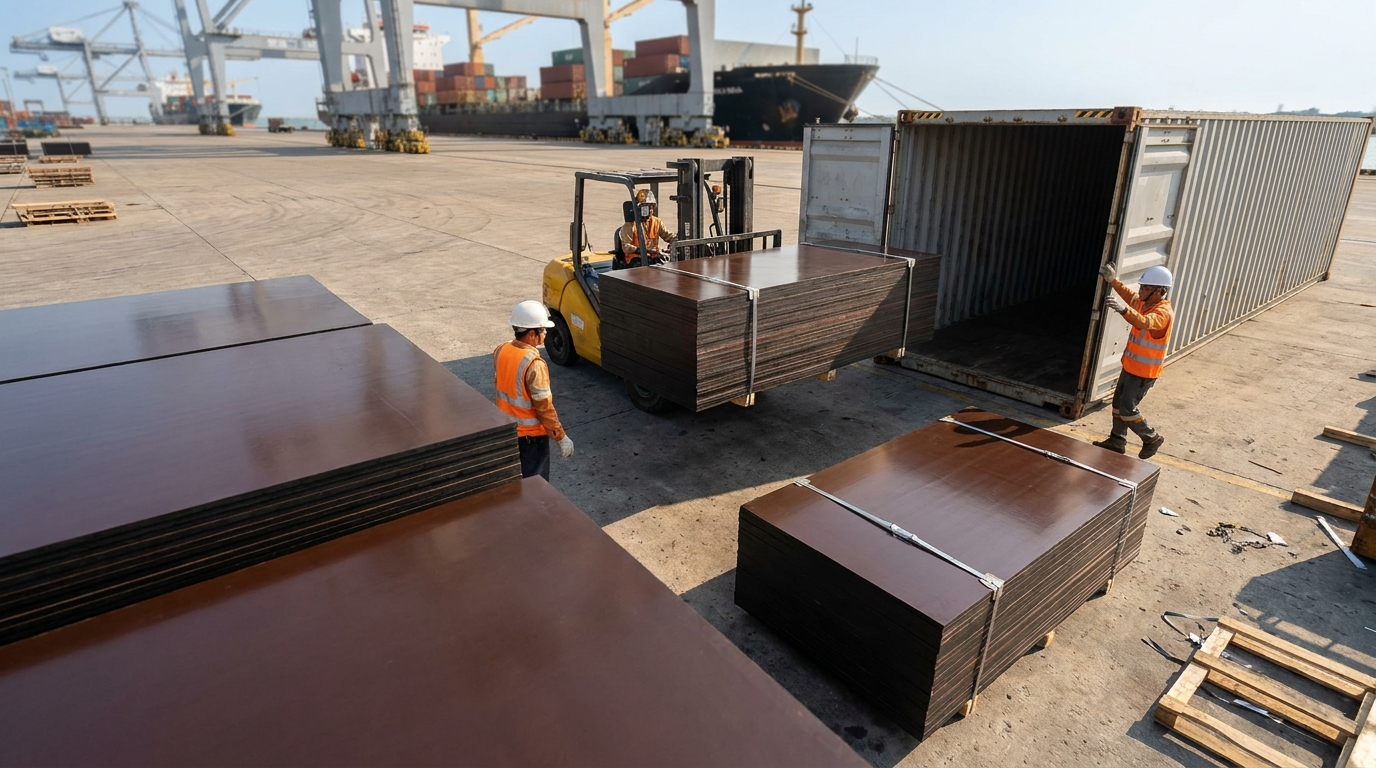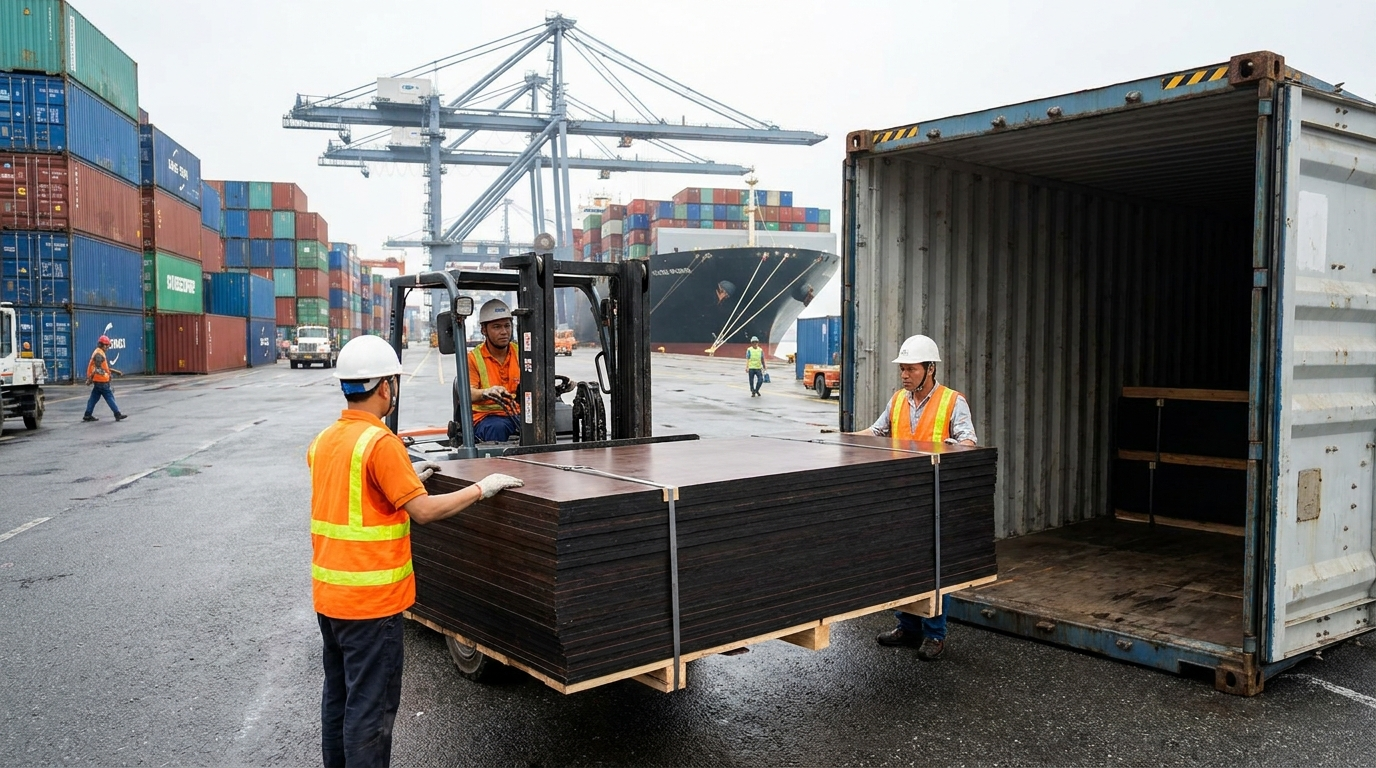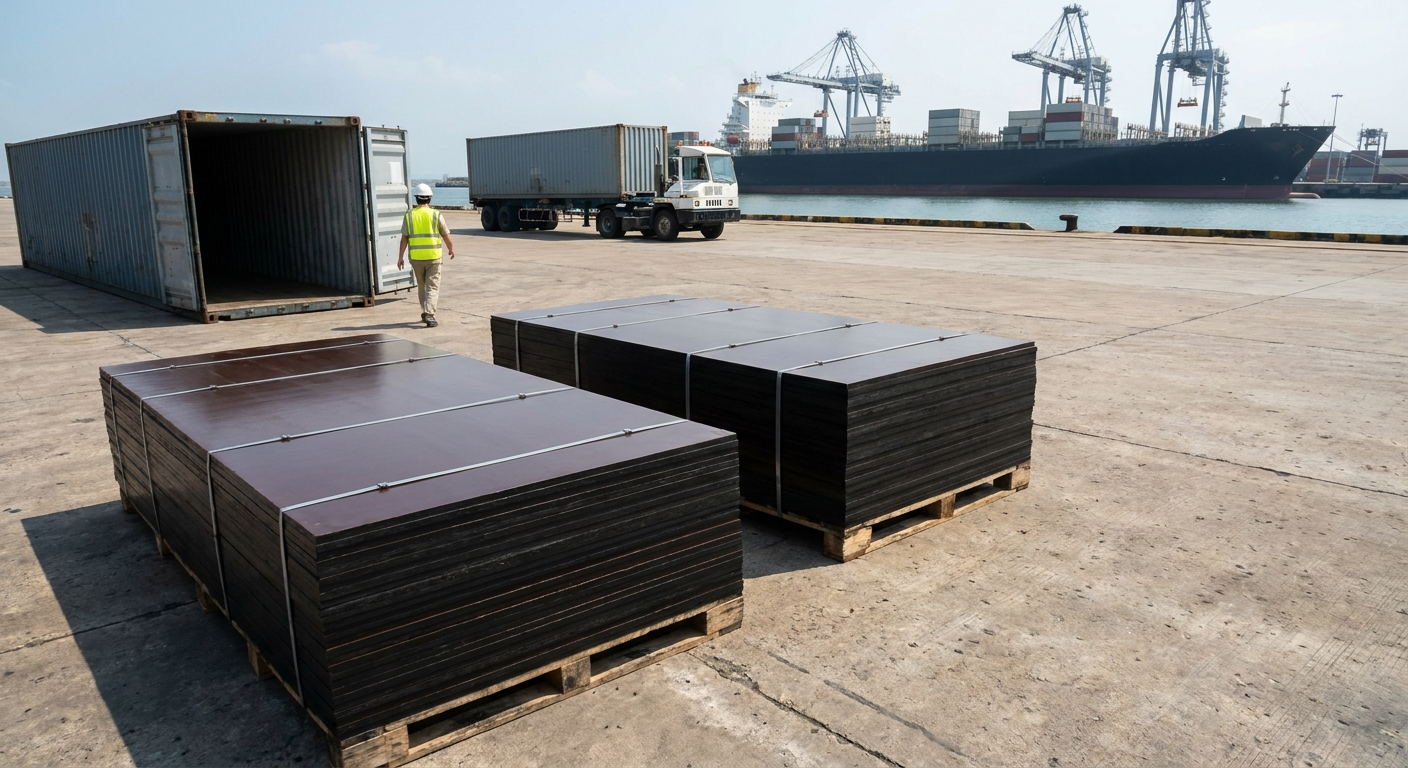
The Importance of Quality Control in Plywood Manufacturing
How to check film-faced plywood quality before you accept a container: face film, bond class, core and thickness, edge sealing, and the documents that tie each bundle to its test results.
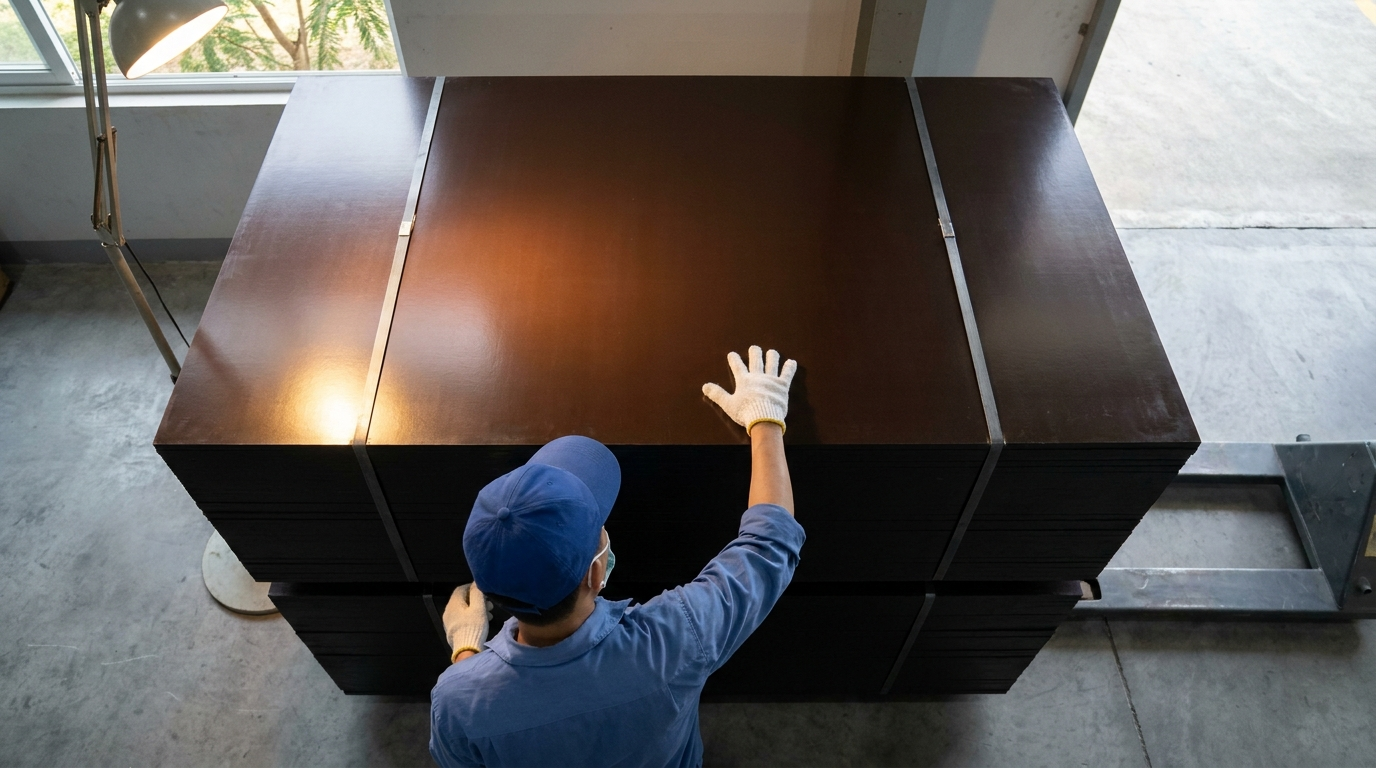
Checking film-faced plywood quality comes down to five things you can test or document: the weight and coverage of the face film, the glue bond class, the core build and thickness tolerance, the edge sealing, and the paperwork that ties each bundle to its test results. A panel can look perfect on the top sheet and still fail on the third pour if the glue line or the core is wrong, so a good check looks past the surface. At our mill in Vietnam, every sheet is inspected individually before it is packed, and this guide explains how a buyer can run the same kind of check before accepting a container.
Why quality checks matter more on formwork panels
Think of film-faced plywood as a tool the crew uses over and over, not a product that gets installed once. It sits against wet concrete, takes vibration and release agent, gets stripped, cleaned and set again, and each of those steps punishes a weak spot. A void in the core becomes a dent after the first pour, a thin patch of film lets water reach the veneer, and an unsealed edge starts to swell after a few cycles. On site, those small defects show up as rough concrete, extra repair work and panels that are thrown away earlier than the budget planned.
That is why a buyer's check should focus on what predicts performance, not on how glossy the bundle looks under warehouse lights. If you need help telling a production defect from normal site wear once panels are in use, our guide to formwork plywood defects versus normal wear covers that side of the story. Here, the focus is the panel as it arrives.
What to check on the panel itself
Start with the face. Phenolic film is specified by weight in grams per square metre, and on our range it is a 125 g/m² top-grade film on Pro Form and 165 g/m² on Pro Form Lite, Form Basic, Form Extra, Eco Form and Eco Form Plus, applied to both face and back. On the sheet, the film should be even in colour with no bubbles, bare spots, wrinkles or deep scratches, because any break in the film is where moisture will find the veneer. Look along the sheet at a low angle under good light, which shows surface faults far better than looking straight down.
Next, look at the edges and the core. Edges should be sealed with one uniform coat of paint, black on our film-faced grades, with no open voids or gaps between plies. The edge is also the only place you can see the core, so it tells you whether the veneers are laid tight or whether there are overlaps and missing pieces inside. Then measure: thickness at several points across the sheet, length and width against the order, and squareness by comparing the two diagonals. Our width and length tolerance is 1 mm per metre, and the moisture content target is 12 percent, so those are fair numbers to check against.
| Check | What a good panel shows |
|---|---|
| Face film | Even colour on both faces, no bubbles, bare spots or deep scratches |
| Edges | One uniform coat of sealing paint, no open voids between plies |
| Core at the edge | Tight veneers, no visible gaps or overlaps |
| Size and squareness | Within the agreed tolerance; diagonals match |
| Flatness | Sheet lies flat on a level stack without rocking |
Bond class is the test that predicts pours
The glue line holds the veneers together, and it decides how a panel behaves after repeated wetting and drying. European standard EN 636 sorts plywood by the conditions it is made for, and the bond classes describe how the glue line performs in tests that include soaking and boiling samples before they are pulled apart. A Class 3 (EN 636-3) bond is made for exterior conditions, while a Class 2 bond is made for humid conditions with limited exposure. In plain words, the boil test is a fast way of asking whether the glue will still hold after months of wet concrete and site weather.
On our film-faced range, Pro Form and Pro Form Lite use WBP phenolic glue and carry an EN 636-3 Class 3 rating, with reuse rated at up to 20 and up to 15 pours. Form Basic, Form Extra, Eco Form and Eco Form Plus are Class 2 panels bonded with MUF (melamine-urea-formaldehyde) resin, with the same phenolic face film; their reuse ratings are up to 10, up to 15, up to 6 and up to 8 pours respectively. Our HDO and MatteFace overlay panels have their own split between Class 3 and Class 2 grades, so check each product page rather than assuming a whole family shares one class. When you compare offers from different mills, ask for the bond class in writing and match it to the job, because a Class 2 panel priced against a Class 3 panel is a different product, not a discount.
How we check film-faced plywood before it ships
Our production follows a 12-step controlled process on plantation-grown wood, and the checks run through that whole chain rather than waiting for the finished sheet. Our in-house laboratory tests samples for modulus of rupture (MOR) and modulus of elasticity (MOE), which describe bending strength and stiffness, along with bond strength and formaldehyde emission. For independent testing we work with outside partners SGS, TÜV, Eurofins and Quatest.
Before packing, every sheet is inspected individually. That 100% sheet inspection is where film faults, edge gaps and size problems are pulled out before they reach a bundle. Each bundle then carries its own QR code, which links it to its production record, so a question raised on site months later can be traced back to the batch it came from. You can read more about these controls on our quality page.
Documents to ask for with each order
A good panel needs paperwork that proves it, and the documents you need depend on where the panels are going. For Europe, ask for CE marking under EN 13986, which covers wood-based panels used in construction. For the United States, ask for EPA TSCA Title VI documentation on formaldehyde emissions. If the order is placed as certified material, the FSC-COC or PEFC claim should appear on the invoice itself, not only on a certificate attached to an email. Test reports for the order and our ISO 9001 quality management certificate complete the file, and the full list is on our certifications page.
Buyers shipping into the EU often also need deforestation due diligence evidence. We can provide an EUDR evidence pack on request, which ties the timber back to its plantation source. It is easier to agree on the document list when the order is placed than to chase papers once the vessel has sailed.
A pre-shipment check you can run
The simplest pre-shipment check is an inspection at loading, either by your own team or by a third-party inspection company you appoint. Ask the inspector to pull sheets from different bundles rather than the top of one stack, and to check film, edges, thickness and size against the order. Where the order allows it, cutting one or two sample sheets shows the core in cross-section and makes core gaps or overlaps easy to see. The inspector should photograph the bundle QR codes as well, so the report links each finding to a traceable batch.
If you cannot attend loading, you can still check the first container closely on arrival and use it to set expectations for the rest of the programme. Our guides on evaluating a Vietnam plywood supplier and the film-faced plywood buying guide cover supplier checks and specification choices in more depth, and our Vietnam plywood supplier overview explains how sourcing from Vietnam works end to end.
Ordering film-faced plywood with a clear quality brief
The easiest way to get a consistent container is to put the checks above into the order: film weight, bond class, thickness and tolerance, edge sealing and the document list. Our film-faced plywood range lists each grade, and the Pro Form product page shows the full specification for our Class 3 phenolic grade. Since 1992 we have shipped to buyers in 55+ countries, and we are happy to build the inspection plan into your order. Send your specification through our request for quotation form, or contact our sales team to talk through the grade that fits your pours.