The Sneak Peek into Vietnam Plywood by Vinawood
How Vinawood works as a film faced plywood exporter in Vietnam: the panels we make, how an export order moves from spec sheet to loaded container, and the documents that ship with it.
Most people who find this page already know Vietnam makes plywood. What they really want to know is what happens between the first email and a sealed container, and whether the sheet that turns up on site is the sheet that was quoted. Fair question. So here's a plain account of how we work as a film faced plywood exporter in Vietnam: what we make, how an order moves through the mill, and which papers go with it.
We've been making construction plywood since 1992. These days that's roughly 5,000 containers a year, going to 55+ countries, and most of it ends up nailed to formwork. Still comparing suppliers? Our Vietnam plywood supplier guide deals with picking one, and the importer due-diligence guide lists the checks we'd run on any mill, ours included. This page is only about how we do things.
What we make, and who buys it
Formwork is the temporary mould crews pour wet concrete into. It's where almost every sheet we press goes. A contractor in Toronto wants something a bit different from a rental yard in Poland, and a precast plant in the Gulf wants something different again, but they all worry about the same thing: will the panel strip clean and come back for another pour without the face lifting? That one question shaped our range more than any price list did.
The cores are plantation-grown Acacia and Eucalyptus (plus some Hevea), from plantations that get replanted and cut again on short cycles. That's good news for buyers, because veneer quality doesn't swing much between orders. On top goes a phenolic face film, basically a resin-soaked paper thinner than a fingernail, bonded on under heat. Our panels are used with major formwork systems, Doka and Peri included, and Alsina too. Those crews aren't gentle with a sheet.
The film-faced range, from first panel to top grade
If you only read one thing about our film-faced plywood, make it the glue. The core glue decides how a panel copes with rain on an open deck and with being stripped over and over. Eco Form and Eco Form Plus sit at the economy end, and Eco Form Plus is rated for up to 8 reuses. Form Basic goes up to 10.
Form Extra is where people get confused. It uses our Superior Glue, a melamine-urea-formaldehyde (MUF) core resin rated to EN 636-2, which is Europe's class for humid service. The face film is the same phenolic film Form Basic has. So why does it last longer, up to 15 reuses? The glue line is tougher. It isn't a Class 3 panel, and we don't sell it as one.
Class 3 needs phenolic (PF) glue in the core. Pro Form Lite slots in between Form Extra and Pro Form at up to 15 reuses, and Pro Form tops the range at up to 20. Both meet EN 636-3, the exterior class. Keep in mind those reuse numbers are ceilings, not promises; release agent and stripping habits matter a lot, and so does keeping cut edges sealed.
| Panel | Core glue | Bond class | Reuse |
|---|---|---|---|
| Eco Form Plus | WBP, water-resistant | EN 636-2 | up to 8 |
| Form Basic | WBP, water-resistant | EN 636-2 | up to 10 |
| Form Extra | Superior Glue MUF | EN 636-2 | up to 15 |
| Pro Form Lite | Phenolic (PF) | EN 636-3, Class 3 | up to 15 |
| Pro Form | Phenolic (PF) | EN 636-3, Class 3 | up to 20 |
One word trips up a lot of buyers: WBP. It's short for weather and boil proof, and people read "proof" literally. What it actually describes is a glue line that survives water and boil testing. Leave a stack uncovered with raw edges and it'll still drink water.
HDO, MatteFace and other overlays
Forming crews in North America often want an overlay instead of glossy film. Our HDO plywood comes in three grades. HDO Basic is Class 2 and good for up to 10 reuses; HDO Standard and HDO Premium are Class 3, and Premium is rated for up to 20. Then there's MatteFace Plywood (MTF), a matte phenolic surface film panel made for formwork and good for up to 15 reuses. Buyers often search for it as MDO formwork plywood. You'll find the 1S, 2S and 1SF builds in the MatteFace range.
Two names cause mix-ups every month. P-Form has a polypropylene face (a plastic overlay) and has nothing to do with Pro Form apart from the spelling. Consply is commercial plywood with a Bintangor face and no film. It's fine for packing and general building work. Don't pour concrete against it.
How an export order moves from spec sheet to container
It starts with a spec pack. We'll ask for thickness and sheet size first, then glue class and face film weight (in grams per square metre), the emission class, which certificates your market wants, and where it's going. That last bit matters more than people expect. A German buyer needs CE marking and probably FSC claims; a buyer in Texas needs a TSCA Title VI certificate instead. We'd honestly rather ask a silly question twice than press the wrong panel.
New account, or a grade you haven't bought before? Then samples come next. Your site team can try their release agent on them, check the face against the finish they need, and cut a few edges to look at the core. Bulk orders get planned as container loads, and you can usually mix thicknesses of one grade in the same box.
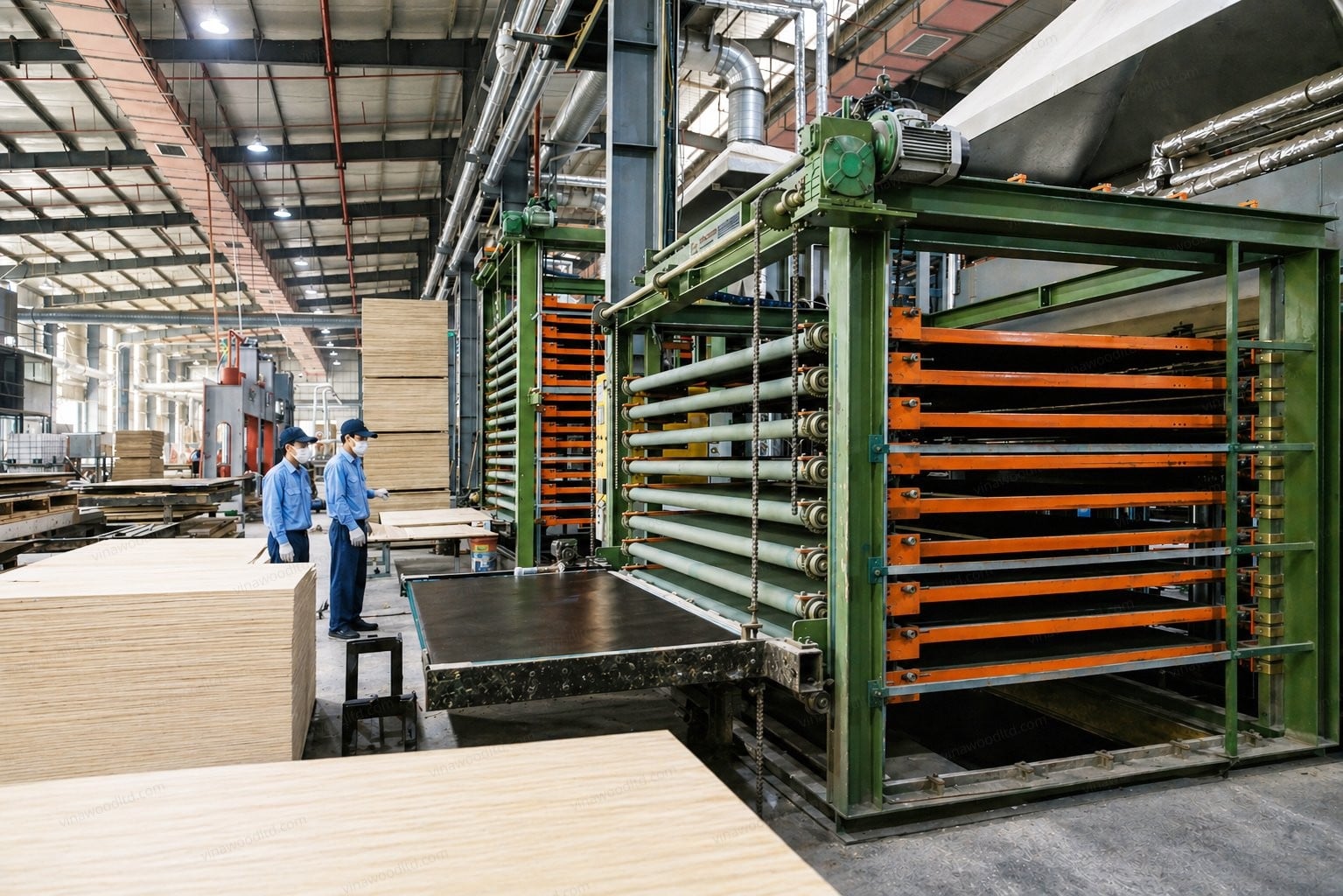
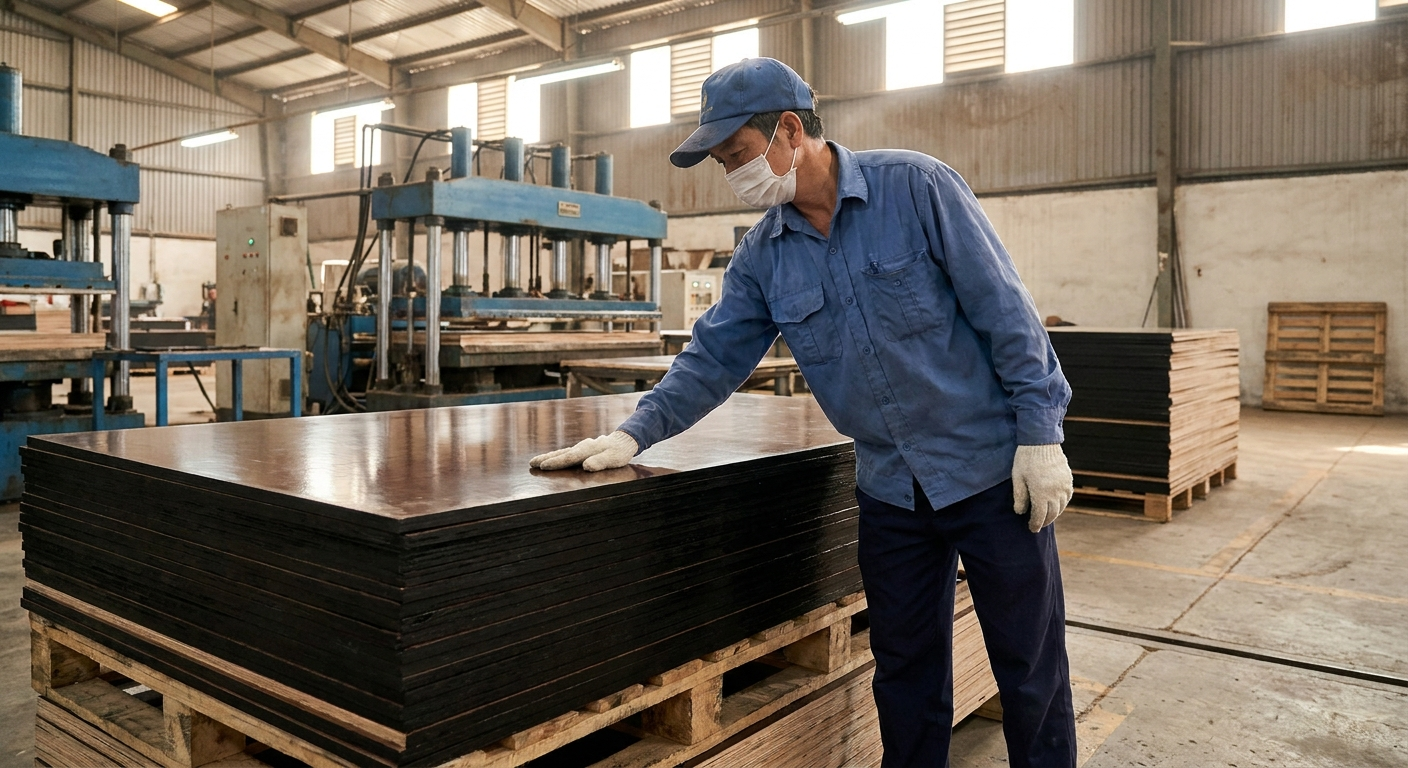
Production happens in-house in Vietnam. Veneer peeling, drying, gluing, pressing, sanding and the final face lamination all run under our roof, in a 12-step sequence. Why does that matter to you? If a sheet fails at the press, we can trace it back to the veneer batch behind it and fix the cause instead of patching the symptom. There's a fuller walk-through in our guide to how film-faced plywood is made.
Here's the part we'd point a new buyer to first. Every single sheet gets inspected before it's packed. Our in-house lab pulls samples from each run and tests bending strength and stiffness (MOR and MOE), bond strength and formaldehyde. When a market needs outside proof, independent labs like SGS, TÜV, Eurofins or Quatest do the testing.
Packing, loading and export papers
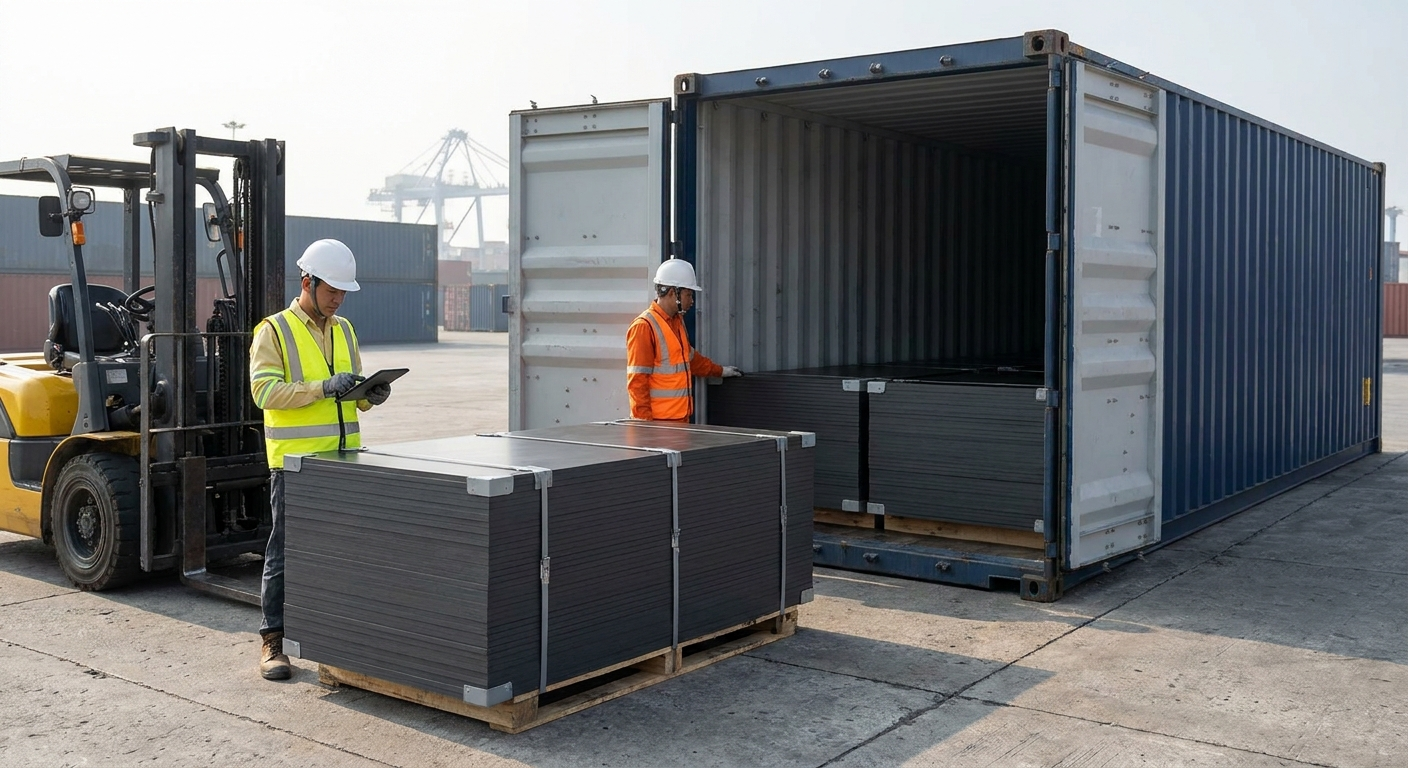
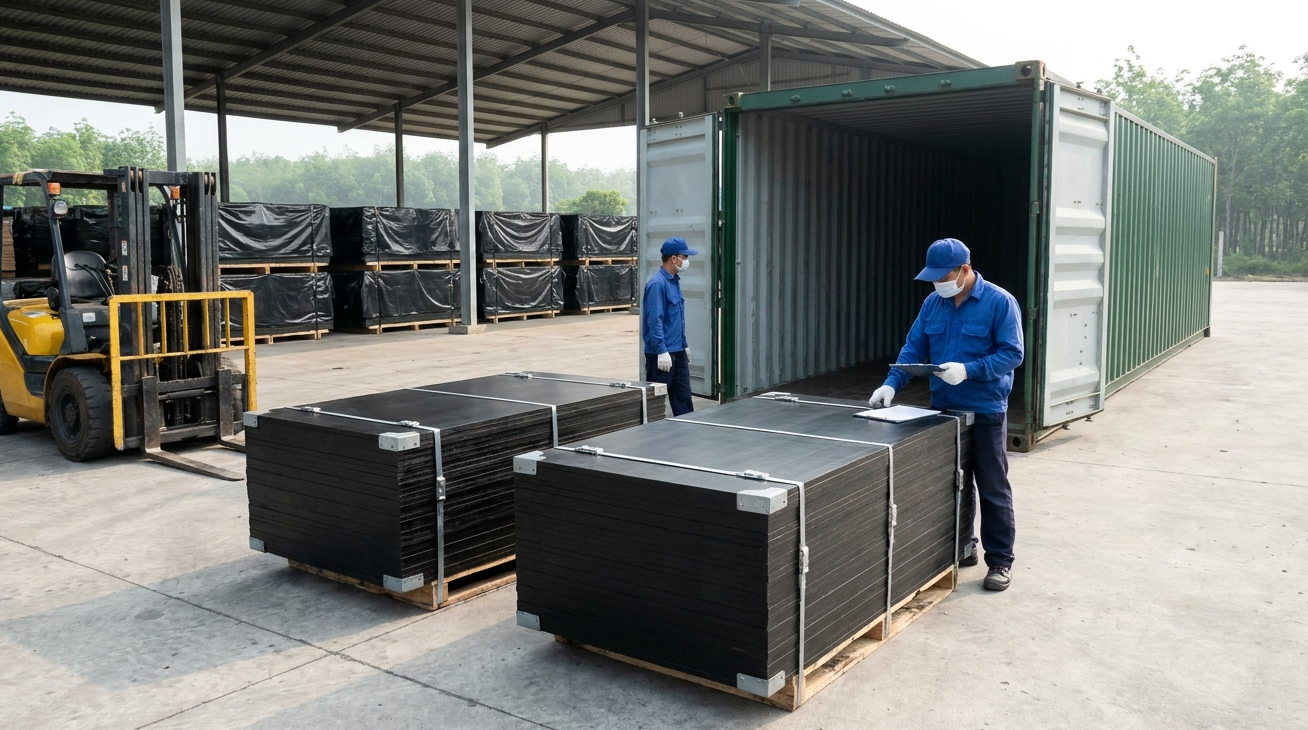
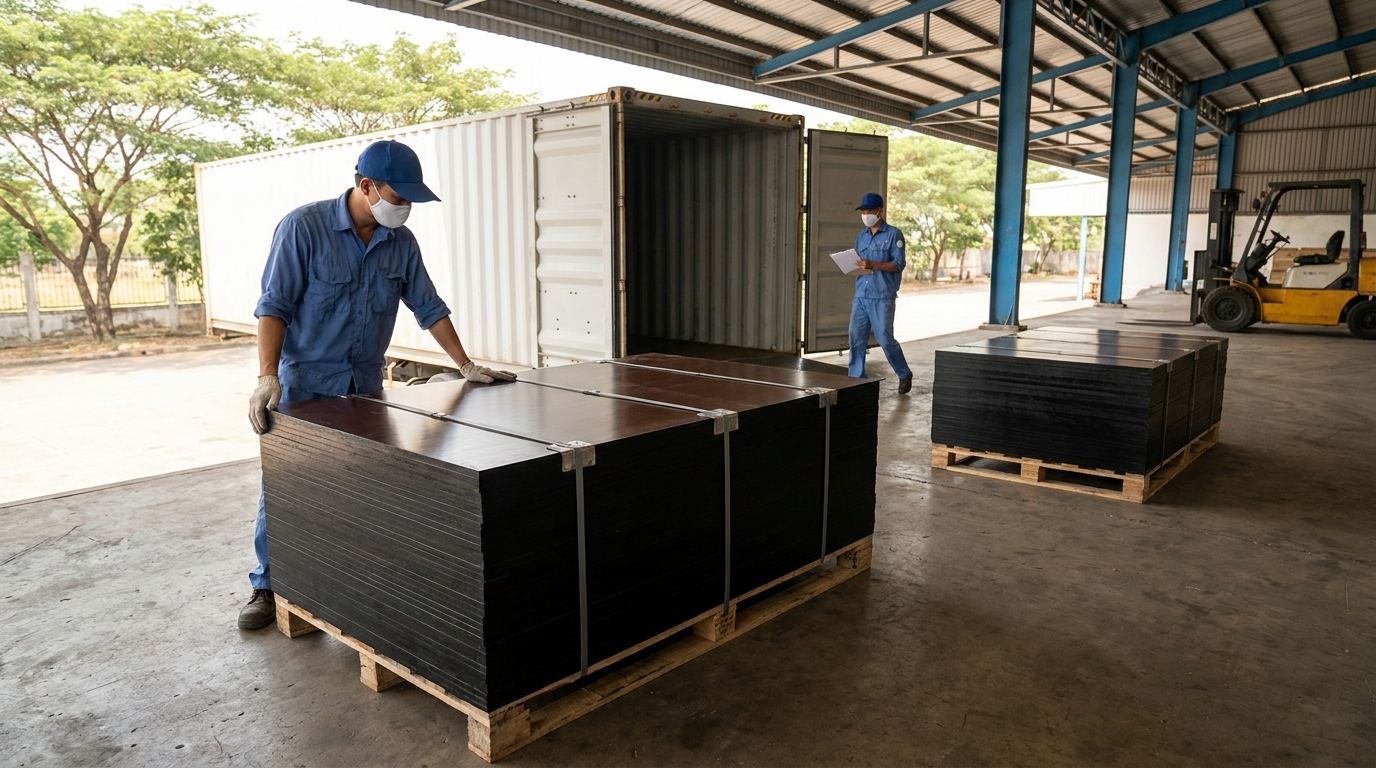
Most transit damage starts at a corner. So bundles go on wooden pallets, with steel banding over corner protectors and sealed edges to slow down moisture on a long voyage. Each bundle also gets a QR code tied to its production record. It's handy when a site manager asks which batch a sheet came from.
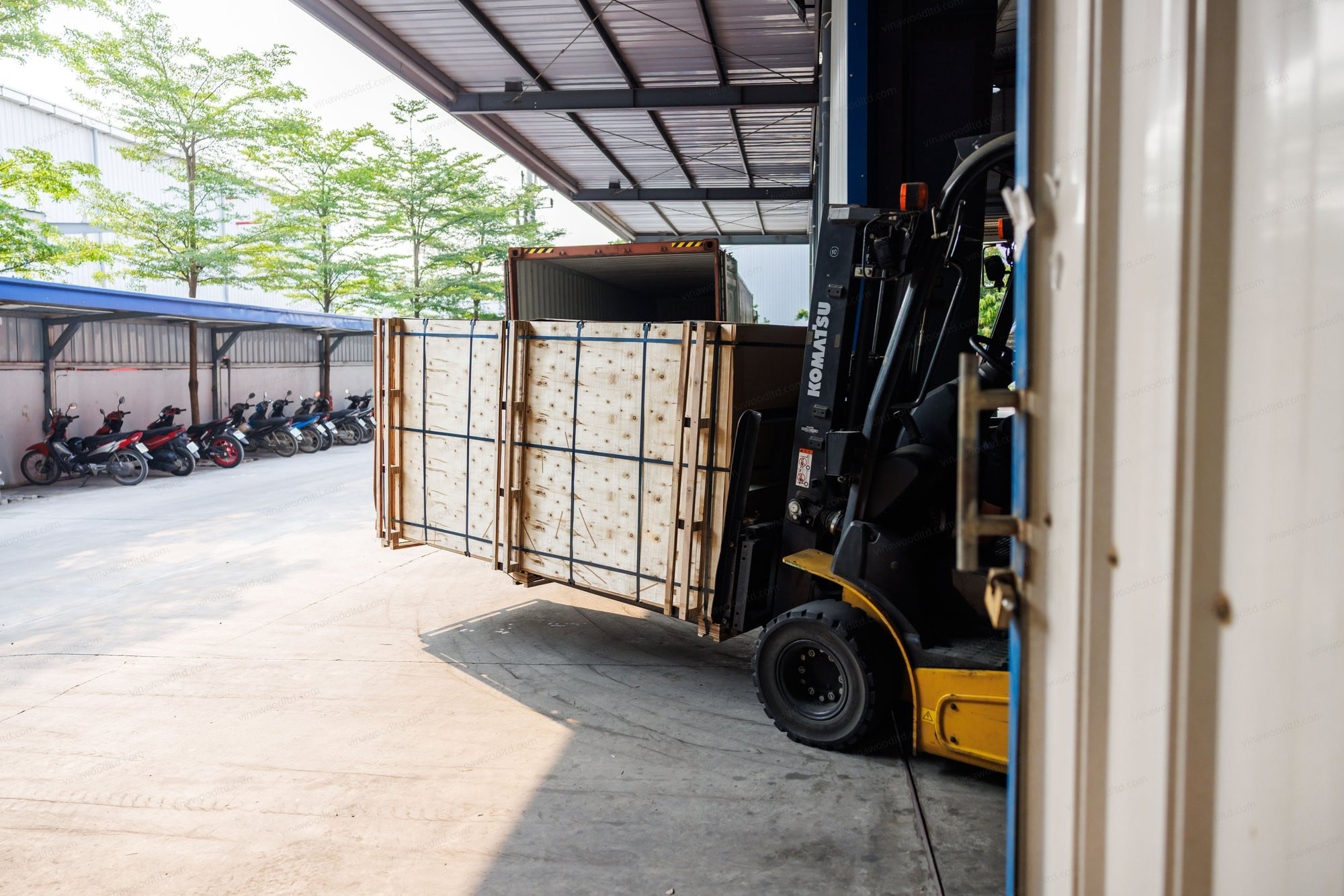
We load at the factory, and the containers leave Vietnam through Hai Phong port. You'll get the usual commercial invoice and packing list, the bill of lading and a certificate of origin. On top of that, depending on where it's headed, there can be FSC-COC claims on the invoice, a CE declaration of performance under EN 13986, or an EPA TSCA Title VI certificate covering formaldehyde. US importers often ask about trade cases. Formwork panels and PS-structural plywood fall outside the countervailing duty case on Vietnamese hardwood plywood, though your broker should still check scope against the exact product before booking.
As for certificates, we hold ISO 9001, FSC-COC and PEFC, CE marking to EN 13986 and EPA TSCA Title VI (CARB P2). There's also the Korean KS mark, an EPD, UKCA and BIS. Any of them can be checked with the body that issued it, and current copies sit on our certifications page.
Anti-slip decks and custom builds
Quite a few enquiries aren't about formwork at all. Trailer floors and stage decks need grip, which is what our wiremesh anti-slip plywood is for: a film face pressed with a wire-mesh pattern on one side. It's made in 2440 x 1220 mm and 2500 x 1250 mm.
Custom orders mostly come down to size and face. Most of our panels are made in thicknesses from 12 to 21 mm, and a lot of European buyers prefer 2500 x 1250 mm over 2440 x 1220 mm. Film colour and overlay can be changed to order, and the core build too if the spec allows. Tell us what the panel has to do and we'll tell you straight whether we can make it.
Stock closer to North American sites
Not every job can wait for a container to cross the Pacific. Vinawood keeps distribution warehouses in Toronto, Vancouver, Calgary, Montreal, Miami, Houston and Baltimore, and they supply ready stock to local distributors. That cuts the wait between winning a job and getting panels on site.
Starting a quote
Quotes come back fastest when the spec pack already names the destination port. Send us the grade you're thinking of, or just describe the job, and we'll come back with a recommendation and a quotation. Want to sanity-check what Vietnamese plywood can and can't do first? Start with five common misconceptions about it. When you're ready, request a quote here.
▶Sources & References (4)
- EN 13986: Wood-based panels for use in construction — CEN European Committee for Standardization (2015)
- EN 636:2012+A1:2015 Plywood Specifications — European Committee for Standardization (CEN) (2015)
- Formaldehyde Emission Standards for Composite Wood Products (TSCA Title VI) — US EPA (2024)
- FSC Chain of Custody Standard FSC-STD-40-004 — Forest Stewardship Council (2021)