What Is Tongue And Groove Plywood? Advantage & Application
Tongue and groove (T&G) plywood interlocks panel to panel so a subfloor spans joists without edge blocking. A full guide: span ratings and thickness for subfloor, the glue-and-screw install sequence, roof and wall sheeting uses, grades and bond class, and how to choose the right panel.
A 23/32" (about 18 mm) tongue-and-groove plywood subfloor span-rated 24/16 carries 100 psf live load over joists at 16 inches on center with no midspan blocking. Standard square-edge plywood at the same thickness needs blocking under every panel edge, or the unsupported seams flex underfoot. That structural shortcut, getting away with no edge blocking, is the whole reason tongue-and-groove plywood exists. The interlocking edge transfers shear from panel to panel, so adjacent sheets share the load instead of each one handling it alone. The premium over plain plywood is roughly 10 to 15 percent. The payoff is a floor that doesn't squeak.
What is tongue and groove plywood?
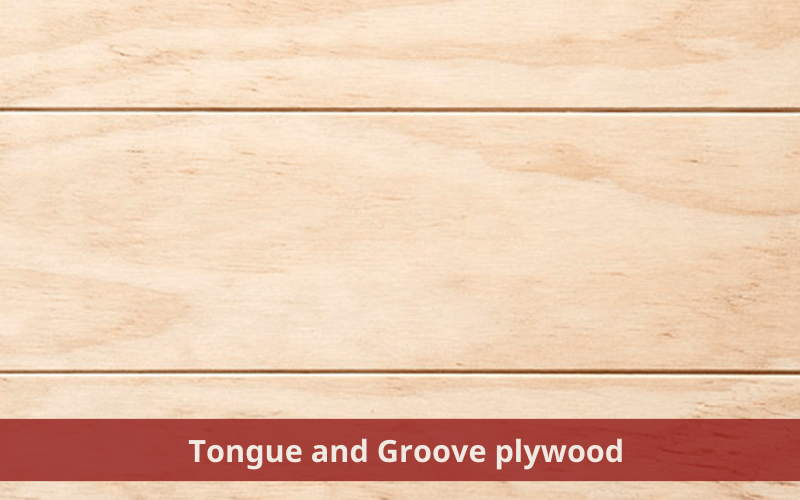
Tongue-and-groove (T&G) plywood is structural plywood with one long edge milled into a tongue and the opposite long edge milled into a matching groove. Drop one panel next to its neighbor, tap the tongue into the groove with a sledge and a scrap block, and the joint locks. No fasteners through the joint itself; the fit does the work.
On a floor deck the difference shows up underfoot. A square-edge plywood subfloor depends on the joist below to hold each panel rigid; T&G hands load between panels, so a person walking near a panel edge doesn't feel the floor flex. Quieter, stiffer, fewer callbacks for the framer. The trade-off is install time: the tongue has to seat fully into the groove, which wants a flat framing surface and a sledge, and most crews pre-glue the joint with construction adhesive before the panel goes down.
Tongue and groove subfloor: spans, thickness, install
Subfloor is the dominant use of T&G plywood, and it is where the panel earns its premium. The key spec is the APA span rating stamped on the panel, written as two numbers such as 24/16. The first number is the maximum roof-rafter spacing in inches; the second is the maximum floor-joist spacing. For a floor, read the second number: a 24/16 panel spans joists up to 16 inches on center, a 48/24 panel up to 24 inches on center.
Thickness follows the joist spacing. The standard call-out for residential floors on 16-inch joists is 23/32" (nominal 3/4", about 18 mm); the actual milled thickness is 23/32", as explained in our guide to 3/4 plywood. Wider joist spacing or heavier loads move the spec up to 7/8" or 1-1/8".
| Nominal thickness | Typical span rating | Max joist spacing | Typical application |
|---|---|---|---|
| 19/32" (~15 mm) | 20 oc / 40 psf | 16 in (with support) | Light residential, underlayment over structural deck |
| 23/32" (3/4", ~18 mm) | 24/16 | 16 in on center | Standard residential subfloor |
| 7/8" (~22 mm) | 32/16 | 19.2 in on center | Engineered-joist floors, wider spacing |
| 1-1/8" (~28 mm) | 48/24 | 24 in on center | Heavy load, commercial, wide-spaced framing |
The install sequence is glue and screw, in that order. Run a bead of construction adhesive along each joist, set the panel with the groove edge toward the wall so the next panel's tongue seats from the open side, tap the tongue home with a sledge and a protective block, then screw the panel to the joists. Adhesive kills the squeak; screws hold the panel down and back out cleanly if a board ever has to come up. Leave a 1/8" gap at panel ends and along walls for expansion, and stagger the end joints in a brick pattern so shear transfer stays continuous across the deck. T&G removes the edge blocking a square-edge floor would need, but it does not remove the need for a flat, correctly spaced set of joists underneath.
Advantages of tongue and groove plywood
The interlocked edge changes how the floor system performs:
- Stronger joints. Load transfers across the joint instead of stopping at the panel edge, so point loads like a refrigerator or a filing cabinet stay flat where square-edge ply would dish.
- Improved stability. The tight fit closes the gap square-edge sheets leave between panels. Less air infiltration, and less of the gap that makes a square-edge floor squeak as wood expands and contracts.
- Faster install on flat framing. Snap the tongue into the groove and the panel self-aligns; no chasing the edge with a tape measure.
- Cleaner finish. No visible gap between panels, which reads better on an exposed ceiling or a wall sheeting run than a butted square edge.
- Long service life. Multi-ply cross-laminated construction resists warping, and the joint adds shear stiffness without adding panel weight.
What tongue and groove plywood is used for
Subfloor is the headline market, but the same shear-transfer benefit carries the other uses.
- Floors and subfloors. T&G handles 16- and 19.2-inch joist spacing without midspan blocking, and keeps adjacent panels in plane so a finished floor of hardwood, tile, or vinyl sits flat.
- Roof sheeting. Roof decks under shingle, metal, or tile use T&G to span rafters without edge blocking. On a roof, read the first number of the span rating for the rafter spacing.
- Wall sheeting and sheathing. A continuous T&G surface ties studs together and helps the wall resist racking; combined with proper bracing it acts as a structural diaphragm. The tight seam is also why "tongue and groove sheeting" is the term many roofers and framers search for the same panel.
- Exposed ceilings and finish surfaces. Tight joints read as architectural rather than industrial, and give drywall or plaster a flat substrate with no seam telegraphing through.
- Furniture and outdoor structures. Cabinet sides, shelves, shed and deck decking in treated stock where the interlocked edge helps keep large surfaces flat.
Types and grades of tongue and groove plywood
T&G ships in several face species, thicknesses, and grades. For structural subfloor and sheeting, the panel is almost always a softwood or plantation-hardwood face on an Exposure 1 bond, not a decorative or marine grade.
By face species. Structural T&G subfloor usually carries a softwood face such as Douglas fir or southern pine, or a plantation-hardwood face; decorative T&G for exposed ceilings uses birch, maple, or oak faces. Which side of that line you are on is really the hardwood versus softwood decision.
By bond class. Structural subfloor and sheeting are Exposure 1 (the X in CDX), meaning a waterproof bond rated for construction-stage moisture, not permanent weather. That is the correct class for a floor deck that will be closed in; it is not a marine or EN 636-3 exterior panel, and it should not be specified as one.
By grade. The face-grade letters (A through D) describe appearance, not strength, and are decoded in our plywood grades guide. A subfloor face is typically C or D because it will be covered; an exposed T&G ceiling wants an A or B face.
How to choose the right tongue and groove plywood
Match the panel to the load, the spacing, and the finish, in that order.
- Span rating first. Pick the panel whose second span number meets or exceeds your joist spacing. Do not read thickness alone; a 23/32" panel can carry different span ratings depending on construction.
- Bond class for the environment. Exposure 1 for a closed-in floor deck; a genuinely wet or exterior application is a different panel entirely, not a thicker subfloor sheet.
- Face grade for the finish. Utility face under flooring, finish face only where the panel stays visible.
- Certification. For code and indoor-air compliance, look for the APA stamp on structural panels and CARB Phase 2 / EPA TSCA Title VI on the formaldehyde side.
Install tips
- Leave a 1/8" expansion gap around the perimeter and at panel ends for wood movement.
- Adhesive plus screws on the joists: adhesive kills squeak, screws hold it down and back out cleanly.
- Stagger the end joints between rows so shear transfer stays continuous across the deck.
- Start with the groove edge toward the wall, so the next panel's tongue seats from the open side.
- Protect the tongue: tap with a sledge against a scrap block, never directly on the milled edge.
Frequently asked questions
Is tongue and groove better than square-edge plywood for subfloor? For flooring, usually yes. T&G transfers shear across the seam, so it handles span and point loads more cleanly and needs no edge blocking. Square-edge ply still works where the budget is tight and blocking is added under every seam.
What is T&G sheeting? Tongue-and-groove sheeting is the same interlocking-edge plywood used for roof and wall sheathing; the interlock means the panel edges don't need separate blocking under them.
What thickness of T&G plywood for a subfloor? 23/32" (nominal 3/4", about 18 mm) is the standard call-out for 16-inch on-center joists. Wider spacing moves up to 7/8" or 1-1/8".
Is tongue and groove plywood waterproof? No. The tight joint slows water entry but does not seal it. Structural T&G is an Exposure 1 panel for construction-stage moisture, not a waterproof or marine product.
About Vinawood
Vinawood is a Vietnamese plywood manufacturer founded in 1992, exporting more than 5,000 containers a year to 55+ countries with 100% individual-sheet inspection. Structural T&G subfloor and sheeting in North America is an APA-rated softwood domain, and for permanent structural floor decking, APA-stamped domestic panels remain the convention. Vinawood's role is factory-direct commercial and decorative plywood, including plantation-hardwood-faced panels for the furniture, cabinet, and exposed-ceiling side of T&G work; explore the commercial plywood collection for that range. Certifications include EPA TSCA Title VI / CARB Phase 2, CE under EN 13986, FSC chain-of-custody, and ISO 9001, with documentation on every shipment. For a spec match against your project: vinawoodltd.com.
Category
guides
Related Markets
Related Countries
Related Products
▶Sources & References (2)
- APA Form E30 — APA Rated Sturd-I-Floor & span ratings — APA — The Engineered Wood Association (2023)
- Voluntary Product Standard PS 1-19 — Structural Plywood — APA / U.S. Department of Commerce (2019)