Formwork Panels: Uses, Benefits and Price
What a concrete formwork panel is (a frame plus a face sheet), how wood, steel, aluminium, plastic and composite panels compare, the plywood face grades Vinawood makes for framed wall and slab systems, and how to judge formwork panel price by cost per pour.
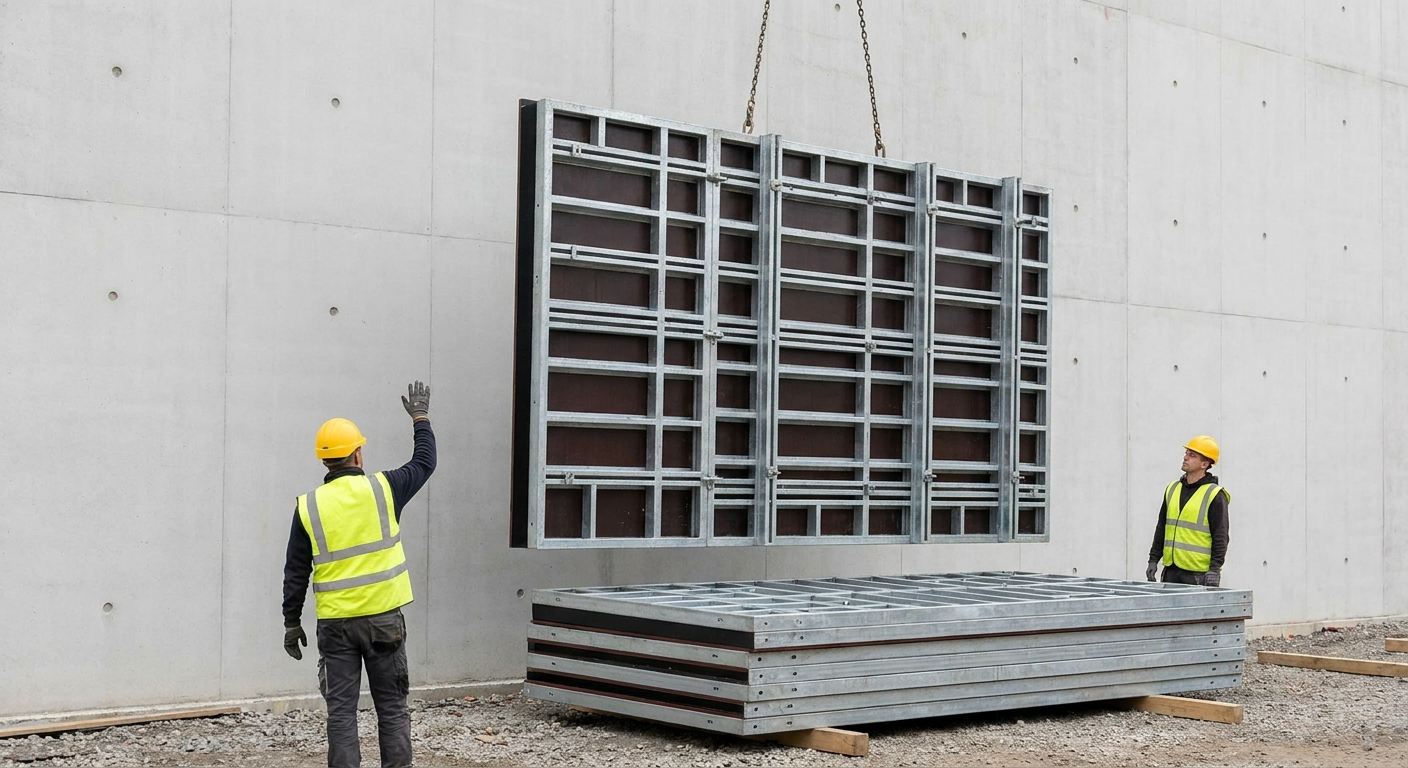
A concrete formwork panel is a reusable mold unit, usually a frame with a face sheet fixed to it, that holds fresh concrete in shape until it can carry itself. Crews clamp them into walls or slab decks and pour. Once the concrete has some strength they strip the lot and carry on upstairs. Think of it in two halves. The frame takes the load, while the face (the bit the concrete actually touches) decides what the wall looks like afterwards and how long before the panel ends up in the skip.
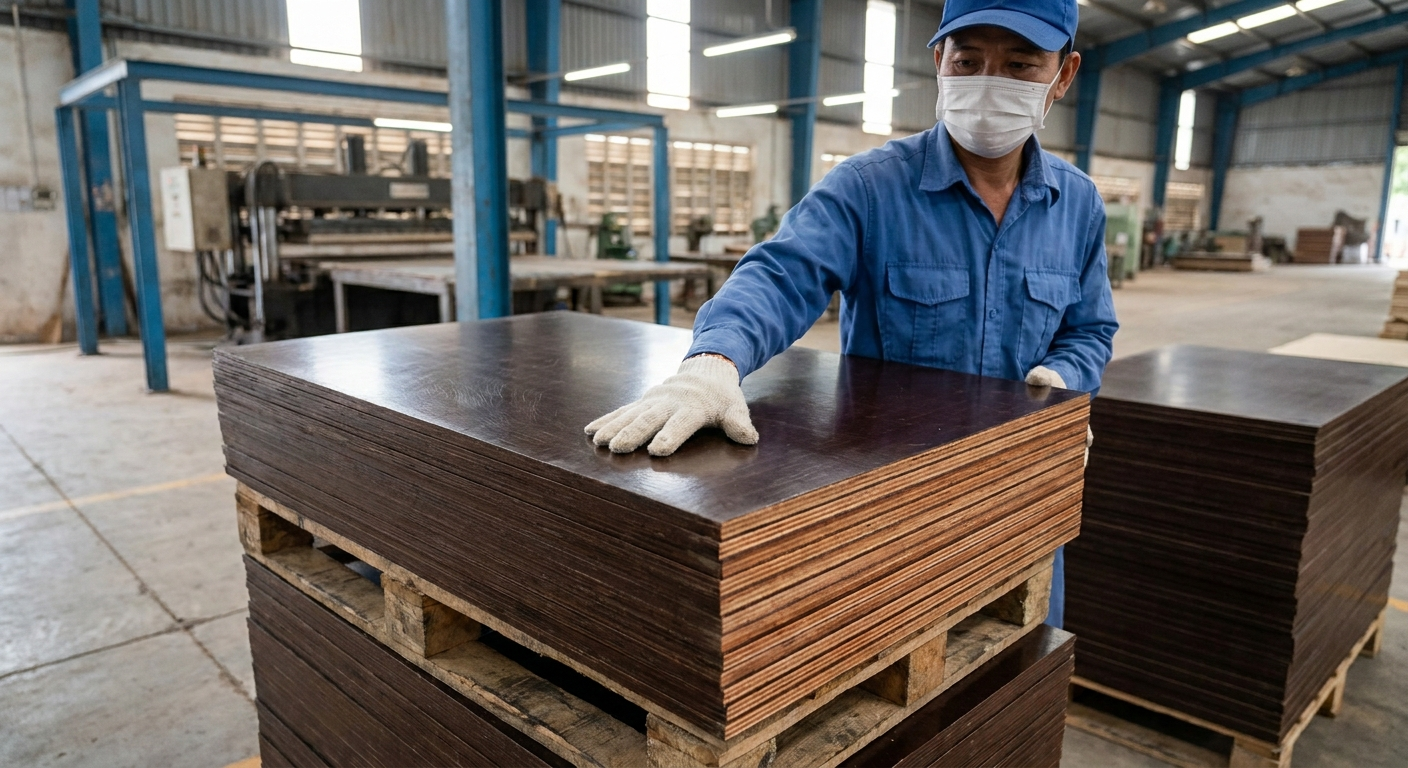
Keep that frame-and-face split in mind, because "formwork panel" gets used for two quite different things. Some buyers mean a whole steel or aluminium system panel. Others mean the plywood sheet bolted to it. We make the second: film-faced, HDO and MatteFace plywood face panels for framed wall and slab systems, produced in Vietnam since 1992.
What is a formwork panel?
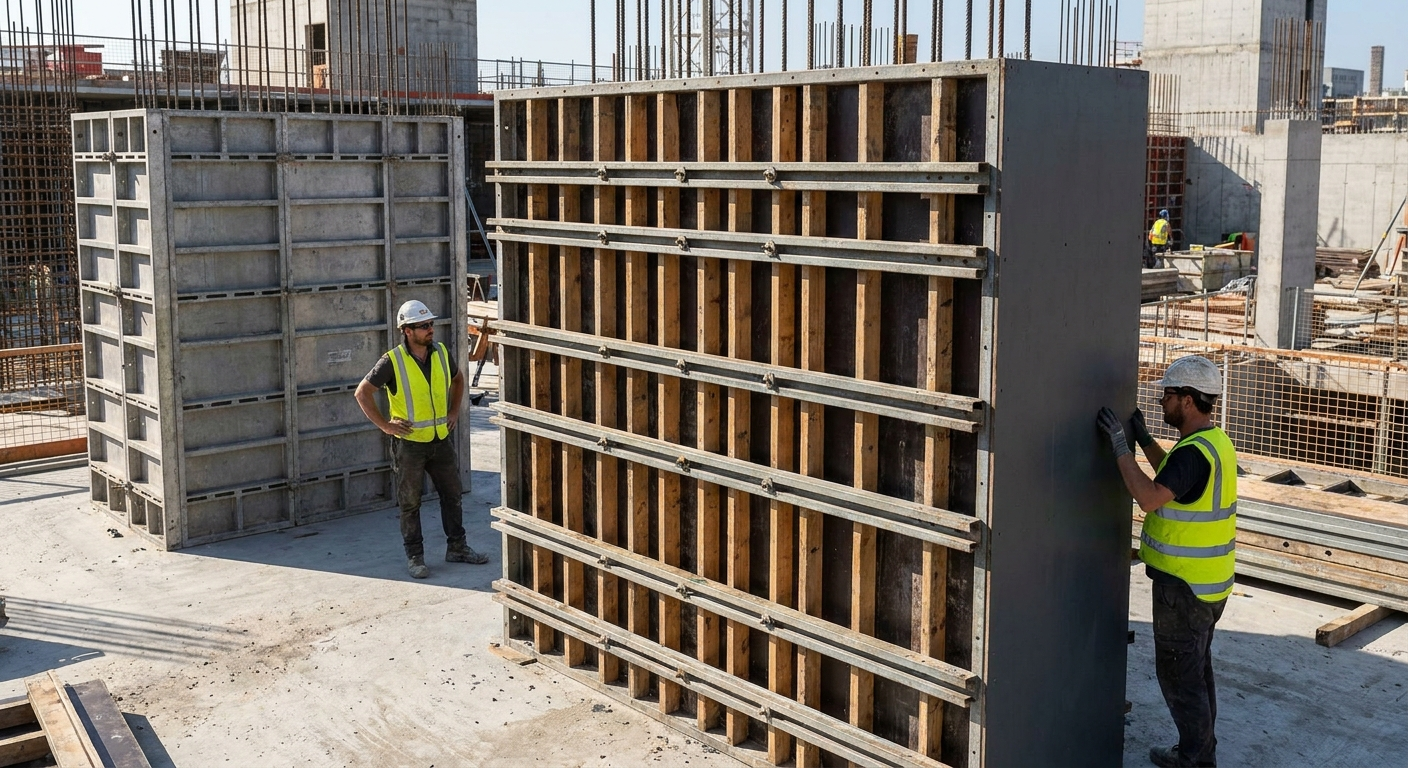
Walk behind a wall gang and the frame is what you see: walers running across, strongbacks running up, cross members in steel, aluminium or timber. On the far side sits the face sheet. Usually that's 18 mm (3/4 in) plywood with a resin overlay. Nothing else meets the wet concrete. Ties pass through both sides of a wall form to stop them bulging under pour pressure; when the concrete's ready, out come the ties and the panel lifts off in one rigid piece.
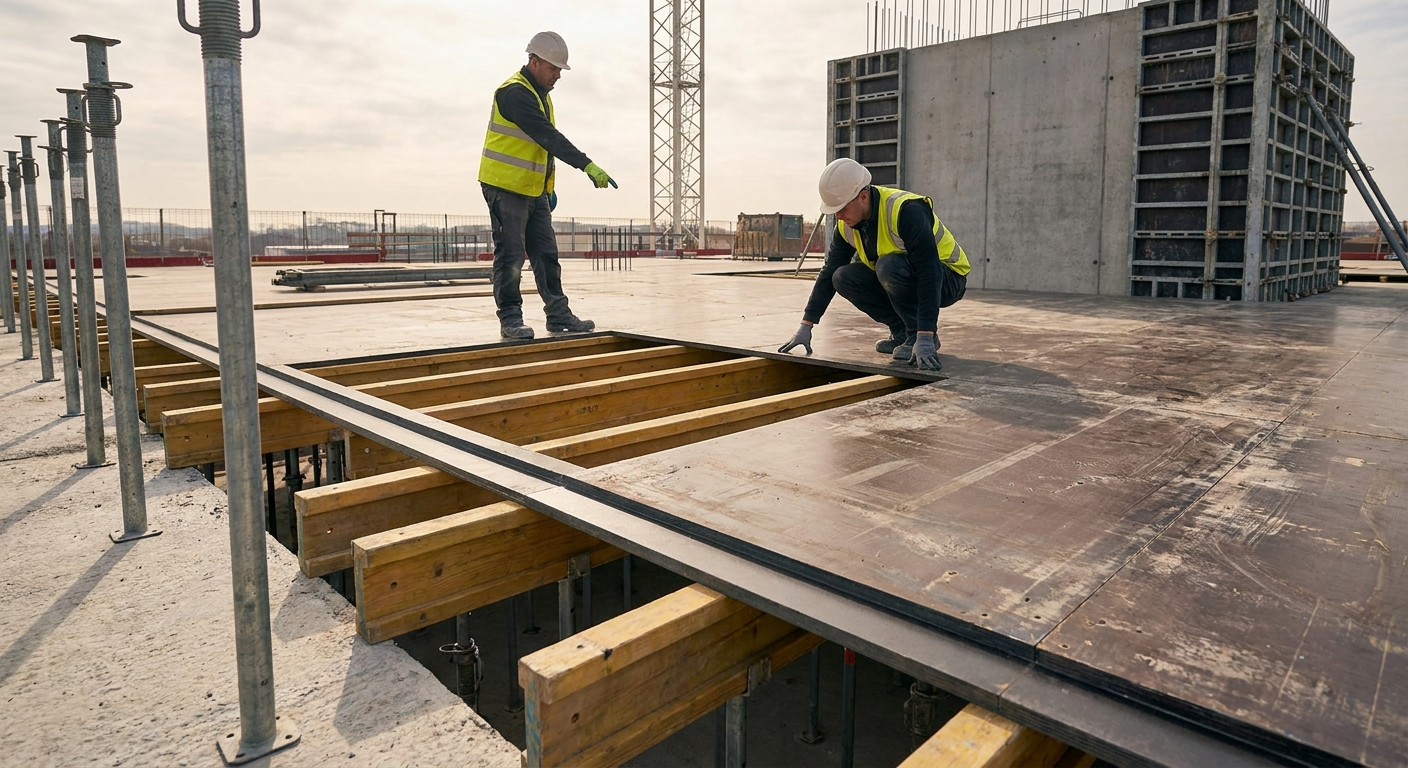
Slabs work differently. There's no upright framed panel; plywood sheets lie flat on timber joists, which sit on adjustable steel props, and together the sheets make the deck. Here the plywood is doing structural work, spanning joist to joist with wet concrete on it and boots walking across it. It sets the soffit finish as well. Leave a ceiling exposed and people will notice a bad one.
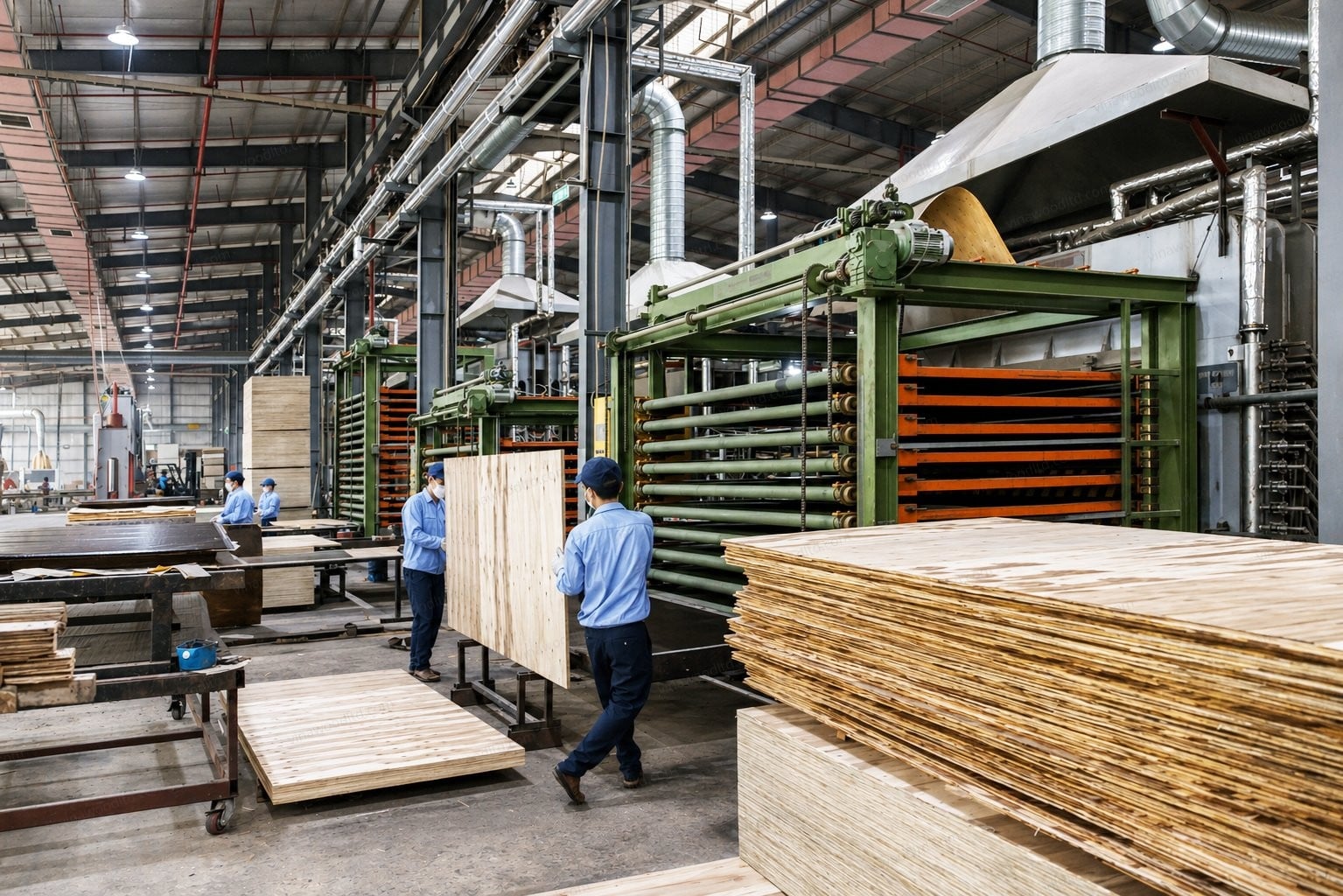
Types of formwork panels: wood, steel, aluminium, plastic and composite
Systems are usually sorted by frame and face material. All-steel panels are heavy and very stiff, so you'll find them on repetitive civil work like culverts and bridge piers, cast the same way dozens of times. Aluminium frames weigh far less per square metre; on plenty of wall pours a two-person crew moves them without waiting for the crane. Plastic and composite panels are light and wash off easily. They flex more, though, which tends to keep them on footings and low walls where pour pressure stays modest.
Timber shows up in two ways. There's the three-layer solid-wood panel, glued up from softwood boards and common as a face in parts of Europe. Vinawood doesn't make it. Then there's plywood, the most widely used face on framed steel and aluminium systems around the world, because a damaged corner can be cut out and replaced on site in an afternoon. The trade-offs for the non-plywood routes are on formwork plywood alternatives.
Real sites mix and match. On one floor you might find aluminium wall gangs faced with film-faced plywood next to round steel column forms, with a timber-joist deck overhead. Vinawood face panels are used with framed systems from Doka, Peri and Alsina wherever the sheet module suits the frame.
The plywood face panels we make
Most of the cost of a panel's working life sits in the face, and most of the finish quality too. Two things separate our grades. The overlay is the resin layer on top: it sets the concrete finish and keeps water off the veneer. Bond class is about the glue inside. Class 2 panels (EN 636-2) are glued with MUF, short for melamine-urea-formaldehyde. Class 3 (EN 636-3) means phenolic PF resin. PF copes better when a sheet is soaked pour after pour.
| Grade | Face | Core bond | Reuse (maximum) | Typical use |
|---|---|---|---|---|
| Eco Form Plus | Phenolic film | MUF, EN 636-2 | up to 8 | Short programmes, footings |
| Form Basic | Phenolic film | MUF, EN 636-2 | up to 10 | General wall and slab work |
| Form Extra | Phenolic film (same face as Form Basic) | Superior Glue MUF, EN 636-2 | up to 15 | Longer programmes on Class 2 |
| Pro Form Lite | Phenolic film | PF, EN 636-3 (Class 3) | up to 15 | Wet sites needing Class 3 |
| Pro Form | Phenolic film | PF, EN 636-3 (Class 3) | up to 20 | High-rise cores, repeat gangs |
| HDO Basic / Premium | High-density overlay | Basic: EN 636-2 (Class 2); Premium: PF, EN 636-3 (Class 3) | Basic up to 10; Premium up to 20 | North American fair-face |
| MatteFace Plywood (MTF) | Matte phenolic surface film | WBP | up to 15 | Matte architectural walls (often searched as MDO) |
Which rows matter depends on the destination. In North America the choice is usually HDO for glossy fair-face, MatteFace for matte walls, or a film-faced grade for everything else. European and other export buyers mostly stay on the film-faced ladder, from Eco Form Plus and Form Basic up through Form Extra, Pro Form Lite and Pro Form. Only Pro Form, Pro Form Lite, HDO Standard and HDO Premium are Class 3; HDO Basic is Class 2. Form Extra gets its extra cycles from a stronger MUF glue line. It isn't Class 3. Check that on any quote that says otherwise.
Wall, slab and column panels
Framed panels earn their keep on walls. Two faces stand opposite, tied through, and the plywood has to hold fluid pressure that climbs with pour height and placing speed. Exposed walls show every step between sheets, so face consistency matters more here than almost anywhere. Sheet choice for vertical work is on wall formwork plywood.
Slabs make the plywood span. The joist spacing tells you how stiff the sheet has to be. Get it wrong and the panel dishes between joists, and the soffit comes out wavy. Because decks get stripped and re-laid every floor, the reuse ceiling decides a lot of the budget on high-rise jobs (see slab formwork plywood). Columns are their own animal. Small faces, high pressure, lots of cut edges. Edge sealing and a hard face make a visible difference there, as column formwork plywood explains.
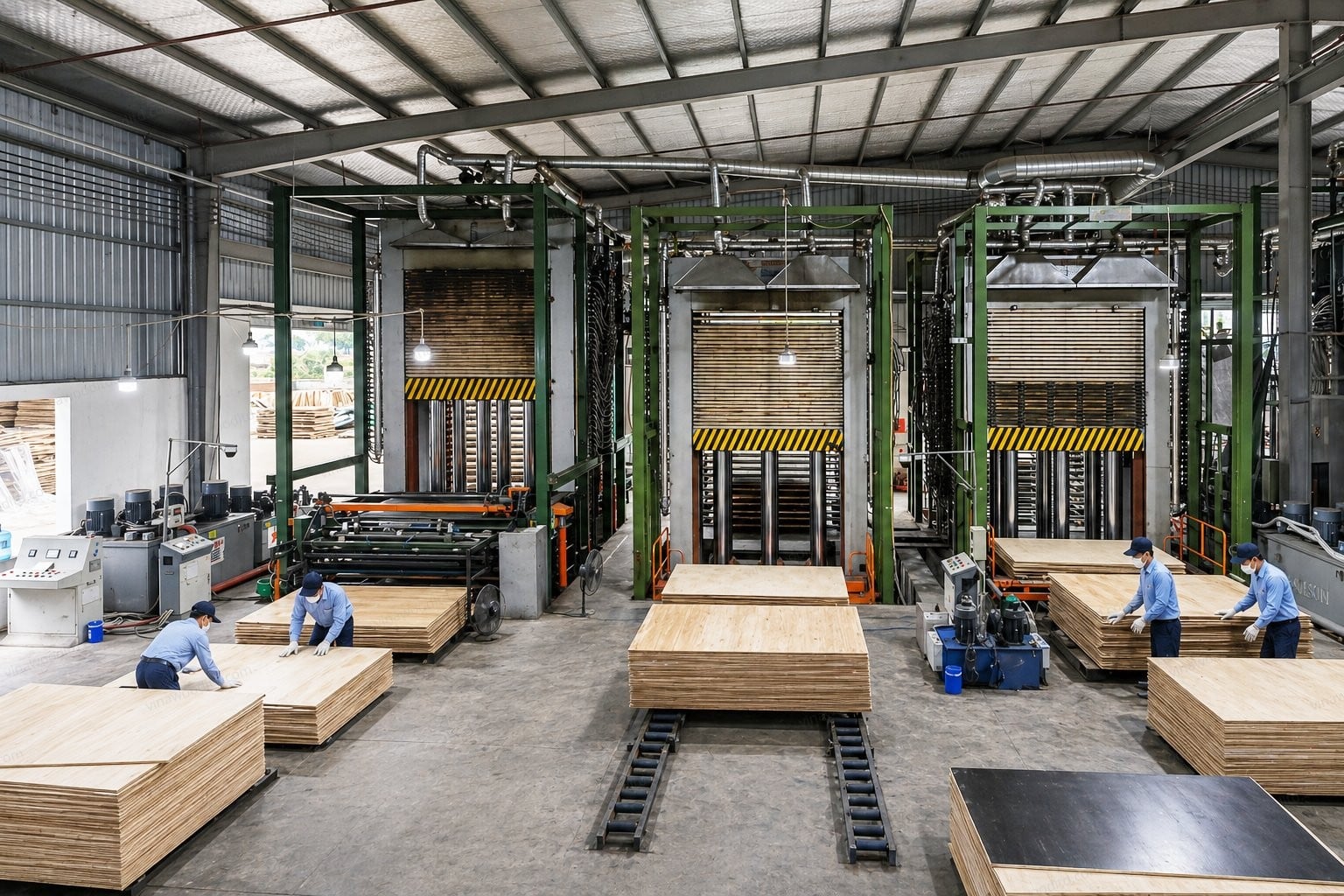
Sheet sizes and how they match the frame
A face panel has to fit its frame, and two modules dominate. North American systems use 1220 × 2440 mm (4 × 8 ft). Many European wall frames assume 1250 × 2500 mm, which we also stock as a film-faced size. Mix them on one wall and every joint gets a lip. Order the module your frames were designed for, even if the other one is on the dock today.
Thickness follows load. Eighteen millimetres covers most wall and slab work, and we also run 12, 15 and 21 mm for frames that need them. Watch tolerance as closely as the nominal figure. A sheet half a millimetre fat beside one half a millimetre thin leaves a ridge you can feel on the finished wall. We can cut to size for odd frames, but let the formwork designer pick the thickness, not whatever happens to be on the dock.
Advantages of plywood formwork panels
Why is plywood still the default face? Mostly weight against stiffness. Every veneer layer has its grain turned 90 degrees to the one below, which is why the sheet stays flat through wet-dry cycles that would cup a solid board. Two people can still carry an 18 mm sheet. And when a crane hook clips a corner, the crew swaps one sheet rather than sending the whole frame off for repair.
The overlay adds the rest. Phenolic film and HDO both shed water and release cleanly from cured concrete, so there's less patching once the forms are off. On the glue side, WBP (weather and boil proof) means water-resistant. It doesn't mean sealed, and that's why cut edges still get paint. A panel that's looked after gets close to its rated maximum, which is where the cost per pour comes down.
Edge sealing and reuse care
Most face panels die at the edges long before the overlay wears through. Every saw cut opens raw veneer. Between pours, water creeps into that end grain until the core swells and the film lifts at the corner. Sealing every cut edge the same day, with the paint your supplier recommends, is the lowest-cost protection you can buy for the reuse number on the invoice.
The rest is habit. Release agent before each pour. Plastic or wooden wedges for stripping, never steel bars. Clean faces while residue is soft, then stack sheets flat on bearers, face to face, under a cover. Two sites can run the same grade and report very different cycle counts, and the gap often comes down to one crew leaving stacks out in the rain. More on realistic cycle counts is in how many times can you reuse formwork plywood.
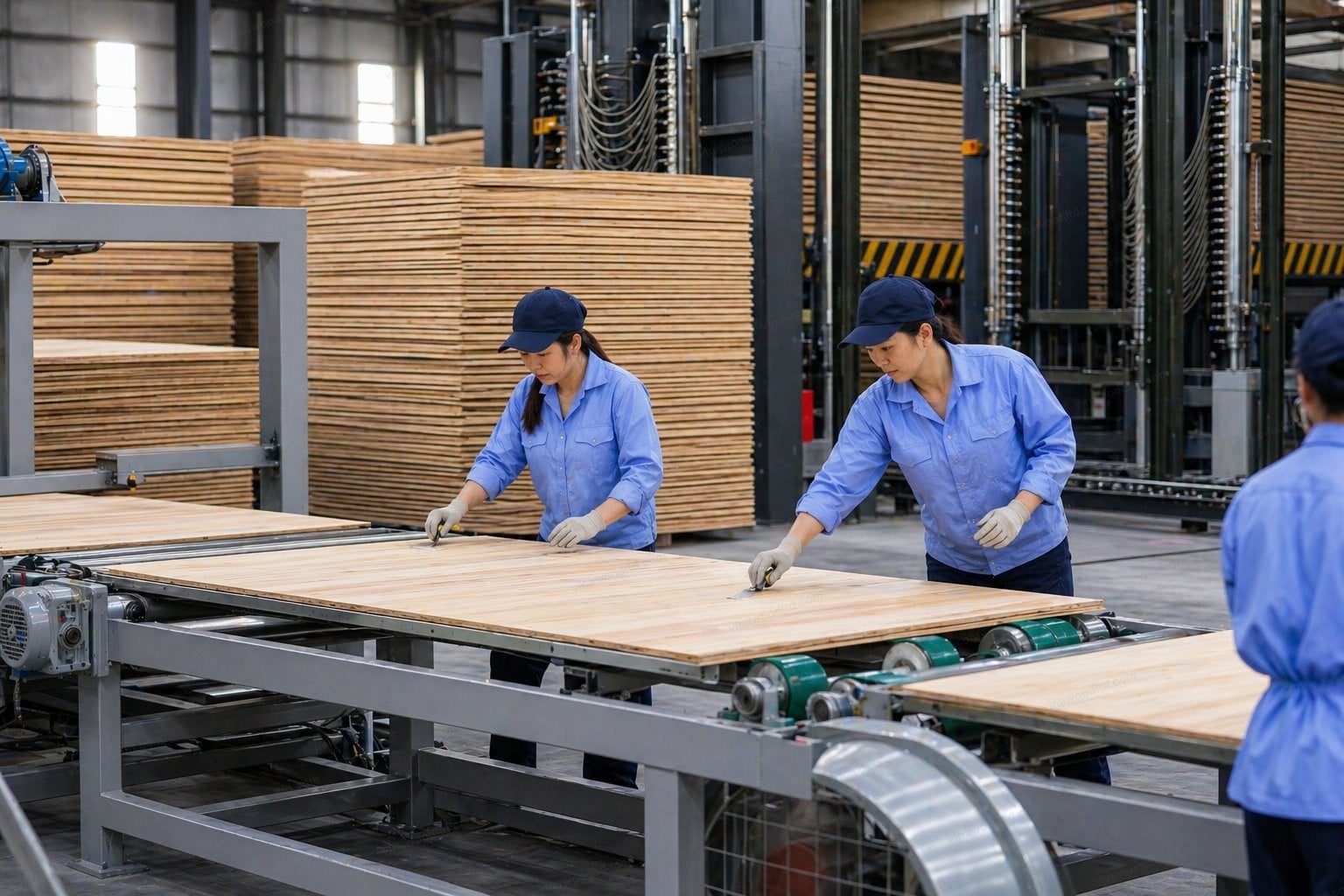
Formwork panel price
Asking what a formwork panel costs is a bit like asking what a truck costs. A complete steel or aluminium system panel is capital equipment you depreciate over years; a plywood face is a consumable you replace as it wears. They're priced on different logic. Face sheet prices move with resin and freight too. We'd rather not print a number that's out of date before the container leaves port.
Compare face panels on cost per pour instead. Take the sheet price, add its share of freight, then divide by the pours you realistically expect. A grade rated up to 20 can come out lower per pour than one rated up to 8 even with a bigger invoice, as long as the programme actually needs those cycles. On a short job, though, paying for a Class 3 phenolic panel you'll pour four times is money wasted.
The drivers are simple once named. Overlay and bond class set the base. Thickness and module change both material and how many sheets fit in a container, and volume plus destination decide freight per sheet. Put those on the RFQ and quotes become comparable.
How to specify a formwork panel on an RFQ
A tight RFQ saves weeks of email. Lead with the face, meaning the overlay you want and the finish the drawings call for. Write bond class as EN 636-2 or EN 636-3, then module and thickness. US jobs need CARB P2 / TSCA Title VI on the emission line; European ones need EN 13986 CE marking. Add the pour programme if you have it; the cycle count tells us which grade is the honest pick.
Request a quote for formwork face panels
We've made plywood in Vietnam since 1992 and ship about 5,000 containers a year to 55+ countries, inspecting every sheet before packing under ISO 9001. Cores are plantation-grown Acacia or Eucalyptus, Hevea on some lots. For ready stock in North America, Vinawood keeps distribution warehouses in Toronto, Vancouver, Calgary, Montreal, Miami, Houston and Baltimore that supply local distributors. Send your panel spec through the RFQ form or the quotation form, and see concrete forming plywood for the full type ladder.