Film Faced Plywood for Concrete Formwork: The Complete Guide
Film-faced plywood for concrete formwork is two specs: phenolic face film and MUF or PF core glue. Reuse is up to 8-20 by mill grade, not a unit-price table. Vinawood, est. 1992, factory-direct to 55+ countries.
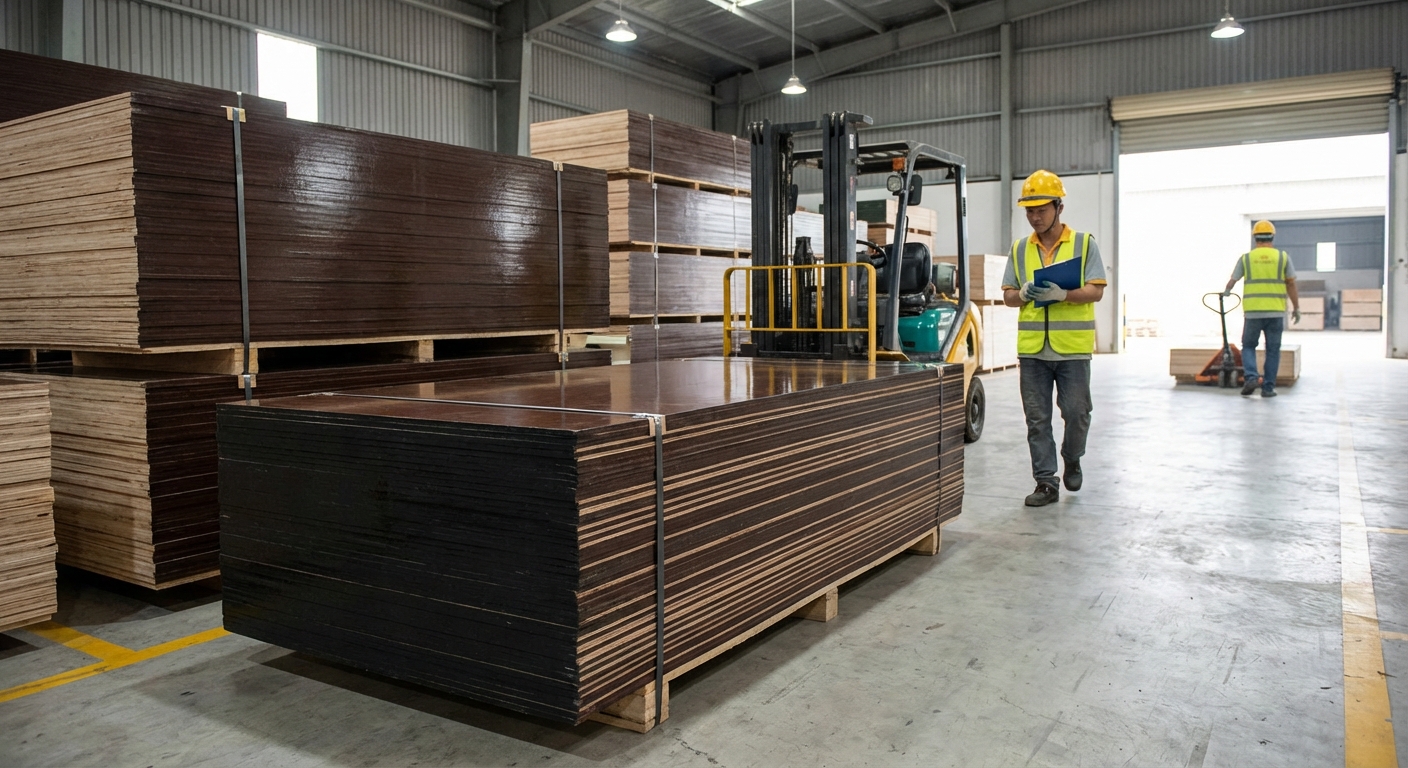
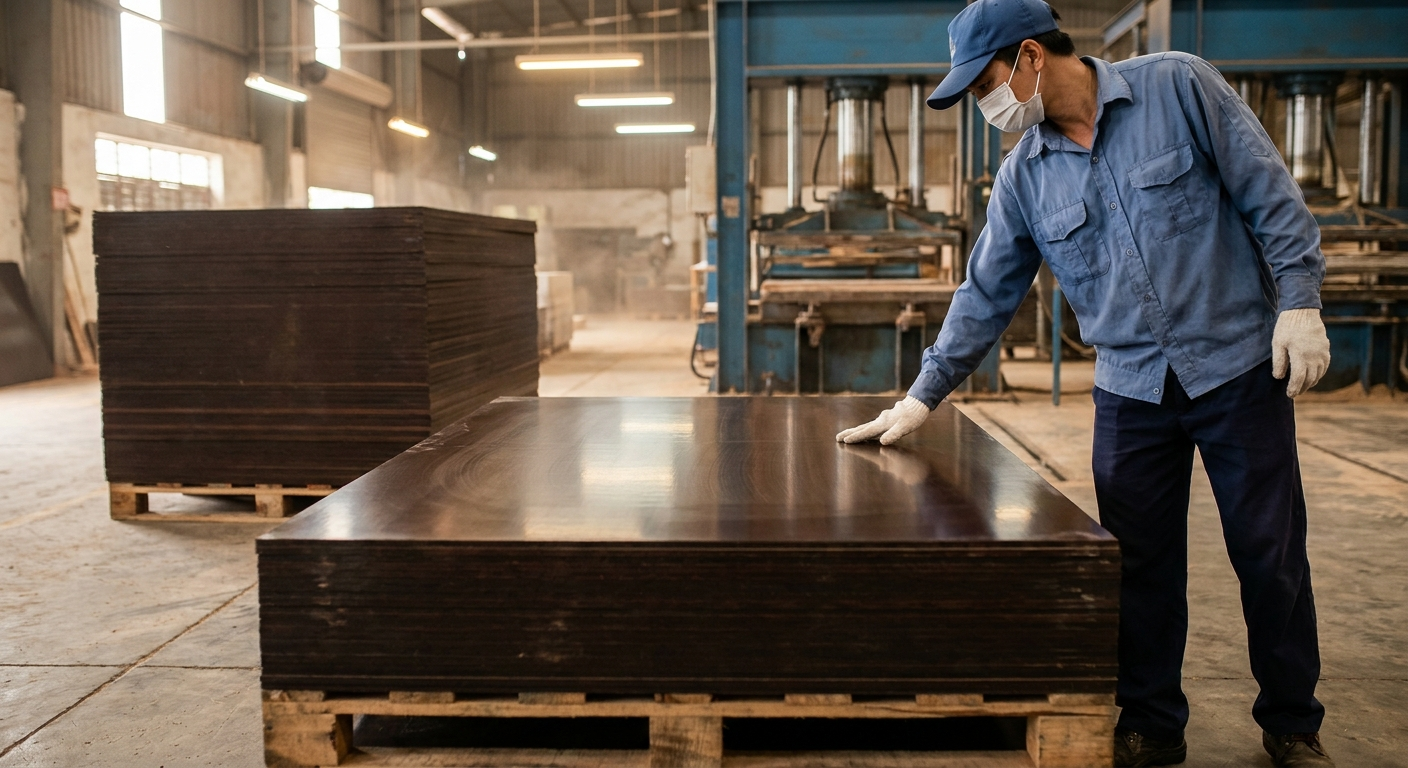
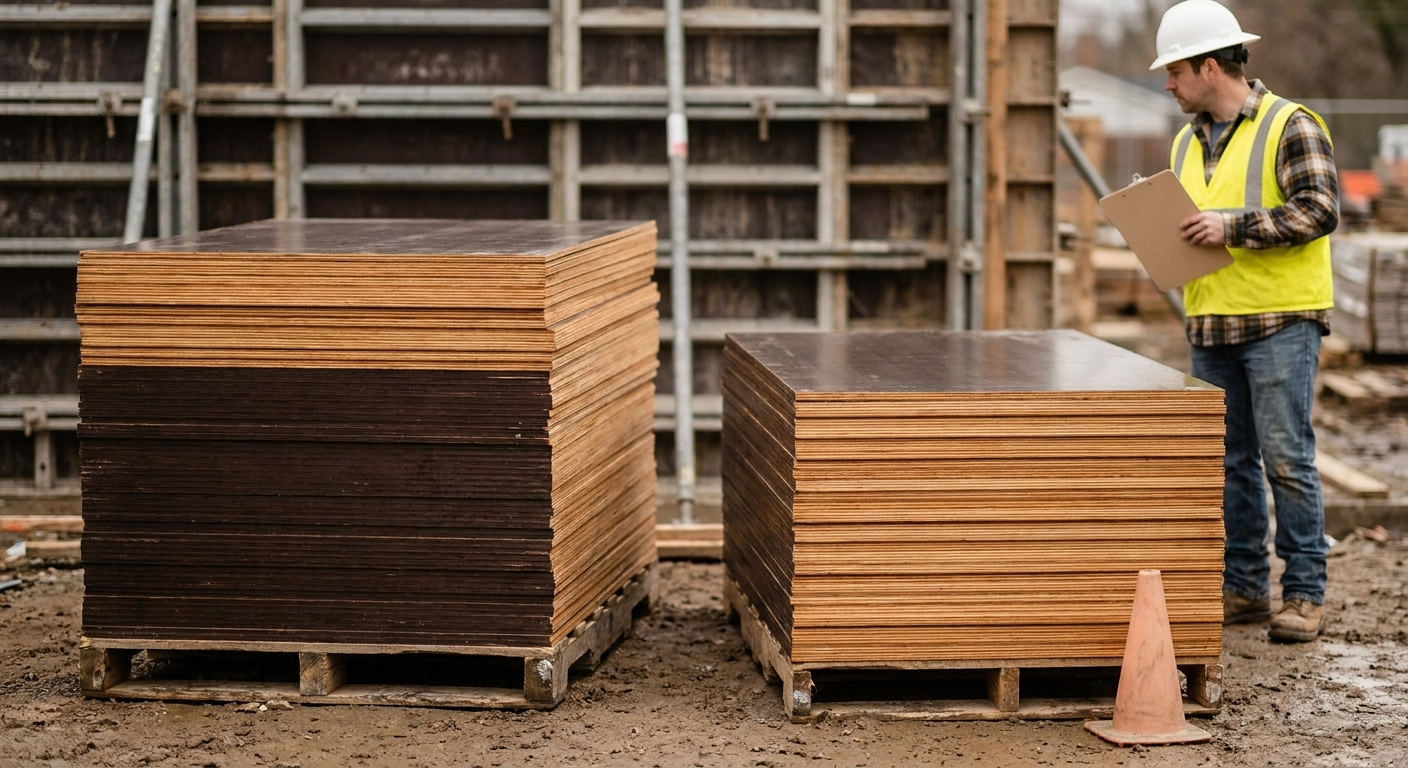
Film faced plywood is a hardwood plywood panel with a phenolic resin-impregnated film pressed onto both faces, built to be poured against, stripped and set again as concrete formwork. Contractors and importers reach it through a handful of names: shuttering plywood in the UK and the Gulf, formply in Australia, concrete form plywood in North America, and phenolic board or brown film plywood on many trading lists. Formwork plywood is the generic umbrella. Whatever the search term, the sheet on the quote is the same family, and the grade is decided by the glue class underneath the film.
Taken straight from our product data, the ladder reads like this. Form Basic has an acacia and eucalyptus core, a 165 g/m² dark-brown phenolic film on both faces and a WBP melamine glue line rated Class 2. Pro Form keeps that core species mix under a 125 g/m² phenolic film and switches to WBP phenolic glue, which lifts it to Class 3. In the North American overlay family, HDO Basic is listed at Class 2, so a buyer who needs Class 3 there should name HDO Standard or HDO Premium. Film-faced sheets come in 2440×1220 mm and 2500×1250 mm, mostly at 12, 15, 18 and 21 mm. Vinawood has pressed film faced and phenolic formwork plywood in Vietnam since 1992 and ships about 5,000 containers a year to 55+ countries, so the quickest route to a grade match is to send the pour programme through the RFQ form.
Because wet concrete hits the film rather than bare wood, the strip comes cleaner and grain print drops. Reuse is a published up to N on the product data sheet when edges stay sealed and the crew strips on schedule.
Two lines decide the RFQ before price ever should. Core glue is either MUF (melamine-urea-formaldehyde, EN 636-2) or PF (phenol-formaldehyde, EN 636-3 / Class 3). Face film is the phenolic overlay that touches the pour. Confuse them and you write "phenolic" on an MUF panel because the face is brown. Vinawood has made formwork plywood in Vietnam since 1992 and ships about 5,000 containers a year to 55+ countries from plantation-grown cores, factory-direct. No unit prices on this page.
This is the mill film-faced guide. Overlay types (HDO / MDO search / film-faced) live on concrete forming plywood. Soffit layout lives on plywood for slab formwork. Advantages, regional standards, and the four-field spine sit on the sibling formwork plywood advantages and types guide. Keep those jobs separate.
Core glue and face film are separate specs
Stop treating "film faced plywood for concrete formwork" as one SKU. On every TDS you should read two independent lines, because each one fails in a different way on site. Core glue is the adhesive between veneers - the chemistry that survives when water reaches a screw hole or a site cut. On the Vinawood film-faced line that means MUF (water-resistant WBP, EN 314 Class 2 / EN 636-2) or PF (water-resistant WBP, EN 314 Class 3 / EN 636-3). Face film is the phenolic-impregnated paper that touches concrete. Typical mill weights sit around 120, 165, and 220 g/m² where the catalogue lists them. Paper-thin. Not a visible extra ply.
A panel with MUF glue and a phenolic face is a real EN 636-2 formwork sheet. A panel with PF glue and the same face moves into EN 636-3 and a higher reuse card. The brown face does not name the glue. Glue-versus-film detail sits on melamine vs phenolic film-faced plywood and on phenolic plywood.
What "melamine" actually means on an RFQ
The word means three different things. Mix them and the pack arrives wrong.
- Melamine core resin (MUF) - the glue. EN 636-2. Up to 8, 10, or 15 reuses depending on the grade’s spec sheet (Eco Form Plus, Form Basic, Form Extra). Not Class 3.
- Melamine face film - a surface overlay made from melamine-saturated paper. Not used on the Vinawood formwork range. Face film here is phenolic.
- Melamine decorative laminate - cabinetry. Nothing to do with formwork. Do not import "interior only" from that meaning onto an MUF formwork panel. MUF formwork is a humid-class glue, not furniture board.
Bare melamine is not the overlay name on this range. If a line says "melamine," it should mean core MUF.
Why crews specify film-faced for formwork
People search "why film faced plywood is used in formwork" for a practical reason. The overlay releases. The sheet cuts on site. Reuse is a published up to N, not a rumour. Steel and aluminium systems win on identical high-rise bays with crane time. Most walls, columns, and cut-up slabs still want a sheet you can saw without waiting on a fabricated table for every opening.
Formwork is a large slice of a concrete package. Wrong panel shows up twice: once in the pack, again in grind and patch. Film-faced earns the spec when you need a fair-face or a predictable strip. Shuttering language is the same product family; see the shuttering plywood guide.
Release agent, prompt scrape, and flat stacking are how you actually reach the spec-sheet figure. Skip those and a Pro Form sheet behaves like a cheaper grade by pour six. That is a site habit, not a mill surprise. An 18 mm sheet still fits a circular saw and a two-person carry. The overlay forgives a wet weekend if the edges were sealed.
Cost is reuse class, not a dollar table. We do not publish a unit price. A higher reuse rating on the spec sheet is cheaper per pour only if you actually run those cycles and you clean the sheets. An economy panel that delaminates on pour four is not a bargain.
Grade and reuse ladder
Reuse is up to N. Floor count is not a cycle count. Commercial Bintangor is not on this ladder - that product is not film-faced.
Eco Form Plus (WBP MUF, Class 2, up to 8 reuses). Short programs. Light commercial. Covered work. The catalogue parent for this rung is Eco Form Plus.
Form Basic (EN 636-2, WBP MUF, up to 10 reuses). Standard commercial walls and slabs inside the Class 2 envelope.
Form Extra (Superior Glue MUF, EN 636-2, up to 15 reuses). Same Class 2 as Form Basic. Extra cycles come from glue chemistry, not a heavier face film. Not Class 3. Not phenolic glue. I still get packs labelled "Class 3 Form Extra" from a distributor spreadsheet. The mill TDS says EN 636-2. Correct the sheet before the pour, not after.
Pro Form Lite (SKU FFP0510, WBP phenolic, 165 g/m², EN 636-3 / Class 3, up to 15 reuses). First PF/Class 3 rung between Form Extra and Pro Form. Spec it when the engineer named Class 3 and the film weight does not need the top Pro Form card.
Pro Form (WBP phenolic, EN 636-3 / Class 3, up to 20 reuses). Long-cycle infrastructure, exposed weather, fair-face work that wants the top reuse rating on the spec sheet.
Only Pro Form, Pro Form Lite, HDO Standard and HDO Premium are Class 3. HDO Basic is Class 2, and Form Extra is not Class 3 either. P-Form is polypropylene, a different product - do not order it as Pro Form.
Film weight, size, and layout
Film weight controls surface life. It does not upgrade the glue class. If the job is EN 636-3, a heavier film on an MUF core still fails the spec.
- 120 g/m² - entry phenolic film. Short-cycle Class 2 programs.
- 165 g/m² - Pro Form Lite film weight. Holds across that 15-cycle Class 3 card when site care is decent.
- 220 g/m² - heavy film where the catalogue lists it for long-cycle fair-face decks.
Form Basic and Form Extra can share a face film. Form Extra's longer reuse is the Superior Glue MUF mix, not a thicker overlay. Write that on the RFQ so nobody "upgrades" film and thinks they bought Class 3.
Europe film-faced prefers 1250×2500. North America and many Asian yards run 2440×1220. Both exist in the mill catalogue. Larger modular sizes are a special order, not a default SKU on this page. Every site cut needs mill-style edge sealer. Unsealed edges are the usual early death. Edge paint is water-resistant sealer, not a marine coating.
Thickness is a span and pour-pressure question. 18 mm is the workhorse for walls and columns. 12 mm is edges and low pressure. 21 mm is heavy walls and deep pours. Millimetre-by-pour tables live on the formwork plywood thickness guide. Soffit joist layout lives on the slab page.
Core on the Vinawood formwork range is plantation-grown hardwood (acacia, eucalyptus, hevea). Birch is a European spec many mills cannot fill the same way after 2022. Poplar cores cut weight and cut reuse. Match the core to the card you actually bought.
Always name EN 314 class on the PO, not just "WBP." Trade slang applies WBP to both Class 2 and Class 3. The class number is the line that stops a delivery fight. Interior UF glue is not formwork. A sheet with no class on the certificate is a walk-away.
Distributor logo film is a separate mill job. Artwork, plates, and pack marks sit on the OEM logo film-faced plywood guide.
Film-faced vs HDO vs MatteFace
US and Canadian buyers often ask for HDO or MDO instead. They are overlay equivalents for formwork, not a country-supplier tour.
In the HDO plywood range, HDO Basic is Class 2 with reuse up to 10, while HDO Standard and HDO Premium carry Class 3. HDO Premium / Premium HD run up to 20. MatteFace Plywood (MTF) is a matte phenolic surface film for formwork only, up to 15 reuses. Buyers often search for MatteFace as MDO formwork plywood. MDO is a search term, not a Vinawood product name. Side-by-side overlay language is on film faced vs MDO vs HDO.
Pick film-faced when the spec is EN film overlay and 1250×2500. Pick HDO when the US yard wants a high-density overlay. Pick MatteFace when the soffit or wall wants a matte face rather than gloss film.
Where the panels actually go
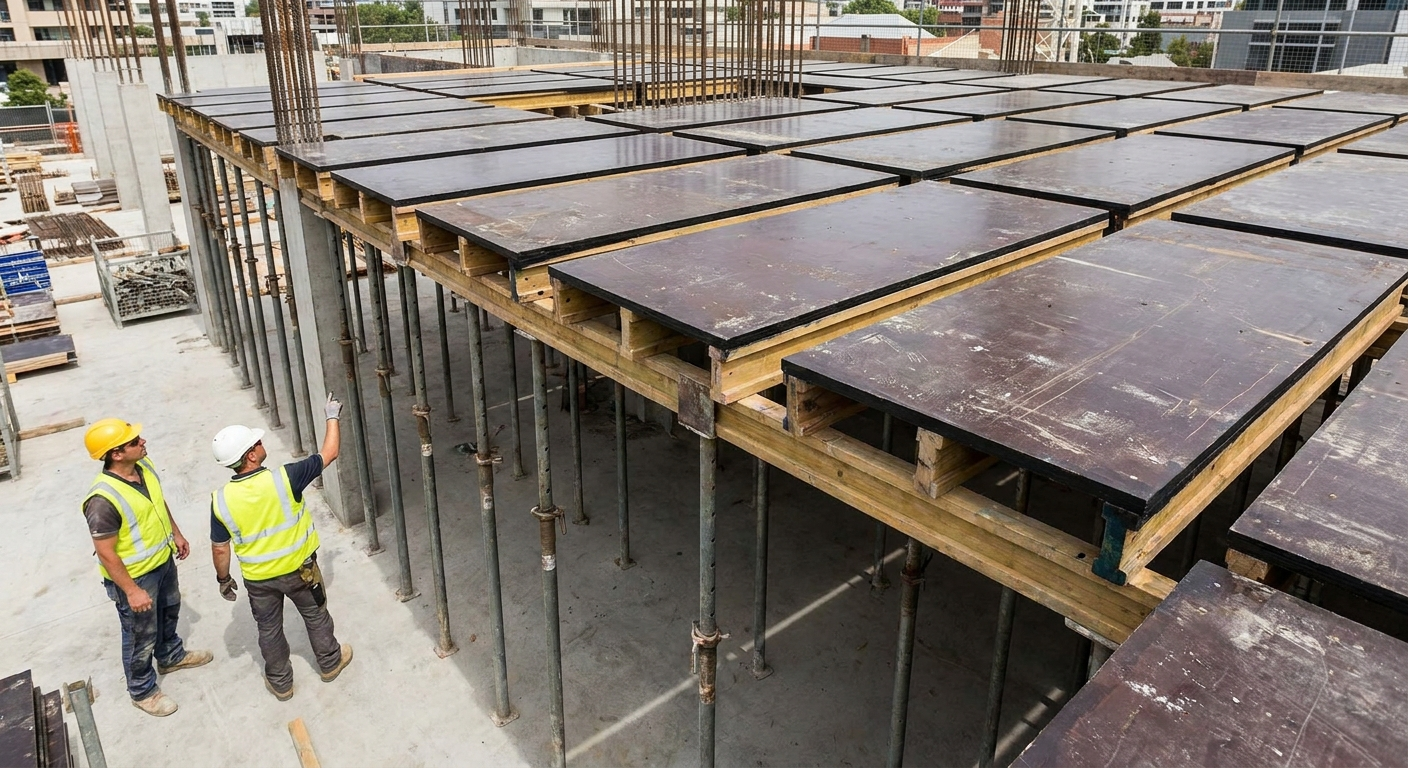
Wall formwork is the volume job - 18 mm, Class 2 or 3 by the engineer. Slab formwork is deflection under wet load. Column and beam boxing is cut-heavy; seal every saw cut. Bridges and deep foundations usually want Pro Form or HDO Premium, 21 mm, Class 3. Fair-face architectural work wants the heavy film and a clean release agent, not a cheap sheet you will grind later.
Covered indoor pours can live on Form Basic or Form Extra if the engineer stayed on EN 636-2. Rain between pours, or a spec that names Class 3, is Pro Form Lite or Pro Form. Do not "make it phenolic" by ordering a heavier film on Form Extra. The glue class does not move.
The film-faced plywood collection is the Europe parent. Factory-direct mill. Vietnam origin. Not a retail store. Ready stock for local distributors also ships from Vinawood warehouses in Toronto, Vancouver, Calgary, Montreal, Miami, Houston, and Baltimore when the programme needs a fast fill.
Mistakes that kill a film-faced pack
- Buying on unit price. No unit price on this page. Reuse class and site care set the real bill.
- Skipping the core. Ask for a cross-section. Unknown mixed species is a flag.
- Leaving cuts open. Edge sealer after every saw. The usual failure.
- Putting MUF on a Class 3 spec. If the engineer named EN 636-3, Form Extra will not pass. The reverse waste is Pro Form on a six-pour covered house slab.
- Reading the face as the glue. Brown film is not "phenolic panel." Read EN 636.
- One thickness for the whole site. Mix 12, 18, and 21 mm to the pressure and span, not to the forklift habit.
ISO 9001, FSC-COC, CE (EN 13986), and EPA TSCA Title VI / CARB P2 are the papers to request. Ask for certificate numbers. A mill that cannot produce a TDS with glue class and film weight is not ready for a container.
What to put on a film-faced RFQ
Send overlay (film-faced vs HDO vs MatteFace), bond class (EN 636-2 or EN 636-3), film weight where the catalogue supports it, size (2440×1220 or 1250×2500), and reuse class. Emission class if the destination asks. That list beats "film faced plywood" as a head term with no product data sheet behind it.
Vinawood has made formwork plywood since 1992, ships about 5,000 containers a year to 55+ countries, and runs a 12-step process with 100% sheet inspection. Plantation-grown cores. Factory-direct from Vietnam. Request mill specs or start an RFQ and we will map Eco Form Plus through Pro Form, or HDO / MatteFace for a North American overlay, without a price table on this page.
Category
how-to
Related Markets
Related Countries
▶Sources & References (3)
- APA Plywood Design Specification - PS 1-19 — APA - The Engineered Wood Association (2019-01-01)
- EN 13986 - Wood-based panels for use in construction — CEN (European Committee for Standardization) (2015-06-01)
- EN 314-2 - Plywood bonding quality — CEN (European Committee for Standardization) (2001-12-01)